





.jpg?w=288)


IRS Schedule SE (Form 1040) is used by freelancers, sole proprietors, and independent contractors to calculate their Social Security and Medicare tax on self-employment income of $400 or more for the year. The form calculates what is similarly withheld on a W-2 as FICA tax for employees.
Example of Completed Schedule SE (Form 1040)
Jeremiah Jones has two jobs and a freelance consulting business. A sample Schedule SE has been prepared for Jones, using the information shown below. In this situation, Jones has total wages in excess of the Social Security wage base
| Wages & Income Summary - Jeremiah Jones | ||||
|---|---|---|---|---|
| ABC Company | DEF Company | Jones Consulting | Totals | |
| Schedule C Income | 0 | 0 | $25,000 | $25,000 |
| Wages | $176,912 | $75,000 | 0 | $251,912 |
| W-2 FICA Withholding | $9,932 | $4,650 | 0 | $14,582 |
| W-2 Medicare Withholding | $2,565 | $1,088 | 0 | $3,653 |
| Self-employment Tax | 0 | 0 | $670 | $670 |
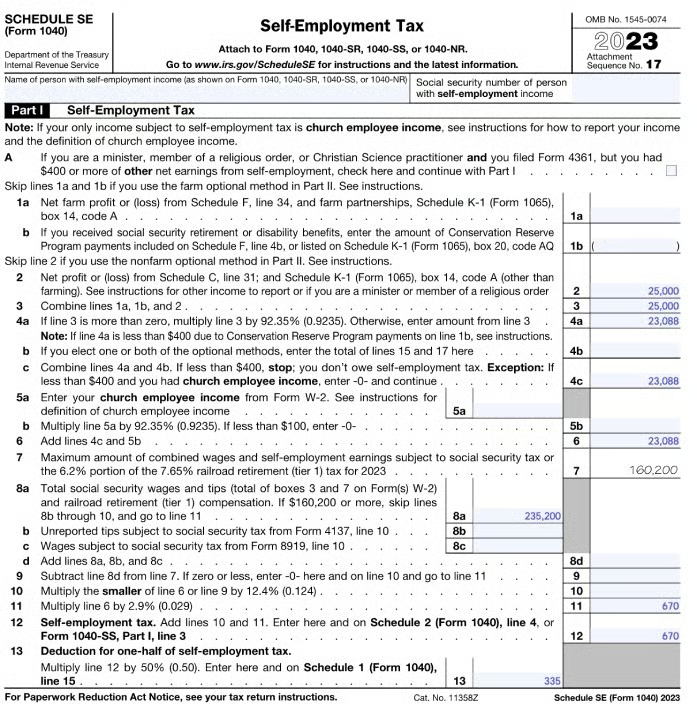
Here is what Jones’ Schedule SE for 2023 would look like:
Part I: Self-employment Tax
- Lines 1a and 1b: These lines are specific to farm income, which will be addressed subsequently in Part II.
- Lines 2 through 4c: Take self-employment income from Schedule C (sole proprietorships and single-member LLCs) or K-1 (partners in a partnership or members of a multimember LLC) and multiply it by 92.35%:
- The 4c amount should be moved to line 6. If you received a W-2 from a church, reference the form instructions and complete lines 5a and 5b as applicable.
- Line 6: Sum the income items from 4c and 5b on these lines.
- Line 7: This field is pre-populated on the form and represents the Social Security wage base.
- Line 8a: This is where you would enter wages up to the amount on line 7. The amount on line 8a should not be greater than line 7:
- In our example, Jones had total wages of $251,912, but only $160,200 was reported on line 8a.
- Lines 8b through 8c: Enter other W-2 income subject to Social Security tax on these lines.
- Line 8d: Get the sum of lines 8a through 8c.
- Lines 9 and 10: Use the percentage provided on this line to compute the amount of Social Security tax due:
- In our example, Jones already paid the maximum Social Security tax obligation through his W-2 wages, so no additional Social Security tax is assessed on his self-employment earnings.
- Line 11: Use the percentage provided to compute the amount of Medicare tax due on the self-employment income:
- In our example, the Medicare tax calculated is not limited by the $3,653 already withheld by Jones’ employer.
- Line 12: Add lines 10 and 11 to calculate total self-employment tax.
- Line 13: Compute the deduction for 50% self-employment tax by multiplying line 11 by 0.50. This deduction is then carried to Form 1040, Schedule 1, line 15.
Interplay Between Self-employment Tax & Wage Income
Every year, the IRS sets a maximum dollar amount upon which Social Security tax can be calculated. When a taxpayer has two separate employers, each one withholds as though it is the only employer, which can lead to excess Social Security withholding:
- ABC Company paid Jones’ wages in excess of the 2023 Social Security wage base of $160,200. Through earnings from that job, the maximum Social Security tax was withheld.
- DEF Company paid Jones another $75,000 and withheld FICA tax accordingly.
- Jones’ consulting company (Jones Consulting) would ordinarily be responsible for the Social Security portion of the self-employment tax. However, since Jones maxed out his Social Security tax obligation through his employment with ABC Company, the only tax calculated on Jones’ Schedule SE is Medicare. The excess Social Security tax withheld is included in “Other Credits & Payments” and carries to Form 1040, line 30.
Part II: Optional Methods to Figure Net Earnings
The amount of tax that an individual pays into the Social Security System impacts the amount of Social Security benefits that can be collected upon retirement. Using an optional method to figure net earnings may increase Social Security tax in the short term—but it may also provide credit toward Social Security coverage in the long term.
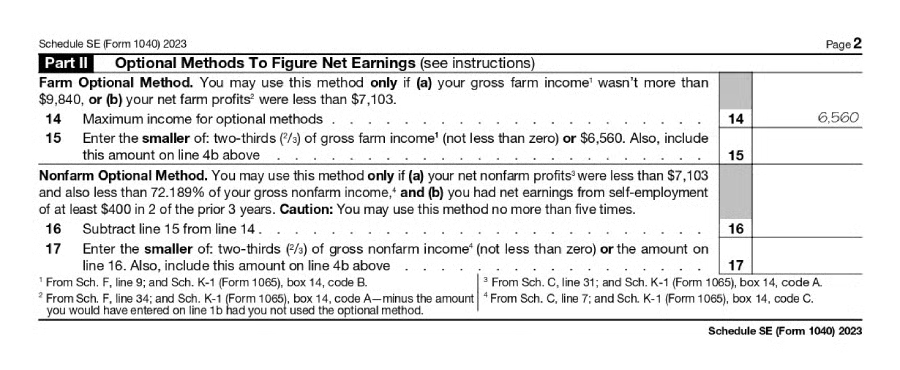
The two optional methods shown in Part II of Schedule SE are the Farm Optional and Nonfarm Optional methods.
This method is for individuals with farm income who meet the following criteria:
- Gross farm income of $10,380 or less
- Net farm profit of $6,920
So, if a farmer has:
- Less than $10,380 in gross income for 2024, they can report two-thirds of their gross income for self-employment purposes.
- Over $10,380 in gross income, they have the option to pay self-employment tax on $6,920 for 2024—as long as their net profit is less than $6,920. This means that they pay more Social Security tax than they would if they report actual earnings.
This method can be used by taxpayers who meet the following criteria:
- Self-employed on a regular basis
- Net profits less than $6,920 (for 2024) and also less than 72.189% of gross nonfarm income
- No one person can use the nonfarm optional method more than five times
Gross nonfarm income is the sum of Form 1040, Schedule C, line 7, and Form 1065, Schedule K-1, Box 14, Code C. As with the farm optional method, reporting income under the nonfarm optional method will result in higher Social Security tax but may result in enhanced Social Security benefits.
The election to use either method is made by completing Part II of Schedule SE. Since line 14 represents the maximum income that is set annually by the IRS, the amount shown is pre-populated on the form.
Form 8959: Additional Medicare Tax
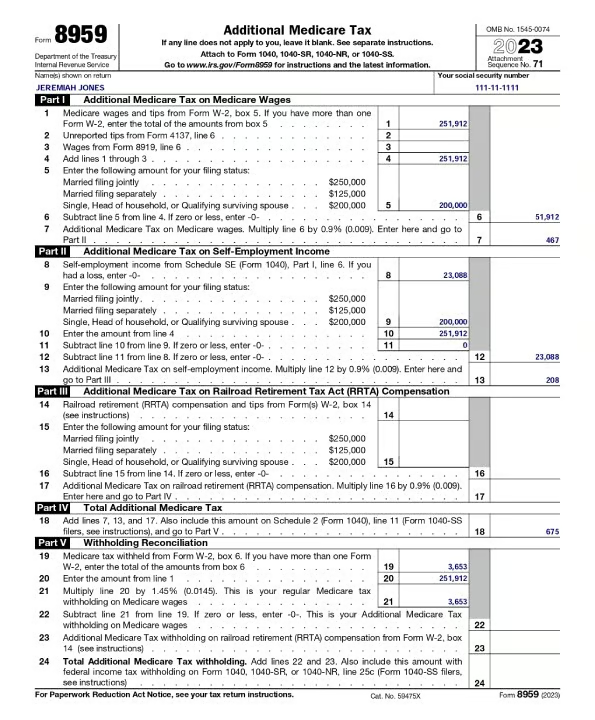
Form 8959 is used when both wages and self-employment income are reported in excess of a threshold amount assigned to each filing status
From our scenario above, Jones’ income was high enough for him to be subjected to this additional tax. His Form 8959 would be populated as shown below:
Where to Report & File Schedule SE
- Where to report: The self-employment tax from Schedule SE, line 12, carries to Form 1040, Schedule 2, line 4. The 50% adjustment from Schedule SE, line 13, carries to Form 1040, Schedule 1, line 15.
- Where to file: Form SE should be attached to Form 1040. Both forms should be filed together by the Form 1040 due date.
Frequently Asked Questions (FAQs)
Do I need to file a tax return if I am under the IRS filing threshold but have self-employment income of at least $400?
Yes. In general, individuals with $400 or more in net earnings from self-employment must file Form 1040, even if their gross income is less than the general filing requirement.
What is the difference between FICA tax and SE tax?
The difference between FICA and SE tax is the individual or entity responsible for remitting the tax. An employer remits FICA, whereas a self-employed taxpayer is responsible for remitting their own self-employment tax. Rates and income caps for both taxes are the same.
Will I have to complete Schedule SE for my LLC income?
Yes, as most LLC income is subject to self-employment tax. Single-member LLCs will use net Schedule C income to calculate earnings for self-employment purposes. Members of multi-member LLCs will use their K-1 to complete Schedule SE. However, your LLC earnings won’t be subject to self-employment tax if you’ve elected for your LLC to be treated as a corporation.
Bottom Line
Schedule SE of Form 1040 is used to calculate and remit self-employment tax for sole proprietors, freelancers, and partners. Self-employment tax is the equivalent of FICA taxes paid by an employer and employee.
