







The accounting equation is the basis for double-entry bookkeeping, which requires that the totals on either side of the equals sign balance. To obtain an asset, it would have to have been obtained either through a liability (funds borrowed) or owner’s equity (funds earned by the owners).
Assets = Liabilities + Owner’s Equity
The equation is the foundation of a bookkeeping system and the compass that guides all accountants and bookkeepers, even with complex transactions. For small businesses, knowing how the accounting equation works can help you better understand financial statements and get a better idea of how bookkeepers do their jobs.
My methodology
I evaluated cryptocurrency bookkeeping software based on how well each platform supports businesses handling digital assets. I focused on these key areas:
- Cryptocurrency management features: I looked at whether the system supports multiple cryptocurrencies, tracks portfolios in real time, and converts crypto to fiat accurately.
- Core accounting functionality: I checked for general ledger capabilities to manage both crypto and fiat transactions in one system.
- Integration and ecosystem fit: I reviewed integrations with platforms like QuickBooks and Xero, along with compatibility with exchanges and wallet tracking tools.
- Pricing and plan value: I compared pricing tiers to see how features align with cost at different business stages.
- Scalability and compliance: I examined how well each solution adapts to growth and whether it aligns with standards like GAAP and IFRS.
Why you can trust Fit Small Business
Components of the accounting equation
There are three major components in the accounting equation: assets, liabilities, and owner’s equity. Those also represent the major account groups in the chart of accounts.
Assets
Assets in accounting are resources that a company owns and uses to generate income and future economic benefits. Examples include company equipment, vehicles, accounts receivable (A/R), prepaid insurance, and office supplies. They can be classified as operating or nonoperating, tangible or intangible, and current or noncurrent.
Liabilities
Liabilities in accounting are amounts owed to other persons or entities as a result of a past event and involve a future settlement using cash, goods, or services. Customers and vendors can be sources of liabilities for operations. Paying taxes, fees, permits, and salaries are liabilities once they become due but aren’t yet paid. Businesses use their assets to pay liabilities.
Owner’s equity
Owner’s equity in accounting is the residual interest or amount that assets exceed liabilities. It also represents the amount of paid-in capital and retained earnings as a result of doing business for profit. It is calculated by deducting total liabilities from total assets when a business is formed initially. After that, owner’s equity should be rolled forward from the prior period using this equation:
Ending Owner’s Equity = Beginning Owner’s Equity + Additional Investments − Owner Withdrawals + Net Income
To compute the ending owner’s equity, you need to add any additional investments, owner withdrawals, and net income to the beginning balance. If the period resulted in a loss, deduct the net loss.
After calculating the ending owner’s equity, plug it into the accounting equation and ensure the equation balances. If it doesn’t, then your books are out of balance, most likely because there was an entry made to an owner’s equity account that isn’t reflected in your calculation above.
A closer look at owner’s equity in the accounting equation
The equity portion of the accounting equation can be further broken down for a closer look at the results of business activity. Given, the expanded accounting equation can be presented in this manner:
Assets = Liabilities + (Contributed Capital + Beginning Retained Earnings + Revenue − Expenses − Dividends)
| Component | What it is | Example |
|---|---|---|
| Contributed capital | Money received from owners or shareholders | If owners invest $5,000, then contributed capital increases by $5,000. |
| Beginning retained earnings | Profits from prior periods retained in the business | If retained earnings in 2024 are $4,000, then beginning retained earnings in 2025 are also $4,000. |
| Revenue | Income from regular operations, before expenses | A toy store earns $1,200 from repairs, so revenue increases by $1,200. |
| Expenses | Costs incurred from operations | $400 in utility bills equals $400 in expenses. |
| Dividends | Profits distributed to owners or shareholders, reducing equity | $600 issued in dividends reduces equity by $600. |
Debits & credits in the accounting equation
Double-entry bookkeeping is based on debits and credits. In simple terms, they are the two sides of the accounting equation. Most accounting platforms, such as QuickBooks and Sage, enforce double-entry accounting by default to keep the accounting equation in balance.
- One side of the accounting equation contains the debits. Debits increase certain types of accounts, such as assets and expenses, but decreases others, such as liabilities, equity, and revenue.
- The other side of the accounting equation contains the credits. Credits increase liability, equity, and revenue accounts, but decreases assets and expenses.
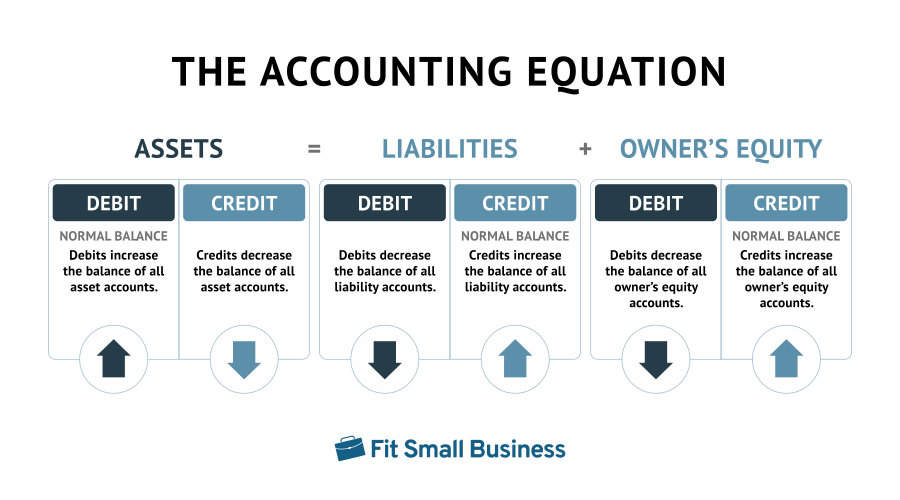
A useful tool for analyzing how transactions change an accounting equation is the T-account. The left side of a T-account is for debits, whereas the right side is for credits. However, the effect of debits and credits on the balance in a T-account depends upon which side of the accounting equation an account is located.
Let’s say you invested $25,000 in a startup and bought equipment worth $9,000. Your T-accounts would look like so:
- Investment of cash (asset): In this transaction, both equity and cash increase. Cash (asset) increases with a debit, while equity increases with a credit.
| Cash | Equity | |||
|---|---|---|---|---|
| Debit $25,000 | Credit | Debit | Credit $25,000 | |
| $25,000 | $25,000 | |||
- Purchase of equipment: The cash (asset) is reduced, but the equipment (asset) is increased. Cash is decreased with a credit, whereas the equipment increases with a debit.
| Cash | Equipment | |||
|---|---|---|---|---|
| Debit | Credit $9,000 | Debit | Credit $9,000 | |
| $9,000 | $9,000 | |||
Revenues & expenses in the accounting equation
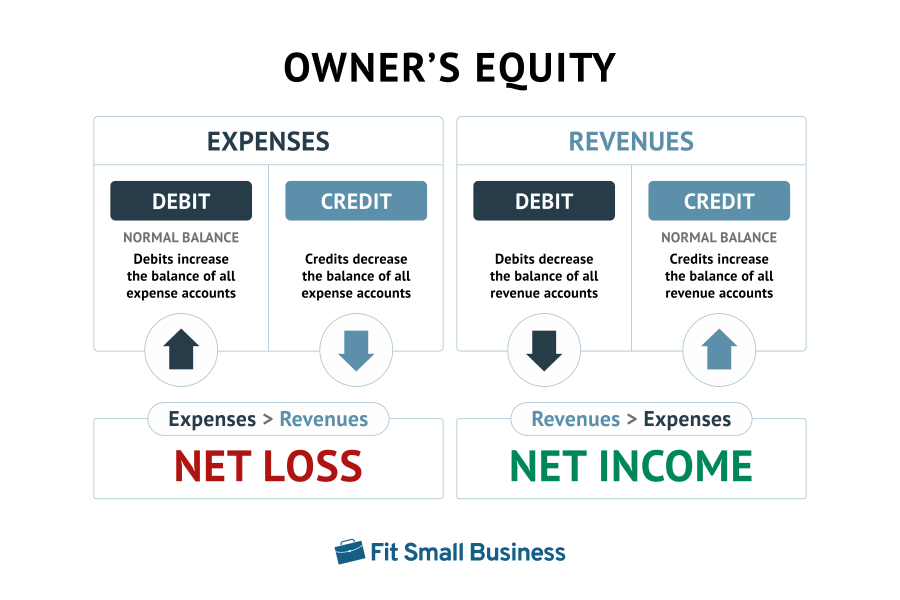
Revenues and expenses are subcomponents of owner’s equity. However, those two aren’t directly added to and deducted from the owner’s equity. Only the net income (revenues > expenses) or net loss (expenses > revenues) is reflected in the owner’s equity.
The image below shows the relationship between revenues, expenses, net income, and owner’s equity.
Effects of transactions on the accounting equation
The accounting equation demonstrates a mathematical equality, which means that all debits must consistently equal all credits. Therefore, every journal entry requires at least one debit and one credit entry, and their combined totals must be equivalent.
Here are some examples of business transactions and the related parts of the accounting equation:
| Assets = | Liabilities + | Owner’s Equity | |
|---|---|---|---|
| Sale of Service on Credit | |||
| Receipt of Customer A/R Payments | |||
| Receipt of Deferred Revenue | |||
| Deferred Revenue Recognized as Revenue | |||
| Purchase of Assets Using Cash | |||
| Purchase of Assets on Credit | |||
| Payment of Operating Expenses | |||
| Recording of Accrued Expenses | |||
| Payment of Accrued Expenses | |||
| Depreciation of Fixed Assets | |||
| Fund Transfer Between Bank Accounts | |||
| Invest Cash in the Business | |||
| Payment to Creditors | |||
| Owner Withdrawal | |||
Legend: = Increase  = Decrease  = No Effect | |||
Let’s look at some more detailed sample transactions.
Sale of services on credit
Al’s Toy Barn sells and repairs toys. During 2025, the company earned $1,200 in fees from repairing action figures. The journal entry to record a sale on credit is:
| Account | Debit | Credit |
|---|---|---|
| Accounts Receivable | 1,200 | |
| Fees Earned | 1,200 |
The effect on the accounting equation is:
| Assets | = | Liabilities | + | Equity |
|---|---|---|---|---|
| + 1,200 | No Effect | + 1,200 |
Receipt of customer A/R payments
Let’s assume the customers paid their outstanding balances to Al’s Toy Barn. The journal entry to record the payment is:
| Account | Debit | Credit |
|---|---|---|
| Cash | 250 | |
| Unearned revenues | 250 |
The effect on the accounting equation is:
| Assets | = | Liabilities | + | Equity |
|---|---|---|---|---|
| + 1,200- 1,200 | ||||
| No Effect | No Effect | No Effect |
When A/R is paid, the amount paid is just transferred to cash. Hence, there’s no effect on total assets.
Receipt of deferred revenue
Deferred revenue arises when customers make an advanced payment for goods or services that are yet to be performed. Instead of recognizing it as revenue, record it first as a liability until you deliver the goods to your customers.
To illustrate, assume that a customer made an advance payment of $250 as a reservation for an upcoming gaming console. The journal entry to record deferred revenue is:
| Account | Debit | Credit |
|---|---|---|
| Cash | 250 | |
| Unearned revenues | 250 |
The effect on the accounting equation is:
| Assets | = | Liabilities | + | Equity |
|---|---|---|---|---|
| + 250 | + 250 | No Effect |
Deferred revenue recognized as revenue
Once you’ve satisfied the obligations to the client, recognize their advance payment as revenue. The journal entry is:
| Account | Debit | Credit |
|---|---|---|
| Unearned revenues | 250 | |
| Revenues | 250 |
The effect on the accounting equation is:
| Assets | = | Liabilities | + | Equity |
|---|---|---|---|---|
| No Effect | - 250 | + 250 |
Unearned revenue is a liability, so debiting it decreases liabilities. Since revenues increase net income, it also effectively increases equity. That’s why we added $250 to equity in this transaction.
Purchase of assets using cash
When you purchase assets using cash, there’s an offsetting effect only in the asset section. One asset (the purchase) goes up, while another asset (cash) goes down. To illustrate, assume that the owner of Al’s Toy Barn purchased new action figures worth $5,000 using cash. The journal entry to record the purchase is:
| Account | Debit | Credit |
|---|---|---|
| Toy inventory | 5,000 | |
| Cash | 5,000 |
The effect on the accounting equation is:
| Assets | = | Liabilities | + | Equity |
|---|---|---|---|---|
| + 5,000- 5,000 | ||||
| No effect | No effect | No effect |
Purchase of assets on credit
Purchasing assets on credit affects both assets and liabilities. Let’s assume that Al’s Toy Barn purchased dolls worth $3,500 on credit. The journal entry to record the credit purchase is:
| Account | Debit | Credit |
|---|---|---|
| Toy inventory | 3,500 | |
| Accounts payable | 3,500 |
The effect on the accounting equation is:
| Assets | = | Liabilities | + | Equity |
|---|---|---|---|---|
| + 3,500 | + 3,500 | No Effect |
Payment of operating expenses
Let’s assume that Al’s Toy Barn paid $1,000 in utility bills. The journal entry to record the payment is:
| Account | Debit | Credit |
|---|---|---|
| Utilities expense | 1,000 | |
| Cash | 1,000 |
The effect on the accounting equation is:
| Assets | = | Liabilities | + | Equity |
|---|---|---|---|---|
| - 1,000 | No Effect | - 1,000 |
Expenses decrease equity because they decrease net income. Remember that we move net income to equity at the end of the accounting period.
Recording of accrued expenses
Accrued expenses occur when you record an expense even if it is not yet paid. It’s important to accrue expenses so that you record them in the proper accounting period, even if you delay payment until the next accounting period. Common examples of accrued expenses would be payroll accruals or accrued rent expenses.
To illustrate, say that the December rent of $1,500 is due on January 5 of the next year. Even if the payment will be made next year, we can accrue it in December so that it will be shown as an expense for December. The journal entry to record the accrual is:
| Account | Debit | Credit |
|---|---|---|
| Rent expense | 1,500 | |
| Rent payable | 1,500 |
The effect on the accounting equation is:
| Assets | = | Liabilities | + | Equity |
|---|---|---|---|---|
| No Effect | + 1,500 | - 1,500 |
Payment of accrued expenses
Based on the data in the previous section, here’s the journal entry to record the payment of the accrued December rent in January.
| Account | Debit | Credit |
|---|---|---|
| Rent payable | 1,500 | |
| Cash | 1,500 |
The effect on the accounting equation is:
| Assets | = | Liabilities | + | Equity |
|---|---|---|---|---|
| - 1,500 | - 1,500 | No Effect |
Depreciation of fixed assets
The journal entry to record depreciation includes an expense account and a contra asset
Let’s assume that the depreciation of Al’s Toy Barn’s fixed assets is $1,200. The journal entry to record depreciation is:
| Account | Debit | Credit |
|---|---|---|
| Depreciation expense | 1,200 | |
| Accumulated depreciation | 1,200 |
The effect on the accounting equation is:
| Assets | = | Liabilities | + | Equity |
|---|---|---|---|---|
| - 1,200 | No Effect | - 1,200 |
Fund transfer between bank accounts
Transfers between bank accounts do not affect total assets since they only transfer cash from one asset account to another. Let’s assume that Al’s Toy Barn transferred $15,000 from its checking account to its payroll account. The journal entry to record the transfer is:
| Account | Debit | Credit |
|---|---|---|
| Cash in bank - checking account | 15,000 | |
| Cash in bank - payroll account | 15,000 |
The effect on the accounting equation is:
| Assets | = | Liabilities | + | Equity |
|---|---|---|---|---|
| + 15,000- 15,000 | ||||
| No Effect | No Effect | No Effect |
Investing cash in the business
Cash investments increase the assets and equity of the business. Let’s assume that Sam Smith, the owner of Al’s Toy Barn, invested $50,000 cash to fund its plans to build a second branch. The journal entry to record the investment is:
| Account | Debit | Credit |
|---|---|---|
| Cash | 50,000 | |
| Sam Smith, Capital | 50,000 |
The effect on the accounting equation is:
| Assets | = | Liabilities | + | Equity |
|---|---|---|---|---|
| + 50,000 | No Effect | + 50,000 |
Payment to creditors
Paying credits decreases both liabilities and assets. To illustrate, assume that Al’s Toy Barn paid $3,500 to its games supplier. The journal entry to record the payment is:
| Account | Debit | Credit |
|---|---|---|
| Accounts payable | 3,500 | |
| Cash | 3,500 |
The Drawing account is a contra-equity account that reduces the balance of owner’s equity in the balance sheet. The effect on the accounting equation is:
| Assets | = | Liabilities | + | Equity |
|---|---|---|---|---|
| - 3,500 | - 3,500 | No Effect |
Owner withdrawal
The business owner sometimes needs to withdraw money from the business for personal expenses. For sole proprietors, this is how owners pay themselves for work performed.
To illustrate, say that Sam Smith, the owner of Al’s Toy Barn, withdrew $5,000 from the business as his “paycheck.” The journal entry to record the withdrawal is:
| Account | Debit | Credit |
|---|---|---|
| Sam Smith, Drawing | 5,000 | |
| Cash | 5,000 |
The effect on the accounting equation is:
| Assets | = | Liabilities | + | Equity |
|---|---|---|---|---|
| - 5,000 | No effect | - 5,000 |
Limits of the accounting equation
While the accounting equation keeps a business’s books balanced, it does not measure performance or profitability. It simply verifies that assets, liabilities, and equity are mathematically consistent. It does not offer any insight into whether resources are being used efficiently or whether the business is generating favorable returns.
Examples of its limits:
- The equation does not show whether assets are productive or if liabilities are sustainable. A balanced equation can exist in both thriving and struggling businesses.
- Errors and omissions can still be present in books with a balanced equation. Additional financial analysis is necessary to catch mistakes or fraud.
- The accounting equation only shows a “snapshot” at a point in time. It does not show trends or cash flow health.
How to calculate the accounting equation
Let’s take a look at how you would use the accounting equation for not just one transaction, but all of the activity on your books for a given period.
- Tally all assets. Add up everything the business owns of value.
- List all liabilities. Sum all debts and obligations.
- Calculate owner’s equity. Use this formula: (Contributed Capital + Beginning Retained Earnings + Revenue − Expenses − Dividends).
- Insert the assets, liabilities, and equity calculated into the accounting equation. Verify that Assets = Liabilities + Equity.
Frequently asked questions (FAQs)
What's the difference between a T-account and ledger?
A T-account is a visual representation of the general ledger, whereas the general ledger is an accounting record that shows more detailed information than a T-account. Accountants and bookkeepers use the T-account to analyze transactions and spot errors easily without going through detailed ledger information.
Can the accounting equation still balance if there are errors in individual accounts?
Yes. The books can balance even if transactions are entered in incorrect accounts and errors offset each other.
Can the equation be thrown off in other ways aside from a simple math error?
Yes. Misclassifying an expense as an asset or vice versa will keep the equation balanced but cause inaccurate financial statements and ratios.
Can the equation detect missing transactions?
No, it can’t. The equation balances only what has been recorded.
Do depreciation and contra accounts affect the accounting equation?
Yes. Accounts like accumulated depreciation (contra asset) reduce total assets, while allowance for doubtful accounts directly offsets receivables.
