






When it comes to task management, I look beyond basic task lists and consider how each tool adapts to different scheduling preferences. ClickUp offers extensive customization, monday.com makes tasks easy to review at a glance, while Todoist requires little setup. In this guide, I compare the best task management software based on pricing, core features, ease of use, and support.
Task management software | Best for | Starting monthly price |
| monday.com | Best for tracking action items | $9/user/mo |
| ClickUp | Best customized task workflows | $7/user/mo |
| Asana | Best for tracking personal goals | $10.99/user/mo |
| Zoho Projects | Best for managing billable projects | $4/user/mo |
| Wrike | Best for managing task dependencies | $10/user/mo |
| Smartsheet | Best for formula-driven task tracking | $9/user/mo |
| Trello | Best for moving tasks through stages | $5/user/mo |
| Todoist | Best for checklist-style task tracking | $5/user/mo |
Why you can trust my advice
Over the past four years as a tech analyst, I have tested over 20 project management platforms and written hundreds of buyer’s guides. For each provider, I conduct hands-on testing and create a scoring rubric based on factors such as pricing, task management, and ease of use. These methods allow me to compare each platform using the same criteria, so the final recommendations reflect how each product serves small business needs.
The Fit Small Business editorial process reflects a commitment to providing the best answer, guidance, and resources when recommending products and services for solopreneurs and small business owners. I researched and reviewed several providers and technological tools to offer the most objective and accurate analysis.


How I evaluated the best task management tools
I assessed a variety of task management tools based on popularity, industry sentiment, and functionality ratings among users. I used a six-category rubric to evaluate and compare the providers. After computing the final scores, I selected the top six based on the highest rankings.
- Pricing (20)%: I examined the best task management software subscription plans and awarded points to those charging less than $15 for the base plan. Then, I explored their value for the money, giving more weight to those offering free-forever plans, as well as annual and volume discounts.
- General features (25%): I compiled a list of capabilities typically found in a task management solution, including time tracking, assigned roles, and reminders. I also checked whether all plans support two-factor authentication to ensure account security and whether they provide a mobile app for ease of use.
- Advanced features (20%): Many providers offer industry-specific features that accommodate unique project management needs. These include features like customizable dashboards, documentation, and diverse project views. I also compared the number of third-party integrations and automation and artificial intelligence tools made available to users.
- Ease of use (10%): I assessed the usability of each task management platform by investigating product demos, user manuals, and customer reviews from reliable websites. I also reviewed recent user feedback and checked the technical skills required to onboard and operate the project management tools.
- Customer support (10%): I investigated the customer service channels each task manager software offers, such as phone, live chat, email, and a help desk. Platforms with 24/7 coverage were awarded higher points.
- Expert score (15%): After assessing each rubric category, I reviewed each task management system's performance by comparing its features to its value for money and ease of use. Then, I evaluated user reviews from third-party consumer websites to determine any standout issues or benefits for small business owners.
- Task management software compared
- 1. monday.com: Best for tracking action items
- monday.com
- 2. ClickUp: Best customized task workflows
- ClickUp
- Asana
- Zoho Projects
- 5. Wrike: Best for managing task dependencies
- Wrike
- 6. Smartsheet: Best for formula-driven task tracking
- Smartsheet
- 7. Trello: Best for moving tasks through stages
- Trello
- 8. Todoist: Best for checklist-style task tracking
- Todoist
- How to choose the right task management software
- FAQs
Task management software compared
Task management software | Key features | My rating |
| 4.92 out of 5 | |
| 4.73 out of 5 | |
| 4.68 out of 5 | |
| 4.58 out of 5 | |
| 4.42 out of 5 | |
| 4.39 out of 5 | |
| 4.06 out of 5 | |
| 3.57 out of 5 |
1. monday.com: Best for tracking action items
Why I chose monday.com
monday.com is the best platform for tracking action items because of its customizable templates and colorful interface. You can choose from over 200 templates and design the visual elements of your board, including colors, columns, views, and groups. While monday offers standard project management views, like Kanban boards and Gantt charts, it also provides nontraditional tracking tools, like the Eisenhower Matrix or Action Plan template.
This platform is also my best project management platform for workflow automation. It can handle any workflow across industries, such as marketing, sales, design, and software development. Additionally, monday.com offers time-based tracking and task dependencies that can trigger an action item every time a task is completed or its status is changed.
While monday.com is great for tracking action items, I have found its rich customization options can overwhelm individuals or teams with simpler project needs (e.g., task monitoring and reminders). Consider a more straightforward alternative like Todoist if you need a platform for monitoring small, simple tasks.
.png)
Pricing
- Free plan: It includes up to two seats, three boards, three workdocs, and access to 200+ templates.
- Basic: $9/seat/month; includes unlimited board items, free viewers, 1,000 AI credits/month.
- Standard: $12/seat/month; includes Gantt chart, calendar views, guest access, 250 automation actions/month.
- Pro: $19/seat/month; includes time tracking, private boards, advanced views, 25,000 automation actions/month.
- Enterprise: Custom pricing; includes portfolio and resource management, enterprise security controls, and up to 250,000 automation actions/month.
AI pricing note: AI starts with Basic and uses monthly credits, with additional credits available for purchase.
Standout features
- Column types: A wide array of column types are available for storing project data, such as assignees, status, date, numbers, timeline, rating, and world clock.
- Shareable forms: No-code form builders let you create personalized forms that you can easily share with employees or on your company website. You can also create follow-up questions with conditional logic.
- Customizable templates: Centralize your projects with premade and custom templates. These are useful for creating boards for specific industries, such as marketing, sales, and software development.
2. ClickUp: Best customized task workflows
Why I chose ClickUp
I chose ClickUp because of its unlimited tasks and customizable project views. Project views let users shift their perspective on project tracking by viewing different aspects of a task. For example, calendar views make it easier to see due dates for each assignment, while board views offer more insights into your workflow.
ClickUp provides dashboards that let you view tasks in a to-do list, board, or calendar format. Users can customize each board for more dynamic views, such as changing the columns, cards, and categories to suit their project goals and intent.
These customizable project views are paired with automation and artificial intelligence features, like ClickUp Brain. With Brain, you can access deep learning technology that answers your project questions instantly and automatically updates tasks and assignments.
In addition to customizability and automation, this task management software lets you assign tasks to multiple or single assignees for more equitable divisions of labor. However, the free plan doesn’t support many team collaboration features, so we recommend a platform like monday.com, which includes automation and AI for team collaboration and tracking action items.
.png)
Pricing
- Free plan: Includes unlimited tasks and members, collaborative documents, Kanban boards, calendar view, and basic sprint management.
- Unlimited: $7/user/month; includes unlimited projects, Gantt charts, integrations, time tracking, and resource management.
- Business: $12/user/month; includes advanced dashboards, sprint reporting, workload management, and 5,000 automations/month.
- Enterprise: Custom pricing; includes SAML SSO, SCIM provisioning, audit logs, data residency, and 250,000 automations/month.
AI pricing note: Brain AI costs $9/user/month; everything AI costs $28/user/mo., and extra AI Super Credits cost $10 per 10,000 credits.
Standout features
- Task checklists: Simplify your to-do lists with drag-and-drop checklists or templates to organize tasks. Checklists also include nesting to create sublists and the option to delegate tasks with assignees.
- Custom task IDs: Each task you create includes a task ID, which you can customize to match your workflow.
- Mind maps: Create visual flow diagrams of projects and convert them into task assignments and notes.
Why I chose Asana
Asana lets small business owners create individual goals and connect each one to the projects responsible for its completion. After you select a project as the progress source, finished tasks and milestones automatically update the goal percentage. The reported progress therefore comes from work completed in Asana instead of a percentage entered by the goal owner.
Larger objectives can be divided into sub-goals, with each sub-goal contributing to the parent goal’s progress. Owners can also label a goal as on track, at risk, or off track to explain whether the current pace is sufficient. A business owner could use this status to flag a delayed store opening even when most preparation tasks are complete.
Asana Goals requires the Advanced plan, which costs $24.99 per user per month with annual billing and may be hard to justify for personal tracking. Todoist is a more budget-friendly option if you only need daily or weekly task-completion goals, since its Productivity view is available on every plan.
.png)
Pricing
- Free plan: Includes up to two users with unlimited tasks and projects, plus list, board, and calendar views.
- Starter: $10.99/user/month; includes Gantt views, reporting dashboards, forms, unlimited automations, and 50,000 AI credits/month.
- Advanced: $24.99/user/month; includes portfolios, goals, workload management, approvals, and 75,000 AI credits/month.
- Enterprise: Custom pricing; includes SAML, SCIM, universal workload management, capacity planning, and 200,000 AI credits/month.
- Enterprise+: Custom pricing; adds SIEM integrations, audit logs, data residency, and managed workspaces.
AI pricing note: AI Studio Basic is included with paid plans, while AI Studio Plus and Pro are paid upgrades.
Standout features
- Multi-homing: Add one task to multiple projects while preserving a single record of updates.
- Task dependencies: Mark blocked work and notify the assignee when the preceding task is complete.
- Approval tasks: Route work to stakeholders for approval, rejection, or requested changes from the task.
- Rules: Automate task assignments or status changes through trigger-and-action rules.
Why I chose Zoho Projects
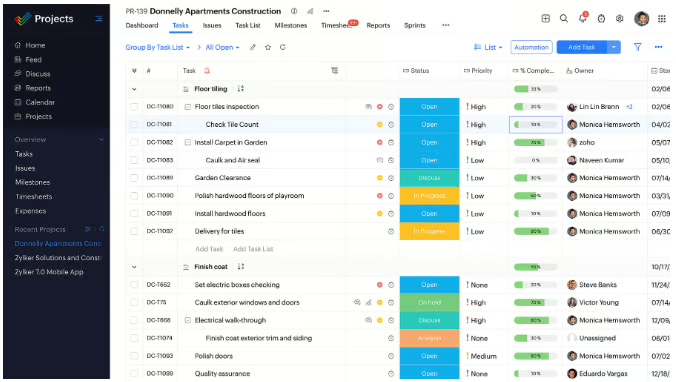
Zoho Projects offers several billing methods based on recorded project work. For example, businesses can charge by employee hours or apply one hourly rate to the entire project. If certain services have different rates, you can set separate charges for individual tasks, while timesheet approvals determine which billable hours count toward project costs.
As work progresses, managers can compare budgeted costs with approved billable hours. Zoho Projects marks a project as At Risk when forecasted costs exceed the budget, and it changes the label to Overrun once actual costs pass the approved amount. In addition, connections with Zoho Books and Zoho Invoice let businesses generate customer invoices from project records.
Since each invoice must be created within a single Zoho project, businesses cannot combine charges from several projects on one client invoice. Asana may be a better choice if you need to review time entries across projects and export timesheet data for invoicing, although its Timesheets and Budgets add-on costs $5.99 per user.
Pricing
- Free plan: Includes up to five users, three projects, subtasks, and 50 monthly workflow executions.
- Free trial for paid plans: 15 days
- Premium: $4/user/month; includes unlimited projects, task blueprints, time tracking, project budgeting, and 5,000 monthly workflow executions.
- Enterprise: $9/user/month; includes portfolio dashboards, cross-project dependencies, baselines, critical path analysis, and SSO.
- Ultimate: $14/user/month; includes multi-project timesheets, unlimited custom dashboards, 100 resources, and 500,000 monthly workflow executions.
AI pricing note: Premium includes Zia features, while the Zoho MCP Server is available on all plans.
Standout features
- Task Blueprint: Standardize task workflows through defined status transitions and required actions at each stage.
- Task dependencies: Connect related tasks across projects and adjust schedules through lead or lag time.
- Time logs and timesheets: Record billable hours against tasks and route timesheets through multiple approval levels.
- Recurring tasks: Schedule repeat work automatically and send reminders before assigned tasks are due.
5. Wrike: Best for managing task dependencies
Why I chose Wrike
If your project includes tasks that must occur in a specific order, Wrike supports four dependency types on its Gantt chart. Finish-to-start links work that begins after an earlier task ends, while start-to-start connects tasks that begin in sequence. Finish-to-finish coordinates completion dates, and start-to-finish requires one task to begin before another can end.
When a task date changes, Wrike automatically adjusts the dates of later tasks that depend on it. Managers can also move several connected tasks to new dates while preserving the scheduled time between them. If revised dates conflict with a fixed milestone, Wrike marks the dependency line red to indicate a scheduling conflict.
Wrike dependencies adjust dates but do not prevent users from completing a task before its predecessor is finished. Consider ClickUp if you want an on-screen warning before a user closes a blocked task, since dependency relationships are available across all ClickUp plans.
.png)
Pricing
- Free plan: Includes project and task management with board and table views.
- Free trial for paid plans: 14 days
- Team: $10/user/month; includes AI Essentials and project planning through dashboards and interactive Gantt charts.
- Business: $25/user/month; includes customizable workflows, reusable templates, and standard integrations.
- Pinnacle: Custom pricing; includes resource planning, budgeting, and advanced business intelligence reporting.
- Apex: Custom pricing; includes higher AI capacity, unlimited whiteboards, and enterprise integrations through Wrike Integrate and Sync.
AI pricing note: AI Essentials is included with Team, AI Elite actions start with Business, and additional AI Elite action packs have custom pricing.
Standout features
- Approvals: Assign specific reviewers to tasks or files and set a deadline for their decision. Wrike records approvals and rejections in the item’s activity history.
- Dynamic request forms: Convert requests into assigned tasks, capturing required data at intake.
- Automation: Create rules that assign tasks or update statuses when certain conditions occur.
6. Smartsheet: Best for formula-driven task tracking
Why I chose Smartsheet
If you already manage work in spreadsheets, Smartsheet lets you use formulas to calculate task information inside the grid. For example, a formula can flag overdue assignments or calculate the days remaining before a deadline. Because column formulas extend to new rows automatically, each task receives the same calculation as soon as it is added.
Smartsheet also supports cross-sheet formulas, which retrieve task data from separate sheets. This lets business owners total completed work across departments or show each project’s latest deadline in one report. Since the software supports familiar functions such as INDEX and MATCH, spreadsheet users can apply calculation methods they already know.
Although formulas provide flexible calculations, they cannot control the start date, end date, duration, completion percentage, or predecessor columns when dependencies are enabled. Consider monday.com if you prefer trigger-based rules, since it can update dates or move tasks after a status change.
Pricing
- Free plan: Not available.
- Free trial for paid plans: 30 days.
- Pro: $9/member/month; includes unlimited sheets, forms, and reports, plus core project views and 250 monthly automations.
- Business: $19/member/month; includes workload tracking, timeline view, admin controls, and unlimited automations.
- Enterprise: Custom pricing; includes portfolio management, scenario planning, SAML SSO, and directory integrations.
- Advanced Work Management: Custom pricing; adds Control Center, Dynamic View, Data Shuttle, premium connectors, and portfolio tools.
AI pricing note: Conversational AI is included in Pro and higher plans.
Standout features
- Forms: A dedicated form builder lets you create rules to collect data and assign tasks. These forms can also be customized with company branding and color schemes.
- Workload tracking: View each team member’s capacity and prioritize tasks based on workload and work allocation. You can also reallocate tasks to avoid uneven workloads.
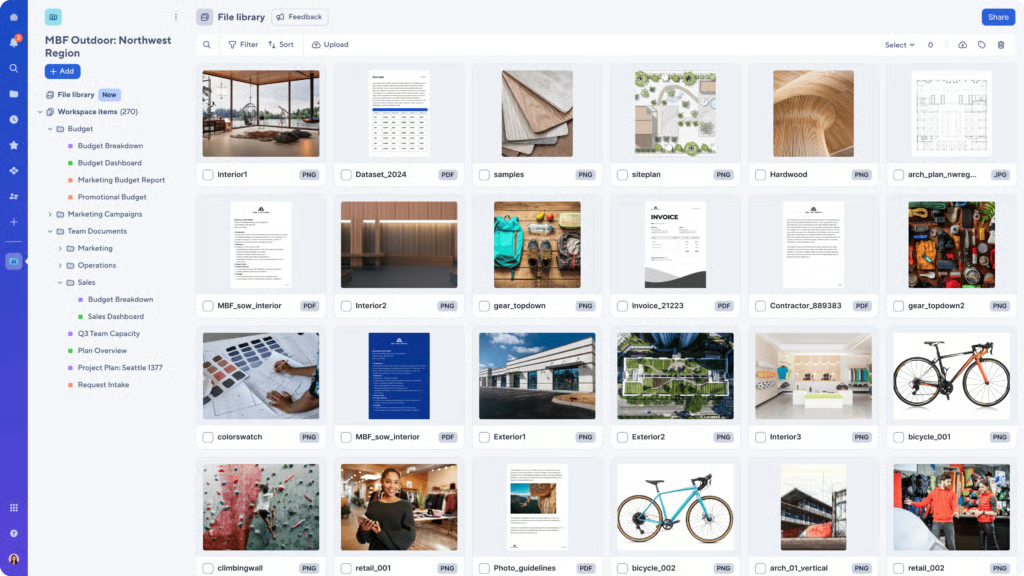
- File library: Create a central space for storing your files, making them easier to search and find for collaborative projects and tasks. Simply upload your files to the library to access them in your workspace.
7. Trello: Best for moving tasks through stages
Why I chose Trello
Known for its Kanban software and customizable boards, Trello is the best task management tool for individuals and small teams needing a quick and straightforward view of their workflows. The free plan includes many advanced features, such as built-in automations, custom templates, and unlimited access to over 200 third-party apps, making it a cost-effective option for solopreneurs and small business owners.
Additionally, an interactive board lets you add lists to track project stages and organize information cards. Customize your board by assigning members, leaving comments, and adding due dates. The Kanban-based templates are also available for different industries and project types, such as agile project management methods.
However, Trello may be less suited for larger project teams with more dynamic and complex tasks. If you’re looking for a more versatile solution with built-in analytics and reporting, you might want to give Wrike a try. In addition to Kanban boards, this provider supports more dynamic project views, including Gantt, timeline, calendar, and card views.
Pricing
- Free plan: Includes up to 10 collaborators, 10 boards, unlimited cards, 250 automation runs.
- Standard: $5/user/month; includes unlimited boards, built-in AI, advanced checklists, custom fields, and 1,000 automation runs.
- Premium: $10/user/month; includes AI, unlimited automation, multiple project views, and workspace admin controls.
- Enterprise: $17.50/user/month; includes unlimited workspaces, organization-wide permissions, Atlassian Guard Standard, and enterprise administrator support.
AI pricing note: AI is included with Standard, Premium, and Enterprise.
Standout features
- Advanced checklists: Organize tasks into a single, easy-to-access list. Add a checklist to a card, list all the tasks as items, and assign a due date and team member.
- Butler automation: Set up automation, commands, and rules on your Trello board. For example, if a Trello card is moved to the “Done” list, all items, including the checklist, due date, and members, will be crossed off.
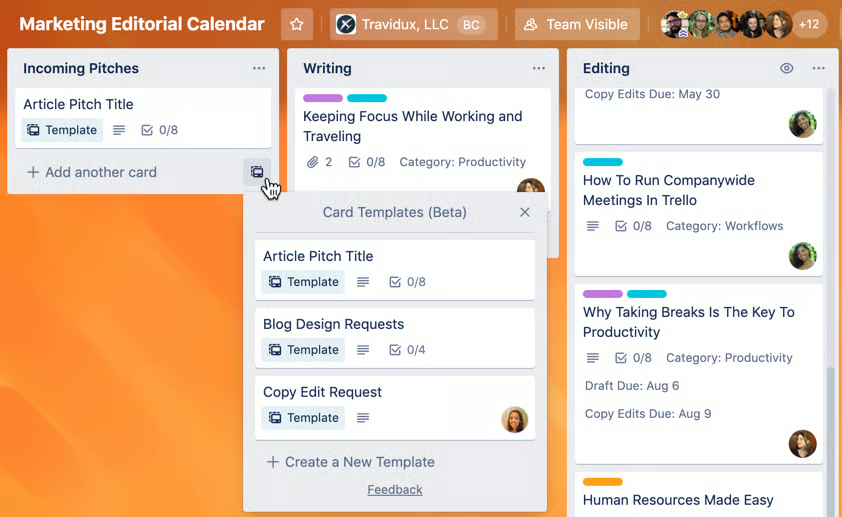
- Card templates: A card is the most detailed unit of a Trello board for representing tasks and ideas. It can hold a wide variety of information, like reminders or a to-do list. Card templates can be used to quickly copy tasks and assignments.
8. Todoist: Best for checklist-style task tracking
Why I chose Todoist
Todoist is the best task management software for solopreneurs and small teams because of its simple tools for managing less intensive tasks. As the name suggests, it's a to-do list app enhanced with tools like task delegation, boards, recurring due dates, and calendar feeds. You can also access all your to-do lists alongside your work projects, errands, weekly plans, and upcoming events in a user-friendly interface.
At the same time, Todoist's simplicity does not mean it lacks advanced features. Paid plans include AI features, such as an AI assistant to help with tasks and filters, productivity visualizations with colorful graphs, and integrations with other workspace tools.
However, Todoist’s list-based approach may not work well for teams that need more complex project management software for customizable workflows, advanced security features, and task automation. In this case, I recommend Smartsheet, which offers enterprise-grade plans beyond a basic to-do list and includes analytics, automation, and workspace management tools.
.png)
Pricing
- Free plan: Includes five personal projects, reminders, list and board layouts, limited AI sessions, and one week of activity history.
- Pro: $5/user/month; includes 300 personal projects, calendar layouts, task duration, full activity history, unlimited Ramble AI sessions.
- Business: $8/user/month; includes Pro for each member, a shared team workspace, 500 team projects, administrative permissions, centralized billing.
AI pricing note: Todoist Assist and Ramble access vary by plan.
Standout features
- Subtasks: Break tasks into smaller parts and divide work among multiple team members. They are embedded within a parent task with the same set of fields, making it easier to organize assignments.
- Activity history: This provides a complete snapshot of your account activity and other collaborators, organized by date. You can filter tasks by completion, updates, modifications, and deleted tasks.
- Task descriptions: To facilitate project start-up and completion, you can add details to each task, such as brief descriptions, documents, due dates, and instructions.
How to choose the right task management software
The right task management software for your business depends on factors concerning your team’s project management strategy. First, identify your existing project challenges (e.g., missed deadlines and uneven workload). Next, create a list of criteria based on your budget, team size, file storage capacity, and must-have features. From there, list the top options that fit your unique requirements.
Consider the following factors when comparing products:
- Ease of setup: Look for a product your team can configure and learn with minimal technical assistance. A complicated setup can delay adoption and push employees back to spreadsheets or email.
- Task controls: Confirm that users can assign responsibility and set deadlines. Subtasks are also useful when an assignment involves several steps or contributors.
- Total cost: Calculate the price for your required number of users, including paid add-ons. Check minimum seat requirements because you may have to pay for more licenses than your business uses.
- Automation: Review whether the software can assign tasks or send reminders based on specific triggers. Small businesses can use these rules for recurring processes such as client onboarding and invoice follow-ups.
- Work views: Choose views that reflect how your employees review their assignments. A calendar suits deadline-driven work, while a Kanban board shows how tasks move between stages.
- Integrations: Check for native integrations with your existing email and file storage apps. Native integrations can reduce duplicate data entry between systems.
- Reporting: Look for reports that show overdue assignments and current project status. Custom dashboards may be useful if owners need to monitor several projects from one screen.
- Growth requirements: Review the cost of adding permissions or workload tools as your business expands. A low starting price may become less economical if essential controls require a higher plan.
Task management software comes in many forms and often helps streamline the complex process of managing projects and people. In the era of AI, the best task management apps feature automated assignments and customizable dashboards for simplified project organization and calendar scheduling.
FAQs
How much does task management software cost?
Task management software comes in a range of prices, with monthly plans starting as low as $4 per user and a free plan available for small teams on a budget. Some providers also offer enterprise plans with customizable pricing that can go well over $15 a month per user.
What is the best software for task management?
ClickUp is an excellent choice for tracking personal and collective projects. It delivers many workflow automation tools, team collaboration features, and free and paid plans for various industries and business needs.
What is the best app for tracking action items?
monday.com offers dynamic project views that streamline workflows and manage team members. It features action-item templates and columns that enhance visibility at each project stage.