







Think of owner’s equity like a leftover pie after everyone you owe has taken their slice—it’s what’s truly yours as the owner. Unlike a company’s fair market value, owner’s equity doesn’t reflect a company’s overall worth. Instead, it shows how much capital the owners have invested in the business and how much of the business’s earnings have been reinvested to help the company grow.
To understand the concept of owner’s equity, refer to the accounting equation:
Assets = Liabilities + Owner’s Equity
Since owner’s equity is what’s left to the owner, we derive the accounting equation as follows:
Owner’s Equity = Assets − Liabilities
Components of Owner’s Equity in a Sole Proprietorship
Owner’s equity is straightforward in a sole proprietorship. Accounting for it is easy as well since it only requires determining how much was invested, reinvested, and withdrawn from the business.
- Additional investments is when the owner decides to infuse more capital (e.g., new equipment, additional cash)—and it is added to the owner’s equity.
- Owner’s draw or drawings is a permanent withdrawal of capital from the business without any intention to return it back.
- Net income is accumulated profits of the business since its inception. This is reinvested in the business which is why it accumulates in the owner’s capital account.
- Beginning and ending owner’s equity are the balances of owner’s equity at the start and end of the accounting period.
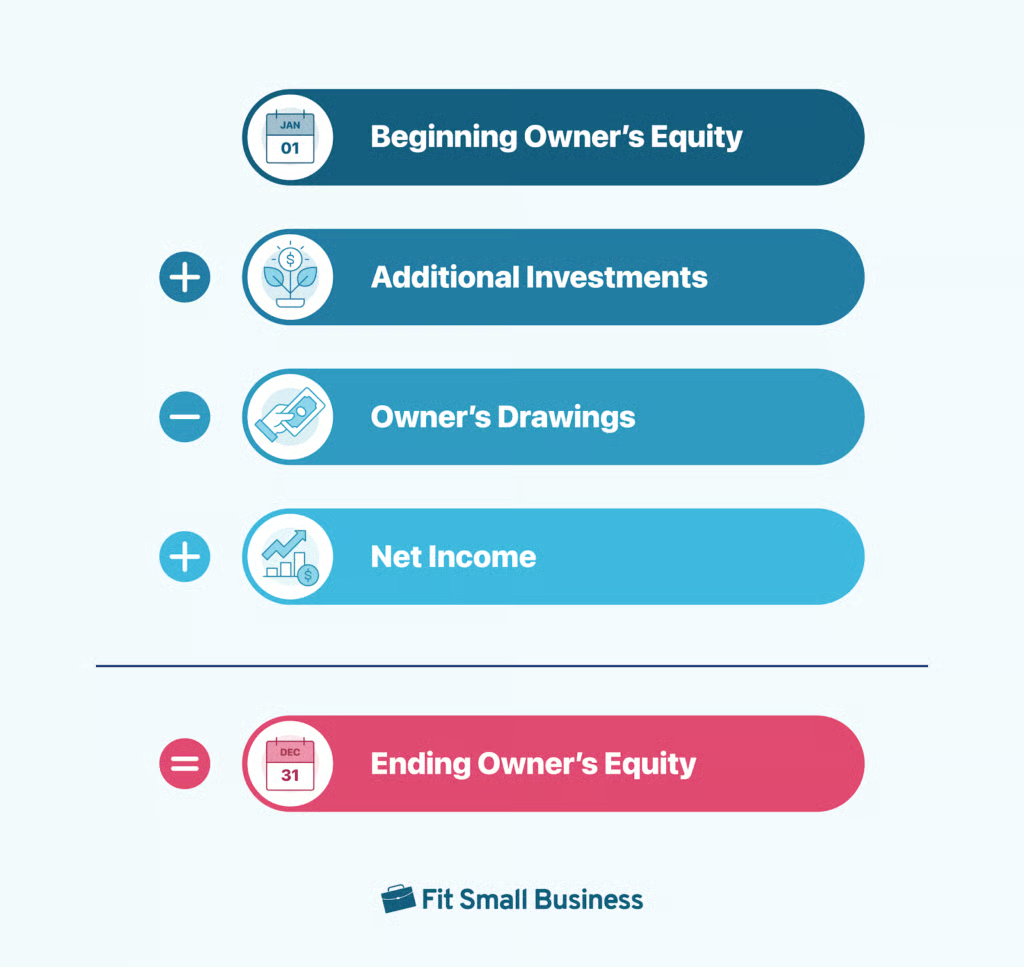
For example, say Dave invested $200,000 to launch a tech startup. After six months of operations, the company earned a net income of $300,000. This means the total owner’s capital is $500,000 ($200,000 + $300,000).
Now, suppose Dave permanently withdrew $10,000 from the business due to a medical emergency. Dave’s capital after withdrawal is now $490,000 ($500,000 − $10,000).
Components of Stockholders’ Equity in a Corporation
Since not all businesses are structured as sole proprietorships, I want to cover stockholders’ equity for readers who own or manage a corporation. Corporations use different terms for capital—such as common stock, preferred stock, and additional paid-in capital—which distinguish them from sole proprietorships.
Here are the components of a corporation’s stockholders’ equity section.
Common Stock
Common stock, also known internationally as ordinary shares, is a stock that grants stockholders voting rights and a claim on the corporation’s net assets in the event of liquidation.
In accounting, it represents the par value of common stock. When investors purchase common stocks, the price of each stock consists of the par value plus any premium that the corporation wants to add. Think of it as a markup, wherein the par value is the cost and the premium is the amount you put on top of the cost.
- Stock is a type of security that represents ownership in a corporation. It can be common or preferred.
- Par value is the nominal value of the stock that can be seen in the stock certificate. It represents the minimum amount that should be paid to purchase each stock.
- Market value is the value of the stock as published in the stock market.
- Premium is the excess amount paid above the par value or the positive difference between the market value and par value.
Preferred Stock
Preferred stock is a special class of stock that often comes with preferences but has no voting rights. Unlike common stock, it has unique features that make it attractive to different investors.
Let’s go over the types of preferences associated with preferred stock:
- Preference to dividends means that preferred stockholders are prioritized during dividend distribution. This kind of preference can be:
- Cumulative preference dividends is when the stockholder will still get dividend payments on years where the corporation did not pay dividends (e.g., dividends in arrears). The opposite of this is noncumulative preference dividends.
- Participating preference dividends is when the stockholder can participate in the distribution of additional profits on top of their fixed dividend payment.
- Preference to liquidation means that the preferred stockholder will first be paid in full before the common stockholders, ensuring that they get the full value of their investment during liquidation.
- Callable is when the corporation has the right to repurchase the stocks from preferred stockholders. The opposite of callable is puttable, wherein it is the stockholder who will decide when to sell the shares back to the corporation.
- Convertible preferred stock can be converted into common stock once certain conditions are met.
Additional Paid-in Capital
Earlier, I discussed par value and the amount on top of it. This additional amount is formally referred to as additional paid-in capital (APIC) or, internationally, the share premium. In corporate jargon, APIC is also referred to as “in excess of par.”
To illustrate, say I purchased 1,000 shares of ABC Corporation. Here are the details:
- Par value of ABC shares: $1 per share
- Market value of ABC shares: $100 per share
- Computation of APIC:
- Par value of my common shares:
= $1,000 (1,000 shares × $1)
- Market value of my common shares (this is what I paid to acquire the shares):
= $100,000 (1,000 shares × $100)
- My APIC:
= $99,000 ($100,000 − $1,000)
Retained Earnings
The retained earnings (RE) account reflects all the income and losses a business has accumulated since its inception reduced by any distributions to owners or dividends. Essentially, RE represent the company’s undistributed earnings.
In sole proprietorships, there is no RE account. Instead, all net income and losses are directly added to the owner’s capital balance. Partnerships follow a similar approach, with one key difference: the amount credited to each partner’s capital account is based on their agreed-upon profit-sharing ratio.
What Is the Statement of Owner’s Equity?
The statement of owner’s equity is a financial statement that shows the changes in owner’s equity items during the accounting period. It reconciles the beginning owner’s equity to ending owner’s equity—and both must agree to the owner’s equity amount shown on the beginning and ending balance sheet. This financial statement isn’t common in small business accounting software.
