







Speed has become the new standard in ecommerce, and customers increasingly ask: How does same-day delivery work? Once considered a luxury, it is now an increasing consumer expectation and a growing powerful tool for retailers to boost conversions, reduce cart abandonment, and build loyalty.
Same-day delivery requires tightly coordinated logistics — inventory visibility, fast fulfillment, and reliable couriers — but when done right, it can set your business apart from competitors and drive repeat sales.
In this article, I explain exactly what same-day delivery is, how it works, and what it takes to make it successful. You’ll learn the difference between same-day delivery and same-day shipping, the logistics requirements, the benefits and risks, and whether it’s realistically doable for your business. I’ll also cover implementation strategies, cost considerations, and future trends, such as AI and sustainability, that are reshaping same-day delivery.
- What is same-day delivery?
- Same-day delivery vs same-day shipping: Key differences
- How does same-day delivery work?
- Benefits of same-day delivery for small businesses
- What you need to make same-day delivery work
- Is same-day delivery doable for small businesses?
- How to implement same-day delivery in your business
- Challenges and risks of same-day delivery you need to plan for
- The future of same-day delivery:Trends shaping 2025 and beyond
- Frequently asked questions (FAQs)
- Bottom line: Is same-day delivery right for your business?
What is same-day delivery?
Same-day delivery is a fulfillment method where customers receive their order on the same calendar day it was placed. This differs from same-day shipping, where the order simply leaves the warehouse that day but may arrive later. By 2025, the US market for same-day delivery is projected at $11.5 billion, with global services reaching $14.7 billion.
The model gained traction in 2009 when Amazon introduced “order by noon, get it tonight” to US key cities. In 2015, Amazon formally called it same-day delivery and offered it to Prime members, setting a new standard for shipping speed. More recently, Amazon expanded again — adding fresh groceries to the service in over 1,000 US cities and planning to reach more than 2,300 by year’s end, putting growing pressure on traditional grocers.
How consumers see it today: Same-day delivery is now common across sectors such as retail, grocery, pharmaceuticals, and electronics. Whether it’s a forgotten birthday gift, urgent office supplies, or last-minute groceries, customers increasingly view same-day delivery as a basic service rather than a luxury.
Why this matters for small businesses: This shift brings both opportunity and challenge. Offering same-day delivery can boost conversions and customer satisfaction — but only if the logistics are managed carefully.
Same-day delivery vs same-day shipping: Key differences
Many business owners use the terms same-day delivery and same-day shipping interchangeably, but they mean very different things, and understanding the difference is critical for your operations and customer promises.
Same-day shipping means the order is processed and leaves your warehouse the same day it was purchased. Delivery still takes the usual one to five business days, depending on the carrier. Think of it as “fast dispatch,” not fast arrival.
Same-day delivery means the order is picked, packed, shipped, and delivered to the customer’s address all in one day — often within four to eight hours.
This difference shapes customer expectations. A buyer who pays for same-day delivery expects to use the product tonight. A buyer who selects same-day shipping is often satisfied knowing it’s in transit quickly, even if it doesn’t arrive until later in the week.
The impact on customer trust: A 2025 survey revealed that 46% of shoppers are willing to pay extra for true same-day delivery; however, misleading them by labeling shipping as delivery can result in complaints, returns, and negative reviews. Precise messaging avoids misunderstandings and strengthens loyalty.
Related reads:
- The Ultimate Small Business Guide to Ecommerce Fulfillment
- 8 Best Fulfillment Companies for Small Businesses in 2025
How does same-day delivery work?
Same-day delivery works through a tightly coordinated process that starts the moment a customer places an order and ends with doorstep delivery just a few hours later. Unlike standard shipping, every step is accelerated and highly localized. Here’s how it typically works:
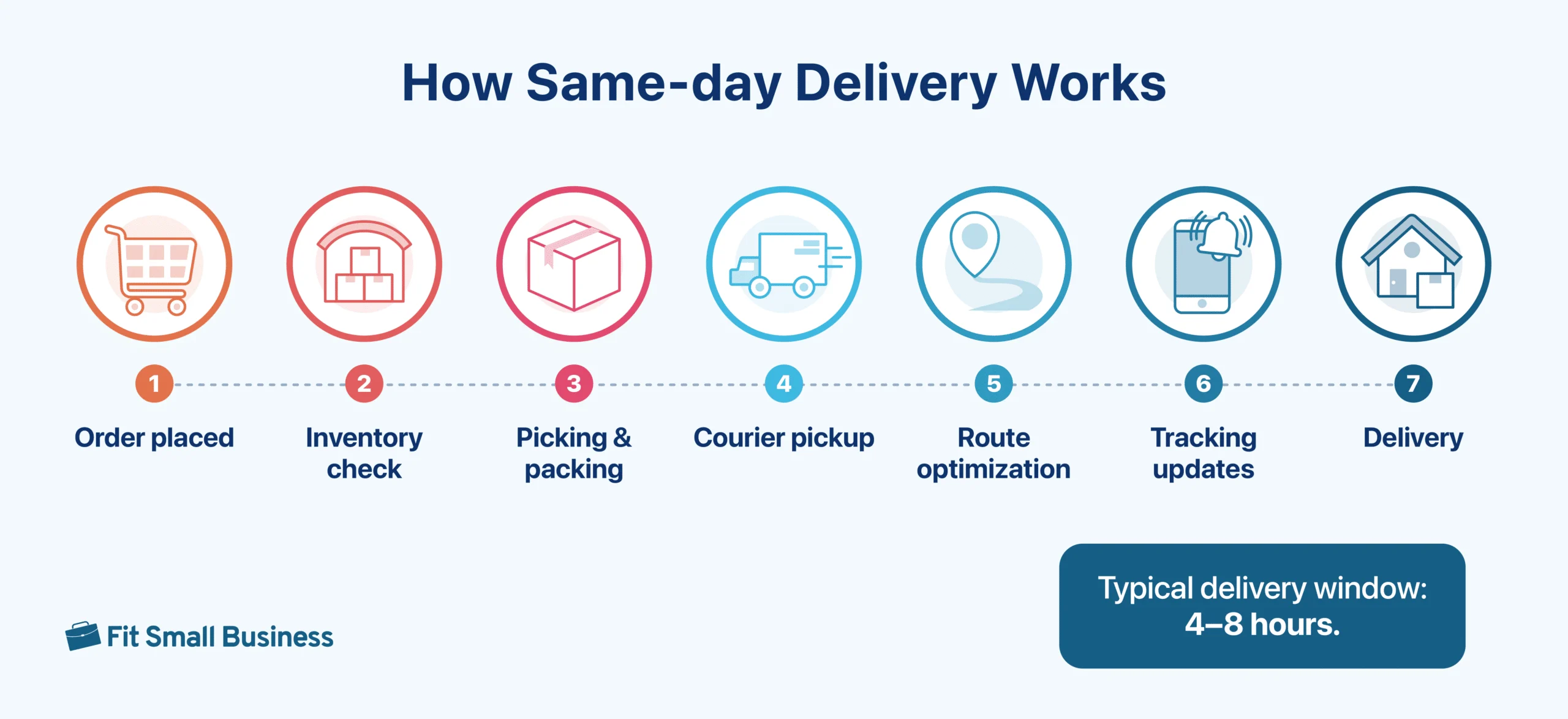
- Order placement and cutoff time: The customer places an order before the store’s cutoff, often around 12 p.m. local time. Orders after this time usually roll over to the next day.
- Inventory allocation: The system checks for available stock in a nearby fulfillment center or retail store. This is why real-time inventory management is crucial.
- Picking and packing: Staff (or automated systems) quickly prepare the order for shipment, sometimes within minutes.
- Courier assignment and pickup: A courier, either an in-house driver or a third-party partner, is dispatched to collect the package.
- Route optimization: Delivery software chooses the most efficient route, accounting for traffic, weather, and distance.
- Real-time tracking: Customers receive updates through email, SMS, or app notifications, including ETAs and delays.
- Same-day delivery accomplished: The order arrives at the customer’s door, usually within four to eight hours of purchase.
Benefits of same-day delivery for small businesses
Speed and convenience are the major benefits of same-day delivery for buyers, but it offers a lot more benefits for your business — increased sales and loyalty are just the tip of the iceberg. As a small business, the impact can be significant. The impact of same-day delivery on your small business includes:
- Higher conversions and fewer abandoned carts: Shoppers are less likely to abandon their carts when they see fast delivery options. In fact, 68% of consumers say they’re more likely to shop online if same-day delivery is offered.
- Stronger customer loyalty: Speed builds trust. A commonly cited study showed that 74% of shoppers are more likely to buy again from a retailer that delivers the same day. Repeat customers and word-of-mouth referrals also increase sales in the long run.
- Efficient inventory turnover: By moving items faster, small businesses avoid overstocking and reduce storage costs. Faster turnover frees up cash flow while keeping shelves stocked with products customers actually want.
- Competitive edge in local markets: In crowded retail spaces, offering same-day delivery sets you apart from larger chains or online competitors that may not serve your local area as quickly.
What you need to make same-day delivery work
Running same-day delivery successfully demands more than just fast couriers — it needs a tightly connected system that aligns cutoff times, inventory accuracy, quick fulfillment, partner delivery networks, and customer communication. Without precise order cut‑off coordination and accurate real‑time inventory visibility, even well‑intentioned delivery promises fall apart.
So, what exactly do you need to make same-day delivery work? Here are the essentials every small business should have in place:
- Cutoff times: You’ll need to set and display clear cutoff times (often noon or early afternoon) so customers know when they must order to qualify for same-day delivery. Transparency avoids disappointment.
- Real-time inventory management: Same-day delivery only works if your system can track stock levels accurately. Overselling leads to failed promises and unhappy customers.
- Fast picking and packing: Every minute counts. Many small businesses adopt barcoding, mobile scanners, or even light automation to speed up fulfillment.
- Courier partnerships: Reliable couriers are essential. This can be an in-house driver, a gig worker platform like Roadie, or a third-party logistics (3PL) provider. For SMBs, outsourcing often makes more sense than maintaining your own fleet.
- Customer communication: Automated alerts about cutoff times, delivery windows, and tracking links build trust and reduce support calls. In fact, 56% of consumers now say they want real-time tracking features with their deliveries, making it a must-have for same-day service.
The takeaway is clear: making same-day delivery work requires integrating technology, logistics partners, and customer communication into a single smooth process.
Is same-day delivery doable for small businesses?
Yes, same-day delivery is achievable, but success largely depends on your location, product mix, and margins. While the model was pioneered by retail giants like Amazon and Walmart, many retailers are now making it work by leveraging technology and third-party partners.
That said, same-day delivery is most doable under these conditions:
- Your business operates in urban and metro areas: Same-day delivery is most efficient where customers are concentrated. Dense areas make it easier to justify courier costs and complete multiple deliveries in a short window.
- You sell high-margin or urgent products: Categories such as food items, electronics, gifts like balloon and flower arrangements, medical supplies, and office products often deliver the strongest ROI. Shoppers are more willing to pay a premium when speed is critical.
- You have stores that can double as fulfillment centers: Physical locations can serve as micro-hubs. This “ship-from-store” model reduces delivery times and leverages existing inventory. For example, Sur La Table uses Walmart GoLocal to fulfill online orders directly from nearby stores, offering same-day convenience without new infrastructure.
- You can partner with third-party couriers: Platforms like Uber, Postmates, and Roadie offer affordable last-mile delivery without requiring a dedicated fleet. This flexibility helps businesses scale quickly.
- You expand your coverage gradually and carefully: Same-day delivery doesn’t need to cover every product or ZIP code. Many retailers start by offering it on popular items within a defined radius, then expand gradually as demand grows.
How to implement same-day delivery in your business
Implementing same-day delivery can be overwhelming, but the key here is to start small, set realistic expectations, and build on what works. Here’s how to make it happen:
- Determine feasibility first: Not every product is right for same-day delivery. Evaluate whether your top-selling items are suited for fast shipping, and weigh the cost against expected demand. Look at past order data to see which products are frequently purchased with urgency and during what seasons. This helps you decide what stock to prioritize for same-day delivery and ensures you’re not overcommitting on low-demand items.
- Start with a pilot zone: Don’t try to roll out same-day delivery everywhere at once. Begin with a single city, ZIP code cluster, or a few high-demand products. A focused pilot lets you test processes without overextending resources.
- Set and display clear cutoff times: Customers need to know the deadline for same-day delivery — often noon or early afternoon. Displaying this prominently at checkout sets realistic expectations and prevents complaints.
- Use local hubs and fulfillment partners: Whether through your own storefronts, local warehouses, or third-party logistics providers, the goal is to position inventory closer to your customers. Brick-and-mortar retailers can turn stores into micro-fulfillment centers, while ecommerce-only merchants can forward-stock fast-moving products in distributed fulfillment networks like ShipBob. Pairing these hubs with courier partners such as Uber, Postmates, or Roadie ensures faster last-mile delivery without the overhead of running your own fleet.
- Automate order management and tracking: Integrating your ecommerce platform with courier APIs ensures orders are processed instantly and customers receive real-time tracking updates.
- Price same-day delivery strategically: You don’t need to cover the entire cost yourself. Many retailers charge a flat fee or waive fees above a certain order size. Consider the customer demand: 41% of consumers are willing to pay extra for same-day delivery, with 24% even open to paying more for narrow delivery windows. And during peak seasons, over 50% of consumers say they’d pay a premium — up to $9 per package —for same- or next-day delivery.
- Measure and refine continuously: Track whether faster delivery leads to higher conversion rates, bigger average order values, or more repeat customers. Use these insights to fine-tune delivery zones, cutoff times, and pricing models.
Challenges and risks of same-day delivery you need to plan for
Offering same-day delivery can definitely boost sales and build loyalty, but it also comes with costs and operational risks you need to prepare for. Here are the main challenges and examples of how they play out in real life:
- Higher operating costs: Same-day delivery requires more drivers, fuel, and labor than standard shipping. Local micro-fulfillment or courier partnerships add flexibility but increase per-order expenses. Even Amazon experienced massive cost increases — shipping expenses jumped over 60% from 2019 to 2020, rising from $37.9 billion to $61.1 billion — illustrating how rapidly logistics costs can erupt.
- Return management is harder: Fast deliveries don’t eliminate returns. If an item arrives late, is misrouted, or gets damaged, you’ll need processes for refunds or reattempts the same day.
- Seasonal demand spikes strain capacity: Holidays, flash sales, and peak shopping periods can double or triple order volume. Walmart reported delivering 5 billion same-day and next-day items in 2024 but acknowledged that Black Friday and Christmas surges required pulling in temporary drivers and stricter cutoffs. Without similar contingency plans, smaller merchants risk disappointing holiday shoppers.
- Logistics complexity: Real-time inventory tracking and fulfillment must be flawless. Best Buy, for example, only offers same-day delivery in select metro areas because coordinating fast-moving electronics across stores, couriers, and warehouses is logistically demanding. Even one out-of-stock SKU or a delayed driver can break the same-day promise.
- Limited geographic reach: Same-day delivery works best in metro areas where dense demand offsets costs. Amazon announced expansion to 4,000 small towns and rural areas by 2026, but the investment in micro-fulfillment centers is massive. Smaller businesses without that scale must prioritize urban coverage first.
- Technology dependency: Same-day delivery hinges on robust software integrations for order management, routing, and courier dispatch. A single tech failure — like a broken API or label printer — can throw off every delivery that day, especially when there’s no backup system.
- Customer expectation management: When you charge a premium for same-day delivery, you must deliver on that promise. Sur La Table, which offers same-day delivery through Walmart GoLocal, sets clear radius limits (20 miles) and order cutoffs to avoid missed expectations.
The future of same-day delivery:Trends shaping 2025 and beyond
The next wave of same-day delivery will be shaped by technology, consumer expectations, and sustainability pressures. Even small retailers can benefit from these innovations if they know where to focus.
- AI-powered forecasting: Artificial intelligence can predict demand spikes, adjust cutoff times automatically, and place inventory closer to buyers. This minimizes missed orders and wasted resources. McKinsey reports that AI-driven demand planning has helped retailers reduce inventory levels by 20% to 30%.
- Smarter last-mile routing: Delivery platforms now use machine learning to optimize courier routes in real time. AI-powered route optimization can reduce delivery time and fuel usage, while predictive analytics — forecast to become standard — could cut operational costs by up to 15% and improve service levels by 65%.
- Customer communication with AI: Chatbots and automation provide instant ETAs, delivery updates, and delay notifications. This reduces support requests while keeping customers reassured that their same-day orders are on track.
- Autonomous delivery options: Autonomous vehicles and drones are projected to handle more and more urban deliveries in the next few years, reducing reliance on human drivers. Companies like Walmart and Amazon are already piloting drone delivery for groceries and small parcels.
- Eco-friendly delivery models: Sustainability is becoming a decision factor for shoppers. Eco-conscious delivery is increasingly becoming a consumer demand, with 77% of shoppers say they’re willing to wait longer for eco‑friendly shipping, and a majority would even pay a small premium — 57% are OK with a 10% surcharge, while 80% of even the most price-sensitive shoppers would accept a 5% increase to support greener logistics.
- Consolidated shipments and flexibility: Instead of multiple packages a week, 37% of consumers prefer one bundled delivery, which reduces costs and aligns with environmental values. At the same time, more customers want flexible delivery windows, forcing logistics providers to offer personalized scheduling.
- Urban micro-hubs and dark stores: To meet demand in dense areas, retailers are investing in local fulfillment hubs that reduce last-mile distances. These micro-hubs make it easier to guarantee same-day delivery without overextending courier fleets. A growing model is the dark store — a traditional retail location repurposed exclusively for online order fulfillment. Instead of welcoming walk-in customers, dark stores operate like mini-warehouses stocked with high-demand products, allowing staff or couriers to process orders quickly for nearby delivery. Grocery chains like Kroger and Carrefour have adopted this model in major cities, using dark stores to speed up same-day and even two-hour delivery promises.
Related reads: 98 Online Shopping Statistics Retailers Should Know in 2025
Frequently asked questions (FAQs)
Is same-day delivery profitable?
Yes, if managed carefully. Profitability depends on focusing on high-demand products, setting clear cutoff times, and charging a fee to offset costs.
Which businesses benefit most from same-day delivery?
It’s most effective for businesses selling urgent or time-sensitive products, or those with stores in metro areas that can act as fulfillment hubs. Ecommerce-only retailers can achieve it through 3PL partners and courier networks.
What are the main challenges of same-day delivery?
Key challenges include higher operating costs, complex logistics, limited reach in rural areas, technology dependence, and high customer expectations.
Bottom line: Is same-day delivery right for your business?
Same-day delivery can help small businesses increase sales, customer loyalty, and competitiveness — but only if it’s implemented strategically. It works best for high-demand items in metro areas, supported by clear cutoff times, reliable courier partners, and automation. The investment is worthwhile if you can balance costs with customer expectations. Start small, test, and refine. Businesses that adopt same-day delivery carefully will win on speed without sacrificing margins.
