




.jpg?w=288)
.jpg?w=288)

For businesses, measuring employee productivity is important in helping identify how company resources, money, and time are used to produce products or provide services. Learning how to measure employee productivity will help you gauge your workforce’s overall efficiency and capability. It also provides you with the data you need to make operational changes, such as expanding your team or investing in new production equipment.
While there are a number of ways for computing this, the most common is through the quantitative method. We discuss this and other methods in depth below, including what to factor in and the steps for calculating productivity. You can also use our free calculator to determine the productivity rates on a per-employee and per-hour basis, expressed in $ amounts.
Employee Productivity Calculator
Step 1: Determine the Method for Computing Productivity
There are various methods and formulas you can use to measure employee productivity. Depending on the type of business you have, the work that your employees do, and your company goals, you can calculate productivity by quantitative and qualitative means, or by specific key performance indicators (KPIs).
Method 1: Quantitative Method
The easiest and most widely used is the quantitative method. This allows you to quantify your employees’ productivity based on the number of products or services they produce or provide in a specific time period.
The basic formula for calculating productivity using this method is:
Output / Input = Productivity
Output is the quantity or value of products produced or services provided in a given time interval. This can be the number of items, the amount of revenue, or the cost of goods generated. On the other hand, input is the number of units used in producing an item or providing a service. Depending on the industry your business belongs to, it can refer to a variety of factors, such as hours worked, volume, money, or headcount.
Let’s say your business produces 1,200 items per week with 15 employees (or a total of 600 work hours). The quantity of items would be the output and the employee count or work hours would be the input. Using the above formula, your weekly labor productivity rate would be 100 items per employee (or two items per hour of work). The computation looks like this:
1,200 items in a week / 15 workers = 80 items per worker, per week
OR
1,200 items in a week / 600 work hours = 2 items per hour, per week
You can also calculate productivity in terms of a worker’s contribution to the worth of goods produced. For example, if your business generates $6,000 worth of items per week with 15 workers (or a total of 600 work hours), your weekly labor productivity rate would be $400 per employee (or $10 per hour worked). The computation looks like this:
$6,000 worth of items weekly / 15 workers = $400 worth of items per worker, per week
OR
$6,000 worth of items weekly / 600 hours worked = $10 worth of items per hour, per week
The above formula may offer a straightforward way of calculating employee productivity based on a single output, but it doesn’t account for other factors, such as capital spending or labor costs. If you want a more comprehensive look at your business’ productivity rates, consider using a multifactor method. Expand the section below to learn more.
Multifactor Productivity
Multifactor productivity lets you compare the output to a combined set of inputs used to produce the output. This approach enables you to take into account the various factors that affect the output or production, such as labor, capital, and material costs. The standard formula is as follows:
Output / (Input A + Input B + Input C) = Multifactor productivity
Let’s say your business produced a total of 5,000 items in the month of June. The total labor cost for the same period is $200, and you spent $200 in materials to produce your products. You also used $600 of your capital to purchase new machinery for your production line. The multifactor formula, including your productivity rate for June, would be:
Units or items produced / (Labor cost + Capital spending + Material cost) = Multifactor productivity rate
OR
5,000 / ($200 + $600 + $200) = 5 units per dollar
While this method provides a multifactor view of your workforce’s productivity, small business owners might find it challenging to use and difficult to understand. However, it’s great for computing whether or not a change in one of the inputs will increase or decrease productivity.
For example, you have five employees who produce 25 logos per day. Each worker receives a daily pay of $40 (or $200 daily for all five employees). To increase worker output, you give a $10 bonus to those who submit two additional logos on top of the daily quota. Assuming that all of your workers will meet the bonus quota, the team’s new daily output will be 35 logos instead of 25.
To measure the change in productivity, start with identifying the regular productivity rate. Then, use the multifactor formula in calculating the productivity rate with the bonus.
Regular productivity rate:
25 logos or units / $200 daily labor cost = 0.125 units per dollar
New productivity rate with the bonus:
35 logos or units / ($200 daily labor cost + $50 daily bonus amount) = 0.14 units per dollar
Next, compute the productivity rate change between the two using this formula:
((New or Current productivity / Regular or Past productivity) – 1) X 100 = Percent change in productivity
OR
((0.14 / 0.125) – 1) X 100 = 12% productivity rate change
This means that the planned bonus can increase the team’s daily productivity by up to 12%—provided all five employees meet the bonus quota.
Method 2: Qualitative Method
This method is relatively challenging to calculate as it measures the quality of work performed. Unlike the quantitative method, it typically doesn’t have standard formulas you can use. However, you can use an assessment form or a satisfaction survey and assign numeric values to specific answer options (such as a job well done or needing improvements) to help measure and track an employee’s qualitative productivity.
The assessment factors for this method can vary, depending on the job type, company goals, and business industry you’re in (e.g., customer service job, sales industry, etc.). Examples of qualitative factors you can use include customer reviews of services rendered and feedback from team members.
Method 3: Other Productivity Metrics
Looking at quantitative items like hours worked, revenue, and goods produced are three of the standard factors for measuring overall worker efficiency, but there are other productivity metrics and KPIs you can use.
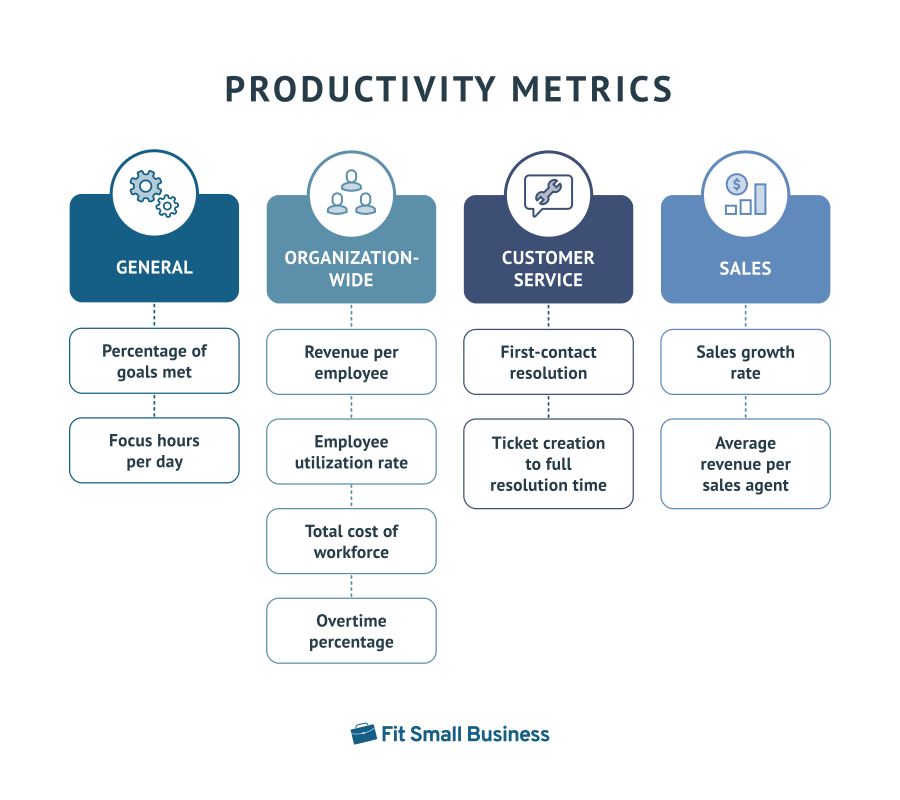
1. Percentage of goals met
With your employees’ productivity linked to the number of work goals they accomplish, you can easily determine where your workforce (or department) stands in terms of efficiency. However, you’ll need quantifiable goals to measure this particular metric. An example is identifying the number of actual products produced in a specific time period versus the planned production goal for the same period.
The basic formula is:
(Actual output / Planned goal) X 100 = Percentage of goals met
2. Focus hours per day
With the increase in the number of employees doing remote work, measuring the daily focus hours has become an important metric in assessing workforce productivity. This metric looks at the number of hours that employees spend doing nothing else but work tasks.
There are two categories:
- Deep work: This is the time that employees focus on tasks without interruptions (such as meetings). You can measure this by looking at the worker’s calendar and the number of interruptions in a day. If there are too many meetings with minimal break times in between, it is unlikely that your employee was able to do any focused or deep work for that day.
- Operational work: This refers to operational work (such as answering emails, filing documents, and doing simple administrative tasks) that can take anywhere from 15 minutes up to two hours to complete. To assess this, look at how long these tasks take. Add all the number of minutes or hours on a daily basis and then average it over a month.
1. Revenue per employee (RPE)
This ratio provides an estimate of the company’s total revenue divided by the number of employees for a specific time period. The basic formula for this is:
Total revenue / Number of current employees = Revenue per employee
A business with a high RPE ratio usually indicates a higher level of productivity. This translates to bigger profits, which allows business owners to offer better salary packages to employees.
2. Employee utilization rate
This refers to the percentage of an employee’s work hours spent on projects or tasks that can be billed to clients. Businesses and workers in the professional services sector often use this productivity metric. The basic formula for this is:
(Billable hours for a specific period / Total employee work hours for the period) X 100 = Utilization rate percentage
Monitoring employee utilization rates can help you check if an employee is being under- or overutilized. Knowing your utilization rate is also important in assessing your hiring requirements, as well as the number of billable hours your business needs to remain profitable.
3. Total cost of workforce (TCOW) rate
This is the total amount of money that a business spends on its employees, calculated as a percentage of the company’s total operating costs. The total workforce costs include everything from employee and contingent worker salaries, benefits, bonus amounts, overtime, vacation pay, training expenses, recruiting fees, and other personnel-related costs. To calculate your company’s TCOW rate, here’s the formula:
(Total workforce costs / Total operating costs) X 100 = TCOW rate
4. Overtime percentage
Knowing your overtime hours and the applicable overtime percentage rates are important as these can impact company profitability. This percentage also provides insight into the time employees spend outside of regular work hours to complete tasks, allowing you to balance staff workloads to minimize overtime. The formula for this is:
(Overtime hours for a specific period / Regular hours for the period) X 100 = Overtime percentage
1. First-contact resolution percentage
If you want to track your employees’ capability to resolve customer queries or issues at the first point of contact for a specific period of time (eg. for a week or month), then use the below formula.
(Issues resolved the first time / Issues handled by customer service reps) X 100 = First-contact resolution percentage
However, if you want to determine the number of minutes that your support team spent in sending first responses to customer support tickets for a specific time period, you can use this formula.
Total time taken (in minutes) to send a first response / Total number of customer tickets = First-response time
2. Ticket creation to full resolution time
This helps you look at the time in which a customer’s issue was resolved, calculated as either number of days or hours. For this method, you have to look at each support ticket and identify when it was raised and marked resolved. Here’s the standard formula.
Total resolution time for all tickets resolved / Number of tickets resolved = Average resolution time
1. Sales growth rate
Sales growth is a basic KPI that tells you how your business is performing in terms of revenue (or products and/or services sold). To compute this metric, you need the sales data for the current and previous periods (e.g., current and previous month or year). The basic formula is:
((Current period sales / Previous period sales) – 1) X 100 = Sales growth percentage
2. Average revenue per sales agent
One way of measuring a sales representative’s productivity is by looking at each worker’s capability to generate revenue for a specific time period. The basic formula is:
Revenue from sales / Number of sales agents = Average revenue per sales agent
However, you need to establish a sales baseline for this metric to compare average revenue contributions because not all employees are equal. Some may be junior sales agents with a limited client base, while others may work in favorable locations.
Step 2: Identify Your Productivity Factors
Now that you know the different ways of measuring productivity, the next step is to determine what you want to assess and for what time period. Do you want to calculate the average time it takes for a customer rep to resolve support tickets in a day, week, or month? Or, do you want to know how much revenue a sales team or employee is contributing to the company on a quarterly or annual basis?
Knowing what aspect of productivity you want to measure will determine your output and input items. It will also help you identify the methodology and productivity formula to use, including the timeline (e.g., daily, weekly, or monthly) for when you should run your productivity reports.
Step 3: Establish Baseline Data
Setting up baseline metrics provides you with benchmark data to compare your results with. It also helps you identify a productive level for your metrics. With this baseline, you can easily assess whether the actual results are above, below, or on par with the standard productivity rates you set for a role, team, or work task.
Step 4: Set Clear Objectives & Goals
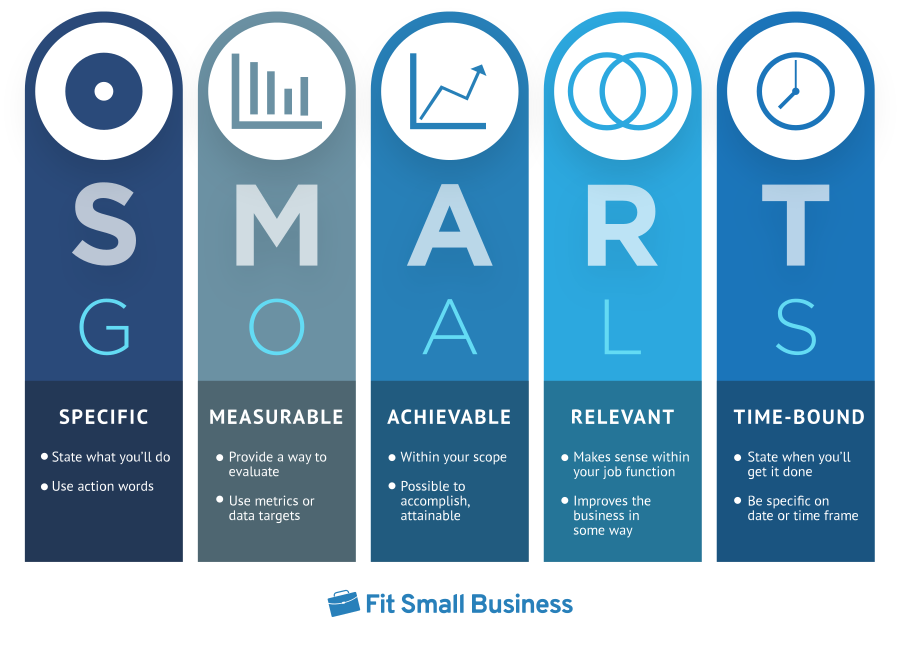
Examine how employee performance can contribute to the company’s objectives. The level to which your workforce meets business targets is an indication of their productivity. For your workers to become high-performing employees, it’s important to create well-defined goals and share these with your team so they know what is expected from them and how their work will be measured.
To set up clear objectives for your company and employees, we recommend using the SMART goals method. If you’re unsure what this looks like, our guide to SMART goals contains several examples for small businesses.
Why Should You Measure Employee Productivity?
In a nutshell, calculating and tracking employee productivity helps business owners understand the various factors that impact worker efficiency, business revenue, and company performance. Measuring workplace productivity also contributes to:
- Employee growth: Regular performance and productivity tracking make workers more mindful of the company’s objectives and their role in attaining the goals. It also provides better transparency of the tasks to be done, especially if you create clear targets for your team. And if your workers make mistakes, you or your people managers can give timely and constructive feedback. You can even provide support via coaching, mentoring, or formal training programs to help workers learn and grow.
- Operational and process improvements: Productivity metrics bring to light areas that need to be improved. You can spot potential issues or production bottlenecks and address these before losses occur. If you plan to make changes that will impact worker productivity or day-to-day operations, you can create a change management strategy to make the transition less stressful.
- Performance and people management: Evaluating employee performance on a specific set of factors (e.g., sales numbers or the number of goods produced) helps with tracking and measuring productivity. It’s up to you and your people managers to regularly assess employees, share how performance is graded, coach your staff, and make adjustments to their work to ensure you’re getting the maximum output from your team.
- Company culture: The culture within a company can impact employee productivity because it drives how your staff feels about working for your business after their basic compensation and safety needs are addressed. Knowing your productivity ratios can also help you make better decisions on who to reward and who will require additional training and support to improve their skills and productivity.
Bottom Line
Knowing how to measure employee productivity can help you understand and evaluate the factors that affect overall worker performance and efficiency. There isn’t a one-size fits all formula for measuring this, so feel free to experiment and seek innovative ways to determine your company’s productivity metrics.
While identifying the productivity methodology to be used is important, it is equally critical that you discuss with your workers how and on what parameters they should be tracked, including their role in attaining company goals. This way, they’ll feel more engaged and do better at work, which increases productivity and performance.
