







Mobile commerce, or mCommerce, is a defining force in today’s retail industry, driven by rapid technological advancements and changing consumer behaviors. As this sector of ecommerce is quickly growing, retail success hinges on keeping up with dynamic mobile commerce trends.
1. Mobile Ecommerce Market Share
Mobile commerce, or mCommerce, is rapidly reshaping the retail landscape. In 2023, mobile commerce sales reached $2.2 trillion, making up roughly 60% of all ecommerce sales worldwide. Looking ahead, experts project an impressive growth trajectory, with mobile commerce sales expected to reach $3.4 trillion by 2027. This dwarfs the $982 billion generated back in 2018.
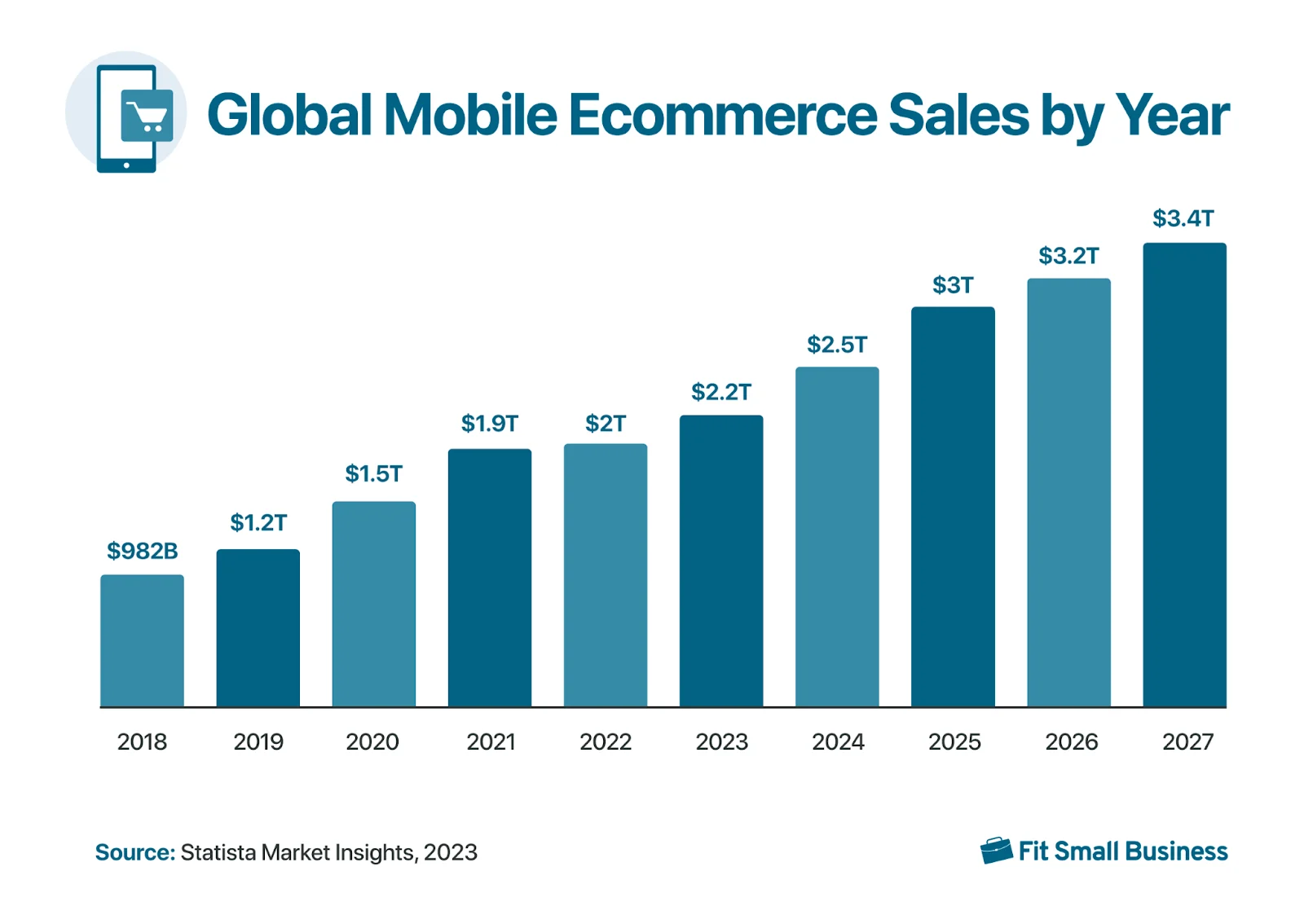
Ecommerce is increasingly surpassing in-person shopping, and with over 6 billion global smartphone users, businesses not optimizing for mobile are missing a crucial opportunity. mCommerce is now dominating as the largest segment of online shopping—meaning the mobile-first approach is no longer optional but a critical strategy for success. To keep up and stay competitive, businesses must prioritize mobile optimization and align with the latest mobile commerce trends to capture this growing market share.
2. Social Commerce
Social commerce is turning mobile-first social media platforms into shopping channels, with apps like Instagram, TikTok, and Facebook serving as a means for not just mobile marketing and discovery, but also for purchases. The market for these channels is rapidly expanding, with projections indicating that sales through social media platforms could reach $8.5 trillion by 2030.
It’s also an easily accessible channel for businesses, with ecommerce platform integrations readily available.
The biggest mobile commerce trends happening on social channels are:
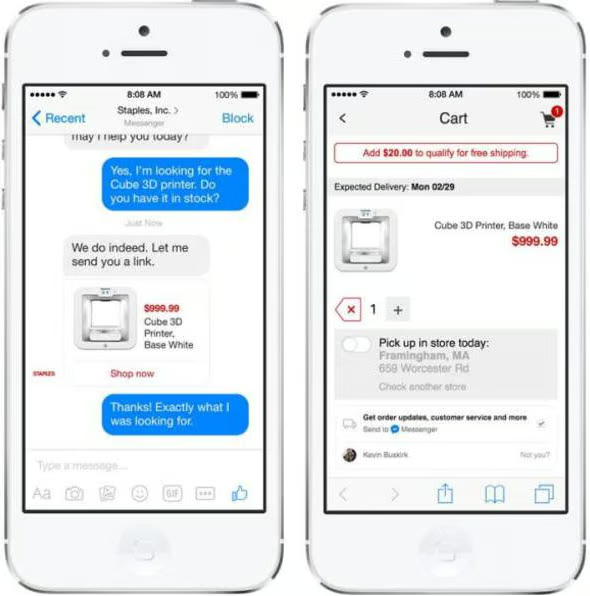
- Social messaging chatbots: Enhancing customer interaction with integrated purchasing options.
- Selling through stories: Leveraging the popularity of temporary content, brands now use stories to showcase products, enabling direct purchases with a simple swipe-up feature.
- Shoppable posts: Tagging products in posts simplifies the buying process, allowing customers to purchase at the moment of inspiration with just a few clicks.
- Livestream shopping: This emerging mobile shopping trend combines real-time interaction with instant purchasing, creating an immersive and engaging shopping experience.
3. Voice Shopping
Voice shopping is quickly growing, driven by the widespread use of mobile-equipped smart speakers and mobile voice assistants (like Siri, Bixby, and Google Assistant). This trend offers significant opportunities for retailers in the mobile space, with with key insights and statistics painting a compelling picture:
- Usage: As of 2023, there are 4.2 billion active voice assistant devices in circulation, with 1 billion voice searches occurring each month via mobile.
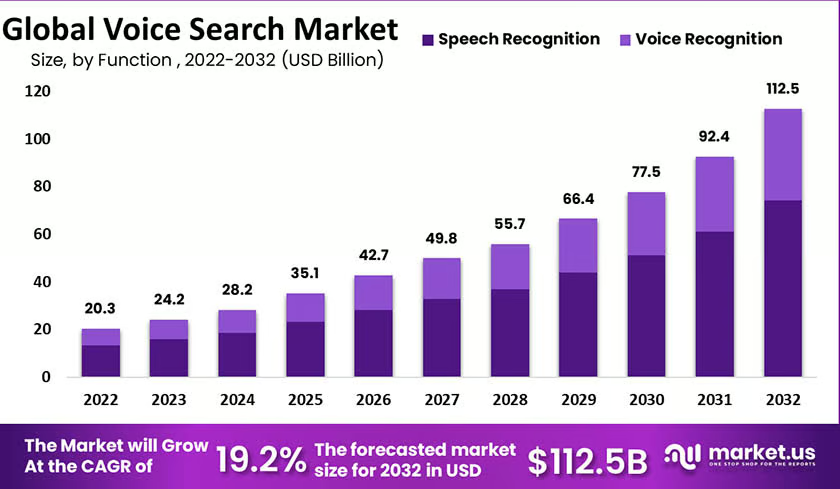
- Market share: The voice search market was valued at $20.3 billion in 2022, and is expected to reach $112 billion by 2032.
- Optimization: Around 80% of voice searches are predicted to be conversational by 2024, with specific keyword usage (like “best,” “easy,” “free,” “top,” “list,” etc.), changing the way retailers optimize their stores for online shopping search-engine visibility.
4. One-Click Ordering
One-click checkout, also known as one-click ordering, is a popular feature that allows customers to finalize their purchases in a single action, streamlining the traditional multi-step checkout process. By saving customer info and payment details through secure platforms such as Shop Pay and Paypal Express Checkout, it offers a quick and effortless transaction.
This convenience service has become one of the strongest mobile shopping trends thanks to its ability to to increase conversion rates— which is especially crucial in mCommerce, as mobile shopping cart abandon rates are the highest of any device at 85.65%.
Studies show that customers using one-click shopping tend to spend more, with a 43% increase in purchase frequency and a 36% rise in the number of items bought. Beyond its benefits to retailers, one-click checkout enhances the customer experience when using a small screen, and has cemented itself as part of modern consumer expectations.

5. Mobile Fraud
As overall ecommerce and mobile banking fraud is on the rise, mobile commerce faces unique challenges like unauthorized app transactions, fake mobile payment apps, and security vulnerabilities in mobile payment systems. According to a recent report, fraud executed from mobile devices has jumped from 47% in 2022 to 61% in 2023.
Retailers are now focusing on implementing advanced mobile-centric security solutions—such as two-factor authentication, biometric verifications like fingerprint and facial recognition, and encryption technologies specifically designed for mobile transactions. The use of AI and machine learning in detecting unusual transaction patterns and potential fraud on mobile devices is also becoming increasingly prevalent.
6. AI Chatbots
The popularity of AI-driven chatbots has revolutionized how customers interact with mobile commerce, providing a level of service that is both highly efficient and scalable.
In addition to answering questions, chatbots are becoming sophisticated enough to guide customers through the entire shopping process and gather valuable data about customer preferences and behaviors.
Chatbots are a practical tool for large corporations and small businesses alike. With prebuilt chatbot apps and chatbot frameworks available, any business can easily incorporate this technology into their mobile experience, making it one of the biggest emerging mobile shopping trends across the board.
7. Virtual Marketplace Apps
Popular marketplace apps, like Walmart, Temu, and eBay, are dominating the mobile scene, making their use an important mobile commerce trend for consumers and retailers alike. For example, Amazon’s mobile app is the No.1 most popular shopping app on the Google Play Store (and No. 2 on the Apple App Store) with 98 million users every month—offering a way for smaller businesses to generate more sales by becoming third-party sellers.
These apps appeal to users and sellers for several key reasons:
- Broad Audience Reach: Popular marketplaces attract a massive global audience that predominantly shops via mobile, providing retailers with immediate access to a wider customer base.
- Optimized Mobile Interfaces: With user-friendly and sophisticated mobile interfaces, these marketplaces offer a seamless shopping experience. Retailers benefit from this advanced technology without the need for extensive development on their part.
- Trusted Shopping Experience: The credibility and enterprise-level security of these platforms provide higher consumer confidence.
8. VR and AR
Augmented Reality (AR) and Virtual Reality (VR) are redefining mobile shopping by offering immersive and interactive ways for customers to engage with products—filling in the gap between the in-store and mobile shopping experience. The market size of these technologies was valued at 57.26 billion in 2023, and is expected to grow at a compound annual growth rate (CAGR) of 39.8% from 2023 to 2030.
AR in particular has become a powerful mobile commerce tool in reducing product returns and increasing conversions. By using their mobile device’s camera, this feature allows customers to visualize products in their own space before making a purchase. With mobile-first juggernauts like Amazon leading the AR/VR charge, it’s becoming crucial for other retailers to adopt this technology in order to stay competitive.

9. Omnichannel Strategy
An effective omnichannel strategy is crucial in today’s retail environment. Integrating traditional ecommerce with physical stores and mobile platforms—such as an app or social media account—provides a consistent and seamless shopping experience for customers. Retailers adopting this approach are seeing increased customer loyalty and spending.
Mobile apps, especially, are a vital part of the omnichannel approach. Apps allow retailers to have optimized user interfaces, personalized content, targeted marketing, and deeper customer relationships. Push notifications, for instance, offer a direct line of communication with customers at a 27.6% open rate, and lead to a purchase 28% of the time.
10. Data Collection & Personalization
Mobile data collection and data-driven personalization are helping shape consumers’ mobile shopping experience as well as retailers’ selling and marketing strategies.
Ecommerce stores and online businesses have long leveraged user data to understand customer interest, preferences, shopping habits, and buying patterns. Mobile commerce and mobile consumer behavior is a goldmine for this info, offering a deeper view into insights such as browsing habits, purchase history, in-app behavior, and search queries, as well as customer feedback and social media interactions.
These insights are invaluable in refining product offerings, optimizing site and app design, sharpening demographic targeting, and enhancing advertising campaigns. While data collection can be a point of contention for privacy advocates, shoppers often benefit from it by receiving a personalized shopping experience and customized suggestions.
Personalization is one of the biggest mobile shopping trends, with 62% of consumers saying that they expect it, and that a brand is likely to lose their loyalty if their experience is not personalized. At the same time, data collection is a controversial subject, with only 40% of consumers saying they trust brands to use their data responsibly and keep it safe.
Bottom Line
The landscape of mobile commerce is evolving rapidly, driven by technological advancements and changing consumer preferences. Retailers who embrace these mobile commerce trends are not only staying ahead in the competitive market but are also providing an enhanced shopping experience that meets the dynamic needs of modern consumers. The key to success in mobile commerce lies in being adaptable, customer-centric, and innovative.
