





.jpg?w=288)


Scrambled merchandising is a merchandising technique in which you mix unrelated or off-brand products into your store that are not associated with your original brand or product selection. The technique is most often used to test out the introduction of new products, reach new customers, offset seasonal slumps, and meet unmet demands in your target market.
In this guide, we will look into the pros and cons of the scrambled assortment technique, a few use cases and examples, as well as the most frequently asked questions.
Pros & Cons of Scrambled Assortments
Traditional merchandising techniques say that you should create cohesivity and a clear brand image with your product selection and display. So, why would mixing in outside products be a good idea?
You are certainly correct to think that a scrambled assortment goes against more traditional merchandising sensibilities, but that disruption is exactly why people use a scrambled product assortment.
| PROS | CONS |
|---|---|
| Increases sales | Risk of skewing brand image |
| Draws shopper attention | Potentially confusing to customers |
| Creates interest | Can create false expectations of your store’s offerings |
| Allows you to attract new customers | Can create merchandising challenges |
| Creates a sense that scrambled products are limited, increasing demand | Can create product knowledge challenges for associates, which can lead to poor customer service |
| Can become a gateway to expand your brand | |
| Allows you to explore adding different products with limited risk | |
Through the addition of new, eye-catching products, scrambled assortment merchandising has the potential to increase your sales by attracting new customers and meeting a demand you may not yet have met. Additionally, this merchandising technique lets you experiment with new offerings with limited investment or risk, as you typically will not make a large investment in new products upon first introduction. This limited stock can also create a sense of limited supply, which can boost demand even more. Additionally, if the new products prove successful, scrambled assortments can give you the opportunity to expand your brand.
However, there are some pitfalls of a mixed merchandising scheme as well. It can cause your brand image to become muddled, creating false expectations and confusion for shoppers.
And, it can be tricky for your associates to accommodate as well, creating merchandising challenges as they have to accommodate new stock and difficulties in keeping up with product knowledge, which can impact their ability to deliver customer service.
When to Use Scrambled Merchandising
While a scrambled assortment can reap a lot of benefits, the strategy should be used at the right time if you want to avoid potential pitfalls. But, when is that “right time?”
- If you are expanding your brand: If you are considering expanding your brand, say from an apparel store to an apparel and home store, scrambled merchandising can be a great place to start. It gives you the ability to mix in a few new items to get a feel for how they will be received before taking on the total rebrand. In this case, scrambled assortments are also a great tool to ease people into a brand shift without going from zero to one hundred.
- If there is a major event: You can also use scrambled assortment to mix in new products that are associated with an event or major happening. During the Super Bowl season, for example, you might sell jerseys, seat covers, and foam fingers even if your store does not typically sell sporting goods.
- If you discover a hole in the market: If you find that your customer base is looking for something that neither you nor your competitors are selling, scrambled assortments are a great way to start adding that item to your store. For example, when my store started mixing in candles into our product selection, it was because a customer had complained that there were no good places to buy gifts, only clothes, in our neighborhood. We introduced candles, which became a staple for gift shoppers in our locale.
- If you need to reach a new customer base: If you are looking to expand your customer base without losing your original shoppers, you can use scrambled merchandising to draw in new shoppers while retaining the old.
- If you are struggling with seasonality: If you struggle with meeting your sales goals at certain points in the year, you can use scrambled assortment to boost sales during those periods.
- If you want to capitalize on a trend: If you can get your hands on a viral or trending product, it will almost be guaranteed to sell. Using scrambled assortments, you can mix in those random viral products without worrying about traditional merchandising anxieties of cohesivity.
Scrambled Assortments Uses & Examples
Let’s take a look at scrambled merchandising in action to get a better sense of how it works in practice and the ways it can impact a business.
Clothes, Accessories & Reusable Egg Cartons
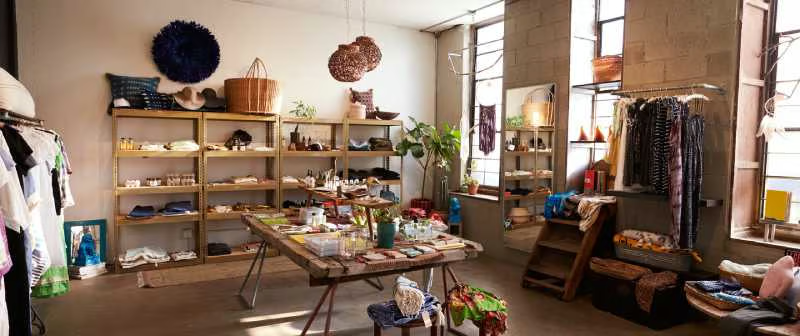
Boulder, Colorado, is known as a place where outdoor enthusiasts thrive and sustainability is a major cultural force. A local clothing store, known for its boho-inspired clothes and accessories, knew it had an environmentally-conscious customer base. So, when the owner was growing frustrated at the number of egg cartons she was throwing away each month, she assumed her customers were too.
In response, she introduced reusable egg cartons that people could take to their markets or use at their home farms (pictured on the left middle shelf) into her store. The owner quickly learned that these cartons were meeting an unmet demand, and they have since become a bestseller.
Fidget With It
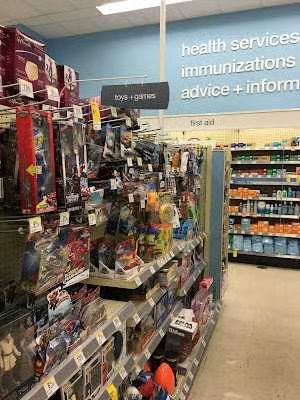
We all remember when fidget spinners hit the market in the late twenty-teens, and every kid under the age of 19 had one whirring around in their hands at all times. My local grocery store noticed this, too, and saw an opportunity. At the time, the store only sold food, cleaning supplies, and a small selection of personal care products. But, when fidget spinners became all the rage, they introduced the small toy to their product selection.
Because the grocery was the only store in town with fidget spinners—or any children’s toys—available, the small gadgets flew off the shelves. With this success, my local store created an entire toys and games section. From there, they continued to experiment with different product categories and are now a true one-stop-shop for toys, toiletries, outdoor gear, food, home decor, and more—all because they decided to try scrambled assortments.
Frequently Asked Questions (FAQs)
Click through the questions below to get answers to some of your most frequently asked scrambled merchandising questions.
How are scrambled assortments different from other merchandising techniques?
Whereas typical merchandising strategies strive to create cohesion and a consistent brand image, scrambled merchandising seeks to disrupt this by introducing unexpected and “off-brand” merchandise in such a way that will boost sales and even expand your brand.
How does scrambled merchandising increase sales?
Scrambled merchandising increases sales by attracting new customers, drawing people’s attention, and inspiring people to buy items they wouldn’t typically get from you.
What kinds of businesses use scrambled merchandising?
Small and large retailers alike use scrambled merchandising—it is an effective strategy for anyone looking to boost sales or expand their brand.
Bottom Line
While scrambled merchandising seemingly goes against the aims of traditional merchandising strategies, it is nonetheless a great technique to boost sales, expand your brand, and reach new customers. Scrambled assortments should be used wisely, at a time that makes sense for your business. They can allow you to capitalize on unmet needs, cultural moments, and slow sales periods.
