Lea Uradu, J.D.

Lea Uradu, J.D.

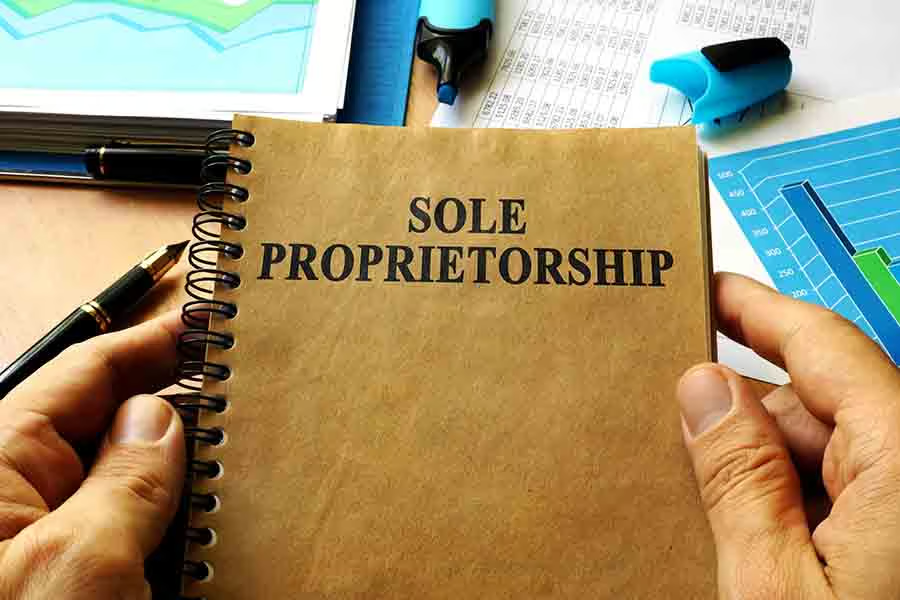
A person holding a notebook with a sole proprietorship written.
What Is a Sole Proprietorship? (+ Examples)

A sole proprietorship is a small, unincorporated business run by a single person. This business structure is easy to set up and doesn’t require much paperwork. The entity does not exist apart from the owner, so if you start one, then you can use your first and last names as your business name or adopt…

Jun 15, 2023
Gorgeous woman in formal attire holding a tablet.
How to Get an Employer Identification Number (EIN)

An employer identification number (EIN) is a unique nine-digit number that identifies your small business when you file taxes, open a business bank account, get a business loan, or perform other business activities. Obtaining an EIN is free, and you can apply for it online, by fax, or by mail if your business is in…

Jun 14, 2023
how_do_i_pay_myself_from_my_business
How Do I Pay Myself From My Business?

How you pay yourself as a business owner depends largely on your business’s structure. Sole proprietorships and partners can just take money from the business account, but S Corporation (S-corp) and C Corporation (C-corp) owners must pay themselves for any services performed through payroll. The drop-down menu below lets you choose your entity type to…

Jun 8, 2023
Featured Image for Rental Property Repairs vs Improvements
What Is a Repair vs Improvement on a Rental Property?

Before you make changes to your rental property, you need to first figure out if the change is a repair or an improvement. You need to know this because each has its own tax handling, which will have an effect on your bottom line: Repairs are a major rental property deduction and keep the rental…

Jun 2, 2023
Featured Image of IRS Hobby Loss Rules
IRS Hobby Loss Rules & Tips To Avoid Them

An IRS-designated hobby loss is a loss from an activity that the IRS classifies as more of a hobby than a business. In general, a trade or business is an activity conducted for the purpose of making a living or profit. The IRS may presume that an activity is a hobby if it has not…

Jun 2, 2023
Featured Image of At-Risk Rules for Rental Properties & Schedule C Businesses
At-risk Rules for Rental Properties & Schedule C Businesses

The at-risk rules limit your ability to deduct losses from your business activities. With these rules in place, the losses you may deduct on your individual tax return are limited to your investment in the company. The most common scenario that might result in a disallowed loss under the at-risk rules is if you invest…

Jun 2, 2023
Featured Image of Qualifying Business Income Deduction
What Is the 20% Pass Through Deduction (QBID) & Who Qualifies?

The qualifying business income deduction (QBID) lets pass-through entities take 20% off of their qualified business income (QBI); it essentially reduces the amount of QBI exposed to taxation. For the purpose of this deduction, QBI is the net amount of qualified income, gain, deduction, and loss from any qualified trade or business, including income from…

May 30, 2023
Featured Image of What it Means to Materially Participate
What It Means to Materially Participate & the Passive Activity Loss Rules

The term “material participation” is used to describe your involvement in a business activity. Generally speaking, you materially participate in an activity if you’re involved in the operation of the activity on a regular, continuous, and substantial basis. If you meet these requirements, any losses from the activity are not limited by the passive activity…

May 17, 2023
WOTC file placed on top of the table.
What Is the Work Opportunity Tax Credit (WOTC)?

The Work Opportunity Credit (WOTC) is a federal tax credit for employers who hire and pay people who are having trouble getting into the workforce. The credit is usually equal to 40% of the qualified first-year wages of employees who worked at least 400 hours. The credit is reduced to 25% of the qualified first-year…

May 2, 2023
Small business tax credt on computer screen.
7 Small Business Tax Credits That Your Company May Qualify For

Business tax credits can be a powerful tool for small businesses to lower their tax bill directly. If you’re eligible for any of the tax savings credits—such as Work Opportunity Tax Credit, Employer Credit for Payroll Taxes Paid on Employee Tips, Employer Credit for Paid Family & Medical Leave, and Disabled Access Credit—you’ll likely need…

Apr 28, 2023
A disabled worker is shaking hands with his employer.
How To Claim the Tax Credit for Hiring Disabled Workers

The Work Opportunity Tax Credit (WOTC) is a tax incentive offered to employers who hire disabled workers. The maximum amount of credit that you can claim is $2,400, depending on when the employee was hired and how long they worked for you during the tax year. This powerful tax savings tool is set to expire…

Apr 27, 2023
Tax credits.
How To Claim the Tax Credit for Hiring Unemployed Workers

Employers can get a tax credit called the Work Opportunity Tax Credit (WOTC) of up to $2,400 per employee if they hire people who have been out of work for a long time. For this credit, a person is considered to have long-term unemployment if they have been out of work for at least 27…

Apr 26, 2023
Fit Small Business Logo

Our mission is to provide small business owners with the information you need to succeed. Learn how to start, market, run, and grow your business today!

Property of TechnologyAdvice. © 2026 TechnologyAdvice. All Rights Reserved

Advertiser Disclosure: Some of the products that appear on this site are from companies from which TechnologyAdvice receives compensation. This compensation may impact how and where products appear on this site including, for example, the order in which they appear. TechnologyAdvice does not include all companies or all types of products available in the marketplace.