





I evaluated more than 20 POS systems across pricing, payment processing, checkout tools, inventory, reporting, hardware, ease of use, and support. Square is my top choice for most small businesses because it has no monthly starting fee, works for several business types, includes built-in payment processing, and gives new businesses room to add features as they grow.
However, Square is not the best choice for every business. Shopify POS is better for businesses selling online and in person, Toast is built specifically for restaurants, Helcim can be more economical for businesses processing higher card volumes, and Lightspeed offers much deeper inventory management.
- Best POS systems at a glance
- Best POS systems compared
- How I chose the best POS systems for small businesses
- Square: Best POS system for small business 2026 (and best free)
- Shopify POS: Best POS for multi-location and ecommerce retail
- Toast: Best restaurant POS
- Helcim: Best for low-cost payment processing and transparent pricing
- GoDaddy POS: Best in-person flat-rate pricing
- KORONA POS: Best payment processor-agnostic POS
- POS Nation: Best for selling age-restricted products
- Clover: Best for mobile sales
- Lightspeed Retail: Best for inventory management
- Methodology: How I evaluated the best POS systems for small businesses
- How much does a POS system cost?
- How to choose the best POS system for your business
- Find POS options by industry
- Bottom line
Best POS systems at a glance
Vendor | Best for | Software fee starting price (/month) | Card-present transaction fee | Minimum hardware Cost |
| Square | Best overall and best free | $0 | 2.6% + 15 cents | $59; iPhone card reader |
| Shopify POS | Multi-location and ecommerce | $5 | 2.4%-2.6% + 10 cents | $49; iPhone card reader |
| Toast | Restaurants | $0 | 2.49% + 15 cents | $0; Pay-as-you-go plan |
| Helcim | Low-cost payment processing and transparent pricing | $0 | Interchange-plus processing | $0; Tap to Pay, $99 card reader |
| GoDaddy POS | In-person flat-rate pricing | $0 | 2.5% (Standard), 2.3% (Plus Plan) | $0; Tap to Pay or $99 card reader |
| KORONA POS | Payment processor-agnostic POS | $59 | Depends on processor | Custom |
| POS Nation | Age-restricted businesses | $49 | Depends on processor | Custom |
| Clover | Mobile sales | $0 | 2.3% + 10 cents | $279; Compact terminal |
| Lightspeed | Inventory management | $109 | 2.6% + 10 cents | Custom |
Best POS systems compared
Provider | My expert rating (out of 5) | Offline mode | POS hardware options* | Multi-location support |
| Square | 4.6 | Yes | Excellent, affordable | Yes |
| Shopify POS | 4.52 | Limited | Excellent, affordable | Yes |
| Toast | 4.26 | Yes | Excellent for restaurants | Yes |
| Helcim | 4.2 | Limited | Limited | Yes |
| GoDaddy POS | 4.11 | Limited | Basic | Limited |
| KORONA POS | 4.09 | Yes | Basic | Yes |
| POS Nation | 4.07 | Yes | Limited | Yes |
| Clover | 4.05 | Yes | Excellent; expensive | Yes |
| Lightspeed | 4.0 | Yes | Good | Yes |
*Hardware options:
- Excellent: Wide range of proprietary and third-party hardware options
- Affordable: Solid selection with competitively priced devices
- Limited: Few supported devices, hardware sold separately
- Basic: Minimal hardware support suitable for simple setups
Which POS system should you choose?
Choose Square if you want an affordable system that is easy to set up and can handle retail, services, appointments, food service, mobile sales, and ecommerce without requiring a monthly software subscription.
Choose Shopify POS if ecommerce is a major part of your business and you want online orders, customers, inventory, and store sales managed through the same platform.
Choose Toast if you operate a restaurant and need tools for menus, tableside ordering, kitchen workflows, tipping, online ordering, and delivery.
Choose Helcim if payment processing costs matter more to you than having advanced retail or restaurant tools. Its interchange-plus pricing and automatic volume discounts can become more attractive as processing volume increases.
Choose Lightspeed Retail if managing inventory is your biggest challenge. It offers deeper product, vendor, purchase order, and multi-location inventory tools than simpler systems.
Choose Clover if you want portable hardware and more choice in how you buy your POS and payment processing services.
Choose KORONA POS if choosing your own payment processor is a priority or your business needs a processor that supports an industry Square or Shopify may not accept.
Choose POS Nation if you sell age-restricted products and need built-in ID verification and specialized inventory controls.
Choose GoDaddy POS if you already use GoDaddy for your website or online store and want a simple, inexpensive way to add in-person payments.
How I chose the best POS systems for small businesses
I evaluated more than 20 POS systems based on pricing, checkout tools, payment processing, inventory management, reporting, ease of use, support, and overall value for small businesses. I also reviewed user feedback, tested or demoed products when available, and drew from my firsthand experience using POS systems in retail and ecommerce settings.
My final recommendations prioritize systems that are easy to set up, reliable during daily operations, and practical for different business types, including retail stores, restaurants, ecommerce sellers, mobile businesses, and service providers. Learn more about my methodology below.
Why you can trust Fit Small Business
I have over three years of experience evaluating point-of-sale systems and more than a decade working with small businesses, particularly ecommerce merchants. For this guide, I tested as many systems as I could and pulled from my firsthand experience working in small businesses. We also regularly demo many of these systems with the company product teams to stay abreast of new features.
Our team regularly updates and fact-checks this piece to provide the latest information.
Square: Best POS system for small business 2026 (and best free)
Why I chose Square
Square is the POS I would recommend first to most small businesses because it removes many of the barriers that make adopting a POS expensive or difficult. There is no monthly fee for the base software, setup is straightforward, and one account gives you POS, payment processing, basic inventory, reporting, customer tools, and an online store.
Square also works across more business types than most competitors. Its dedicated retail, restaurant, and appointment tools let a business start with a simple setup and add more specialized features later.
The main limitation is payment processing. Square requires Square Payments, so businesses cannot shop around for another merchant account or negotiate with competing processors. Its flat-rate pricing is easy to understand but can also become less economical as card volume increases.
Best for: New and small businesses that want a low-cost POS with minimal setup.
Do not choose Square if: Choosing your own payment processor or negotiating processing rates is a priority.
On top of being my top pick for best overall POS system, Square is also featured prominently in several of my industry-specific buyer’s guides, including:
Square standout features
- AI assistant: Square AI, a conversational assistant, is built into the Square Dashboard. US-based sellers can ask natural-language questions about sales, staff, customers, and transactions to get instant insights — no reports required.
- Forever-free plan: Square is free to sign up, free to use, and doesn’t impose any limits on sales, products, or users.
- User-friendliness: Its touch-screen, app-based software is intuitive for business owners and employees alike, ensuring fast training and smooth transactions.
- Scalability: Square offers an entire ecosystem of business software, including payroll, marketing, and more, available as modular add-ons so you can add what you need when you need it.
- Popular and affordable hardware: Square regularly makes our lists of the best credit card readers and leading POS cash registers. Its systems offer great value for what you pay and are widely available from major retailers.
Square pricing
- Monthly software fees: $0-$149, depending on the POS version and plan tier
- Installation fee: None. Setup is do-it-yourself with guided onboarding resources
- Contract length: Month to month; no long-term commitment required
- Payment processing fees:
- In-person: 2.6% + 15 cents
- Online: 2.9% + 30 cents
- Keyed-in: 3.5% + 15 cents
- Custom rates available for businesses processing over $250,000 annually.
Square POS only works with Square Payments. When you sign up for a free Square account, you’re automatically enrolled in both the POS platform and its integrated payment processor. This makes the setup seamless, but it also means you can’t choose your own processor.
You can expand your system with optional add-ons for marketing, payroll, shift scheduling, loyalty programs, and team messaging.
Important note: Square does not support high-risk businesses, with the exception of CBD merchants on a limited, case-by-case basis. If you’re in a high-risk industry or want the flexibility to use your own payment processor, consider alternatives like Lightspeed, Clover, or KORONA.
Square POS hardware
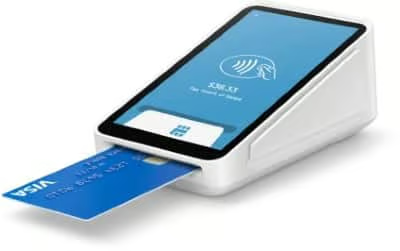
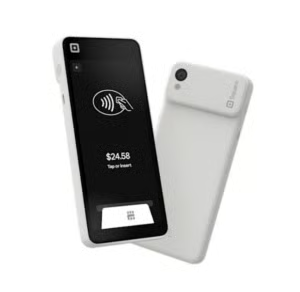
Square provides both mobile devices for on-the-go sales and all-in-one registers for countertop checkout.
Square mobile hardware
| Device | Price | Best for |
|---|---|---|
| Square Terminal (contactless + chip) | $299 or $27/month for financing | Simple card and digital wallet payments via phone or tablet |
| Square Handheld | $399 or $37/month for financing | Mobile checkout and tableside orderingt |
Square countertop registers
| Device | Price | Best for |
|---|---|---|
| Square Stand | $149 or $14/month for financing | Compact all-in-one for small counters |
| Square Register | $899 or $44/month for financing | Full countertop POS with dual screens for staff and customers |
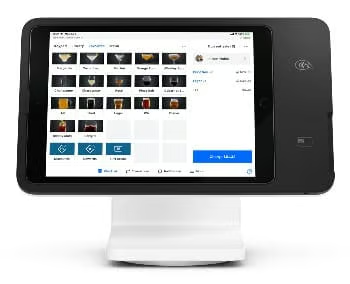
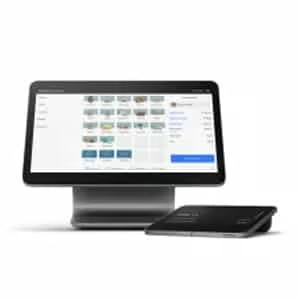
In addition to the hardware options above, you can download the Square app on any iPhone or iPad and key in payments or connect a card reader.
Square POS comparisons
Want to see how Square stacks up against other POS systems? Check out some of our most popular comparison articles:
Want to learn more about what it’s like using Square as a POS system? Check out our full Square Register video review:
Shopify POS: Best POS for multi-location and ecommerce retail
Why I chose Shopify POS
Shopify POS is my top choice for retailers that treat ecommerce and physical stores as one business rather than separate sales channels.
Inventory, orders, products, customers, and sales remain connected between Shopify's ecommerce platform and its POS. This makes functions such as local pickup, returns across channels, shipping an unavailable store item to a customer, and tracking inventory across locations much easier to manage.
For a business that already runs on Shopify, the decision is particularly easy because Shopify POS is built into the same platform. Businesses that need its deeper in-store tools can add POS Pro for $89 per location.
The trade-off is cost. Shopify makes the most sense if you will actually use its ecommerce features. A business that sells only from one physical location can usually get comparable basic POS functions for less elsewhere.
Best for: Retailers selling through a website, physical stores, social channels, and other connected sales channels.
Do not choose Shopify POS if: You do not need Shopify ecommerce or want to use a different payment processor for in-person sales.
On top of being my top pick for retail and ecommerce, Shopify is also included in several of my industry-specific buyers’ guides for its flexibility across business models, including:
Shopify POS standout features
- Redesigned POS interface: A cleaner layout with a new vertical sidebar makes navigation faster and more intuitive for retail staff.
- Context-aware smart search: Search adjusts to the active screen (e.g., products, orders, customers) and tolerates typos, helping staff find what they need quickly.
- Ship-and-carryout checkout: Customers can take home available items and have the rest shipped — processed in a single transaction.
- Branded POS theming: Add logos, brand colors, and videos to idle and PIN entry screens to create a consistent in-store experience.
- Smarter checkout moments: Staff can issue store credit, offer SMS marketing opt-ins, and apply automatic cash rounding — all within the POS.
- Smart inventory: Real-time, cross-channel and location visibility, low stock reports, demand forecasting, inventory analysis, purchase orders and receiving, markdown suggestions, and more.
- Omnichannel sales: One central data center for all sales lets you offer customer experiences like in-store pickup, buy online exchange in-store, local delivery, and more. Plus, you can access ecommerce tools, like order fulfillment, directly from the POS.
- Social media selling: Shopify has partnerships with most social media platforms, including Facebook, Instagram, TikTok, and Pinterest, making it easy to sync your product catalog and sell to customers directly on those channels.
- Robust register tools: Shopify POS is feature-rich, with customizable tiles and layouts, optional checkout validation, buy now, pay later (BNPL) payments, customizable payment types such as IOUs, customizable receipts, returns, and exchanges, and more.
Of course, one of the best parts of using Shopify POS is that it syncs seamlessly with your Shopify online store.
Shopify POS pricing
- Monthly software fees:
- POS: $5-$89 per location
- Ecommerce (optional): $39-$399
- Shopify Lite POS is included with any ecommerce plan, but if you operate a physical store, we recommend upgrading to POS Pro at $89/month for full retail functionality.
- Installation fee: None. Setup is self-guided with Shopify’s DIY onboarding tools.
- Contract length: Choose between month-to-month, annual, or multiyear subscriptions.
If you use Shopify POS, you’ll also need to use Shopify Payments, the platform’s built-in payment processor. This integration simplifies setup and compliance, with standard industry rates:
- In-person transactions: 2.4% + 10 cents to 2.6% + 10 cents
- Online transactions: 2.5% to 2.9% + 30 cents
Shopify Payments includes PCI-compliant servers and encrypted data handling. Learn more in our Shopify Payments review.
If you also run a Shopify online store, you can technically use a third-party payment processor for ecommerce — but you’ll pay an extra transaction fee. For in-person sales through Shopify POS, Shopify Payments is required. Learn more about Shopify fees and how much it costs to run your business using Shopify.
Important note: Shopify POS isn’t compatible with high-risk businesses. Like Square, Shopify uses aggregated payment services, which means merchants don’t get a dedicated merchant account. As a result, Shopify tends to restrict industries with elevated risk. If your business falls into that category, consider an alternative like KORONA, Clover, or Lightspeed, which allow you to choose your own processor.
Shopify POS hardware
Shopify provides mobile devices for simple checkout and all-in-one registers for full retail setups. Card readers, iPad stands, and other accessories like cash drawers and barcode scanners can all be purchased through Shopify, including the following:
| Tap and Chip Reader | Shopify Terminal | Countertop Kit |
|---|---|---|
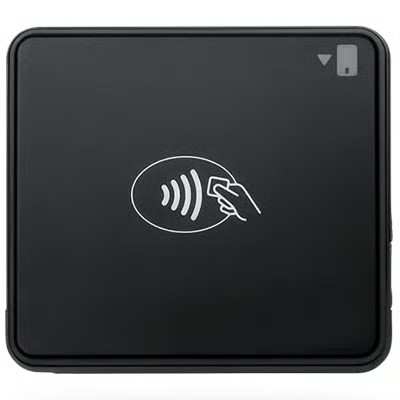 | 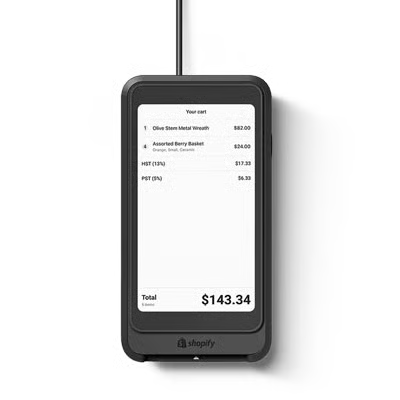 | 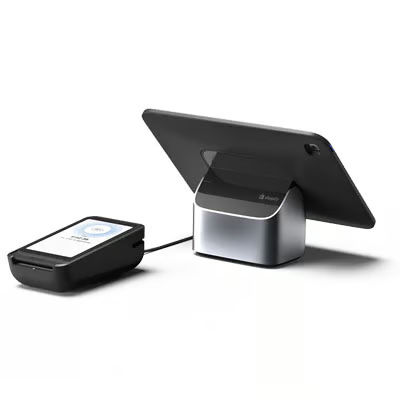 |
| Securely accept tap, chip, and swipe payments, all fully integrated with Shopify POS. Available for iOS only. Dock available for $40 (in-store use) | Customer-facing display and card reader meant to be paired with a tablet POS. | Tablet stand and card reader terminal for a full countertop setup. Options available for Android and iOS (tablet sold separately). |
| Buy Tap and Chip Reader | Buy Shopify Terminal | Buy Countertop Kit |
Shopify POS is app-based and works on iOS and Android devices, including iPhone 7 or higher, iPad Air Gen 2 or higher, iPad Gen 5 or higher, iPad mini Gen 4 or higher, all iPad Pro models, and Android devices running version 10.0 or higher.
Want to see Shopify POS in action? Check out our setup tutorial:
Toast: Best restaurant POS
Why I chose Toast
Toast is a restaurant-first POS system that combines industry-specific functionality with flexible pricing options. It offers a free starter POS — it is second to Square in our picks for best free POS software — and pay-as-you-go hardware, making it ideal for new restaurants with limited budgets. At the same time, it supports growth with built-in tools for online ordering, delivery, loyalty, marketing, kitchen display systems, and employee management.
While you’re locked into Toast’s payment processing and a two-year contract, the system’s ease of use, durable hardware, and guest-focused features make it a smart choice for foodservice businesses.
Toast covers nearly every restaurant workflow from tableside ordering to delivery integration. While its costs and hardware lock-in can be drawbacks, Toast remains the leading choice for restaurants because it simplifies operations, speeds up service, and integrates front-of-house and back-of-house management in one system.
Best for: Restaurants, cafes, bars, food trucks, and other food-service businesses.
Do not choose Toast if: You want month-to-month service, your own payment processor, or hardware that can easily move to another POS platform.
Toast is also our top choice for the following:
Toast standout features
- ToastIQ intelligence suite: AI-powered insights like upsell suggestions, shift summaries, and digital chits
- Built-in advertising and marketing automation: Launch cross-channel campaigns directly from the POS, using AI to optimize timing and targeting
- Free baseline POS system: Toast’s starter plan includes cloud-based POS software and a single-terminal hardware kit with $0 upfront and $0 monthly cost.
- Pay-as-you-go hardware: Restaurants can scale their setup affordably with flexible hardware financing tied to payment processing.
- Restaurant-specific payroll management: Built-in tools to manage tips, wages, and compliance for foodservice teams.
- Comprehensive online ordering and delivery tools: Native support for branded online ordering, delivery tracking, third-party app integration, and mobile ordering.
- In-depth customer information and in-house dining tools: Capture guest data, manage table service, and offer loyalty rewards from the same system.
- Mobile app reporting functionality: Real-time performance insights from Toast’s mobile app, including sales, labor, and order trends.
- Multilingual settings: Select features and kitchen tickets can be displayed in English, Spanish, or Chinese for multilingual teams.
- Benchmark reporting: As of 2024, Toast’s new Benchmarks tool compares your restaurant’s performance to similar businesses across its 127,000+ user network.
Toast pricing
- Monthly software fee: $0-$69, or custom pricing for complex setups
- Installation fee: Optional, starting at $250 for professional installation
- Contract length: Two-year standard agreement.
- Processing fees:
- In-person
- Pay-as-you-go: 3.09% + 15 cents
- Standard plan: 2.49% + 15 cents
- Online
- Pay-as-you-go: 3.09% + 15 cents
- Standard plan: 3.50% + 15 cents
- Custom rates are available for high-volume businesses
Toast uses its own built-in payment processor, Toast Payments, which is required to use the POS. It supports tableside, online, kiosk, and counter payments, and includes security features like encrypted transactions, fraud monitoring, offline mode, and fast deposits.
You can customize your POS with modular add-ons for payroll, mobile ordering, team scheduling and communication, marketing, digital storefronts, and accounting integrations.
While Toast’s processing rates are on the higher side compared to other systems on this list, the depth of features and restaurant-specific functionality still make it a strong value overall.
If lower processing fees are a priority, consider Square for Restaurants. If you prefer going with more flexible payment processor options, Lightspeed Restaurant and Clover offer more control over processing partners.
Toast hardware
All of Toast’s hardware is industry-grade and IP-rated to withstand steam and dust intrusion. Toast handheld terminals, including the popular Toast Go 2, are drop-tested to withstand a restaurant environment.
| Countertop Terminal | Handheld Mobile POS | Guest Self-service Kiosk |
|---|---|---|
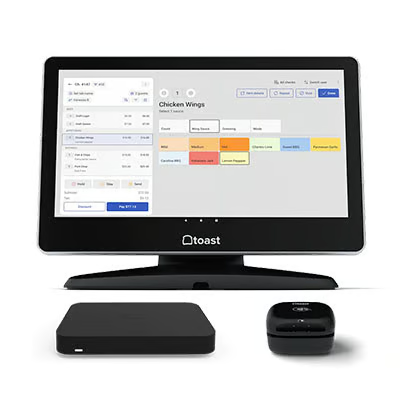 | 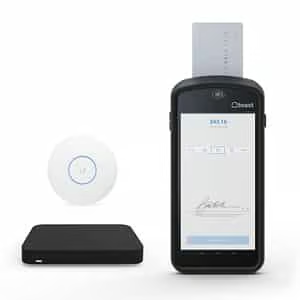 | 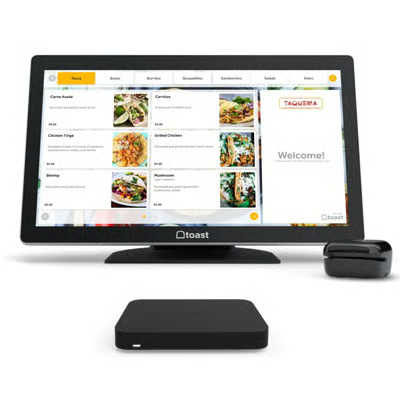 |
| Pay upfront: $1,024.20 + $69 per monthOrPay-as-You-Go: $0 and 3.09% + 15 cents per in-person transaction | Pay upfront: $799.20 + $69 per monthOrPay-as-You-Go: $0 and 3.09% + 15 cents per in-person transaction | Pay upfront: $1,339.20 + $99 per monthorPay-as-You-Go: $0 and 3.09% + 15 cents per in-person transaction |
| Countertop Terminal, Toast Tap card reader, Router | Toast Go 2 order and payment device, Wireless Access Point, Router | 22” touch-screen kiosk with router and card reader |
Want to learn more about what it’s like using Toast as a POS system? Check out our full Toast POS video review:
Helcim: Best for low-cost payment processing and transparent pricing
Why I chose Helcim
Helcim approaches POS from the payment-processing side. Instead of charging a monthly POS software fee and a flat processing rate, it provides the POS software for free and uses interchange-plus payment pricing.
This makes Helcim particularly interesting for established businesses where processing fees account for a larger share of operating costs. Rates decrease automatically as volume increases.
Helcim also includes invoicing, recurring billing, a virtual terminal, customer management, and basic POS functionality at no additional monthly cost. That combination works especially well for B2B and service businesses that take payments through several methods.
The trade-off is the POS itself. Retail inventory, restaurant workflows, hardware choices, and third-party integrations are more limited than those available from Square, Shopify, Toast, or Lightspeed.
Best for: B2B companies, service businesses, professionals, and merchants processing enough card volume for interchange-plus pricing to matter.
Do not choose Helcim if: You need advanced retail inventory or restaurant management tools.
Helcim pricing
- POS software: Free
- Monthly fees: None
- Payment processing: Interchange-plus pricing (rates vary by card type and volume)
- Volume discounts: Applied automatically as processing increases
- Contracts: No long-term commitment
- Surcharging: Enabled by default for all merchant accounts
Helcim’s pricing structure is designed to keep costs predictable and competitive, especially for businesses processing higher volumes.
Helcim standout features
- Free invoicing and recurring billing: Native tools included at no extra cost.
- Virtual terminal: Process card-not-present payments without additional fees.
- Fee optimization tools: Automatic volume discounts and interchange-plus pricing.
- PCI compliance guarantee: Helps reduce compliance burden for small businesses.
- Service-focused integrations: Tools built with professional service workflows in mind.
Helcim hardware
| Helcim Card Reader | Helcim Smart Terminal |
|---|---|
 | 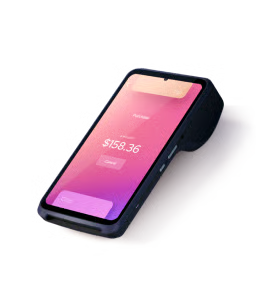 |
| $199 | $349 or $32/month for 12 months |
| Compact EMV and contactless card reader for in-person payments on a counter or portable setup. | Full featured countertop terminal with chip, swipe, and contactless support — ideal for service counters and retail checkouts. |
GoDaddy POS: Best in-person flat-rate pricing
Why I chose GoDaddy POS
GoDaddy POS makes the most sense for businesses already using GoDaddy for their website or online store. It gives these merchants a simple way to add in-person payments without adopting a separate ecommerce and POS platform.
The free Standard plan includes basic POS functions and GoDaddy Payments at 2.5%. The $34.99 Plus plan lowers the in-person processing rate to 2.3% and adds inventory alerts, employee management, pickup ordering, and other tools.
Its weakness is depth. Inventory, reporting, hardware, and multi-location features do not match systems such as Shopify or Lightspeed.
Best for: Small sellers already using GoDaddy that need straightforward in-person checkout.
Do not choose GoDaddy POS if: You expect to need advanced inventory, reporting, or multi-location management.
GoDaddy POS pricing
GoDaddy POS offers two software plans:
- Standard plan: Free with purchase of GoDaddy hardware. Includes built-in POS features like product setup, basic inventory tracking, and access to GoDaddy Payments at a flat 2.5% rate (no per-transaction fee).
- Plus plan: $34.99 per month. Adds advanced features such as lower payment processing fees (2.3% flat rate), inventory stock alerts, online ordering with in-store pickup, employee management, and customizable digital receipts.
- Surcharge option: Merchants can offset fees with GoDaddy’s compliant surcharge program, reducing processing fees to as low as 0% for in-person credit card transactions.
Both plans come with no contract and a 30-day money-back guarantee.
GoDaddy POS standout features
- Offline + online sync: Track and fulfill online orders in store with a unified product catalog.
- Built-in POS software: Easy barcode setup, modifiers, and pre-set discounts.
- Inventory and order management: See stock by channel and place orders directly from the terminal.
- Customization tools: Configure discounts, roles, permissions, and branding (logos, receipts, icons).
- Add-ons and integrations: Access third-party tools for loyalty, employee management, and time tracking.
- 24/7 support: Moreover, merchants processing over $100K/year get personalized onboarding at no extra cost
- AI tool (Airo): GoDaddy also offers an AI assistant for merchants called Airo. During their product demo with our team, they showed us how it can help set up products, pricing, and reports within the admin dashboard.
GoDaddy POS hardware
All devices listed below include free two-day shipping, a one-year warranty, and a 30-day money-back guarantee. GoDaddy POS also has the Tap to Pay (free) feature, which lets you accept contactless payments directly on a smartphone.
| GoDaddy Card Reader | Smart Terminal | Smart Terminal Flex |
|---|---|---|
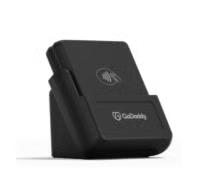 | 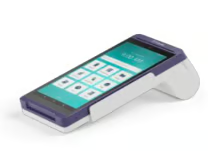 | 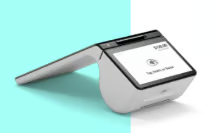 |
| $99 | $299 | $499 |
| Take mobile payments via app | Single (6 in.) touchscreen and compact design | All-in-one dual-screen device (8” merchant screen and 5” customer screen) |
KORONA POS: Best payment processor-agnostic POS
Why I chose KORONA POS
KORONA is a highly flexible, cloud-based POS that supports nearly any type of retail business. Unlike most systems, KORONA is payment processor-agnostic, giving businesses the freedom to choose the most affordable or industry-compliant provider.
It includes built-in ID scanning, loss prevention features, and ticketing tools — making it ideal for niche retail and venue-based operations. Hardware compatibility is also broad, allowing many businesses to use existing equipment. KORONA also integrates with QuickBooks and earned top marks in our retail and specialty POS rankings for affordability, versatility, and customer support.
Best for: Retailers that want control over their payment processor or need specialized processing.
Do not choose KORONA if: You want payment processing and POS supplied through one simple account.
KORONA actually made it to our top picks for best POS for vape shops, convenience and liquor stores, and best touch-screen POS systems. It is also our top POS pick for bakeries.
KORONA POS standout features
- Robust inventory management: Calculate ideal reorder levels, automate counting schedules, set up or manage multiple product code systems, easily scan or receive products, and print labels and tags.
- Front-end and reporting customizations: Customize your dashboard interface and customer display screen, process returns, schedule promotions, track customers, and more.
- Ticket sales and membership management: Sell and track tickets for individual events, groups, series, seasons, and more, all from the POS.
- Loss prevention tools: Customizable authorization settings for tools like price changes and allowed balance differences, forced cash drawer close, no-sale tenders, and more.
Of course, another standout feature of KORONA POS is its payment processor-agnostic setup, which we discuss below.
KORONA POS pricing
- Monthly software fee: $59-$79, depending on features.
- Installation fee: None. Guided installation and training are included with your account.
- Contract: Month to month — no long-term commitment.
- Add-on modules: Optional features for advanced inventory, invoicing, table service, ticketing, franchise management, and custom integrations are available for $10-$50/month each.
- Free trial: KORONA offers an unlimited free trial with no credit card required. Payment integration is disabled during the trial, and transaction volume is capped, but your setup and data carry over when you upgrade.
KORONA doesn’t offer its own payment processing. Instead, it’s processor agnostic — letting you choose and connect your preferred merchant services provider. This gives you the flexibility to shop for lower fees or use a specialized processor if you’re a high-risk or nontraditional business. KORONA will assist with setup after signup.
KORONA POS hardware
KORONA offers a variety of countertop and mobile POS tablets, along with peripherals, including tickets and inventory scanners, cash drawers, and receipt printers. All pricing is custom-quoted. Leasing plans are available, as are payment plans for outright purchases.
POS Nation: Best for selling age-restricted products
Why I chose POS Nation
POS Nation delivers a highly functional POS system designed for high-compliance retail environments, such as liquor stores and convenience shops. Built-in age verification is a standout feature, supporting both manual birthdate entry and ID barcode scanning, helping reduce the risk of costly violations, which can range from $500 to $5,000.
POS Nation is the best fit for liquor, tobacco, and vape shops because it’s one of the few POS systems built with age verification and compliance safeguards at its core. While it’s less flexible for general retailers and carries higher upfront costs, POS Nation stands out as the most valuable option for regulated businesses that need reliable ID checks, advanced inventory tracking, and detailed reporting built into their POS system.
You can choose between pre-built POS packages or fully customized setups, all of which include a two-year hardware warranty and age verification tools by default. Its acquisition of BottlePOS in 2022 also deepened its specialization in liquor store POS solutions. In fact, BottlePOS now ranks as our top pick for liquor store businesses.
Best for: Convenience stores, markets, liquor stores, tobacco retailers, and other sellers that regularly verify customer age.
Do not choose POS Nation if: You run a general small retail operation that does not need compliance-focused features.
POS Nation pricing
POS Nation offers two types of pricing: pre-built packages and custom packages. The pre-built packages include a monthly software fee, a two-year hardware warranty, age verification, and a dual pricing module. The custom package offers options to include different hardware add-ons depending on your business type.
- Starter plan: $49 per month
- Growth plan: $99 per month
- Premium plan: $149 per month
POS Nation standout features
- Lottery ticket management: Track and reconcile scratch-off and draw game inventory to reduce loss and improve accuracy.
- Inventory product bundles: Group items together for combo pricing or promotions, perfect for kits, packs, or bundled discounts.
- Automatic purchase orders: Reorder stock automatically based on inventory thresholds and vendor preferences.
- Built-in age verification tools: Supports both manual entry and ID barcode scanning for compliance with age-restricted product laws.
- Perishable and case-break inventory tracking: Monitor expiration dates and sell inventory by the case, pack, or unit.
- Loss prevention reports and tools: Identify shrinkage trends, voids, and suspicious transactions with detailed reporting.
- Options for integrated self-checkout, scales, and scanners: Expand functionality with hardware suited for grocery or high-traffic environments.
POS Nation hardware
As of this writing, POS Nation requires a custom quote to receive hardware pricing, even though standard hardware costs are visible online. The final pricing often depends on your selected software package, business type, and any included add-ons or services. We recommend requesting a quote to get the most accurate and bundled cost.
Clover: Best for mobile sales
Why I chose Clover
Clover offers one of the widest ranges of dedicated POS hardware in this group, from compact card readers to handheld terminals and full countertop stations.
Its mobile devices can work over Wi-Fi or cellular connections, which makes Clover especially useful for businesses taking payments away from a fixed counter.
Clover is also different from Square, Shopify, and Toast because businesses can obtain the system from Clover directly or through banks and merchant services providers. That can create opportunities to compare payment-processing packages.
It can also make Clover harder to shop for. Hardware prices, processing rates, software fees, and contract terms can vary depending on who sells you the system.
Best for: Mobile businesses, events, pop-ups, and merchants that want dedicated portable POS hardware.
Do not choose Clover if: You want simple, identical pricing and contract terms regardless of where you purchase your POS.
Clover standout features
- Popular, reliable card readers: Choose from a variety of highly rated mobile and countertop hardware.
- Payment processing tools: Virtual terminal, invoicing, scan-to-pay, store credits, layaways, gift cards, and BNPL options.
- CRM and marketing: Set up customer profiles, create a data-driven rewards program, prompt customers who haven’t returned in a while with a promotion, collect customer feedback, and more.
- Easy to use software: Overall, the software is intuitive, easy to use, and highly customizable to suit different businesses.
Clover pricing
Clover’s pricing structure is more complex than most systems on this list, largely because of how it’s sold. You can purchase Clover directly from its website or through one of many third-party resellers in the Fiserv network — including banks and merchant services providers.
Here’s what pricing looks like if you buy Clover directly:
- Monthly software fees: $0; Starts at $16 for retail if bundled with hardware
- In-person processing fees: 2.3% to 2.6% + 10 cents
- Online processing fee: 3.5% + 10 cents
Unlike most other POS providers on this list, except KORONA, Clover separates the POS software from the payment processor. That means you can shop around for the best processor and purchase your Clover hardware through them, rather than being locked into a bundled payment system.
Important note: Because Clover is sold through a wide network of resellers, contract terms, processing rates, and support quality can vary significantly. Be sure to review the fine print and compare offers carefully before signing.
Clover POS hardware
| Clover Go | Clover Flex | Clover Flex Pocket |
|---|---|---|
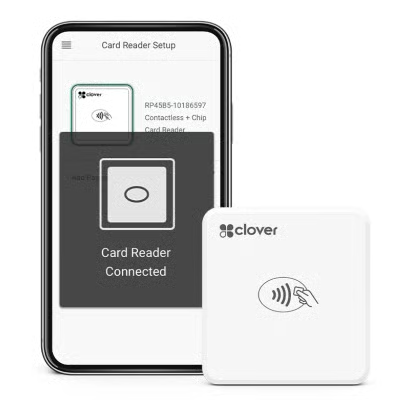 | 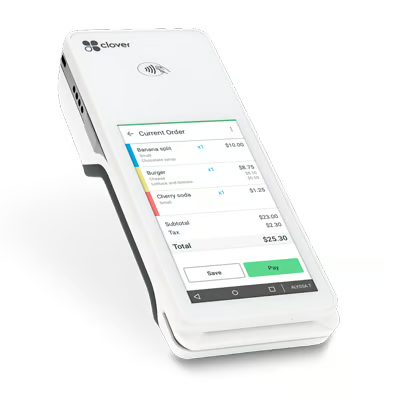 |  |
| $199 | $749 | $699 |
| Cellular-enabled mobile tap, dip, and chip card reader that integrates with most smartphones | Wi-Fi and LTE-compatible handheld POS Terminal | 25% lighter than the original Clover Flex, still has barcode scanning and all-day battery life; larger screen than the original Flex |
| Clover Compact | Clover Mini | Clover Station Solo |
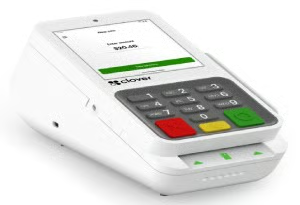 | 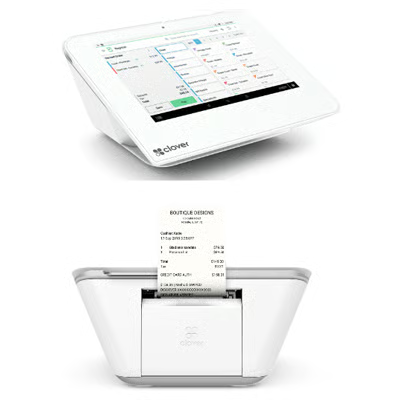 | 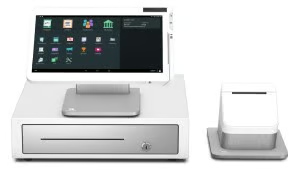 |
| $349 | $849 | $1,799 |
| Accepts swipe (MSR), chip (EMV + signature), and contactless (NFC) payments with built-in receipt printer | Low profile, all-in-one POS display, payment terminal, and receipt printer | Contactless card reader, single screen, receipt printer, cash drawer, camera & scanner |
Each device after your first one adds an additional monthly fee, except for Go readers. The specific rate varies by your software plan.
Lightspeed Retail: Best for inventory management
Why I chose Lightspeed Retail
Lightspeed is a better fit than simpler POS systems when inventory management is a major part of running the business.
Retailers can manage product variants, bundles, purchase orders, vendors, serial numbers, SKUs, multi-location inventory, and detailed reporting from the platform. This makes Lightspeed especially useful for businesses carrying large or specialized catalogs.
That depth also makes it more expensive and more involved to set up than Square. A very small retailer with straightforward inventory will probably pay for functions it does not need.
Best for: Established retailers with large catalogs, many variants, multiple vendors, or inventory across several locations.
Do not choose Lightspeed if: Your inventory is simple and keeping monthly POS costs low is a higher priority.
Lightspeed is also our top recommendation for the following:
Over the past several years, Lightspeed has acquired several other POS systems, including ShopKeep, Vend, and Upserve. Lightspeed has baked many of the features from these products into its offerings and, at the time of publication, still offers versions of these products.
Lightspeed has also acquired Ecwid, a popular shopping cart platform, to improve its native ecommerce tools, which are free for certain POS plans.
Lightspeed Retail standout features
- Inventory management: Granular, matrix, inventory management with many variant options, built-in purchase ordering, kitting/bundling, and serial and SKU tracking.
- Robust analytics: Over 50 preset reports, including data visualizations and tips on actionable insights.
- B2B catalog and supplier management: More than 3,000 preloaded vendor catalogs, vendor tracking, automated vendor returns, and integrated supplier network.
- Marketing and loyalty: Auto customer segmentation, flexible point-based loyalty programs, integrated email marketing, customer habit tracking, and more
- Native ecommerce: Over 30 themes to choose from, able to sync your online and in-store products and sales, integrated SEO and shipping tools.
Lightspeed Retail pricing
- Monthly software fees: (varies by POS type, payment processor, and payment plan; lowest rates available with annual billing) $109 to $339 ($89 to $289 paid annually) for retail
- Installation fee: $0
- Contract length: One year
- Processing fees:
- In-person: Lightspeed Payments: 2.6% + 10 cents; other processors vary
- Online: Lightspeed Payments: 2.6% + 30 cents; other processors vary
- Custom processing rates available with certain plans and sales volumes
Like Square, Shopify, and Toast, Lightspeed has built-in payment processing that is the default option when you choose Lightspeed POS. However, certain versions of Lightspeed are compatible with third-party payment processors, meaning it is possible to choose your own payment processor with Lightspeed, especially if your business is considered high-risk.
However, note that Lightspeed may charge higher monthly fees if you use a third-party processor.
Lightspeed Retail hardware
Lightspeed runs on iPads and desktop computers. All Lightspeed hardware is quote-based. You can purchase the terminals, card readers, and other accessories you need directly from Lightspeed.
Want to see some of Lightspeed’s inventory tools in action? See our video overview:
Methodology: How I evaluated the best POS systems for small businesses
I started with a list of over 20 best POS systems for small businesses. I then evaluated them by price, POS functions like check and order management, payment processing, and inventory management. I also looked at user reviews and, in many cases, demoed the products firsthand and leveraged my experience using the systems in the past.
Click through below to see my full evaluation criteria:
- Pricing (30%): I prioritized POS systems that include a free plan or free trial, affordable subscriptions, and additional plans so that you won’t grow out of the system. I also awarded points to systems with affordable integrated payment processing, flexible hardware options, and no restrictions on the number of users, inventory, and transactions. Finally, I penalized systems that require long-term contracts and hefty installation fees.
- Register features (20%): Businesses need speedy and customizable checkout tools, easy customer management, mobility to sell anywhere, a process to track orders, and a way to process online orders. Because the way businesses operate has changed so much in recent years, I also considered contactless payments, integrated online ordering, and omnichannel sales tools.
- Management tools (15%): The most important backend feature I considered was inventory tracking. I also considered how sophisticated and user-friendly the reporting dashboard of each system is and what marketing and employee management tools are available.
- Ease of use (15%): I prioritized POS systems with 24/7 phone support, as most small businesses don’t stick to a 9-to-5 schedule. I also considered the installation processes and whether the system has an offline mode or hybrid installation so that you can continue operations when you lose internet access. Training mode or training videos are also helpful in getting new employees up to speed. But, most importantly, I examined the workflows and interfaces of the systems. Are they intuitive? Is it easy to find and complete daily functions? This weighed heavily in my overall recommendations.
- Expert Score (20%): I considered the overall quality of each system’s features, along with system stability, and security. I evaluated whether it offers a good value for its price point and standout features. Finally, I accounted for all of our on-staff experts’ personal experience using each system and interacting with customer service representatives (CSRs), its reviews, and the personal experience of other small business owners.
How much does a POS system cost?
The cheapest POS system is not always the lowest-cost option. Compare the monthly software fee, payment processing rate, hardware, add-ons, and whether the provider locks you into its own payment processor.
Cost factor | What to check |
| Software fee | Free plans vs paid plans, per-location fees, and add-ons |
| Payment processing | In-person, online, keyed-in, invoice, and chargeback fees |
| Hardware | Card readers, terminals, registers, cash drawers, scanners, and printers |
| Installation | DIY setup vs paid onboarding or installation |
| Contract terms | Month-to-month plans, cancellation fees, and long-term agreements |
| Add-ons | Loyalty, payroll, marketing, ecommerce, inventory, and staff tools |
| Support | Standard support vs premium support or onboarding packages |
Read more: How Much Does a POS System Cost?
How to choose the best POS system for your business
The best POS system for small business depends on what you sell, where you sell, how you accept payments, and which tools you need to manage daily operations. Before choosing a provider, compare business fit, payment processing, hardware, inventory, sales channels, reporting, offline mode, and room to grow.
Step 1: Start with your business type
Start by matching the POS system to your business model. A retail store, restaurant, ecommerce business, service provider, mobile seller, and regulated retailer all need different POS tools.
Related: Types of POS Systems: Small Business Guide
Step 2: Compare payment processing
Payment processing can have a bigger impact on long-term cost than the monthly POS fee. Compare in-person, online, keyed-in, invoice, and chargeback fees.
Also check whether the POS requires its own built-in processor or lets you bring your own merchant account. Built-in processing is easier to set up, while processor flexibility can help high-volume businesses negotiate better rates.
Step 3: Check hardware needs
Decide what hardware your business needs before choosing software. A pop-up shop may only need a mobile reader, while a restaurant may need handheld terminals, kitchen displays, and receipt printers.
Common POS hardware includes:
- Mobile card readers
- Countertop registers
- Handheld terminals
- Cash drawers
- Barcode scanners
- Receipt printers
- Customer displays
- Kitchen printers or kitchen display systems
Also consider whether the provider requires proprietary hardware or lets you use tablets, existing devices, or third-party accessories.
Step 4: Review inventory tools
Inventory needs vary by business type. Retailers often need variants, stock alerts, purchase orders, transfers, and barcode tools. Restaurants need modifiers, menu management, ingredient tracking, and recipe-level reporting.
If you sell online and in person, look for real-time inventory syncing so you do not oversell items across channels.
Step 5: Confirm offline mode
Offline mode is essential if internet interruptions would stop sales. This matters for restaurants, pop-ups, food trucks, mobile sellers, events, and stores with unreliable Wi-Fi.
Check whether the POS can continue taking payments offline, record cash transactions, save orders, and sync data when the connection returns. Also review any offline payment limits or liability rules.
Step 6: Check supported sales channels
Choose a POS that supports where you sell now and where you plan to sell next. Some systems are built for in-store checkout, while others are stronger for ecommerce, mobile sales, delivery, marketplace, or social selling.
Check for support for:
- In-store sales
- Mobile checkout
- Online store
- Marketplace selling
- Social selling
- Delivery or pickup
- BOPIS
- Multilocation sales
For omnichannel businesses, Shopify POS is often stronger. For restaurants, Toast is usually a better fit. For simple in-person selling, Square or GoDaddy may be enough.
Step 7: Evaluate reporting
Reporting should help you understand sales, inventory, staff performance, customer activity, and payment trends. At minimum, look for daily sales reports, product performance, category sales, payment reports, and employee activity.
Growing businesses may also need inventory forecasting, customer reports, labor reports, multi-location dashboards, and custom reporting.
Step 8: Review scalability
Choose a POS that can grow with your business. This includes adding users, registers, locations, products, sales channels, integrations, and advanced features without forcing a full system change.
Look for:
- Multi-location tools
- User permissions
- Integrations
- Add-ons
- Upgrade paths
- API or app marketplace access
- Advanced reporting
- Customer loyalty or marketing tools
A free POS can work well at launch, but make sure its paid plans can support your next stage.
Step 9: Test ease of use
Before committing, test the checkout flow and daily back-office tasks. A POS system should be easy for staff to learn and reliable during busy hours.
During a demo or trial, test:
- Ringing up a sale
- Processing a return
- Applying discounts
- Adding products
- Updating inventory
- Creating staff permissions
- Running end-of-day reports
- Connecting hardware
- Managing online and in-store sales
The right POS should fit your workflow without adding extra steps to checkout, inventory, or reporting.
Related: Benefits of Using a POS System
Find POS options by industry
Different businesses have different POS needs depending on how they sell, accept payments, and manage inventory. If you want recommendations tailored to your business type, explore our industry-specific POS guides below.
Retail and inventory-heavy businesses
- Best retail POS systems
- Best POS inventory systems
- Best multichannel POS systems
- Best free POS software for small businesses
- Cloud-based POS systems
- Best open-source POS software
Restaurants, cafes, and food service
Specialty and regulated retail
Niche and specialty retail
- Bookstore POS systems
- POS systems for consignment stores
- Garden center POS systems
- Grocery store POS systems
Mobile, hardware, and alternative POS setups
- Best POS apps for mobile businesses
- Best iPad POS systems
- Best touch-screen POS systems
- Best POS systems for rentals
- Best self-service kiosk systems
Service-based businesses
Frequently asked questions (FAQs)
What is the best POS system for small business?
Square is the best POS system for most small businesses because it combines free POS software, built-in payment processing, affordable hardware, inventory, reporting, and online sales tools. Businesses with more specialized needs may be better served by Shopify for ecommerce, Toast for restaurants, Helcim for payment pricing, or Lightspeed for advanced inventory.
What is the best free POS system?
Square is my top free POS choice for most small businesses. Its base software has no monthly fee and supports in-person, mobile, and online sales. The main limitation is that you must use Square Payments.
Toast and GoDaddy also have $0 starting options, but both are better suited to narrower use cases.
How much does a POS system cost?
POS software can cost anywhere from $0 to several hundred dollars per month. Businesses may also pay for payment processing, hardware, installation, additional registers, add-ons, and optional services.
For many businesses, card-processing fees make up a larger portion of total POS cost than the software subscription.
Which POS system is best for retail?
Square is a strong option for small retailers that want affordable, straightforward POS software. Shopify POS is better for retailers selling online and in physical stores, while Lightspeed is better for businesses with more demanding inventory requirements.
Which POS system is best for restaurants?
Toast is my top restaurant POS because its software, payments, hardware, and add-ons are built specifically around food-service workflows. Square for Restaurants is a less expensive alternative for smaller or simpler operations.
Can I use my own payment processor with a POS system?
It depends on the POS. Square, Shopify POS, and Toast require their respective payment services for in-person transactions. KORONA allows businesses to connect supported outside processors, while Clover's processing options depend on where the system is purchased.
What should I look for in a POS system?
Start with total cost, payment processing, checkout tools, hardware, inventory, reporting, offline mode, support, integrations, and the sales channels you need. The best option is the one that handles your most common workflows without forcing you to pay for tools your business does not use.
Bottom line
Square is the best POS system for most small businesses because it gives new and growing merchants a low-cost starting point without sacrificing the core tools needed to run daily sales.
It is not the right choice for every business. Shopify is stronger for connected ecommerce and retail, Toast is built specifically for restaurants, Helcim can reduce payment costs for the right merchant profile, and Lightspeed offers much deeper inventory management.
Start by narrowing your options according to business type, then compare payment-processing costs, hardware, contract terms, and the features you will use every day. Those factors usually matter more than the advertised monthly POS price.
You might also like..
Best Inventory Management Software for Small Businesses in 2026
10 Best Inventory Software that Integrate with QuickBooks (2026)
