







A business owner’s policy (BOP) is advantageous for small business owners because it brings together general liability, commercial, and business interruption coverage—often for a lower price than if you were to purchase the policies separately. Learn what a BOP policy is, how much it costs, and what coverages it typically includes, as well as top providers for BOP insurance.
The Hartford has been helping small business owners find the right coverage for over 30 years and is one of our top picks for the best small business insurance provider. Its agents work with you to secure the right policy for your individual needs. Get a free, no-obligation quote online in minutes.
Visit The Hartford
or call (888) 219-3051
What Is BOP Insurance?
BOP insurance is one policy that contains multiple lines of coverage: general liability, commercial property, and usually, business interruption coverage. Providing insurance in this way is advantageous for both policyholders and insurance companies:
- For the business owner, a BOP is usually more affordable than buying all the coverages separately. It is also more convenient because it allows you to manage one policy with one company for multiple types of losses. Providers make insurance endorsements available, such as cyber liability or professional liability, which you can add to a BOP to make one tailored policy for your needs.
- For insurance providers, BOPs are good because they can sell multiple policies to the same customer, both increasing sales and the likelihood of retention.
BOP Insurance Costs
Affordability is the primary reason small business owners should consider buying BOP insurance. A business owner’s policy typically costs anywhere from $500 to $4,900 per year:
The two coverages most commonly included in BOP insurance—general liability and commercial property—could easily cost more if purchased separately. Individual costs for both general liability and commercial property will depend on the industry the business falls under and its coverages.
Business Owner’s Policy Costs by Industry
These are estimated price ranges averaged from multiple quotes to give you an idea of what BOP insurance costs. Prices may differ for your business.
| Industry (Profession) | Coverage Limits | Annual Premium Ranges |
|---|---|---|
| Construction & Contracting (Handyman) | $1 million occurrence—$2 million aggregate | $500 to $4,300 |
| Architects (Landscape Architectural) | $1 million occurrence—$2 million aggregate | $500 to $3,900 |
| Cleaning (Janitorial & Cleaning―Residential) | $1 million occurrence—$2 million aggregate | $630 to $4,900 |
| Personal Care (Beauty Salons) | $1 million occurrence—$2 million aggregate | $630 to $3,000 |
| Nonprofessional Services (Photographers) | $1 million occurrence—$2 million aggregate | $500 to $2,900 |
| Financial Services (Accounting Services) | $1 million occurrence—$2 million aggregate | $500 to $1,900 |
| Business Consultants (Management Consulting) | $1 million occurrence—$2 million aggregate | $500 to $2,000 |
| Healthcare (General Physicians) | $1 million occurrence—$2 million aggregate | $630 to $2,100 |
Your business’ industry has a major impact on how much a BOP will cost. Certain industries, including construction or retail, have a higher risk for both property and liability claims. Business consultants, in contrast, don’t have many property exposures, but they may face more liability lawsuits.
When calculating the premium for BOP insurance, insurers consider factors, such as:
- Claims history: Typically, insurers focus on the past three to five years of your business when it comes to claims.
- Number of employees: The more staff you have, the greater risk you face of theft and liability lawsuits.
- Property value: Since a BOP includes commercial property, the value of the property will be factored into the premium.
- Policy terms: Requesting higher coverage limits causes your premiums to go up. Conversely, you can ask for a higher deductible to lower your costs, but you should only do so if you can afford to pay the higher deductible out of pocket.
- Industry: A business in a riskier industry, such as construction, can expect to pay a higher premium than a lower-risk business like a photography studio.
- Geography: Geography impacts premiums in multiple ways. Some ZIP codes are more litigious than others, and some areas of the United States are more susceptible to natural disasters.
What BOP Insurance Covers
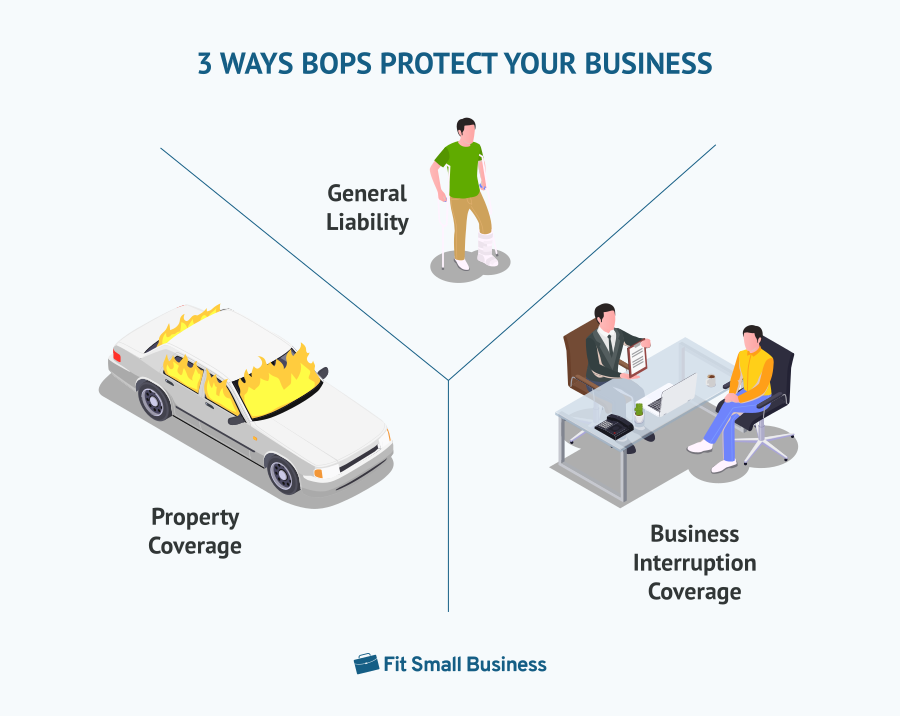
A strong business owner’s policy includes three major components: general liability, commercial property, and business interruption insurance.
General Liability in BOP Insurance
The general liability coverage in BOP insurance protects your business by paying costs associated with third-party property damage, bodily harm, and advertising injuries like defamation and copyright infringement. These costs might include the injured party’s medical and repair bills or your legal fees if they sue.
Situations that might trigger the liability portion of a business owner’s policy include:
- A fire in your store that causes smoke damage to a neighboring business
- A customer slipping and falling, which causes physical injury
- A graphic designer’s allegation that you used their work without permission
Liability claims may be your greatest financial risk if you work with the public, so getting general liability coverage is essential for your business.
Commercial Property in BOP Insurance
Unlike general liability, which is a third-party coverage, commercial property insurance is a first-party coverage to pay for damage to your business’ physical assets. These assets typically include business-owned buildings, equipment, fixtures, furniture, and inventory.
You can choose to insure your business property either at its actual value or its replacement cost value. Opting for the actual value insures items at their market value, which means your insurer pays the replacement cost minus depreciation. This option usually has a lower premium than insuring for the replacement cost.
Business Interruption Insurance in BOP Insurance
Most small business insurers also add business interruption insurance to the property coverage in a business owner’s policy. Also called business income insurance, this coverage pays for lost income and ongoing expenses when a covered loss prevents the business from operating. Insurers typically only cover these costs for 12 consecutive months, but 18-month and two-year business interruption coverage is becoming more common.
Here are some examples of what the business interruption coverage in your BOP insurance might pay for:
- Lost revenue
- Employees’ wages
- Rent
- Utilities
- Relocation expenses
Business interruption insurance can help your business survive if a fire or a burst pipe forces you to shut down for even a brief period.
Other Coverages That May Be Included in BOP Insurance
BOP insurance is relatively standardized throughout the insurance industry, which means it typically includes general liability and commercial property coverage no matter which insurer offers it. However, other coverages can be added to a business owner’s policy through endorsements or riders.
Here are some examples of coverage insurers sometimes offer as endorsements or riders to their BOP insurance:
- Cyber liability insurance: Covers costs associated with a data breach or cyberattack
- Professional liability insurance (also called errors and omissions insurance): Covers legal fees when clients claim they suffered financial loss due to your negligence
- Inland marine insurance: Covers business property in transit or at offsite locations
- Spoilage and temperature change: Covers the cost of replacing spoiled perishable inventory after a mechanical malfunction or power outage
- Accounts receivable (A/R): Covers financial losses arising if your accounts receivable records are damaged by a covered peril
- Earthquake insurance: Covers damage caused by earthquakes, mudflow, and landslides
- Employee dishonesty: Covers financial loss due to employee theft and other illegal activities
What’s Not Covered in BOP Insurance
While a business owner’s policy is a good foundation for most small business owners, some situations may call for additional coverages that aren’t included in BOP insurance. Simply put, a BOP doesn’t cover everything.
Other policies small business owners might need include:
- Commercial auto insurance: Covers injury, damage, and lawsuits arising from accidents involving business-owned vehicles
- Workers’ compensation insurance: Covers employees’ work-related injuries and illnesses by paying their medical bills and replacement wages
Who Needs BOP Insurance?
When considering whether BOP insurance is right for your business, it is important to first understand that not all businesses qualify for it. Every insurer has different rules, but BOPs generally are reserved for businesses in low-risk industries that have between 100 and 500 employees (usually at the lower end of the range) and anywhere from $1 million to $5 million maximum in revenue. In short, a BOP is a great policy designed for small businesses.
Most homeowners’ insurance policies exclude business activities and exposures. If you run your small business out of your home, consider getting a BOP to cover your business liability and property. However, some home insurance providers offer business riders. It’s best to review all your policy options with your agent before deciding whether you need a home-based business insurance policy.
Beyond home-based businesses, if your business is in the following industries, consider BOP insurance:
- Retail
- Restaurants
- Contractors, such as handyperson, landscapers, and janitorial services
- Beauty salons
- Nonprofessional services
- Convenience stores
Top BOP Insurance Companies
Most insurance companies that work with small businesses offer BOP insurance, so many create endorsements or add coverages to either stand out in the crowd or attract businesses in specific industries. This means business owners should look at both price and policy terms to see which BOP gives them the ideal coverage for their operations.
Our list of top BOP insurance companies includes a few large national carriers that either specialize in or dedicate teams to small business insurance, plus an online broker that can help business owners compare quotes from multiple top-rated insurers:
- The Hartford: Best overall provider of BOP insurance
- Simply Business: Best for comparing quotes and buying insurance online
- Chubb: Best for high-revenue businesses
- Hiscox: Best for cyber liability endorsements
- Travelers: Best for industry-specific BOPs
The Hartford: Best Overall Provider of BOP Insurance
Standout Features
- BOP insurance costs an average of $85 a month
- Numerous endorsements available to tailor BOP coverage for your business
- Excellent customer service includes online policy maintenance and 24/7 call center
- The Hartford BOP includes business income insurance
Financial stability: With over 200 years of experience, The Hartford has maintained great financial stability. AM Best rated The Hartford A+ (Superior).
Simply Business: Best for Comparing BOP Insurance Quotes
Standout Features
- Compare quotes for multiple lines of coverage
- Purchase a policy online without speaking to anyone, or talk to a dedicated agent
- Account portal to manage your policy
- Choose from endorsements offered by different carriers
Financial stability: Simply Business works with multiple top-rated carriers. For example, one provider it works with, Hiscox, has an AM Best rating of A (Excellent).
Chubb: Best for High-revenue Businesses
Standout Features
- Capacity for businesses with revenue up to $30 million
- Appetite for over 1,000 different business classifications
- Automatic blanket limit for valuable property
- Optional endorsements include employment practices liability insurance (EPLI), equipment breakdown, and water backup
Financial stability: With roots stretching to the 1880s, Chubb has maintained a global reputation for financial stability. AM Best rated Chubb A++ (Superior).
Hiscox: Best for Cyber Liability Endorsements
Standout Features
- Terrific cyber insurance coverage and services
- BOP insurance costs average between $41 and $63 a month
- Up to $10,000 included automatically for recovery of electronic data
- BOP for businesses with revenue up to $3 million
Financial stability: Hiscox has a solid financial position. AM Best has rated Hiscox A (Excellent).
Travelers: Best for Industry-specific BOPs
Standout Features
- Customizable with endorsements like hired and nonowned auto, tools and equipment, and cyber insurance
- Workers’ comp and commercial auto available
- Broad definition of property for buildings owned or leased, equipment, and furniture
- Loss income includes coverage for employee payroll
Financial stability: Founded in 1853 and operating globally, Travelers’ financial position is strong. AM Best’s rating of Travelers is A++ (Superior).
Bottom Line
BOP insurance is a cost-effective and convenient way for small business owners to get the fundamental policies they need to protect their business. Combining general liability and property coverage in a single package lets insurers sell BOPs for less, but it also means business owners only have one policy and one premium to keep track of.
It’s easy to find a business owner’s policy that’s best for your business by contacting The Hartford. Its team of specialists will get to know your business to ensure you get the right policy at the right price. Get a free, no-obligation quote online in minutes.
