





An invoice number is a unique and sequential number assigned to each invoice document. Invoice numbers can be purely numeric, such as 10021, or alphanumeric, such as INV-10021. It allows businesses and customers to refer to a particular invoice easily when multiple invoices exist, making it much easier to match invoices with payments.
For small businesses, invoice numbers enable you to track and organize invoices further. Since invoice numbers are sequential, you can spot if there is a missing invoice quickly, allowing you to investigate further and detect errors along the way.
The image below shows where you can usually find the invoice number. Invoice designs differ, but invoice numbers are usually placed in the upper portion of the document.
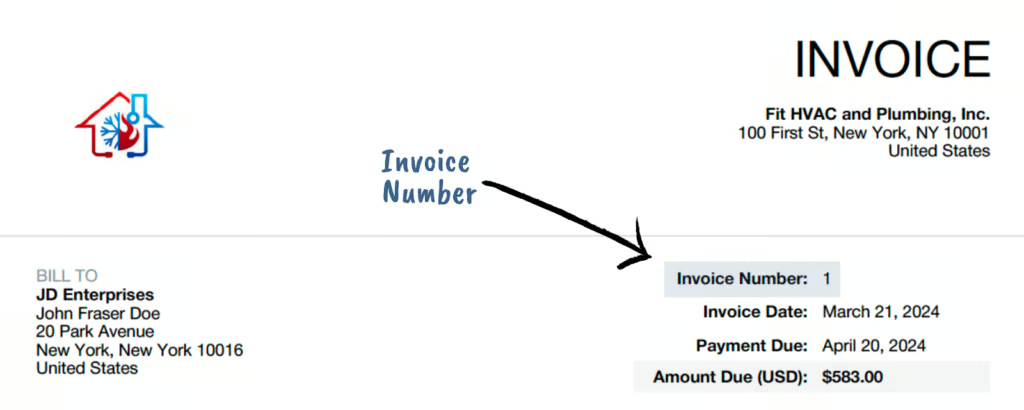
In this guide, we’ll go over the uses and importance of invoice numbers. We’ll also show you how you can design a unique invoice number for your small business.
Importance of Invoice Numbers
Every invoice must have a unique invoice number. Without it, the invoice can’t be easily tracked or retrieved. Regardless of the invoice design, the invoice number must be present and prominent in the document.
1. Matching Customer Payments
When customers pay their dues, the business must match the payment with the corresponding invoice to verify if the customer has paid the correct amount. Some businesses require customers to indicate the invoice number in the payment to make it easy for the bookkeeper to mark invoices as paid.
2. Avoiding Duplicate Invoices
Without a proper invoice numbering system, there’s a high chance that you’ll have duplicate invoices. Proper numbering helps you organize all invoices and provide a single reference number for each invoice issued.
If you’re using invoicing software, the tool often auto-generates the invoice number. So, when there are two invoices with duplicate information but different invoice numbers, it’s easy to declare that one is a duplicate invoice.
3. Auditing Sales Transactions
An invoice is a source document in accounting that serves as evidence for revenue transactions. Invoice numbers can help you organize sales transactions per period, especially for sales cutoff testing. When performing cutoff procedures, you can check if current period recorded sales match current period invoices—as the next period’s invoices may be recorded as the current period sales or vice versa.
Hence, keeping a detailed inventory of invoice numbers can help you identify if all invoices have been recorded or if there are missing invoices. For example, if you have determined that invoices 1050 to 1100 are invoices issued in 2023, invoice numbers 1101 onward are assumed to be invoices issued in 2024.
4. Sending Payment Reminders or Collection Letters
Some customers can have multiple outstanding invoices in your business records. Invoice numbers will be the first point of reference when sending payment reminders or collection letters. For instance, the reminder may be worded like, “Hello, Customer. We’re sending you this gentle reminder for your outstanding balance of $230 in Invoice No. 12589 dated March 25, 2024. The due date is on April 15, 2024. Please settle this invoice on or before the due date.”
Mentioning the invoice number makes it easy for the customer to pull up the invoice from their records and verify if the reminder is correct. Without an invoice number mentioned in the reminder, it would be hard for the customer to locate the invoice document.
Related resources:
- How To Ask for Payment in an Email [+3 Professional Email Templates]
- How To Write a Collection Letter [+ Free Templates]
Designing an Invoice Numbering System
For your invoice numbering system, it’s easiest to start with 1 as the invoice number. However, that is rather plain and confusing, considering that there are other reference numbers used in the business—such as purchase order number or payment reference number. To make it unique, use unique numbers or letters that can serve as identifiers.
Here are some ideas that can help you design an invoice numbering system:
| Syntax | Why Use It |
|---|---|
| [Customer Number] + [ - ] + [Filler C301 + - + 0000 + 1 = C301-00001 C502 + - + 000 + 25 = C502-00025 C932 + - + 0 + 1007 = C932-01007 | Indicating the customer number in the invoice number can help internal users access other information related to the customer. With only the invoice number, you can go to your business’ customer relationship management (CRM) software and use the customer number to access their information. |
| [mm/yy] + [ - ] + [Filler] + [Number Series] Examples: 0401 + - + 0000 + 1 = 0401-00001 0401 + - + 000 + 22 = 0401-00022 0401 + - + 00 + 359 = 0401-00359 | This system helps you identify invoices based on the month and year. Use this syntax if dates matter in your invoice tracking. For instance, if the month and year are April and 2024, respectively, the first part of the invoice number is 0424. The first part will change as the months and years go by. |
| [State Code] + [Filler] + [Number Series] Examples: TX + 0000 + 1 = TX00001 CA + 000 + 55 = CA00055 FL + 0 + 1389 = FL01389 | Say you conduct business in different states and want invoice numbers to reflect state information. You can add the state code at the beginning of the invoice number to help you identify what state the customer resides in. |
| [Project Code] + [Filler] + [Number Series] Examples: CMKG + 0000 + 1 = CMKG0001 WDEV + 000 + 92 = WDEV0092 SOCM + 0 + 187 = SOCM0187 | Project codes can help you determine which project the invoice belongs to. For example, you can assign project codes like CMKG for content marketing, WDEV for web design and development, or SOCM for social media management. These unique codes can help internal teams identify invoices. |
| [Document Code] + [Filler] + [Number Series] Examples: IN + 0000 + 1 = IN00001 INV + 00 + 752 = INV00752 | The invoice number can be designed to differentiate it from other business documents. For instance, you can put IN or INV at the beginning of the number. Customers can easily recognize the document as an invoice if they see the unique document code. Moreover, internal users can segregate invoices from other source documents easily by looking at the number. |
These are some examples of invoice numbering syntaxes. We recommend that you design a unique invoice numbering system that best suits your processes.
Frequently Asked Questions (FAQs)
Who provides the invoice number?
It is the seller who provides and generates the invoice number. It is often generated automatically in the invoicing or accounting software used and should be predominantly displayed at the top of the invoice.
What should my first invoice number be?
New businesses start with invoice number one. But as you begin a new accounting period, the invoice number starts with the number after the last invoice number. For instance, if calendar year 2024 ended with invoice number 1120, the invoice number for 2025 should start at 1121.
Bottom Line
We hope this article helped you understand what an invoice number is and why it’s important in the accounting system. Without invoice numbers, you will have difficulty organizing and sending invoices. For customers, they will also have a hard time distinguishing which invoice arrived first. However, accounting and invoicing software generate invoice numbers for you automatically whenever you create an invoice.
