







Six Sigma is a project management methodology that identifies defects and variations in business processes to facilitate business transformation and improve output quality. It’s typically used by manufacturing firms, as it improves operational efficiency. However, other industries like banking and ecommerce adopt it for its cost reduction and enhanced productivity benefits. In this article, we’ll explore what Six Sigma is in project management.
History of Six Sigma Project Management
To know more about what Six Sigma is in project management, let’s discuss how it was first introduced. The concept was developed in the 1980s by Bill Smith, a quality assurance manager at Motorola, a mobile communications company. During his leadership stint, he sought to streamline business processes by eliminating defects. The company adopted a policy of applying statistical quality control to evaluate process capability and product specifications.
The new project management framework hinges on sigma, measuring how far a process deviates from accuracy or perfection. Motorola leveraged the idea of three sigma, which refers to three standard deviations from the mean.
The company expanded this concept to Six Sigma, having three additional standard deviations from the mean, to include product specifications. This means six deviations, instead of three, must happen before the process results in a defect. When a process operates at Six Sigma, only 3.4 errors per 1 million process events yield a defect. It’s near perfection, making the methodology suitable for businesses aiming to optimize value chains, like in manufacturing.
Six Sigma Key Principles
Now that you have a rough idea of what Six Sigma is in project management, let’s discuss its core philosophy. Its ultimate goal is to produce high-quality products with fewer defects and establish a sustainable, highly optimized process. To achieve this, project teams are guided by these key principles:
- Focus on the customer: Identify customers’ needs and motivations. Determine the standards of quality based on market demands.
- Assess the value chain and find the problem: Outline the steps in creating a product or service and gather data to spot bottlenecks. Data collection must be organized, with the following clearly defined: types of data to be gathered, why it must be collected, how data accuracy will be determined, and what kinds of insights are expected.
- Eliminate defects: After analyzing the process and spotting the problem, apply the necessary solutions to eliminate variations and defects.
- Let all stakeholders participate in business transformation: All team members must take part in finding solutions. Everyone must be well-trained to apply changes to processes.
- Create an easy-to-adopt framework for change: To ensure that your process remains competitive, review it every now and then and apply changes when necessary. The changes in processes must be designed in such a way that a seamless transition is attainable.
Six Sigma Methodologies
To understand better how Six Sigma works, you must be familiar with its two main methodologies: DMAIC and DMADV. Both approaches aim to remove variations and improve processes, but each has a unique framework that facilitates business transformation.
DMAIC Methodology
This data-driven methodology is used to improve existing products or services to boost customer satisfaction. The acronym describes the five phases of the process, namely:
- D – efine: Identify the project’s key components: problem, goals, resources, scope, and timeline. Compile these elements in a project charter to provide your team with a comprehensive project overview.
- M – easure: Set the baseline to make measuring progress later easier. Evaluate the effectiveness of the current processes.
- A – nalyze: Determine what causes the process to slow down. Collect data to uncover the root causes of the issues.
- I – mprove: Apply changes and gauge how effective the solutions are in improving outputs. Draft an implementation plan to organize the execution of changes.
- C – ontrol: Create a system that will sustain the streamlined processes. Prepare for potential obstacles.
DMADV Methodology
This methodology, a slight variation of the DMAIC, shares the same first three steps as DMAIC. It’s suitable for projects requiring a new product design process. It follows these steps:
- D – efine: Determine the project’s design goals and process.
- M – easure: Consider the important characteristics of the product, service, or process. Then, assess customers’ needs.
- A – nalyze: Use data to establish goals or designs that satisfy market demands.
- D – esign: Create the product, service, or process according to the data you collected.
- V – erify: Test the design and hand it to the customer, or draft a plan to keep track of the design’s effectiveness.
Advantages of Six Sigma
The Six Sigma project management methodology is especially suitable for operations teams focused on streamlining specific business functions, as it aims to eliminate waste and defects and increase efficiency and productivity. If you’re handling business operations, these are the benefits you’ll get from applying this type of project management approach:
Data-backed Decision-making
Six Sigma compels project teams to gather and analyze data to identify bottlenecks and improve overall processes. Root cause analysis is a popular technique used in the “Analyze” phase of the DMAIC and DMADV approaches, which involves looking at quantitative and qualitative information to infer which variables trigger operational issues.
Benchmarking is another technique that refers to comparing processes against other departments or external competitors to inform strategic changes. By harnessing data, you’ll reduce the risk of making biased decisions.
Long-term Reduced Expenses
Inefficient processes yield several unnecessary costs that derail a project’s budget. You’ll lose money reworking products, addressing customer complaints, re-capturing loyal clients’ trust, and disposing of wastes. However, by applying Six Sigma, which focuses on reviewing processes thoroughly and evaluating historical data, you effectively reduce these expenses in the long run and improve operational efficiency.
Improved Product Quality & Customer Satisfaction
The goal of Six Sigma project management methodology is to reduce errors and waste. With improved processes, you ultimately secure customer satisfaction and generate loyalty. This extends to increased brand awareness, with your company being known to have superior-quality goods. This is especially important for companies manufacturing products that must comply with the strictest safety standards, such as airplanes and cars.
Continuous Improvement
Using Six Sigma for project management cultivates a culture of deliberate improvement, prompting you to analyze and optimize processes regularly. It compels you to identify problems and define benchmarks for progress. For instance, Six Sigma in IT project management involves teams exercising meticulousness in documenting hardware repairs and software bug fixes.
Over time, the Six Sigma approach becomes imbibed in the company’s culture, making team members more conscious of refining how work is done. This ultimately contributes to proactive excellence that translates into increased profitability in the organization.
Disadvantages of Six Sigma
Although Six Sigma offers several benefits, it comes with drawbacks businesses must be aware of to gauge if it’s the right methodology for their projects. Similarly, it will help you manage obstacles if ever you choose this project management approach. Below are some of Six Sigma’s disadvantages:
Time-consuming Approach
Applying Six Sigma to projects takes a significant amount of time and effort, as it involves gathering and analyzing data, applying changes to processes (which may be radical, in some instances), and training team members to ensure that they know how to apply the methodology properly. The last one may be the most time-consuming, considering team members’ learning curve. If some hesitate to adopt this methodology, that may further delay your project.
Resource-intensive Process
Using advanced technologies and testing different approaches for business transformation are part of the Six Sigma implementation. This requires more sophisticated material resources and highly skilled workers. The mastery of employees on the methodology requires certification. With this, the upfront costs for Six Sigma project implementation are higher compared to other methodologies.
Less Room for Innovation
The implementation of the Six Sigma methodology is extremely rigid, with the tendency to be hyperfocused on reaching numerical targets. This keeps team members from exercising innovation at work. Moreover, most teams tend to overly depend on the knowledge and expertise of those with the highest level of certification, limiting the ideas for enhancing business processes.
Six Sigma Techniques
How to use Six Sigma in project management involves the use of various techniques to facilitate business transformation. Refer to the table below for a quick overview of the popular strategies:
| Six Sigma Techniques | Six Sigma Phase | How It Works |
|---|---|---|
| Voice of the Customer | Define | This entails seeking customer feedback about their experiences with products and services. |
| Benchmarking | Measure | This involves comparing processes to other departments within the business (internal), to industry leaders (functional), and to competitors (external). |
| Root Cause Analysis | Analyze | This entails understanding the main cause of the problem. A common method used is the Five Whys, which prompts team members to ask why repeatedly to get to the bottom of the issue. |
| Cause & Effect Matrix | Analyze | This illustrates the relationship between process inputs and outputs. |
| Pareto Chart | Analyze | This shows the causes of defects and the frequency of these variations in a business process. |
| Brainstorming | Improve | This involves discussing different ideas and strategies for tackling the identified problem. The facilitator is usually the team leader with the highest level of Six Sigma certification. |
| Kaizen | Control | This literally means improvement in Japanese. It refers to business activities team members engage in to reach regular, incremental improvements in the business process. |
Six Sigma Certification Belts
Part of understanding what Six Sigma methodology is in project management is being familiar with its training certifications. The certifications have different levels, represented by belt color, similar to karate. In total, there are five training tiers. These are the Six Sigma certification belts:
| Certification Level | What It Means |
|---|---|
| White Belt | Understands the fundamentals and team members' roles in improving operations efficiency |
| Yellow Belt | Knows how to create process maps and collect data to improve operations |
| Green Belt | Plans and executes processes, sometimes leading teams on smaller projects |
| Black Belt | Leads and trains team members |
| Master Black Belt | Develops strategies and determines key metrics |
Aside from these certification levels, Six Sigma has “Champions” who draft an organizational deployment plan and define individual projects that are aligned with the company’s vision, mission, goals, and metrics. The “Executive” determines the strategic focus of the project according to the organization’s culture and vision.
Cost of Six Sigma Certifications
The cost depends on the professional association providing the Six Sigma certification and the type of certification or belt color you’re pursuing. Here’s an overview of costs under different associations:
| Six Sigma Certification | Council for Six Sigma Certification | American Society for Quality | International Association for Six Sigma Certification |
|---|---|---|---|
| White Belt | Free | Not available | Not available |
| Yellow Belt | $99 | $422 | $250 |
| Green Belt | $159 | $469 | $350 |
| Black Belt | $229 | $568 | $450 |
The costs above for the Council for Six Sigma Certification are for primary certification. Pay an additional $300 for advanced certifications for Green Belt Level II, Black Belt Level II, and Black Belt Level III. An additional $665 is required for the Master Black Belt. Meanwhile, the American Society for Quality offers a $100 discount for members on all certification levels.
Project Management Systems With Six Sigma Templates
To start with Six Sigma, consider using project management software solutions offering templates outlining the critical DMAIC or DMADV steps. The platforms below are our top picks:
Project management software monday.com allows you to key in important activities under each DMAIC step. It features columns for action steps, team members responsible for executing the steps, the priority level of the task, and start dates and deadlines. If the action steps entail referring to specific documents, the platform has a dedicated column for uploaded files.
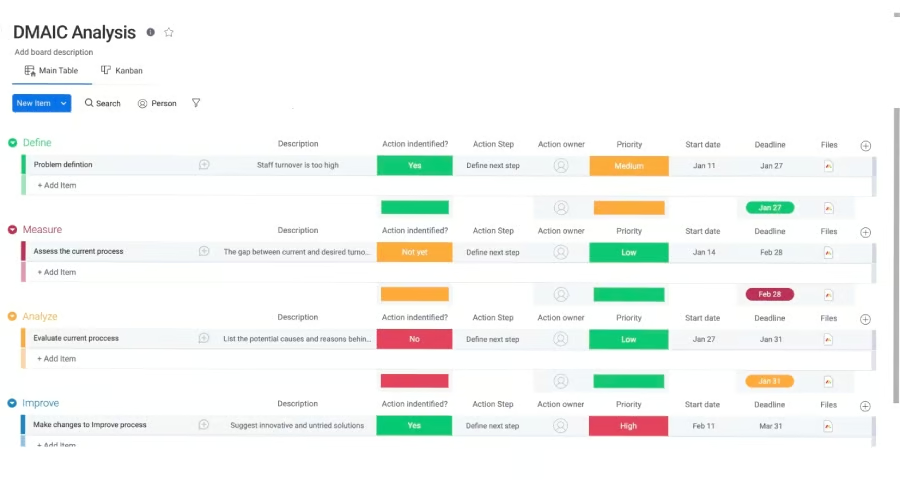
The DMAIC template is only one of the 200-plus templates monday.com offers. It’s available in the free version, but if you want to unlock advanced project management capabilities like time tracking and dependencies, upgrade to the paid plans, which start at $12 per user for a minimum of three seats.
One of ClickUp’s Six Sigma templates is the DMAIC whiteboard, which lays out the steps in color-coded columns and the tasks in sticky notes. You have the option to change the column colors and upload images on the whiteboard to customize the board according to your unique workflow process. Collaborate with team members through the platform’s built-in file annotation, video recording, and email.
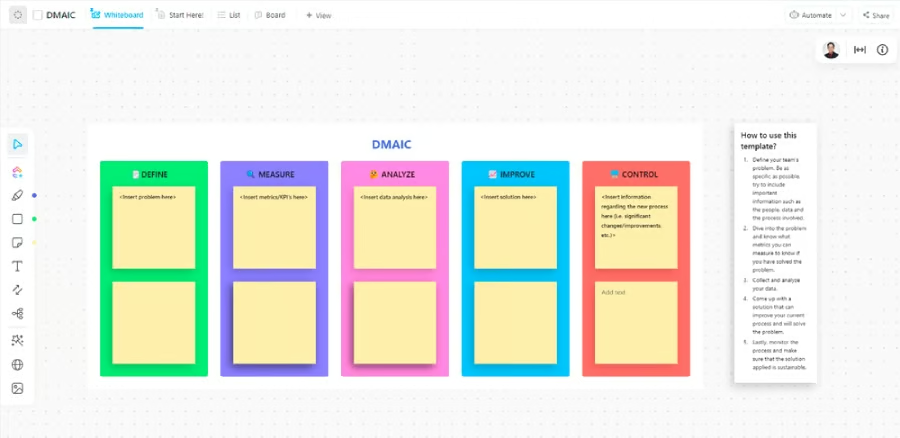
Like monday.com, ClickUp has several other Six Sigma templates to help you get started on your project easily. Subscribe to the platform for only $10 per user, monthly. Try its free version first to see if it suits your business needs.
Smartsheet offers plenty of Six Sigma templates, including the voice of the customer table. This features four columns that let users input who the customer is, what they said about a product or service, what they need, and which actions must be taken to accommodate customers’ demands. Other Smartsheet Six Sigma templates include the Five Whys and Pareto chart.
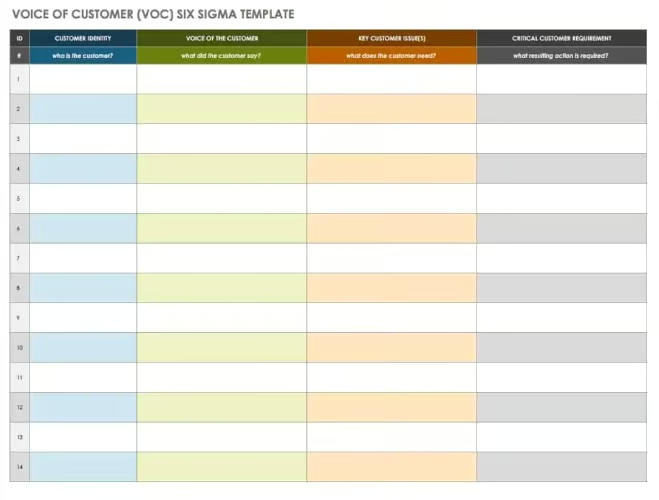
The platform’s subscription fee starts at $12 per user, monthly. But if you’re a solopreneur who only needs essential project management features, the free version may be enough for you.
Frequently Asked Questions (FAQs)
What is the focus of the Six Sigma project?
The primary focus of the Six Sigma project is quality improvement through business transformation. It seeks to identify and address problems in the value chain and create a sustainable system for optimized work processes.
Why is it called Six Sigma?
The project management methodology is called Six Sigma because it comes from the statistical concept of Sigma, which measures the process deviation from the process target. One sigma represents a single standard deviation.
Statistically, a process with six sigmas means that 99.9999998% of outcomes must be within six standard deviations from the mean. With only 0.0000002% of results going beyond the anticipated outcomes, the highest product quality is guaranteed.
Is a degree a requirement to obtain a Lean Six Sigma Certification?
It depends on the institution offering the certification. Some look for a bachelor’s or master’s degree, while others only require a mastery of the Project Management Body of Knowledge (PMBOK).
Bottom Line
Six Sigma is a project management methodology focused on improving quality by eliminating defects and reducing variations in the business process. It promotes data-backed decision-making, reduces expenses in the long run, and creates a culture of continuous improvement among teams.
To implement Six Sigma successfully on projects, businesses must adhere to its principles of customer focus, rigorous assessment of the value chain, and maximum participation among all stakeholders. Learn more about the best approaches for handling projects by reading our comprehensive guide on project management for small businesses.
