







Key performance indicators (KPIs) for employees are measurable values that allow you to determine how effectively workers achieve business objectives. They also let you monitor worker productivity and efficiency, enabling you to spot potential problems and make the necessary adjustments to help you stay on track with team or organizational goals.
Categories of Key Performance Indicators
KPIs for employees vary from industry to industry and role to role. There are four common categories: qualitative, quantitative, time-based, and work effectiveness.
A quantitative KPI for employees is the easiest to measure because it involves hard data and statistics. Quantitative KPIs can be percentages, amounts, or numbers of units, such as the number of customer tickets resolved or the number of closed sales transactions.
Qualitative staff KPIs are sometimes difficult to measure because these typically require subjective assessments by the employee’s manager or clients.
You can track these KPIs by looking at the employee’s work output and how it affects team productivity, customer satisfaction, or overall job performance. For example, you can use customer satisfaction scores and client feedback to determine the quality of support that the employee offers.
Time-based employee key performance indicators monitor when issues are resolved or processes become more efficient. These KPIs can be the time it takes for an employee to close sales deals, fix software bugs, assemble products, or prepare invoices to bill clients.
Monitoring qualitative KPIs alongside quantitative and time-based KPIs provides a well-rounded picture of an employee’s work performance. However, you should also add work effectiveness measures to see how employees manage tasks, improve processes, and tackle problems.
These KPIs indicate time or task management, innovation, analytics, and problem-solving skills. But they’re most effective when compared contextually. For example, you can measure a worker’s overtime hours compared with their output or quality scores for a fuller perspective on their work effectiveness.
12 Examples of KPIs for Employees
Key performance indicators vary by industry, department, and an employee’s position in an organization. Review our top 12 employee KPI examples.
1. Productivity Rate
This is a crucial employee KPI because it directly impacts a company’s output and efficiency. It can be measured quantitatively, such as units produced, or qualitatively, like project milestones reached.
When implementing this KPI, it’s important to set clear, achievable benchmarks based on historical data or industry standards. However, managers should be cautious to ensure that focusing on quantity doesn’t compromise quality.
2. Quality of Work
This is another vital KPI, as it affects customer satisfaction and brand reputation, and it reduces the need for rework. Measure this KPI through quality control checks, peer reviews, or customer feedback.
To implement this effectively, organizations should develop clear quality standards for different types of work. The key consideration here is to balance quality with productivity to prevent perfectionism from slowing down the work process.
3. Goal Achievement
This KPI is essential for aligning efforts with organizational objectives. Measure this KPI by tracking the completion of specific, measurable, achievable, relevant, time-bound (SMART) goals.
Implementation involves setting regular check-ins to review progress and adjust goals if necessary. When using this KPI, it’s important to ensure that goals are challenging yet attainable to maintain employee motivation.
4. Attendance and Punctuality
These key performance indicators for employees impact team productivity and morale. Measure them using one of the best free time tracking systems or other attendance records. When implementing this KPI, clear communication of expectations and consequences is crucial. However, organizations should be mindful of work-life balance and recognize that there may be legitimate reasons for absence.
5. Customer Satisfaction Scores
These KPIs are directly related to customer retention and business growth. Measure them through surveys, Personal Net Promoter Scores (pNPS), customer feedback forms, and real-time interaction ratings.
While pNPS provides insight into an employee’s ability to create customer loyalty by asking how likely customers are to recommend their service, post-interaction surveys capture immediate satisfaction levels through simple 1-5 ratings. Additional measurement tools include quality monitoring scores from recorded interactions, customer return rates linked to specific employee interactions, and feedback from follow-up communications.
6. Revenue Generated
This is a critical KPI for sales roles and overall business performance. Typically, you measure this KPI by tracking sales figures, new client acquisitions, or upsells. Implementation often involves using CRM systems to attribute revenue to individuals accurately. When setting targets for this KPI, it’s important to consider market conditions and product lifecycle.
7. Task Completion Rate
The task completion rate is an indicator of efficiency and reliability. Measure this using project management tools to track task statuses and completion times. Effective implementation involves breaking larger projects into smaller, trackable tasks. When using this KPI, ensure that tasks are properly prioritized to focus on high-impact activities.
8. Time Tracking
This is crucial for maximizing productivity and identifying inefficiencies. This can be measured using one of the best time tracking software or conducting time audits. Implementation often involves encouraging employees to log their time spent on different activities. However, it is important to focus on outcomes rather than just time spent when evaluating this KPI.
9. Learning and Development Progress
This KPI for employees enhances workers’ skills and job satisfaction. Measure this by tracking course completions, certifications earned, or skills assessments. Effective implementation involves creating individual development plans and providing learning resources. When using this KPI, it’s important to align learning objectives with individual career goals and organizational needs.
10. Teamwork and Collaboration
These KPIs are essential for organizational cohesion and project success. Measure them through peer evaluations, 360-degree feedback, or team performance metrics. Implementation often involves encouraging cross-functional projects and team-building activities. When evaluating this KPI, it’s important to recognize individual contributions and team achievements.
11. Innovation and Creativity
Innovation and creativity drive company growth and competitive advantage. Measure these by tracking new ideas submitted, patents filed, or process improvements implemented. Effective implementation involves creating channels for idea submission and providing time for creative thinking.
12. Adherence to Company Values
This helps shape corporate culture and ensures ethical behavior. Measure this through behavioral assessments, peer feedback, or recognition programs. Implementation involves clearly defining and communicating company values and integrating them into daily operations. When you evaluate this indicator, make sure that leaders consistently model these values.
How to Implement KPIs Successfully
A robust KPI strategy is crucial for measuring individual contributions, driving performance, and aligning personal goals with organizational objectives. Follow our steps and examples to develop an effective KPI strategy for employees.
Align Employee KPIs with Business Objectives
Start by clearly defining your organization’s overall goals and objectives. Then, cascade these down to department-level and individual employee KPIs. The trickle-down effect ensures that every employee’s efforts contribute directly to the company’s success.
For example, if your objective is to improve customer satisfaction, you might outline similar KPIs for several groups.
- Customer Service KPI: Achieve a customer satisfaction score of 90% or higher.
- Sales Rep KPI: Maintain a customer retention rate of 85% or higher.
- Product Developer KPI: Reduce the number of bugs by 30% in new releases.
This alignment helps employees understand how their work impacts the bigger picture and motivates them to achieve their targets.
Use Smart Goals for Employee KPI Development
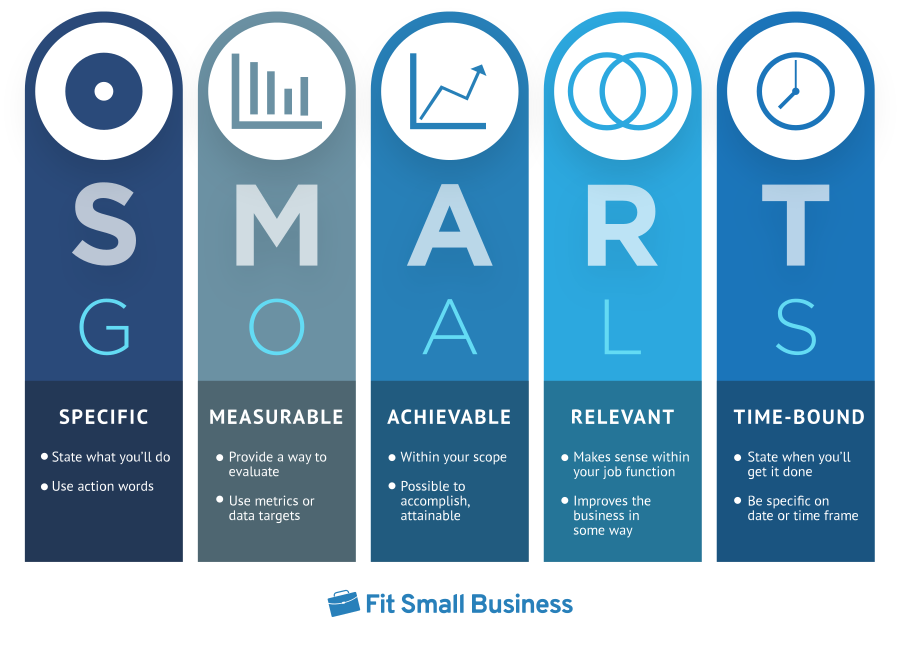
When crafting KPIs for employees, apply the SMART framework: specific, measurable, achievable, relevant, and time-bound.
An example of a SMART goal example for a marketing specialist might include measuring engagement over time.
- Specific: Increase engagement rate on social media posts
- Measurable: By 25%
- Achievable: Based on current performance and industry benchmarks
- Relevant: Directly impacts brand awareness and lead generation
- Time-bound: Over the next quarter
This specificity gives the employee a clear target to work towards and allows for objective performance evaluation.
Balance Leading and Lagging Indicators
Incorporate leading and lagging indicators in your KPI strategy. Lagging indicators measure past performances, while leading indicators predict future outcomes. This provides a comprehensive view of your employee’s performance and potential.
For example, a leading and lagging indicator for a project manager might include project completion against a budget.
- Leading indicator: Percentage of project milestones completed on time
- Definition: The proportion of project milestones or deliverables finished by their scheduled due dates.
- Calculation: (Number of milestones completed on time / total number of milestones) x 100
- Target: 90% or higher
- Frequency: Measured weekly or biweekly
- Lagging indicator: Project completion within budget
- Definition: Whether the project was completed within the allocated budget
- Calculation: (Actual project cost / Budget project cost) x 100
- Target: 100%
- Frequency: Measured at project completion
Implement a Regular Review Process
Establish a system for regularly reviewing and updating employee KPIs. This could be part of quarterly performance reviews or more frequent check-ins. During these reviews, do the following:
- Assess the employee’s progress toward their KPIs.
- Discuss any challenges or roadblocks they’re facing.
- Adjust KPIs if necessary based on changing job responsibilities or business needs.
- Set new KPIs for the upcoming period.
For example, a human resources manager might find their KPI for “number of employees hired” is less relevant than “quality of hires.” In this case, they would adjust their KPIs to better reflect their impact on the organization.
This ongoing process ensures that employee KPIs remain relevant, motivating, and aligned with the company’s evolving needs. It also provides regular opportunities for feedback and professional development discussions.
Why Are KPIs for Employees Important?
Key performance indicators for employees play an important role in driving organizational performance. By identifying and setting an employee KPI for each team member, you can assign work goals and communicate the expected results, including how performance will be measured.
Employee KPIs are also important for businesses because these help increase ownership, bridge gaps, and improve productivity.
Increase Goal Ownership
Employees with realistic goals and clear KPIs are likely to feel more accountable and responsible for tasks or projects assigned to them. It also helps if you communicate how the KPI for employees connects with the overall business objective. Their sense of ownership increases if they know their contributions can impact the company positively (or negatively if they don’t meet the KPIs).
Identify Gaps & Improvement Areas
Employee key performance indicators are a good source of insights on what’s working and what isn’t in terms of achieving work goals. If workers have trouble with a project, you may want to check if they have the necessary tools to do the job or invest in training programs to enhance workforce skills. You may also need to assess the staff KPI that you set—it might be unclear and unrealistic.
Improve Worker Productivity
Employees are more likely to be productive at work and actively participate in projects or tasks if their key performance indicators are clear, measurable, and attainable. Measure employee productivity using quantitative or qualitative methods.
Boost Employee Morale
Workers who meet or exceed KPIs receive satisfaction from doing their job excellently. This contributes to high employee engagement and morale. However, meeting performance metrics alone isn’t enough to sustain long-term employee satisfaction. Organizations need a comprehensive approach to nurture and boost employee morale across their workforces.
Bottom Line
Managing employees and tracking how efficiently they perform their jobs can be challenging. Having SMART work goals and key performance indicators for employees can help you monitor whether or not they’re completing the assigned tasks as expected and within the set timelines. It also provides valuable insights into worker productivity and efficiency, allowing you to address gaps and problems before they negatively impact employee and organizational performance.
