



.jpg?w=288)
.jpg?w=288)

Starting a business is one thing, but it’s something else to successfully turn a low-cost venture into a high-profit business. Give yourself an advantage by choosing an industry or business type that has high revenue and growth potential to yield good returns over time.
Check out our suggestions for low-cost business ideas with high profit below. You can also get a more in-depth guide on starting your own business by downloading our full guide:
- 1. Business consulting
- 2. Voice acting
- 3. Personal chef
- 4. Web development and design
- 5. Content writing
- 6. Language Translation
- 7. Print on demand services
- 8. Virtual assistant
- 9. Cleaning business
- 10. Ghostwriting
- 11. Physical fitness training
- 12. Commercial photography
- 13. Private tutoring
- 14. Dropshipping
- 15. Podcasts
- 16. Online courses
- 17. Lawn care and landscaping
- 18. Property management
- 19. Resale/recommerce
- 20. AI automation
- Frequently asked questions (FAQs)
- Bottom line
1. Business consulting
Business consulting is a general term that can refer to providing advice for many different business functions: marketing and sales, project management, strategic planning, and more.
There are no official or required qualifications to become a consultant per se, though depending on the field you wish to consult in, you may need to hold a certification for that. You can also choose to become a consultant for more informal fields that won’t require you to hold a professional certification, such as business writing, marketing, career guidance, communications, or public relations.
While you may not need additional qualifications to be a business consultant, you’ll need to stay abreast of any developments, trends, and changes in your consultancy field. Your reputation (and thus future business opportunities) will rely on the results you get for your present clients, so you’ll need to stay updated.
Startup cost: $2,600+ (website & portfolio, basic legal/LLC or registration fees, simple branding/marketing, email + scheduling tools)
Average annual revenue: $125,000
Expected growth rate: 4.9% from 2023-2028
2. Voice acting
As with many other business ideas on this list, voice acting has a low barrier to entry, so you would do well to find (or carve out) a specific niche you can serve before you put yourself out there. Do you have a particularly low or high voice? Can you do humorous impressions? Do you prefer something more along the lines of reading audiobooks out loud?
While you may have to deal with lots of competition initially, you’ll also be able to slowly raise your prices as your skills and reputation grow. Evaluate your own skills, observe the competition, and negotiate with clients to make as much profit as possible.
Startup cost: $100-$500 (home mic & pop filter, audio interface or USB mic, recording software, demo reel/voice training)
Average annual revenue: $100,198
Expected growth rate: 19.2% from 2023 to 2032
3. Personal chef
If you enjoy cooking and preparing food but prefer not to work in a restaurant, you can always opt to become a personal chef. This often takes the form of preparing customized meals as requested by clients, and figuring out how to deliver the food to them.
Little formal training is required for this type of work—it’s all about how good you are in the kitchen, as well as your ability to stay on top of administrative tasks like building your customer base, recording their preferences and allergies, and figuring out delivery methods. Though, of course, formal training and experience will only help you land clients.
With enough time and effort, you’ll likely be able to build up to a steady monthly income without putting out too much of an initial investment.
Startup cost: $1,000+ (food-safety certs if required, initial groceries/supplies, basic insulated delivery gear, marketing/insurance)
Average annual revenue: $90,386
Expected growth rate: 4.2% from 2023 to 2033 (Personal chef)
4. Web development and design
Web development (software engineering) and web design (creating a website for a business to use) are potentially lucrative fields that all companies find necessary at some point. More than formal qualifications or certificates, what you’ll need to succeed is solid experience and a good portfolio of completed work.
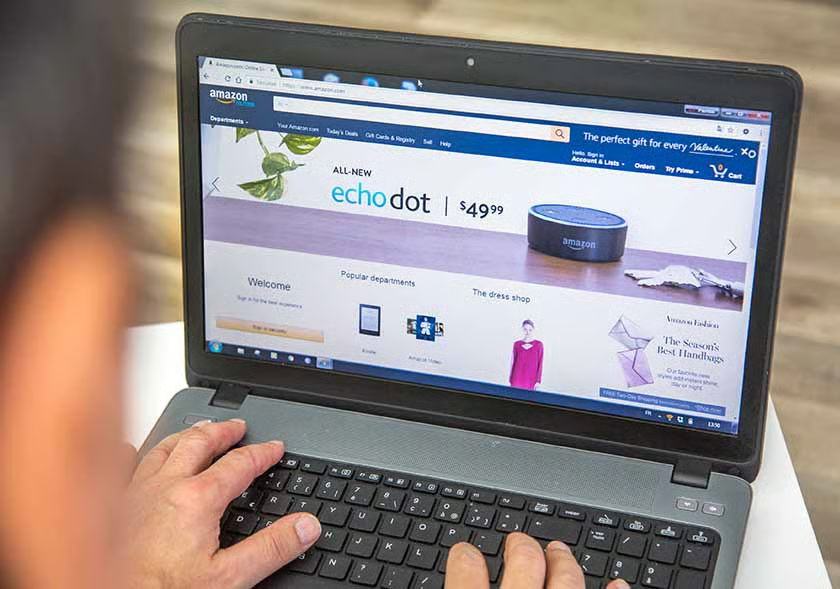
Startup costs can be a little high, as you’ll need to invest in good equipment and software to generate the best possible results for your clients. You’ll also need good communication and marketing skills to connect with them, understand their needs, and deliver a result that keeps them coming back for more.
Startup cost: $1,500-$5,000 (laptop or workstation, dev/design software/licenses, portfolio site & hosting, sample project costs)
Average annual revenue: $95,380 in 2024
Expected growth rate: 8.03% from 2021 to 2027
5. Content writing
Content writing is a broad field that can include copywriting, blog articles, social media posts, research and report writing, and more. A great number of business industries require some form of content writing: travel and tourism, education, marketing agencies, finance, and small businesses in general, to name just a few. In many cases, the highest-paying content writing gigs can be found in the tech, SaaS, and B2B industries.
Initial costs can be as simple as obtaining a laptop from which you can begin writing. You can pay for training classes and online courses to help improve your writing, but it’s also possible to level up your skills by researching best practices, connecting with experienced writers and other colleagues, and just writing a lot over time.
Startup cost: $500-$2,000 (laptop or upgrade, website/portfolio, editing tools/subscriptions, marketing/LinkedIn outreach)
Average annual revenue: $95,000 (Blogger)
Expected growth rate: 5.50% from 2023 to 2030
6. Language Translation
As businesses expand overseas, they will inevitably need some kind of language translation service or training to break communication barriers with new markets and business partners. Whether you offer your services as a freelance translator or build a small agency and find clients, you’ll find that multilingual skills are always in demand and monetizable.
Though some clients may opt to use machine translation, human translators still provide value; only a person can perceive and interpret language phenomena such as catchphrases and slang.
Startup cost: $1,500-$4,000 (computer, CAT-tool subscription or software, website, professional membership/marketing, optional travel budget)
Average annual revenue: $61,730
Expected growth rate: 2.7% from 2022 to 2032
7. Print on demand services
Print-on-demand businesses use a business model similar to dropshipping: instead of maintaining a steady inventory, they manufacture or deliver printed products (clothing, decor, etc.) only when a customer makes an order. This translates into simpler business operations as well as eliminating the need to keep up a large inventory count.
Print-on-demand isn’t the cheapest type of business to start; your main expense in the early stages will be obtaining high-quality printing equipment, for which you should expect to spend a few thousand dollars. You’ll also need to consider other details such as your target market, product range, and supplier management.
Startup cost: $500-$3,000 (design software, product samples, mockups, marketing; optional in-house printer for higher-end setups)
Average annual revenue: $39.909
Expected growth rate: 24.4% from 2023 to 2030
8. Virtual assistant
A virtual assistant helps a client (often a busy high-level executive or business owner) with tasks such as creating and analyzing reports, coordinating with customers and suppliers, managing a schedule, monitoring emails and other communications, creating presentations, and various other administrative tasks.

While you may not necessarily need formal training for a virtual assistant role, you’ll perform much better (and get much more attention from employers) if you can show experience in fulfilling the admin tasks required of you. Clients are often very busy and demanding, so expect a constant stream of work that you’ll need to stay on top of. If you perform well, you can expect good pay as well as referrals to other potential clients.
Startup cost: $300-$1,500 (laptop or upgrade, productivity/CRM tools, training courses, simple website/listing fees)
Average annual revenue: $50,749
Expected growth rate: 25.1% from 2022 to 2030
9. Cleaning business
Cleaning businesses are flexible, as they can be scaled up or down to include anything from entire office buildings to small houses. You can offer basic janitorial or tidying services, to more niche or large-scale tasks such as damage restoration or removal of waste and hazardous materials.
Your startup costs will depend on the choices you make in terms of scale and service offerings, but prepare to spend at least several hundred dollars for cleaning equipment.
Startup cost: $500-$3,000 (cleaning supplies & equipment, bonding/insurance, transportation, basic marketing, and client onboarding materials)
Average annual revenue: Up to $50,000
Expected growth rate: 8.7% from 2022 to 2030
10. Ghostwriting
Ghostwriting refers to writing something—from novels to speeches—for which another person will be credited as the author. Authors, political figures, and business leaders often hire ghostwriters to produce content that they themselves are too busy to create.

As with content writing, your initial costs will be little more than a laptop from which you can write. However, you’ll also need to establish your credibility as a writer over time. Prepare, maintain, and update a portfolio of your writing work so that you can showcase your growing skills to potential employers. One way to do this is to create a small business website that displays your previous writing projects and promotes your niche skills.
Startup cost: $500-$1,500 (laptop/upgrade, website & hosting, portfolio samples, editing tools/subscriptions)
Average annual revenue: $49,572
Expected growth rate: 6.80% from 2023 to 2030
11. Physical fitness training
Fitness training (which often goes hand-in-hand with diet and nutrition consulting) is a simple and reliably in-demand industry where you can end up making decent money without much initial investment. Startup costs are minimal, covering basic training courses such as first aid.
What will really get you more clients, though, is being able to help your first few customers get the results they want. As your reputation in the business improves, you can count on referrals and additional clients coming your way.
While training classes and certifications can help you get a leg up in the early stages, it’s just as important to have solid knowledge of exercise techniques and diet practices, and be able to communicate and work with people from all walks of life.
Startup cost: $200-$2,000 (certifications & liability insurance, basic portable equipment, marketing & booking tools)
Average annual revenue: $46,180 in 2024
Expected growth rate: 4.6% from 2023 to 2033
12. Commercial photography
As with podcasting, photography is a hobby that can also be turned into a profitable business if you choose to go the commercial route. Commercial photography is a relatively low-barrier field to enter, which means competition may be stiff. You’ll increase your chances of standing out and making a decent profit by investing in the best equipment you can afford, finding a niche demand to specialize in, and marketing and networking hard.

Similar to a fitness training business, more commercial photography work will come your way if you manage to impress your first few clients with outstanding results.
Startup cost: $2,000-$8,000 (camera body + one lens (or rental), lighting or flash, editing software, website/portfolio, sample shoot costs)
Average annual revenue: $42,345
Expected growth rate: 2.2% from 2022 to 2032
13. Private tutoring
On the client side, private tutoring is an attractive option because it allows a client’s children to get a leg up in formal education or address a challenge such as a learning deficiency within a private setting. On the service provider side, you’ll likely appreciate the opportunity to give guidance and learning to children of nearly any age. The ability to provide private tutoring either in person or virtually adds to the flexibility of this business option.
While initial costs will likely not be too high for this type of business, it would be beneficial to possess a degree in the subjects you’ll be teaching, or at the very least, have some previous experience. As with pet-sitting, keep your schedule flexible and be willing to travel if necessary.
Startup cost: $200-$1,500 (teaching materials, small marketing push, background check/certification if needed, scheduling tools)
Average annual revenue: $42,053
Expected growth rate: 9.65% from 2022 to 2027
14. Dropshipping
Dropshipping refers to a business model where you (the retailer) act as a storefront with whom customers interact and buy from, but instead of maintaining any inventory yourself, you fulfill orders using a third-party manufacturer or wholesaler. This gives you the advantage of not having to maintain any product stock, as well as keeping costs low by not buying or creating any more items that you need at the moment.
Startup cost: $100-$1,000 (ecommerce platform fees, sample orders, initial ad/test marketing budget, shipping/sample costs)
Average annual revenue: $40,970
Expected growth rate: 23.4% from 2023 to 2030
15. Podcasts
While podcasting is often thought of as a hobby or passion project, it can also be a legitimate, profit-oriented business model. Podcasters can monetize their content with affiliate sales and marketing, subscriptions for listeners, and product advertising. As the podcaster becomes more famous, sponsorships eventually become an option as well. According to Statista, nearly 160 million Americans consume podcasts every month in 2025.

Your startup costs will vary widely, largely depending on how professional a setup you want and how much you intend it to be a for-profit business rather than a hobby. At the higher end, prepare to spend a few thousand dollars for high-end equipment.
Startup cost: $200-$5,000 (microphone, audio interface or USB mic, hosting fees, intro music/artwork, optional editing software or freelance editor)
Average revenue: $300-$5,000 per 10,000 episode views
Expected growth rate: 48.5% from 2015 to 2023
16. Online courses
Create a focused online course or a paid membership that teaches a skill, process, or niche knowledge (think: “How to set up bookkeeping for micro-DAOs,” “Beginner woodworking projects,” or “Monthly copywriting playbooks”). This business converts expertise into repeatable content you can sell again and again.
The e-learning market is large and still growing, which means demand for packaged learning and ongoing memberships remains strong. You can earn anywhere from a modest side-hustle income to full-time revenue.
Startup cost: $500-$5,000 (camera or smartphone + basic lighting and mic, course hosting or membership platform fees, simple course platform/theme, sample production/editing, landing page & initial marketing)
Average revenue: $1,000-$10,000 per month
Expected growth rate: 8.20% from 2025 to 2029
17. Lawn care and landscaping
This business idea converts modest equipment and labor into recurring revenue: you can take on weekly or biweekly maintenance contracts, seasonal installations, and add-ons (such as fertilization, irrigation, or snow removal) that increase lifetime value. It’s easy to start as a solo operator (mow/trim/edge) and scale by adding crews, commercial contracts, or specialty services later on.

Profitability depends on efficient routing, recurring contracts, and upsells (such as hardscaping, seasonal cleanup, and landscape lighting). Owner-operators often earn modest incomes initially, while small teams or companies commonly scale into mid-six-figure revenues as they win commercial or managed accounts.
Startup cost: $500-$50,000 (basic push mower, trimmer, blower, yard tools, and safety gear at the low end; used truck/utility trailer, professional mowers, trailer-mounted equipment, insurance, and initial marketing toward the high end)
Average revenue: $49,686
Expected growth rate: 6.7% from 2025 to 2030
18. Property management
Property management is a low-cost business idea, as it monetizes other people’s assets—you sell time, trust, and operational reliability rather than buying property. Start as an Airbnb co-host (manage turnovers, messaging, pricing, and cleaners) or offer long-term rental management; both let you begin with minimal capital (software, marketing, basic supplies). Short-term rental co-hosting commonly pays via a percentage of revenue or flat monthly fees, so a small portfolio of listings can quickly turn into predictable monthly income.
You can scale into route-style recurring revenue by adding more properties or services, such as cleaning coordination, maintenance coordination, key/lock systems, and home staging for listings preparing to sell or rent. Home-staging jobs in particular can command healthy one-time fees (consultations often go for $200 to $500; full vacant home stagings commonly run $2,000 to $5,000+, depending on scope), creating a useful upsell for a property manager who already handles turnover and listing prep.
Startup cost: $200-$70,000
- Co-hosting solo: $200–$2,000—marketing, short-term rental software, key-exchange/cleaning coordination
- Small property manager: $5,000–$25,000—licensing, insurance/bonding, portfolio marketing, CRM/property software
- Medium-scale company: $25,000–$70,000+—staff, deposits, office/vehicle, working capital
Average revenue: $58,335
Expected growth rate: 8.4% from 2025 to 2035
19. Resale/recommerce
Resale is a promising business model that involves selling used or pre-owned products through marketplaces like eBay, Poshmark, Mercari, or your own shop. It’s highly accessible: you can start from home with a small inventory and scale by improving sourcing, listing skills, and fulfillment workflows.
Many resellers report healthy gross margins (often 10% to 50% on items). The broader secondhand/resale market is expanding quickly (especially apparel). On consignment platform ThredUp, brand adoption of resale programs increased by 3.4 times from 2023 to 2024.
Startup cost: $100-$30,000 (laptop/phone, inventory, basic shipping supplies, seller fees, and photography; inventory management tools)
Average revenue: Varies widely
Expected growth rate: 13% from 2024 to 2029
20. AI automation
Sell ready-made automations that connect a client’s apps (Zapier, Make, Airtable, Google Workspace, CRMs) or build AI-enhanced workflows—price them as a one-time build plus optional monthly support/monitoring. With this type of business, most of the cost is time and expertise rather than heavy equipment: you can start from a laptop, a few platform subscriptions, and a handful of template workflows you adapt for clients.
Demand is strong—Zapier or Make and other no-code platforms power millions of small-business automations, and companies increasingly outsource build + maintenance to specialists. You can scale from single-project gigs (one-time builds) into recurring revenue by offering monthly retainer plans (health checks, task-limits tuning, monitoring, small changes).
Startup cost: $500-$10,000 (laptop or workstation if needed, paid Zapier/Make plan(s) for development and testing, web hosting/portfolio, sample accounts or test data, marketing + sales templates, optional certification/course fees)
Average revenue: $116,607
Expected growth rate: 30.6% from 2024 to 2030
Frequently asked questions (FAQs)
Which business can you start under $50?
There are several low-cost, profitable business ideas you can start with minimal capital, especially if you use skills, inventory, or equipment you already own. For example, you can gradually start reselling pre-owned items, earn ghostwriting clients from referrals, and build online courses. However, to successfully grow your business, you’ll likely need to spend on software and marketing.
What’s the easiest home-based business?
The easiest home-based business to start is one that relies on skills you already have and equipment you already own, or one that has minimal startup costs. Some of these ideas include dropshipping, print on demand, content writing, web development, private tutoring, selling online courses, and recommerce.
What business is trending right now?
Businesses leveraging AI and technology are growing in demand. Explore AI or no-code automation, building AI workflows, and web development.
Bottom line
Starting a business will never be entirely free of initial costs, and even some of the options on this list will require you to invest a few thousand dollars at the beginning. But if you can use this list to find a business type that interests you, and minimize the startup costs while eventually expanding your market share and reputation, then you stand to make solid profits.
