Digital lending has changed the game in connecting business owners with funding opportunities. Instead of having to seek a traditional bank to finance your business, online lending platforms allow borrowers to compare and apply for a variety of business loans, often providing quick access to funds for a wide range of business uses. The best…
10 Best Cash Flow Loans for Small Businesses in 2026
Looking for the best cash flow loans for small businesses? Learn about top lenders, eligibility requirements, and options to manage your cash flow effectively.
I’ve tested Square across different small business setups, and one thing is consistent: the right hardware depends on how you sell. Your checkout flow, sales volume, and whether you’re mobile or stationary matter more than the upfront price. A weekend market vendor can run with a simple reader, while a busy retail store needs a structured counter setup to keep lines moving.
In this guide, I break down each Square device, show you what it actually does in real use, and help you choose the best fit for your business.
Square’s POS software is free to start, with paid upgrades available depending on your business needs. It uses a unified pricing model with three plans — Square Free, Square Plus, and Square Premium — so your POS, payments, inventory, and customer tools all run on the same system without needing extra integrations.
Square earns revenue through payment processing, with standard rates typically starting at 2.6% + 15 cents per in-person transaction. Square hardware is also proprietary, meaning it only works with Square POS. While you can’t use it with other systems, the benefit is a more streamlined setup where everything is designed to work together out of the box.
If you just need to accept quick and simple card payments, use Square Reader.
If you sell at pop-ups or need a mobile setup, use Square Terminal or Square Handheld.
If you run a retail checkout counter, use Square Stand or Square Register.
If you manage a high-volume retail store, use Square Register.
If you operate a restaurant or need tableside service, use Square Handheld.
If you want customers to place their own orders, use Square Kiosk.
If you want the simplest all-in-one setup with minimal accessories, use Square Terminal.
If you’re just starting out and want the lowest upfront cost, use Square Reader.
Square Reader (magstripe vs contactless and chip): Best for low-cost card payments
Who should use it: Solo, occasional or on-the-go sellers, service providers, and new businesses testing demand.
Pricing: Free for the first order; $10 for every succeeding purchase for the Square Reader for magstripe; $59 or $21 per month with financing for the Square Reader for contactless and chip
Both versions connect to your phone or tablet and use the Square POS app to process payments. You enter the sale on your device, then the customer completes the payment on the reader.
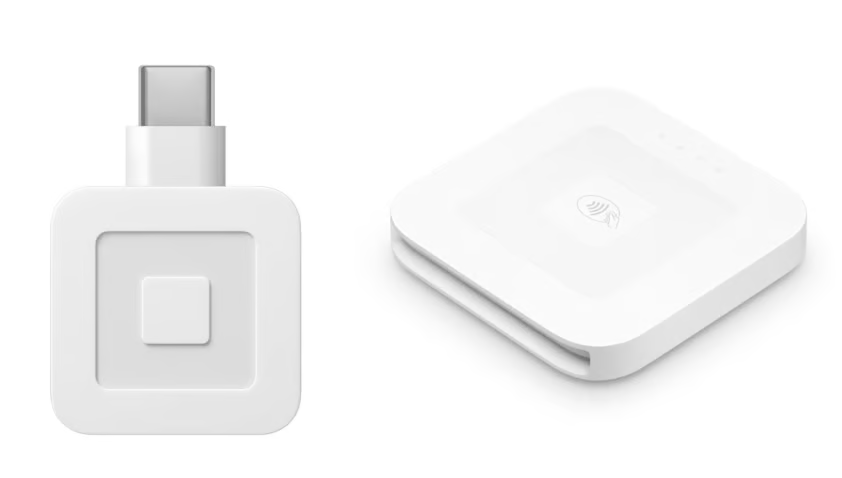
Square Reader for magstripe (left) and Square Reader for contactless and chip (right).
The magstripe reader plugs into your phone (or connects via adapter) and only accepts swipe payments.
The contactless and chip reader connects via Bluetooth and supports tap, chip, and mobile wallets like Apple Pay.
In practice, setup is quick for both, but the contactless version is noticeably smoother for everyday use since most customers prefer tapping or inserting cards.
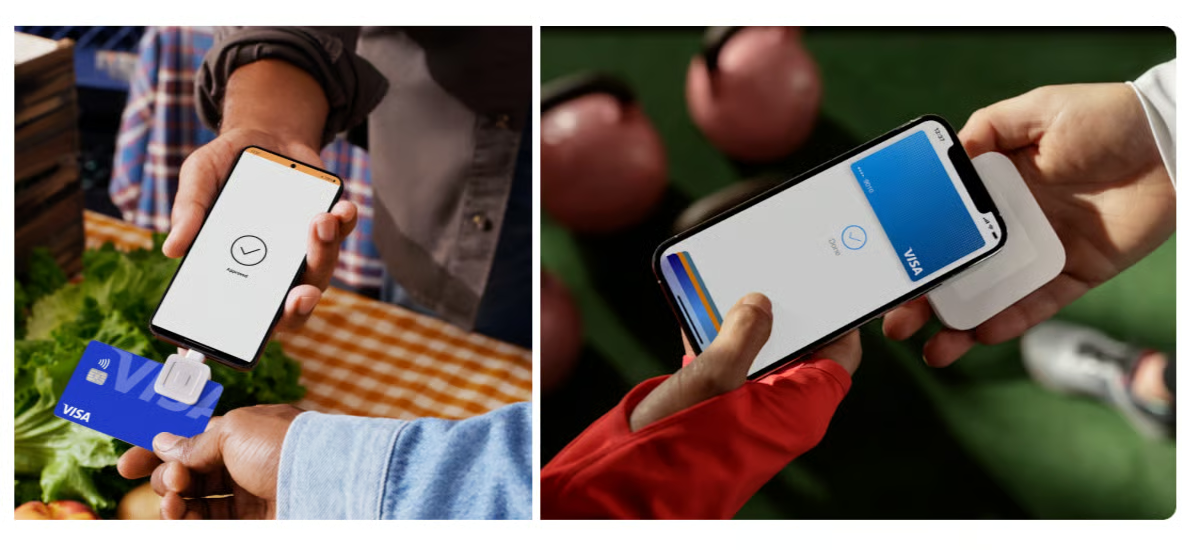
Using Square Readers to accept card and contactless payments on a smartphone — magstrip on the left, contactless and chip on the right.
Magstripe vs contactless and chip: Key differences
Both readers are the most affordable and portable options in Square’s lineup, but they’re also the most limited.
Unlike Square Terminal or Square Register, they rely entirely on your phone or tablet and don’t support built-in receipts or advanced checkout workflows. As your business grows or your sales volume increases, you’ll likely want to upgrade to a standalone device for faster and more consistent checkout.
Square Terminal: Best for small businesses that want a simple, all-in-one POS
Who should use it: Small retail shops, cafes, and service businesses
Pricing: $299 or $27 per month for 12 months with financing
Limited for advanced inventory or multi-register setups
Compact and easy to move around
Higher upfront cost than card readers
How Square Terminal works
Square Terminal is a standalone device that runs the Square POS system directly on the hardware. You ring up sales on the touchscreen, and customers can tap, insert, or swipe their card right on the device. Receipts can be printed from the built-in printer or sent digitally.
This is the easiest Square device to set up and start using. You don’t have to pair it with another device or worry about compatibility. It’s a strong fit if you want a clean counter or need something portable without adding extra hardware.
Square Terminal sits in the middle of Square’s lineup. It’s more capable than Square Reader since it doesn’t rely on a phone, but it’s less suited than Square Register or Stand for managing larger inventories or multiple employees. It works best for straightforward sales like cafes, small shops, and service businesses.
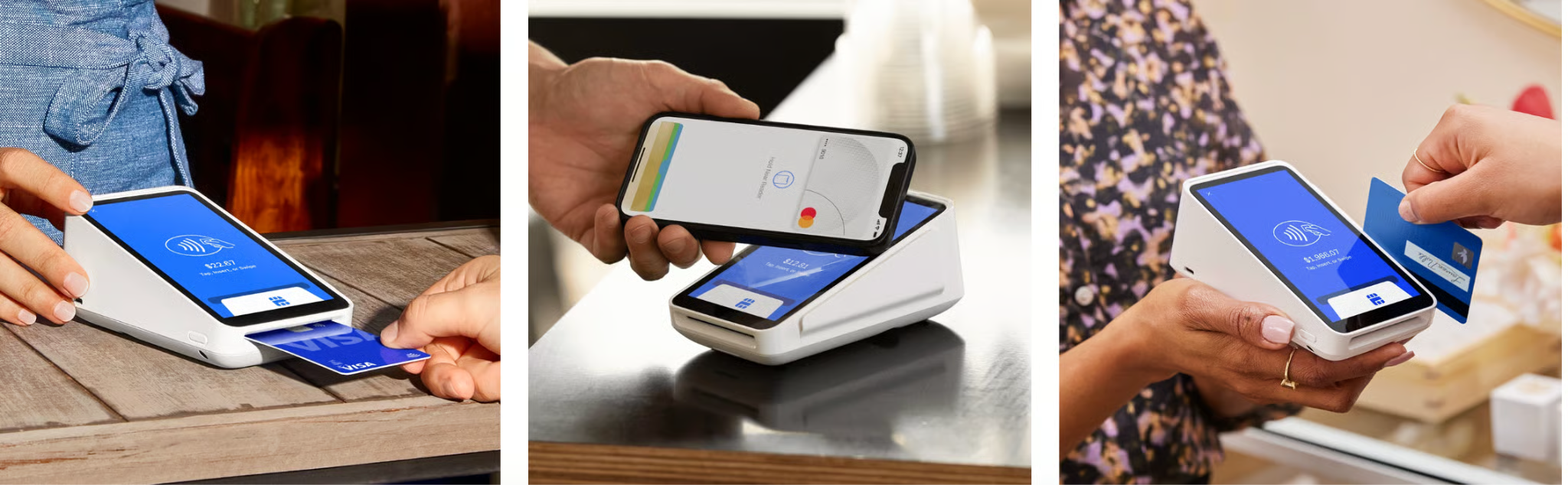
Square Terminal can accept chip, tap, and mobile wallet payments.
How it compares to other Square hardware
Square Terminal is the easiest all-in-one option in Square’s lineup. It combines payment processing, a screen, and receipt printing into a single device.
Unlike Square Reader, it doesn’t depend on your phone. Compared to Square Stand or Register, it’s more compact and flexible but less suited for high-volume retail or complex workflows. If you need something simple that can handle daily sales without extra setup, this is usually the best middle-ground option.
Square Handheld: Best mobile POS for food businesses and service teams
Who should use it: Restaurants, cafes, and service-based businesses that need to take orders and payments away from a central counter.
Square Handheld is a portable, all-in-one device that lets you take orders and accept payments from anywhere. Staff can input orders directly on the device, then customers can tap, insert, or swipe their card on the same unit.
This is where Square stands out for restaurants. Instead of walking back and forth between tables and a register, staff can take orders and payments on the spot, which speeds up service and reduces errors.
Compared to other Square hardware, Handheld is built specifically for mobility. It’s more powerful than the Square Reader since it doesn’t rely on a phone, but unlike Square Terminal, it doesn’t include a receipt printer. Most businesses use it alongside a central system like Square Stand or Register for a complete setup.
How it compares to other Square hardware
Square Handheld is the most mobile option in Square’s lineup with a full POS experience built in.
Unlike Square Terminal, it’s designed for movement rather than countertop use. Compared to Square Reader, it’s a more complete solution that doesn’t depend on a phone. However, it’s not meant to replace a full register setup, especially for businesses that need printed receipts or a fixed checkout station.
Square Stand: Best iPad-based POS for retail counters
Who should use it: Retail stores, boutiques, and small shops that want a structured checkout counter without investing in a full register system.
Pricing: From $149 (iPad sold separately) or $14 per month with financing
Works with accessories like printers, cash drawers, and scanners
Not portable like handheld devices
How Square Stand works
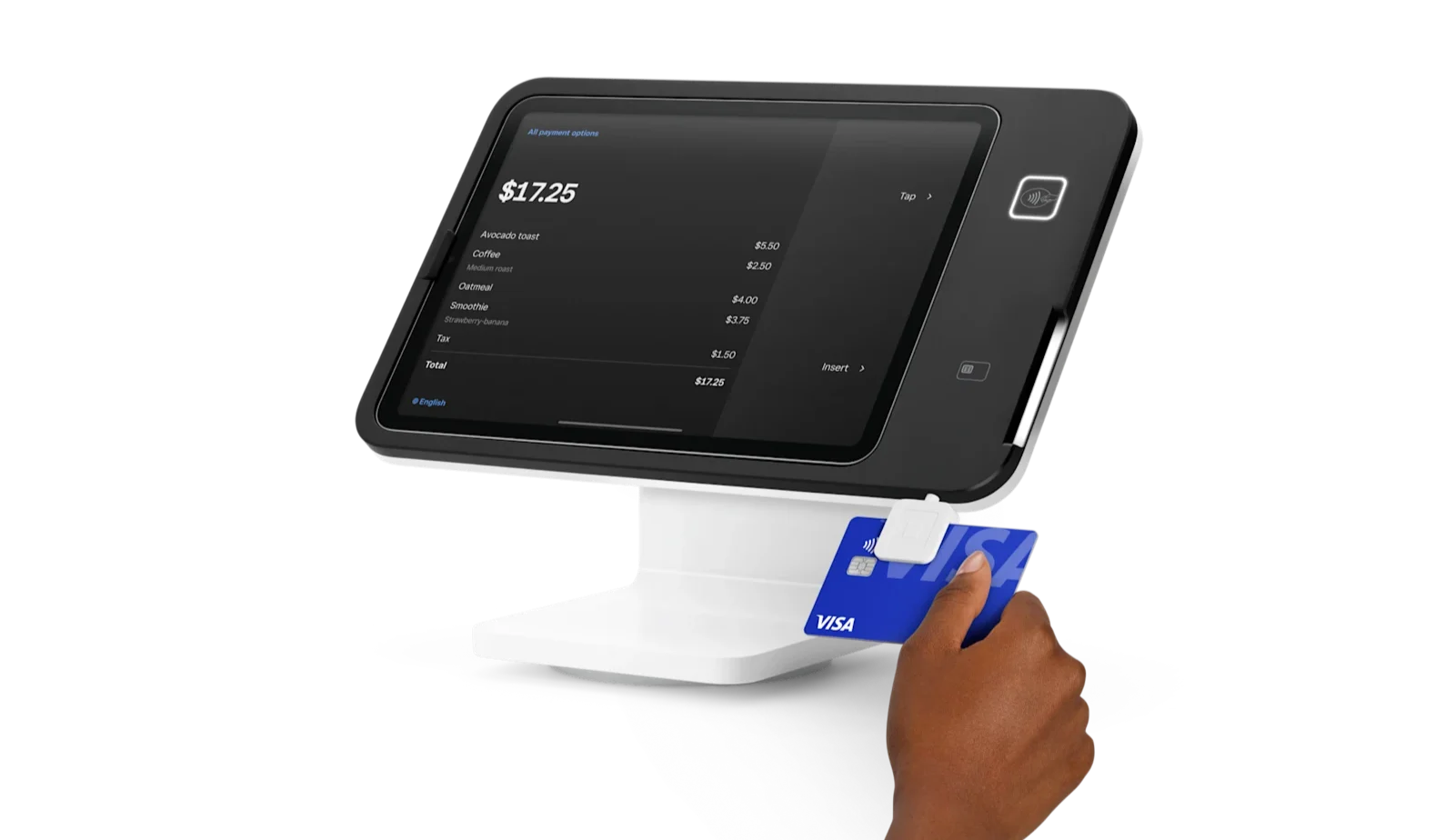
Square Stand is a dock that holds your iPad and connects it to the Square POS system. You run the Square app on the iPad, process sales on the screen, and customers can tap, insert, or swipe their card using the built-in reader.
This setup feels the most familiar for retail environments. The larger screen makes it easier to browse products, manage inventory, and train staff compared to smaller devices like Square Terminal.
Square Stand gives you more flexibility than Square Terminal but requires additional hardware to complete your setup. It’s a good fit for retail businesses that want a larger screen and customizable checkout without committing to a full register system.
Square Stand turns an iPad into a countertop POS for retail checkout.
How it compares to other Square hardware
Square Stand is best suited for countertop use with a more traditional POS setup.
Unlike Square Terminal, it relies on an iPad but gives you a larger display and more room to manage inventory. Compared to Square Register, it’s more affordable and flexible, but requires additional hardware to match a full checkout system. It’s a good middle-ground option for retail businesses that want customization without the higher upfront cost.
Square Register: Best for high-volume retail stores
Who should use it: Established retail businesses with steady foot traffic, multiple staff members, or more complex checkout needs.
Pricing: $899 or $44 per month for 24 months with financing
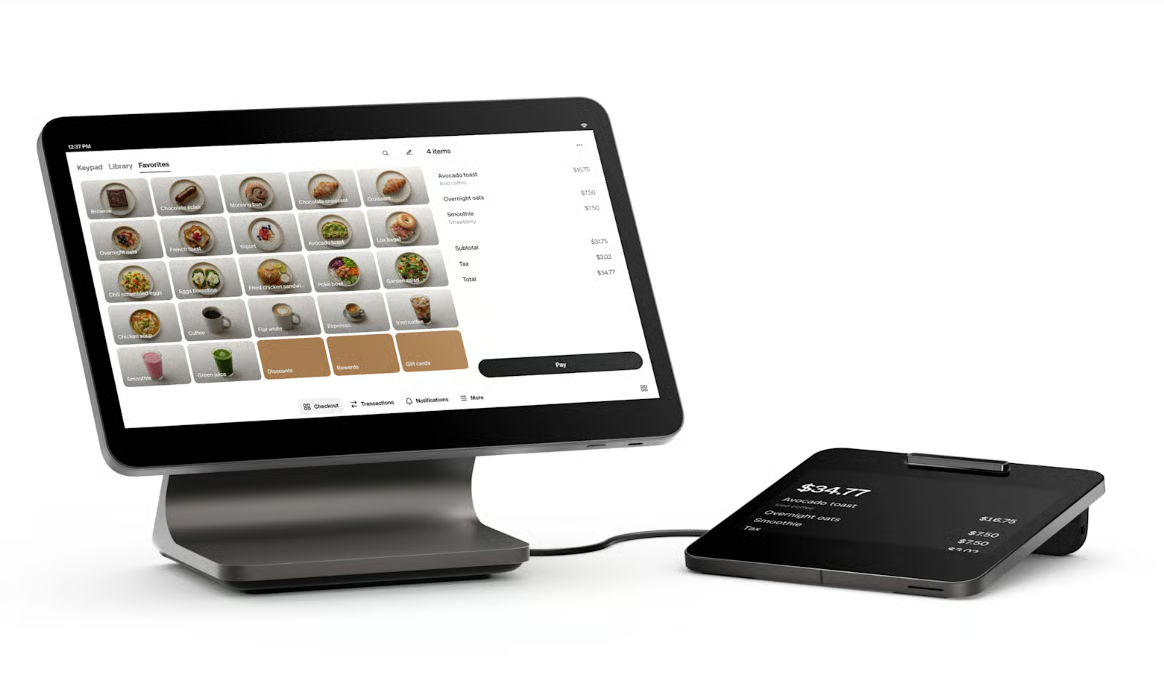
Square Register is a complete countertop POS system with two screens: a larger display for your staff and a smaller customer-facing screen for payment. Staff ring up sales on the main screen, and customers can tap, insert, or swipe their card on the customer display.
Square Register delivers the fastest and most consistent checkout experience in Square’s lineup. It feels closest to a traditional retail POS, especially when you’re processing back-to-back transactions throughout the day.
It’s the most robust option Square offers. Compared to Square Stand or Terminal, it handles higher transaction volume more efficiently, but it comes with a higher upfront cost and less flexibility.
Square Register with dual screens for staff checkout and customer payment.
How it compares to other Square hardware
Square Register is the most complete countertop POS in Square’s lineup.
Unlike Square Stand, it doesn’t rely on an iPad and includes a built-in customer display. Compared to Square Terminal, it offers a larger screen and better support for high-volume sales. It’s the best choice if you want a dedicated checkout station that can handle heavy daily use.
Square Kiosk: Best for self-service ordering in quick-service restaurants
Who should use it: Quick-service restaurants, cafes, and high-traffic businesses that want customers to place their own orders.
Pricing: $149 or $14 per month with financing (iPad sold separately)
Allows customers to place and pay for orders themselves
Requires space and setup planning
Reduces wait times and front-of-house workload
Higher upfront investment
Helps improve order accuracy
Not necessary for low-volume businesses
How Square Kiosk works
Square Kiosk is a self-service ordering station where customers browse your menu, place their order, and complete payment on the screen. Orders are then sent directly to your POS system or kitchen for fulfillment.
Kiosks work best in busy environments where lines build quickly. Customers can order at their own pace, which reduces pressure on staff and keeps service moving during peak hours.
Square Kiosk is a specialized add-on, not a replacement for your POS. Most businesses pair it with Square Register or Stand to manage orders and operations behind the scenes.
How it compares to other Square hardware
Square Kiosk is designed specifically for self-service, not traditional checkout.
Unlike Square Handheld or Terminal, staff don’t use it to take payments. Compared to Square Register, it doesn’t replace your main POS but works alongside it to handle ordering. It’s best suited for businesses focused on speed, efficiency, and reducing front-of-house labor.
These setups mirror common Square POS kits but give you flexibility to mix and match hardware based on how you actually operate.
For the solo seller or pop-up seller
Square Reader for contactless and chip
Smartphone or tablet
Portable battery pack (optional)
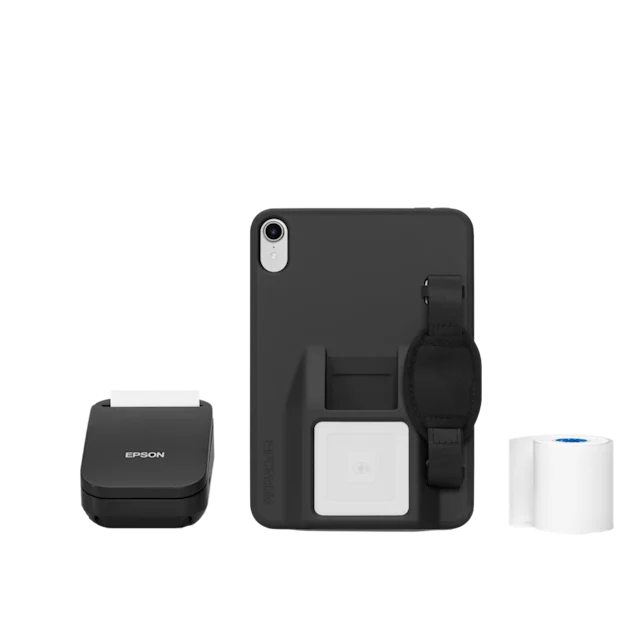
Recommended kit:Mobile POS Kit for Square Reader ($399 or $37 per month with financing) — This is the simplest and lowest-cost way to start. You don’t need a full kit here. Most sellers just use a reader and their phone, then upgrade later.
The Square Mobile POS kit is an on-the-go POS kit for the 6th generation iPad Mini.
For small shops or cafes
This is where kits start to make sense. If you want something simple, Terminal works. If you want a more complete setup with accessories included, a Stand or Register kit saves time.
Square Terminal or
Square Stand + iPad
Receipt printer (optional)
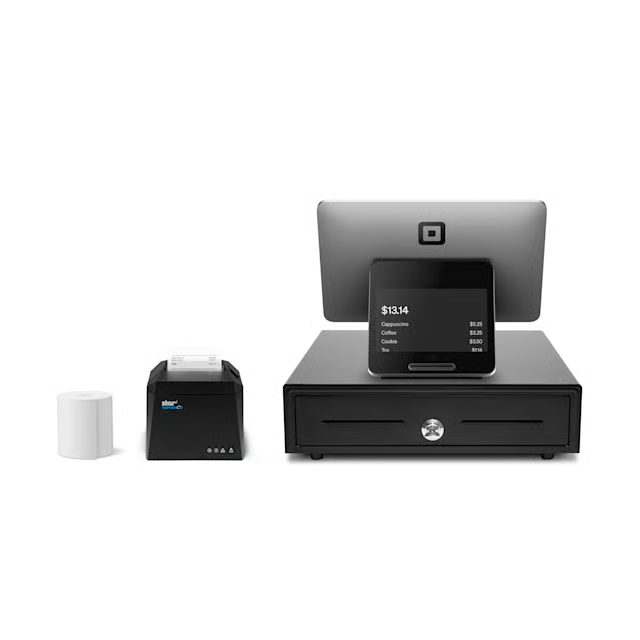
Recommended kit: Upgrade to a Square Register kit ($1,189 or $58 per month with financing) if you expect steady foot traffic. I suggest you add a Square Handheld if you like to accept tableside payments.
The Square Register Kit includes Square Register (2nd generation), cash drawer, and receipt printer.
For retail stores
Retail is where bundled kits really pay off. This setup includes everything you need to run checkout, print receipts, and manage inventory without piecing components together.
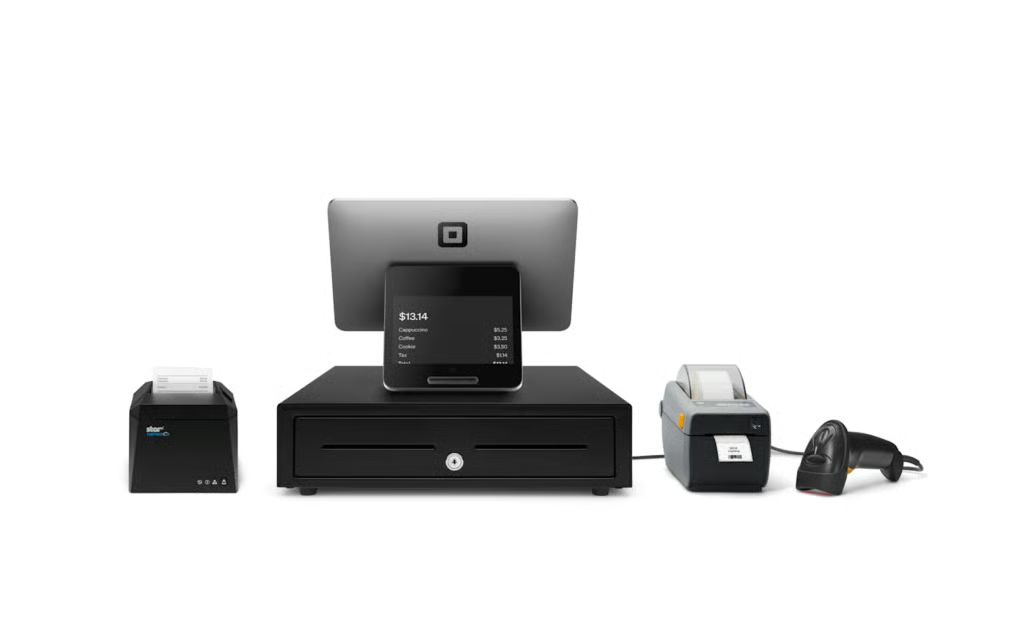
The Square Register Retail Kit includes Square Register (2nd generation), cash drawer, receipt printer, barcode label printer and barcode scanner.
For high-volume retail
Square Register
Cash drawer
Receipt printer
Barcode scanner
Recommended kit: If you’re processing transactions all day, a full Register kit is the most efficient setup. It’s designed to be ready out of the box with core accessories included.
Full-service restaurant
Restaurants usually need a mix of stationary and mobile devices. A Stand-based kit works well as your main POS, while handhelds handle tableside ordering.
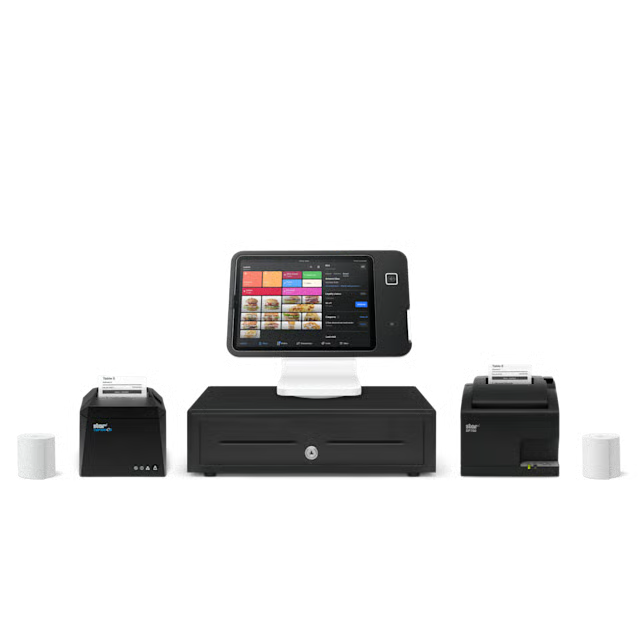
The Square Stand Kit for Restaurants includes a Square Stand (2nd generation) cash drawer, receipt printer, impact printer, and paper.
Quick-service or self-ordering
Kiosk setups are best for high-traffic environments. They don’t replace your POS but work alongside it to reduce lines and improve ordering speed.
Square Kiosk
Kitchen printer
Optional: Square Terminal (backup checkout)
Square accessories and add-ons to budget for
Most Square hardware setups need a few extra pieces to function as a complete POS. These are often the hidden costs that increase your total setup price.
Your total cost depends less on the main device and more on the accessories you add. A basic mobile setup may only need a reader, while a full retail or restaurant setup can include printers, drawers, scanners, and mounts.
Accessory
Price range
What it’s for
Receipt printers
$249-$369
Prints customer receipts or kitchen orders. Most countertop setups need one. Thermal printers don’t require ink and connect via USB, Bluetooth, or Ethernet. Paper typically costs around $89 for 36 rolls.
Cash drawers
$99-$549
Stores cash and opens automatically during transactions. Connects to the receipt printer via cable. Usually includes bill and coin compartments.
Barcode scanners
$119-$249
Speeds up checkout and inventory tracking by scanning products instead of manual entry. Connects via USB or Bluetooth.
Stands, mounts, and docks
$39-$299
Secures your device at the counter, reduces clutter, and improves workflow. Common for iPad-based setups like Square Stand and kiosks.
Do you need Square hardware or can you use your own device?
You don’t need to buy Square hardware right away. Many small businesses start with a phone or tablet and upgrade as their sales grow.
I recommend using your own device if you:
Are just starting out or testing a business
Have low sales volume
Sell on the go (markets, services, pop-ups)
Want the lowest upfront cost
Remember you can get your first Square Reader magstripe for free. You can also get a Square Reader for contactless and chip if you need to accept NFC payments.
Invest in Square hardware if you:
Process many transactions daily
Have employees using your POS
Want faster checkout and fewer errors
Need a more professional, fixed setup
Dedicated hardware like Square Terminal, Stand, or Register helps streamline operations and reduces reliance on personal devices.
Square hardware limitations to know before you buy
Square hardware is easy to start with, but most businesses will need to upgrade as they grow. There are a few tradeoffs to keep in mind before you commit.
Some setups require extra accessories: Devices like Square Stand and Register often need a receipt printer, cash drawer, or scanner to function as a complete POS. These add to your total cost.
Entry-level hardware can slow you down: Square Reader works well for occasional sales, but it can slow checkout during busy periods since everything runs through your phone.
Not all devices are built for mobility: Square Register and Kiosk are designed for fixed setups. If you need flexibility, you’ll need a mobile device like Square Handheld or Terminal.
Some systems are better for simple workflows: Devices like Square Terminal are great for straightforward transactions but may feel limited if you need advanced inventory tracking or multi-register setups.
What to consider when choosing Square hardware
Choosing Square hardware comes down to how your business runs day to day. Start with how you sell, then match your setup to your workflow, staff, and sales volume.
How you sell: If you sell on the go, you’ll need a mobile setup like Square Reader, Terminal, or Handheld. If you sell at a counter, Square Stand or Register is a better fit.
Your transaction volume: Low-volume businesses can get by with simpler hardware. Higher-volume stores need faster systems like Square Register to keep lines moving.
Mobility vs fixed setup: If you need to move around (restaurants, events), choose portable devices. For a dedicated checkout area, go with a countertop system.
Your budget (including accessories): Don’t just look at the device price. Factor in the cost of printers, drawers, and other add-ons when comparing options.
Your future growth: Choose hardware that can scale with your business. It’s often worth investing in a more capable setup early if you expect to grow quickly.
Frequently asked questions (FAQs)
What is the best Square hardware for a small business?
The best Square hardware depends on how you run your business. For most small businesses, Square Terminal is the easiest all-in-one option since it includes a screen, card reader, and receipt printer in a single device. If you’re just starting out or want to keep costs low, Square Reader is a practical entry point. Retail stores with a fixed checkout counter may benefit more from Square Stand or Square Register for a more structured setup.
Which Square device has a built-in receipt printer?
Square Terminal is the only Square device with a built-in receipt printer. All other hardware, including Square Stand and Square Register, requires a separate printer if you want to provide printed receipts.
Do I need an iPad for Square Stand?
Yes, Square Stand requires an iPad to function. The Stand acts as a dock and card reader, while the Square POS app runs on the iPad itself, so you’ll need to purchase or already have a compatible iPad.
Can I use Square without buying hardware?
Yes, you can use Square without buying dedicated hardware by running the Square POS app on your phone or tablet. You can manually enter payments or pair your device with a Square Reader, which is the lowest-cost way to start accepting card payments.
What accessories do I need for Square POS?
Most Square setups require a few accessories to function as a complete POS system. Common add-ons include a receipt printer for printed receipts, a cash drawer if you accept cash, and a barcode scanner for retail inventory. Depending on your setup, you may also need mounts, stands, or networking equipment to keep your system stable and reliable.
Bottom line
The best Square hardware depends on how you run your business, not just your budget.
If you’re just starting out or selling on the go, Square Reader or Square Terminal gives you a low-cost, flexible setup. For retail stores, Square Stand or Square Register offers a more structured checkout experience. Restaurants and service businesses benefit most from Square Handheld for mobility, while Square Kiosk works best for high-volume, self-service environments.
Start simple, then upgrade as your sales volume and operational needs grow. The right setup should make checkout faster and easier for both you and your customers.
If you’re ready to build your setup, visit Square to compare hardware, explore POS kits, and find the right system for your business.
Agatha Aviso is a seasoned expert in retail, eCommerce, and order fulfillment, with a specialization in payments, POS systems, and eCommerce software. She has collaborated with startups and service-based entrepreneurs on content strategy, offering digital marketing expertise and guiding small business owners in launching their online storefronts.
Beyond consulting, Agatha applies her knowledge firsthand—building her own website as well as ecommerce sites for the platforms she reviews.
Loading more content…
Our mission is to provide small business owners with the information you need to succeed. Learn how to start, market, run, and grow your business today!
Advertiser Disclosure: Some of the products that appear on this site are from companies from which TechnologyAdvice receives compensation. This compensation may impact how and where products appear on this site including, for example, the order in which they appear. TechnologyAdvice does not include all companies or all types of products available in the marketplace.