





The best self-service kiosk helps customers place orders, check out, make payments, and complete routine transactions without staff assistance. These systems can reduce lines, speed up service, increase upsells, and give customers more control over the ordering or checkout process.
For this guide, I reviewed self-service kiosk systems based on pricing, payment options, hardware flexibility, POS integrations, kiosk ordering tools, ease of use, and small business value. Square is my top pick for most small businesses because it is affordable, easy to set up, and works well for small restaurants, cafes, and retail kiosks.
| Provider | Best for | Monthly fee |
|---|---|---|
| Square | Small restaurants and retail kiosks | $0-$149 (with POS) |
| Toast | High-volume restaurant self-ordering | $0-$69 |
| KORONA POS | Ticketing and admissions kiosks | $59-$79 |
| Lightspeed | Tabletop restaurant self-ordering | $69-$399+ (with POS) |
| IT Retail | Grocery and market self-checkouts | $49-$149 |
| Clover | Simple, hardware-first self-service kiosks | $34.95 (with POS) |
- Best self-serve kiosks compared
- How I chose the best self-service kiosks
- Square: Best overall self-service kiosk for food and beverage
- Toast: Best overall kiosk for restaurants
- KORONA POS: Best for ticket-selling kiosks
- Lightspeed Restaurant: Best tabletop restaurant kiosk
- IT Retail: Best for grocery and market kiosks
- Clover: Best for simple, hardware-first self-service kiosks
- Methodology: How I evaluated the best self-service kiosks for small businesses
- What is a self-service kiosk?
- When is a self-service kiosk worth it?
- How much a self-service kiosk really costs
- How to choose the best self-service kiosk for your business
- Frequently asked questions
- Bottom line
Best self-serve kiosks compared
| Provider | My score (out of 5) | KDS integration | Loyalty support | Offline mode | Contract length |
|---|---|---|---|---|---|
| Square | 4.34 | Yes | Yes | Yes | Month-to-month |
| Toast | 4.23 | Yes | Yes | Limited | 2 years |
| KORONA POS | 4.14 | Yes | Yes | Yes | Month-to-month |
| Lightspeed | 3.84 | Yes | Yes | Limited | 1 year |
| IT Retail | 3.64 | Yes | Yes | Yes | Month-to-month |
| Clover | 3.61 | Limited | Yes | Limited | Month-to-month / 1 year |
How I chose the best self-service kiosks
I compared more than a dozen self-service kiosk systems based on pricing, payment options, hardware flexibility, kiosk features, POS integrations, ease of use, and overall value for small businesses. I also considered whether each system works well for real customer-facing workflows, such as food ordering, ticketing, grocery checkout, tabletop ordering, and retail self-checkout.
My final recommendations prioritize systems that are practical for independent business owners and easy for customers and staff to use. Learn more about my full methodology below.
Square: Best overall self-service kiosk for food and beverage
Why I chose Square
Square offers one of the most accessible ways for small businesses to add a self-service kiosk without committing to expensive hardware or long-term contracts. Square combines an easy-to-use POS with affordable kiosk software, making it a strong option for businesses that want to start small and scale over time. In fact, Square’s POS systems regularly appear in our POS rankings because they are functional, affordable, and self-installable.
Square’s kiosk setup isn’t as customizable as some restaurant-first platforms, and it locks you into Square’s payment processing. That said, it’s hard to beat Square’s mix of low upfront costs, flexible hardware options, and fast setup, especially compared to systems like Toast that require more hands-on onboarding.
If you’re adding a kiosk to a small cafe or retail shop and want something affordable that you can set up quickly, Square is usually the easiest place to start.
Who should use Square
- Small restaurants, cafes, and counter-service food businesses
- Retail stores looking for simple self-ordering or self-checkout
- New or growing businesses that want low upfront costs
- Owners who want a kiosk that’s easy to install and manage
How is Square’s self-service kiosk priced?
Square’s self-service kiosk pricing is flexible and modular, which makes it easy for small businesses to build a kiosk setup that fits their space and budget.
Kiosk hardware
Square’s Self-Service Kiosk (USB-C) is an iPad-driven kiosk device with built-in payments for self-serve ordering. The hardware costs $149 (or monthly financing) and requires a compatible iPad, sold separately. Compatible iPads include:
- iPad (A16)
- iPad (10th generation)
- iPad Pro 11-inch (1st–4th generation)
- iPad Air (4th, 5th generation)
- iPad Air 11-inch (M2, M3)
To create a freestanding kiosk, you can pair the Square Kiosk with a Bosstab floor stand for $299.
Kiosk software
Square Kiosk runs through the Square Kiosk app and requires a paid Square POS plan:
- $50 per month per device with Square Plus
- $30 per month per device with Square Premium
This setup syncs front- and back-of-house operations with real-time menu updates, order routing, and sales data.
- POS software fees: $0-$149 per month, depending on plan tier
- Installation fee: None; setup is DIY with guided onboarding
- Contract length: Month to month; no long-term commitment
Square POS works exclusively with Square Payments, which simplifies setup but means you can’t use a third-party processor.
Payment processing fees:
- In-person: 2.6% + 15 cents
- Online: 2.9% + 30 cents
- Keyed-in: 3.5% + 15 cents
- Custom rates are available for businesses processing over $250,000 annually.
Square standout features
- Square Kiosk: Previously, Square users had to integrate with kiosk apps designed to work with the Square interface. Now Square has developed its own kiosk hardware (a stand and iPad connector) and software, so users can access native kiosk tools without needing to integrate with external software. The kiosk pricing is affordable, and you’ll get the same in-person processing rate as with other Square functions (2.6% + 15 cents).
- Integrated Square loyalty: You can give your restaurant an upgrade by offering automated rewards. Every system on this list will track customer rewards; however, some, like Lightspeed, lack the ability to redeem rewards at the kiosk. Rewards redemption at the kiosk is a really great feature offered by this low-cost kiosk.
- Kitchen Display System: With the Square KDS, your front- and back-of-house operations will remain coordinated. You can customize tickets, timers, and notifications as you like. You’ll also have access to reports that allow you to optimize your kitchen procedures for greater speed and efficiency.
Toast: Best overall kiosk for restaurants
Why I chose Toast
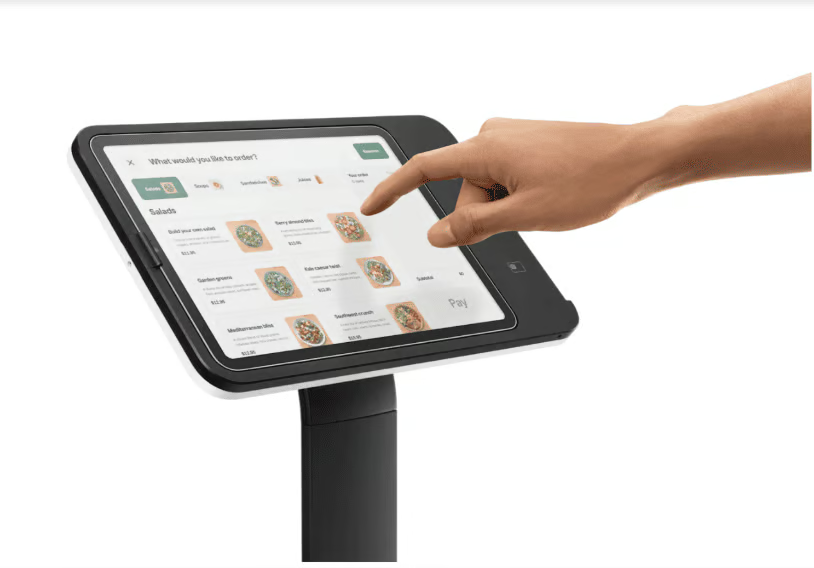
Toast is consistently our top pick for restaurant POS and more specialized software rankings, from cafe POS to kitchen display systems (KDSes). It stands out because it’s purpose-built for restaurant operations and handles high-volume self-ordering better than most general POS systems. Its self-service kiosk connects directly to the POS and KDS, sends orders straight to the kitchen, and supports SMS alerts and QR-coded receipts so customers can pay quickly without crowding the counter.
The main drawback is cost and commitment. Toast’s kiosk is free upfront only if you agree to higher processing rates, and paid plans can get expensive compared to Square. Still, for restaurants that need durability, speed, and tight kitchen coordination, Toast offers deeper restaurant functionality than more flexible but less specialized systems.
If your restaurant sees heavy traffic or relies on kitchen display systems to keep orders moving, Toast is a better fit than more general kiosk setups.
Who should use Toast
- High-volume restaurants and QSRs
- Full-service or fast-casual restaurants with complex menus
- Multi-location restaurant groups
- Operators who want built-in KDS and restaurant-first workflows
How is Toast’s self-service kiosk priced?
- Monthly software fees:
- Starter Kit: $0+
- Point of Sale: $69+
- Build Your Own: Custom pricing
- Monthly self-service kiosk fee:
- Upfront payment: $1,339.20 + $99 to $609 per month
- Pay-as-you-Go: $0 upfront
- In-person payment processing rate:
- Standard: 2.49% + 15 cents
- Pay-as-You-Go: 3.09% + 15 cents to 3.69% + 15 cents
- Contract length: 2 years
- Free trial: None
Toast standout features
- Free Starter POS: Toast’s baseline Starter Kit POS subscription has no monthly software fees. However, you pay slightly higher processing fees (3.09% + 15 cents vs 2.49% + 15 cents). You can also get up to two terminals, including the self-service kiosk hardware, for $0 upfront with the Starter Kit POS.
- SMS text alerts: The Toast kiosk requests customer phone numbers for kiosk orders and sends them automated alerts when their orders are ready.
- QR-coded receipts: The Toast kiosk cannot process cash payments directly at the kiosk; most affordable restaurant kiosks lack this feature. But, Toast offers a low-cost workaround: QR codes printed at the bottom of receipts. Cash-paying customers present their QR-coded receipt to a central cashier, where it can be scanned and immediately pulled up on the POS terminal.
- Flexible hardware: Your Toast kiosks integrate with barcode scanners and scales. So, if you sell build-your-own salads by weight or packaged ready-to-eat (RTE) and ready-to-drink (RTD) items, your customers can still check themselves out. Since you are not locked into iPads, you can also choose 10”, 15”, or 22” touch screens for your kiosks.
KORONA POS: Best for ticket-selling kiosks
Why I chose KORONA POS
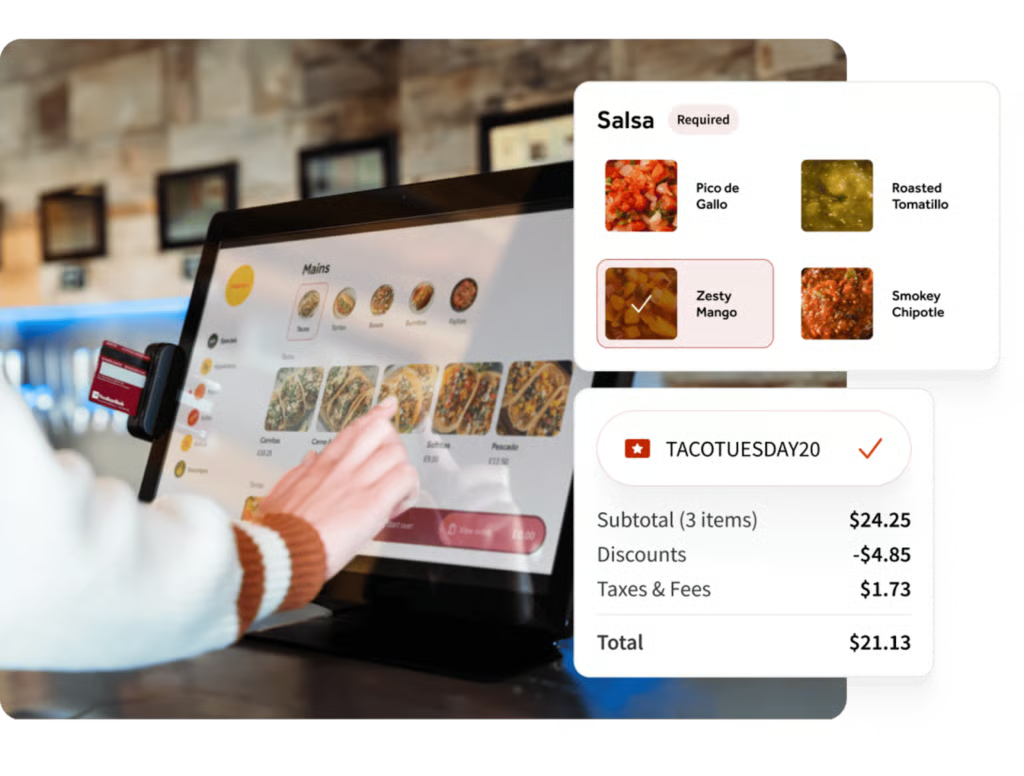
KORONA POS stood out for ticket-based and high-traffic venues where lines can form quickly and access control matters. Its kiosk tools support time-based ticketing, turnstile integration, and RFID scanning, which makes it well-suited for managing admissions while reducing duplicate scans and losses.
The main drawback is cost transparency. KORONA’s hardware pricing isn’t always clear upfront, and ticketing features require a paid add-on per gate. That said, compared with more restaurant-focused systems like Square or Toast, KORONA offers deeper ticketing functionality, industrial-grade kiosk hardware, and the flexibility of month-to-month plans.
If your business relies on ticket sales or controlled entry, KORONA POS is a stronger choice than restaurant-first kiosk systems.
Who should use KORONA POS
- Amusement parks and tourist attractions
- Museums, zoos, and exhibits
- Event venues with timed or gated entry
- Businesses that need RFID or turnstile integration
How is KORONA POS’ self-serve kiosk priced?
- Monthly software fees:
- Core: $59
- Retail: $79
- Plus: +$20 per terminal
- Food, invoicing, ticketing add-ons: +$10 to $50 per month
- Monthly self-service kiosk fee: Custom-quoted
- In-person payment processing rate: Depends on payment processor
- Contract length: Month-to-month
- Free trial: Unlimited
KORONA POS standout features
- Time-based ticketing tools: You can customize the tickets in your KORONA to be tied to specific entry times. This is useful if you need to control traffic flow or if your tickets are for an event with specific start and end times, like a concert.
- Memberships and season passes: Tourist attractions and local parks will love the ability to bill and scan membership cards and season passes. The setup for these ticket types is included in your KORONA POS system; you just have to choose your desired settings. You can further customize memberships by tiers, giving some members access to specific attractions or events.
- Turnstile integration: If your event location or park uses turnstiles, you can set your KORONA-based tickets to integrate with turnstile scanners. This lets you further control traffic flow and manage your entrances.
- Live visitor count: If your venue must adhere to fire codes or other occupancy restrictions, KORONA has you covered. Your POS gives you a live visitor count, so you go beyond simple sales tracking and know your occupancy in real time.
Lightspeed Restaurant: Best tabletop restaurant kiosk
Why I chose Lightspeed Restaurant
Lightspeed Restaurant earns its spot on this list as a suitable fit for restaurants needing deeper inventory controls and reporting than entry-level kiosk systems provide. Its self-ordering tools support both counter service and tableside ordering, and the software handles complex modifiers, ingredient-level inventory, and customer data in a single system.
The main tradeoff is pricing transparency. Lightspeed’s self-ordering kiosk is sold as an add-on with custom pricing, which can make budgeting harder compared to fixed-price options like Square. Still, for restaurants that want advanced reporting and more flexibility around payments and inventory than Toast or Clover offer, Lightspeed is a strong middle ground.
Who should use Lightspeed Restaurant
- Restaurants with complex menus and modifiers
- Businesses that need ingredient-level inventory tracking
- Operators who want advanced reporting and analytics
- Restaurants that want some flexibility in payment processing
How is Lightspeed Restaurant’s self-service kiosk priced?
- Monthly software fees:
- Starter: $69
- Essential: $189
- Premium: $399
- Enterprise: Custom pricing
- Monthly self-service kiosk fee: Custom-quoted
- In-person payment processing rate:
- Lightspeed Payments: 2.6% + 10 cents (custom rates available for Premium plan)
- Other processors: Varies
- Contract length: 1 year
- Free trial: None for restaurant POS
Lightspeed Restaurant standout features
- Counter service mode: Lightspeed’s Self-Order software supports two order modes: kiosk and table. In kiosk mode, customers order and pay for their meals in a single transaction before the food is prepared. In table mode, the Lightspeed Self-Order tablet is assigned to a specific table, with your staff assisting guests.
- SMS text alerts: You can set up your Lightspeed kiosk to request customer cell phone numbers. Your team can then send a text alert through the POS when the customer’s order is ready. No calling out names or remembering order numbers.
- Running tabs: Lightspeed supports long-running customer tabs — what you might call “house accounts” — a feature many POS systems lack. This function makes Lightspeed a good fit for social clubs or coworking spaces that mainly serve members accustomed to paying monthly fees. Members don’t need to have their wallets handy if they want to grab a snack. You can simply bill them for their purchases in the same cycle as you do for their membership fees.
- Full inventory functions: Since the Lightspeed kiosk is fully built into your POS, the kiosk will sync with your inventory in real time. Additionally, the system will alert you to low stock. Depending on your subscription level, your Lightspeed POS may even generate a suggested order for you to send to your supplier for efficient restocking.
IT Retail: Best for grocery and market kiosks
Why I chose IT Retail
IT Retail stands out because it’s built specifically for grocery, convenience, and market-style operations where self-checkout needs to move quickly and stay secure. Its self-service kiosks support features like weight verification, internal security doors, and centralized monitoring, which helps reduce shrink while keeping lines moving.
The tradeoff is flexibility. IT Retail isn’t designed for restaurants or ticketed venues, and its feature set is narrowly focused on retail workflows. That focus is also its strength, though, compared with general POS systems, IT Retail delivers stronger inventory control and self-checkout functionality for grocery-style businesses.
If you run a grocery or convenience store and need secure, inventory-aware self-checkout, IT Retail is a better fit than restaurant-first kiosk systems.
Who should use IT Retail
- Grocery stores and food markets
- Convenience stores and small chains
- Discount and specialty retailers
- Retailers that need inventory-driven self-checkout
How is IT Retail’s self-service kiosk priced?
- Monthly software fees:
- Starter: $49
- Growth: $99
- Premium: $149
- Potential add-on fees for kiosk
- Kiosk hardware: Custom rates
- In-person payment processing rate: Custom rates; not disclosed
- Contract length: Month-to-month
IT Retail standout features
- Multichannel integration: IT Retail offers tools for selling online such as quick and easy product listing; partnerships for marketing, orders, and deliveries; and integrations with several grocery-specific ecommerce solutions.
- Customer rewards: IT Retail uses a simple, reliable, and customizable loyalty program based on rewards points. When customers earn enough points, they can redeem these for percentage discounts on individual items or entire baskets.
- Security features: The kiosk system includes security features like a remote attendant station for staff to monitor each kiosk, weight verification, internal security doors, and a customizable cashier security level in the POS system settings.
Clover: Best for simple, hardware-first self-service kiosks
Why I chose Clover
Clover earns its spot because of its hardware flexibility and predictable pricing for in-person sales. It supports multiple kiosk configurations, from countertop and wall-mounted setups to a full self-ordering restaurant kiosk, making it easier to match your layout and traffic flow.
The tradeoff is cost and focus. Clover’s self-ordering kiosk is expensive upfront and best suited for restaurants rather than retail or service businesses. Still, for operators who want an all-in-one kiosk with built-in payments, guided setup, and reliable performance, Clover delivers a solid, low-friction self-service option.
Who should use Clover
- Restaurants adding a dedicated self-ordering kiosk
- Businesses that want hardware flexibility and multiple mounting options
- High-volume in-person sellers who prefer predictable processing fees
- Operators already using Clover POS
How is Clover’s self-service kiosk priced?
- Self-ordering kiosk hardware: $3,499
- Kiosk software: $34.95 per month, per device
- POS software: $0-$129.85 per month, depending on industry and plan
- Contract length: Month-to-month
Payment processing fees:
- In-person: As low as 2.3% + 10 cents on most plans
- Starter plans: 2.6% + 10 cents
- Online or keyed-in: 3.5% + 10 cents
Clover standout features
- All-in-one self-ordering kiosk with 24-inch display, payment terminal, and built-in printer
- Supports contactless, chip, swipe, and debit PIN payments
- Optimized self-ordering with menu customization and upsells
- Seamless POS sync with real-time menu updates and order routing to KDS or printers
- Flexible mounting options, including floor stand, wall mount, and VESA compatibility
Methodology: How I evaluated the best self-service kiosks for small businesses
I compared more than a dozen self-service kiosk systems based on what matters most to independent business owners, including total cost, ordering and payment functionality, POS integrations, and ease of use for both customers and staff. I also factored in hands-on feedback from our retail and restaurant experts, along with real-world usability and value.
Below is a breakdown of how I evaluated each system:
- Pricing and payments (25%): I looked at whether each provider offers a free plan, free trial, or an entry-level option under $75 per month. I also compared hardware costs and gave preference to kiosk systems that run on commonly available hardware like iPads. Systems that support multiple payment processors scored higher, since this gives businesses more flexibility to shop for better processing rates. I also evaluated how each kiosk handles cash payments.
- Hardware flexibility (10%): I awarded points to kiosk systems that support multiple hardware setups or software workflows. This includes countertop, wall-mounted, and floor-standing configurations that can adapt to different business types and layouts.
- Kiosk features (20%): I evaluated whether kiosks support complex orders with modifiers, combos, and upsells that can increase average order value. I also looked for broad payment support, including cards, mobile wallets, and cash, where available. Systems that collect customer data for loyalty or marketing and integrate directly with POS systems scored higher.
- Ease of use (20%): I focused on how easy the kiosk is for customers to use without staff assistance and how simple it is for owners to manage. I gave higher scores to systems that are easy to self-install or include professional installation, offer 24/7 customer support, and make menu or price updates straightforward. I also considered how kiosks notify customers when orders are ready, giving extra weight to systems with built-in SMS notifications.
- Expert score (25%): Finally, I weighed each system’s overall value, standout features, and popularity among small businesses. I also factored in my own experience using the software and interacting with each provider’s customer support team.
What is a self-service kiosk?
A self-service kiosk is a customer-facing device that lets people place orders, check out, make payments, redeem rewards, buy tickets, or complete routine transactions without staff assistance. Most self-service kiosks connect to a POS system so orders, payments, inventory, customer data, and reports stay synced.
Businesses commonly use self-service kiosks to reduce lines, speed up checkout, improve order accuracy, and give customers more control over the buying process. They are especially useful in restaurants, cafes, retail stores, grocery stores, entertainment venues, and ticketed attractions.
Types of self-service kiosks
| Type of kiosk | What it does | Best for |
|---|---|---|
| Ordering kiosk | Lets customers browse menus, customize orders, and pay without a cashier | Quick-service restaurants, cafes, food courts, and fast casual restaurants |
| Self-checkout kiosk | Lets customers scan items, apply discounts, and pay on their own | Grocery stores, convenience stores, retail shops, and pharmacies |
| Ticketing kiosk | Lets customers buy, print, redeem, or scan tickets | Cinemas, museums, amusement parks, events, and attractions |
| Check-in kiosk | Lets customers check in, confirm appointments, or update information | Clinics, salons, gyms, hotels, and service businesses |
| Payment kiosk | Lets customers pay bills, balances, invoices, or service fees | Utilities, membership businesses, service counters, and government offices |
| Information kiosk | Helps customers find products, locations, services, or account details | Retail stores, malls, campuses, venues, and public spaces |
Self-service kiosk vs POS system
| Tool | What it does | Best for |
|---|---|---|
| POS system | Staff-facing software and hardware for processing sales, payments, inventory, reports, and customer data | Core business operations |
| Self-service kiosk | Customer-facing ordering, checkout, check-in, ticketing, or payment interface | Reducing lines and letting customers complete routine transactions |
| Kiosk POS system | A self-service kiosk connected to the POS, payments, inventory, kitchen display, or reporting tools | Restaurants, retailers, and venues that want self-service plus backend control |
A self-service kiosk usually does not replace the full POS system. Instead, it works as an extension of the POS by giving customers a way to place orders or pay without staff entering each transaction.
When is a self-service kiosk worth it?
A self-service kiosk is worth considering if your business has repeatable ordering or checkout workflows, frequent lines, high transaction volume, or staff tied up with simple customer requests. It can also be useful if you want more consistent upsells, loyalty prompts, or customer notifications.
A kiosk may be a good fit if:
- Customers often wait in line to order or pay.
- Staff spend too much time taking simple orders.
- Your menu or product flow is easy for customers to browse.
- You want to increase upsells or add-ons.
- You need more order accuracy.
- Your POS can sync kiosk orders, payments, and reports.
- You have enough transaction volume to justify the hardware and software costs.
- A kiosk may not be worth it if your business has low transaction volume, highly customized orders, limited space, or customers who need frequent staff guidance.
How much a self-service kiosk really costs
Self-service kiosk costs can vary widely because you are paying for more than the screen. The real cost depends on software, hardware, payment processing, installation, support, and whether the kiosk syncs cleanly with your POS system.
| Cost factor | What to check |
|---|---|
| Kiosk software | Monthly platform fee, POS add-on fee, or per-kiosk subscription |
| Hardware | iPad or tablet, floor stand, countertop stand, card reader, receipt printer, scanner, or full kiosk terminal |
| Payment processing | In-person rates, keyed-in rates, chargeback fees, and whether you must use the provider’s processor |
| Installation | DIY setup vs professional installation, menu setup, hardware configuration, and staff training |
| POS integration | Whether kiosk orders sync with your POS, kitchen display, inventory, payments, and reports |
| Support | Included support, premium support, hardware replacement, and on-site service options |
| Add-ons | Loyalty, SMS alerts, customer notifications, upsells, gift cards, and analytics |
A self-service kiosk can look affordable at first, but the full cost depends on software fees, hardware, payment processing, installation, and POS compatibility. The best option is the one that fits your order volume and reduces enough wait time or staff workload to justify the investment.
How to choose the best self-service kiosk for your business
Choosing the right self-service kiosk starts with understanding how customers order, pay, and move through your space. Once you’re clear on that, compare kiosk options based on hardware, payment flexibility, pricing, and ease of setup. Use the steps below to narrow your choices.
Step 1: Decide on your hardware and software preferences
Self-service kiosks generally fall into two categories:
- Hardware-first kiosks: These are dedicated kiosk devices or kits designed for constant customer use. Systems like Toast, Lightspeed, and Clover offer purpose-built hardware or kiosk accessories that are designed for busy environments.
- Software-first kiosks: These run kiosk software on tablets or third-party hardware. They’re usually more affordable and flexible, but they depend on the durability of the device you choose.
Some providers now offer both. For example, Square supports tablet-based kiosks and proprietary kiosk stands, giving businesses more flexibility.
If you run a high-volume restaurant or retail store, larger stand-alone kiosks or mounted hardware tend to hold up better over time. For quieter locations or tighter budgets, tablet-based kiosks can still handle basic self-ordering and checkout.
Step 2: Match hardware durability to traffic volume
Not every business needs heavy-duty kiosk hardware, but durability matters more as traffic increases.
- High-traffic environments: Look for reinforced stands, locked enclosures, and commercial-grade screens that can handle constant use.
- Lower-traffic businesses: Tablet-based kiosks may be sufficient and easier to move or replace.
In general, hardware designed specifically for kiosks lasts longer than consumer tablets used on their own, especially in restaurants and busy retail settings.
Step 3: Check payment flexibility and cash support
Payment options vary widely by kiosk system.
- Many kiosks support card payments, contactless payments, and digital wallets by default.
- Some systems support cash payments at the kiosk, while others require cash customers to pay at a staffed register.
- Some providers require you to use their in-house payment processor, which limits flexibility on rates.
If cash payments are still common in your business, confirm support early. Payment capabilities often depend on both the hardware and the software plan you choose.
Step 4: Review pricing, plans, and contract terms
Beyond hardware costs, look closely at ongoing expenses.
- Upfront costs: Hardware and installation
- Monthly costs: Kiosk software, POS subscriptions, and support plans
- Payment processing fees: Charged per transaction
- Contracts: Month-to-month vs annual or multi-year agreements
Budget-friendly systems often offer free or low-cost software with optional paid upgrades, while more advanced kiosk setups usually require higher monthly fees or longer contracts. If pricing is custom-quoted, it’s worth asking about discounts, bundles, or financing options.
Step 5: Consider setup time and staff training
The best kiosk system should be easy to manage after launch. If a kiosk system feels complicated to manage during setup, it’s likely to be frustrating long term.
- Look for guided setup tools and clear documentation.
- Staff should be able to update menus, pricing, and availability without calling support.
- Training time should be minimal so kiosks don’t slow down operations.
Frequently asked questions
What is the best self-service kiosk for small businesses?
Square is the best self-service kiosk for most small businesses because it offers affordable kiosk hardware, built-in payment processing, POS integration, loyalty tools, and an easy setup process. Toast is better for high-volume restaurants, while KORONA POS is stronger for ticketing and admissions.
What is a self-service kiosk?
A self-service kiosk is a customer-facing device that lets people place orders, buy items, check in, redeem loyalty rewards, or make payments without staff assistance. Many kiosks connect to a POS system so orders, payments, inventory, and customer data stay synced.
What is the difference between a self-service kiosk and a self-serve kiosk?
A self-service kiosk and a self-serve kiosk usually refer to the same type of system. Both describe hardware and software that allow customers to complete tasks on their own, such as ordering food, checking out, buying tickets, or paying for purchases.
How much does a self-service kiosk cost?
A self-service kiosk can cost anywhere from a low monthly software fee to several thousand dollars upfront, depending on the hardware, POS system, payment processing, installation, and features. Businesses should compare software fees, kiosk hardware, payment rates, contracts, support, and installation costs.
What businesses use self-service kiosks?
Restaurants, cafes, grocery stores, retail shops, cinemas, museums, amusement parks, stadiums, and ticketed venues commonly use self-service kiosks. They are especially useful for businesses that want to reduce lines, speed up ordering, support upsells, or let customers check out without waiting for staff.
What features should a self-service kiosk have?
A self-service kiosk should have an easy touchscreen interface, secure payments, POS integration, order customization, product or menu updates, receipt options, customer notifications, and reporting. Restaurants may also need modifiers, combos, upsells, KDS integration, loyalty support, and SMS order alerts.
Are self-service kiosks worth it for small businesses?
Self-service kiosks can be worth it for small businesses with repeatable ordering or checkout workflows. They can help reduce wait times, free up staff, increase order accuracy, and support upsells, but the value depends on your transaction volume, customer behavior, hardware costs, and POS compatibility.
Bottom line
The right self-service kiosk depends on how your business runs day to day. For most small businesses, Square is the easiest and most flexible option, thanks to its low upfront costs, month-to-month plans, and fast setup. Restaurants with high order volume may prefer Toast’s deeper kitchen workflows, while ticketed venues, grocery stores, and inventory-heavy restaurants are better served by more specialized systems such as KORONA POS, IT Retail, or Lightspeed.
If you’re adding a kiosk for the first time or want a system that can grow with your business, Square is the safest place to start. Its affordable hardware, intuitive software, and all-in-one payments make it easy to launch quickly and scale without committing to long-term contracts.
Visit Square to explore self-service kiosk hardware and pricing.
