





The best customer service software helps small businesses organize requests, respond across multiple channels, automate repetitive tasks, and monitor service quality from one system. The right platform can shorten response times, prevent inquiries from slipping through the cracks, and give agents the customer context needed to resolve issues efficiently.
To help you choose, I evaluated dozens of platforms and narrowed the list to the eight best customer service software for small businesses. Freshdesk leads the ranking, but your best option depends on how your team provides support. HubSpot Service Hub suits businesses wanting free CRM-connected tools, Zoho Desk emphasizes service performance monitoring, and Jira Service Management is designed for internal support requests.
Provider | Best for | Starting price per month, billed annually |
|---|---|---|
| Freshdesk | Easy ticket management | $19/agent |
| HubSpot Service Hub | Free CRM-based support | Free or $7/seat |
| Help Scout | Digital-first support | Free or $25/user |
| Bitrix24 | All-in-one client management | Free or $49/organization |
| Zoho Desk | Service performance insights | Free or $7/user |
| Jira Service Management | Internal service requests | Free or $20.83/agent |
| Zendesk | Advanced ticket management | $19/agent |
| ProProfs Help Desk | Cross-team ticket collaboration | Free or $19.99/user |
Overview of the best customer service software for small business
Provider | Voice support | Built-in CRM | Internal help desk | Expert score out of 5 |
|---|---|---|---|---|
| Freshdesk | ✓ | ✕ | ✕ | 4.63 |
| HubSpot Service Hub | ✓ | ✓ | ✕ | 4.61 |
| Help Scout | ✕ | ✕ | ✕ | 4.53 |
| Bitrix24 | ✓ | ✓ | ✕ | 4.35 |
| Zoho Desk | ✓ | ✕ | ✕ | 4.34 |
| Jira Service Management | ✕ | ✕ | ✓ | 4.32 |
| Zendesk | ✓ | ✕ | ✕ | 4.25 |
| ProProfs Help Desk | ✕ | ✕ | ✓ | 3.99 |
Why you can trust Fit Small Business
To ensure we provide readers with the best answers, the Fit Small Business editorial process adheres to strict standards, including rigorous research, assessment, and provider scoring.
In this review, I evaluated the capabilities that matter most in customer service software for small businesses, including ticket management, support channels, workflow automation, self-service tools, reporting, usability, pricing, and customer support. I also reviewed product documentation and feedback from real users to assess how each platform performs in everyday service workflows.
Furthermore, I leverage the following work experiences when carrying out software reviews:
- Over 14 years of editorial research and writing
- Over eight years of writing expert reviews about sales and business technologies
- Over two years in insurance sales and team management
- Almost two years in sales territory management


Methodology: How I evaluated the best customer service software for small businesses
I evaluated eight customer service platforms using six weighted categories. My scoring focused on how well each product helps small businesses centralize inquiries, manage tickets, communicate across channels, automate repetitive work, and monitor service quality. I also considered affordability, usability, scalability, provider support, and real-user feedback.
- General features (25%): I evaluated the core tools required for daily support operations, including ticketing, shared inboxes, communication channels, workflow automation, email templates, reporting, integrations, and mobile access.
- Advanced and niche features (20%): I assessed capabilities that can improve agent productivity and service quality, including chatbots, predefined responses, gamification, customer satisfaction surveys, and performance metrics.
- Ease of use (20%): I considered each platform’s learning curve, setup process, built-in templates, onboarding requirements, and ability to scale as the support team grows.
- Pricing (15%): I compared free plans and trials, entry-level and higher-tier subscription costs, monthly billing availability, and annual discounts. Providers received higher scores for affordable starting prices and flexible upgrade options.
- Customer support (10%): I reviewed each provider’s service hours, available support channels, knowledge base or community forum, and free resources such as demos, webinars, and tutorials.
- Expert score (10%): I considered overall feature quality, value for money, the clarity of available product information, and average ratings from reputable third-party review sites. These factors helped me assess how well each platform meets the practical needs of a small business support team.
Why I chose Freshdesk
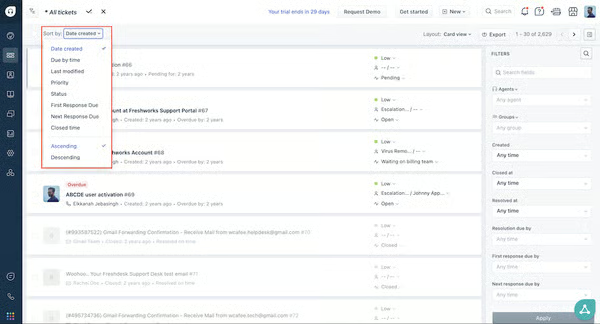
Freshdesk earned my best overall ranking because it gives email-focused support teams a robust ticketing system without imposing a steep learning curve. Its shared inbox, collaboration tools, automations, and self-service resources help small teams organize requests and resolve issues without piecing together several basic help desk tools. Reporting and SLA monitoring also give managers practical visibility into backlogs, response times, and agent performance.
The main limitation is that advanced routing, Freddy AI Copilot, and some analytics capabilities require higher plans or add-ons, which can increase the total cost. Freshdesk Omni is a separate suite that expands the platform with native chat, messaging, and broader omnichannel support. Even with these considerations, Freshdesk remains best suited to small businesses that prioritize intuitive email support and want room to adopt more sophisticated ticketing capabilities as service demand grows.
Key features
- Email ticketing and shared inbox: Freshdesk converts incoming support emails into trackable tickets within a shared workspace. Agents can prioritize, assign, tag, merge, and monitor requests while retaining the full conversation history.
- Ticket collaboration: Internal threads, private notes, linked tasks, and collision detection help agents coordinate without exposing internal discussions or sending duplicate replies.
- Customer portal and knowledge base: Customers can submit and track tickets through a branded portal or use knowledge base articles to resolve routine issues independently.
- Automation, routing, and SLAs: Teams can automate ticket assignments, follow-ups, escalations, and status changes. Higher plans add intelligent routing, multiple SLA policies, and skill-based assignment for more complex queues.
- Analytics and email AI: Prebuilt reports track ticket volume, response times, backlogs, SLA compliance, and agent performance, with deeper customization available on higher tiers. Freddy AI can also respond to email inquiries, while Copilot and AI Insights require eligible plans or add-ons.
Freshdesk pricing
Freshdesk plans | Growth | Pro | Enterprise |
|---|---|---|---|
| Monthly price, billed annually | $19/agent | $55/agent | $89/agent |
| Monthly price, billed monthly | $23/agent | $66/agent | $107/agent |
Free trial: 14 days
Why I chose HubSpot Service Hub
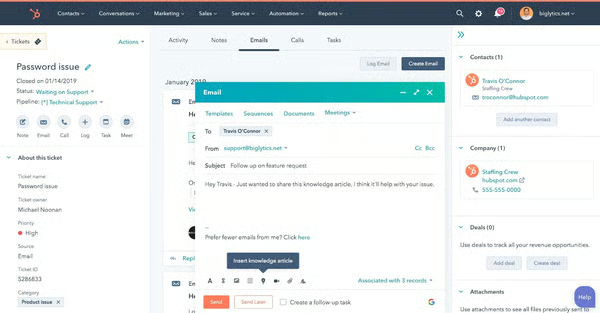
HubSpot Service Hub is among my top free customer service software because it connects ticketing, customer conversations, meetings, and engagement histories with HubSpot’s Smart CRM at no cost. This setup gives agents a fuller picture of each customer without requiring a separate support database. Its free tools also make it a practical starting point for small teams that need basic ticket management and live chat.
The tradeoff is that many capabilities needed to scale support are reserved for higher-tier plans. These include a knowledge base, customer portal, service-level agreement (SLA) management, feedback surveys, and advanced automation. Costs can therefore rise quickly as service requirements become more complex. Still, Service Hub provides strong value for businesses already using HubSpot or those that want customer support closely aligned with their sales and marketing operations.
Key features
- CRM-connected ticketing: HubSpot converts customer requests into trackable tickets and connects each case to the customer’s CRM record, giving agents access to relevant conversations, activities, and account details.
- Unified help desk: Teams can manage supported channels — including email, live chat, calling, SMS, and WhatsApp — from one workspace. Available channels and routing capabilities vary by plan.
- Breeze AI assistance: AI tools help agents summarize tickets, identify sentiment, draft responses, and retrieve customer context. More advanced AI agents and automation may require higher-tier plans or additional credits.
- Self-service tools: Professional and Enterprise plans add a knowledge base and customer portal, allowing customers to find answers and monitor their open support requests without contacting an agent.
- Customer service analytics: HubSpot reports on ticket volume, response and resolution times, customer satisfaction, chat wait times, and knowledge base performance to help teams identify service gaps.
HubSpot Service Hub pricing
HubSpot Service Hub plans | Free | Starter | Professional | Enterprise |
|---|---|---|---|---|
| Monthly price, billed annually | $0 for 2 users | $7/seat | $90/seat | $150/seat |
| Monthly price, billed monthly | $0 for 2 users | $10/seat | $100/seat | N/A |
Why I chose Help Scout
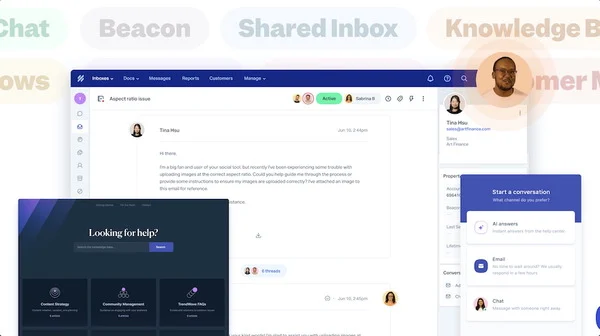
I recommend Help Scout for digital-first businesses that want customer support to feel conversational rather than transactional. Its shared inbox keeps email, chat, text, and social inquiries organized, while Beacon combines live assistance, self-service content, and proactive messaging in one website or in-app widget. This makes Help Scout particularly effective for small teams that want to provide personal support without managing a highly complex help desk.
However, the platform is less suitable for businesses that need advanced ticket hierarchies or technical service management workflows. It also lacks native voice support, so teams handling significant call volume will need a third-party integration. AI Answers presents another cost consideration because usage-based fees apply after the trial. Still, Help Scout is a polished, approachable option for teams that primarily support customers through digital channels.
Key features
- Shared inbox: Help Scout centralizes supported email, live chat, SMS, WhatsApp, Instagram, and Messenger conversations. Agents can assign inquiries, add internal notes, and collaborate from one workspace, although channel availability varies by plan.
- Beacon support widget: Businesses can embed live chat, contact forms, help articles, AI assistance, and proactive messages directly into a website or app.
- Docs knowledge base: Teams can publish searchable support articles and display relevant content through Beacon, giving customers a convenient self-service option.
- AI support tools: AI Assist improves and translates replies, while AI Drafts generates responses using support content and previous conversations. AI Answers can independently resolve common customer questions.
- Workflows and routing: Automation can assign, categorize, prioritize, and route conversations. Higher-tier plans include more advanced routing and service-level agreement controls.
Help Scout pricing
Help Scout plans | Free | Standard | Plus | Pro |
|---|---|---|---|---|
| Monthly price, billed annually | $0 for 5 users | $25/user | $45/user | $75/user |
| Monthly price, billed monthly | $0 for 5 users | $30/user | $54/user | $90/user |
Free trial: 15 days
Why I chose Bitrix24
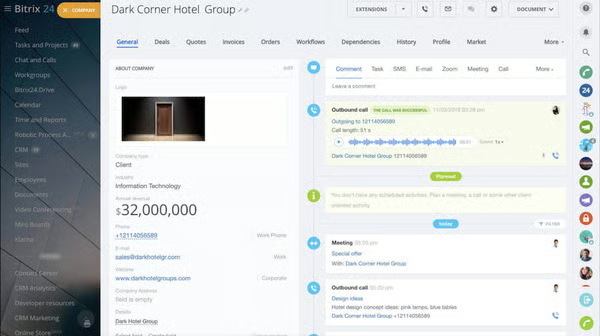
What makes Bitrix24 the top customer service software for client management is its ability to connect customer support, sales, and project management in one system. Its contact center lets teams handle messages, calls, forms, and live chat while preserving each interaction in the customer’s CRM record. This setup is especially valuable for client-based businesses that need to move seamlessly from closing a deal to managing deliverables and providing ongoing support.
However, Bitrix24’s broad feature set creates a steeper learning curve than more streamlined customer service platforms. Its service tools also focus more on managing conversations and queues than complex ticket workflows. Businesses needing advanced ticket cloning, splitting, escalation, or issue management may require a marketplace app or dedicated help desk. Still, Bitrix24 offers substantial value to small businesses that prioritize CRM integration with contact center over specialized ticketing.
Key features
- Omnichannel contact center: Bitrix24 centralizes email, telephony, live chat, website forms, callbacks, messaging apps, and social media inquiries.
- Unified customer profiles: Customer details, conversations, deals, activities, invoices, and account information are stored in a central CRM record, giving service and sales teams shared context.
- Automated inquiry routing: Businesses can distribute incoming messages evenly, sequentially, or to all agents. Returning customers can also be routed to the employee responsible for their CRM record.
- Built-in telephony: Teams can connect a phone number or PBX, create call queues, assign extensions, and associate calls with CRM contacts. Call recording and other capabilities vary by plan, and additional usage fees may apply.
- Client and project management: Bitrix24 combines customer communication with tasks, calendars, document sharing, video meetings, and project tracking, helping service businesses manage work after the sale.
Bitrix24 pricing
Bitrix24 Essentials plans | Free | Basic | Standard | Professional | Enterprise |
|---|---|---|---|---|---|
| Monthly price, billed annually | $0 for 2 users | $49 for 5 users | $99 for 50 users | $199 for 100 users | From $399 for 250 users |
| Monthly price, billed monthly | $0 for 2 users | $69 for 5 users | $144 for 50 users | $289 for 100 users | From $579 for 250 users |
Free trial: 15 days
Why I chose Zoho Desk
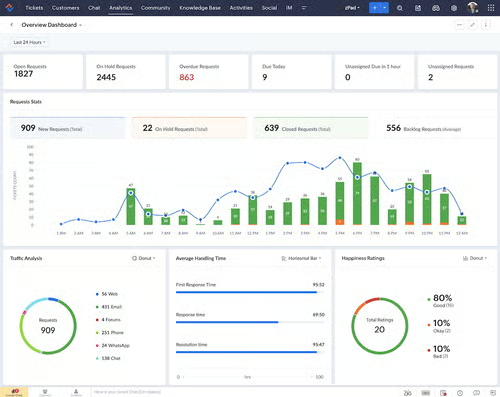
Zoho Desk is a great fit for service teams that want detailed performance insights at a small-business-friendly price. Its customer service reporting tools help businesses monitor ticket resolution, agent productivity, customer satisfaction, and SLA compliance. These insights can guide staffing, coaching, and workflow improvements. The free edition also supports up to three agents with basic email ticketing, giving very small teams a practical starting point.
However, Zoho Desk can take longer to configure and learn than more streamlined customer service platforms because of its extensive settings and capabilities. Custom reporting, Zia AI, telephony, and certain live chat features also require paid or higher-tier plans. Even with these limitations, Zoho Desk delivers strong value for small businesses that prioritize measurable service performance, automation, and long-term scalability.
Key features
- Support analytics: Zoho Desk tracks ticket volume, response and resolution times, agent productivity, customer satisfaction, and knowledge base performance. Custom reports and dashboards help teams focus on the metrics most relevant to their service operations.
- SLA and escalation management: Teams can establish response and resolution targets based on factors such as customer, channel, and ticket priority. Overdue tickets can be escalated automatically to the appropriate agent or manager.
- Omnichannel ticketing: Zoho Desk converts requests from email, social media, web forms, instant messaging, live chat, and telephony into trackable tickets. Channel availability varies by plan.
- Zia AI: Zoho’s AI can summarize tickets, analyze sentiment, suggest responses, retrieve relevant information, and support automated self-service. Advanced capabilities require higher-tier plans.
- Knowledge base and customer portal: Businesses can publish support articles, organize content by brand or category, and give customers a portal to find answers and manage requests.
Zoho Desk pricing
Zoho Desk plans | Free | Express | Standard | Professional | Enterprise |
|---|---|---|---|---|---|
| Monthly price, billed annually | $0 for 3 users | $7/user | $14/user | $23/user | $40/user |
| Monthly price, billed monthly | $0 for 3 users | $9/user | $20/user | $35/user | $50/user |
Free trial: 15 days
Why I chose Jira Service Management
Jira Service Management (via Jira Service Collection) is particularly well suited to small businesses that need structured employee support and IT service management. It provides purpose-built workflows for handling service requests, incidents, problems, changes, and SLAs. Because it runs on the Jira platform, technical teams can also connect support cases with development work. Small teams can start with a free plan supporting up to three agents.
This technical depth creates a steeper setup and learning curve than conventional small business help desks. Jira Service Management is also less suited to customer-facing teams that prioritize social messaging, live chat, and straightforward out-of-the-box ticketing. Those businesses may need additional Atlassian products, marketplace integrations, or a dedicated customer support platform. Still, Jira Service Management is a capable choice for companies that prioritize internal IT support, process control, and asset visibility.
Key features
- Employee service portal: Jira Service Management provides customizable portals where employees can submit IT, HR, facilities, and other internal requests. Each service project can have its own portal and request forms.
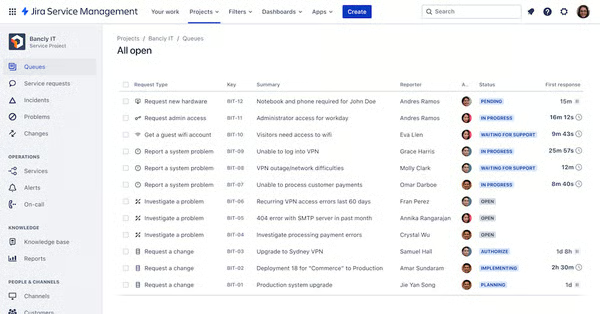
- Configurable request queues: Incoming requests are automatically organized into queues, helping agents prioritize work by request type, urgency, SLA status, or other conditions.
- SLA management: Teams can set response and resolution targets, monitor progress against those goals, and identify requests approaching or exceeding their deadlines.
- Incident, problem, and change management: IT teams can coordinate incident response, investigate recurring issues, assess change risks, and conduct post-incident reviews. Advanced capabilities require higher-tier plans.
- Asset and configuration management: Teams can track devices, software, services, owners, and other configuration items, then connect those records to relevant requests and incidents. Availability and usage allowances vary by plan.
Jira Service Management pricing
Jira Service Collection plans | Free | Standard | Premium | Enterprise |
|---|---|---|---|---|
| Monthly price, billed annually | $0 for 3 agents | $20.83/agent | $47.22/user | Custom |
| Monthly price, billed monthly | $0 for 3 agents | $25/agent | $57.30/user | Custom |
Free trial: 7 days
Why I chose Zendesk
For teams ready to move beyond a shared email inbox, Zendesk provides a mature and scalable ticketing foundation. It centralizes customer requests, preserves interaction histories, automates repetitive processes, and gives managers visibility into ticket and agent activity. Its traditional ticket-based structure is especially useful for businesses that need consistent ownership, routing, and escalation as support volume increases.
Zendesk’s entry-level plan is primarily designed for email-based service and does not include the complete omnichannel experience available in its Suite plans. Businesses that need messaging, live chat, telephony, a knowledge base, or advanced routing will need to upgrade or add compatible capabilities. Zendesk also lacks a free plan, while AI usage and optional add-ons can increase the total cost. Even so, it remains a dependable choice for growing teams that prioritize robust ticket management and want the flexibility to add more service channels over time.
Key features
- Email ticketing: Zendesk converts customer emails into trackable tickets and consolidates them in a shared workspace, giving agents clear ownership and status visibility.
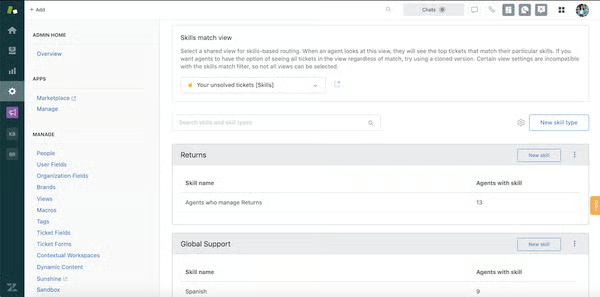
- Ticket routing: Support requests can be assigned to the appropriate agents or groups, reducing manual sorting and promoting more consistent response times.
- Automations and triggers: Teams can create rules that update tickets, send notifications, escalate unattended requests, and perform other actions when specified conditions are met.
- Customer context: Agents can view contact details and recent interaction histories alongside each ticket, helping them respond without asking customers to repeat information.
- Prebuilt analytics and responses: Ready-made dashboards track ticket volume and agent performance, while reusable responses help agents resolve common issues more efficiently.
Zendesk pricing
Zendesk Customer Service plans | Support Team | Suite Team | Suite Professional | Suite Enterprise + Copilot |
|---|---|---|---|---|
| Monthly price, billed annually | $19/agent | $55/agent | $115/agent | Custom |
| Monthly price, billed monthly | $25/agent | $65/agent | $149/agent | Custom |
Free trial: 14 days
Why I chose ProProfs Help Desk
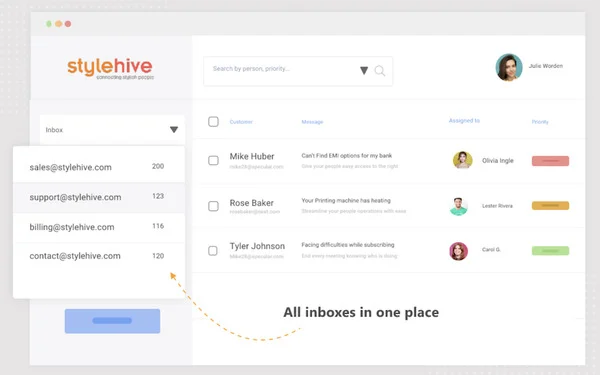
ProProfs Help Desk makes the most sense for small businesses that need several departments to collaborate on support requests. Sales, billing, IT, and customer service teams can manage their respective inboxes in one ticketing system, use private notes to share context, and transfer work without lengthy email chains. Its free plan also gives a solo support agent access to basic email ticketing and multiple inboxes at no cost.
However, the free plan becomes less practical once a business adds agents or handles higher ticket volumes because it is limited to one user and a capped number of monthly tickets. Broader messaging channels, advanced AI, and more sophisticated workflows also require higher-tier packages. Live chat, knowledge base, and survey capabilities may depend on integrations with other ProProfs products. Nevertheless, ProProfs Help Desk is a solid choice for small teams that prioritize email support, departmental coordination, and straightforward ticket management.
Key features
- Multiple shared inboxes: ProProfs Help Desk centralizes addresses such as support@, billing@, sales@, and info@. Teams can manage department-specific inquiries without switching between separate email accounts.
- Ticket collaboration: Private notes, agent collision detection, ticket assignments, and child tickets help departments coordinate while avoiding duplicate responses and unclear ownership.
- Workflow automation: Rules can assign, tag, prioritize, update, and escalate tickets based on predefined conditions. More advanced automation is reserved for higher-tier plans.
- AI assistance: ProProfs can categorize incoming tickets, draft responses, check grammar, rewrite tone, and generate context-aware first replies. AI usage limits and capabilities vary by plan.
- Reporting and feedback: Dashboards track ticket volume, response and resolution times, agent performance, and customer satisfaction. Automated surveys can collect feedback after tickets close.
ProProfs Help Desk pricing
ProProfs Help Desk plans | Free | Essentials | Business | Business Complete Elite | Customer Delight Suite |
|---|---|---|---|---|---|
| Monthly price, billed annually | $0 for 1 user | $19.99/user | $29.99/user | From $179.97 for 3 users | From $499 for unlimited users |
| Monthly price, billed monthly | $0 for 1 user | $39.99/user | $49.99/user | N/A | N/A |
Free trial: 15 days
Frequently asked questions (FAQs)
What is the best customer service software for small businesses?
Freshdesk is the best overall customer service software in my evaluation because it combines ease of use with robust ticketing, automation, reporting, and multichannel support. However, HubSpot Service Hub is a better fit for businesses seeking free CRM-connected support, while Zoho Desk stands out for service performance monitoring.
How much does customer service software cost?
Customer service software can be free or priced per agent per month. The total cost typically depends on the number of users, communication channels, ticket volume, automation rules, AI capabilities, and add-ons. Compare the cost of the specific features your team needs rather than relying only on a provider’s advertised starting price.
What features should small businesses look for in customer service software?
Small businesses should look for ticket management, a shared inbox, automated routing, reporting, self-service tools, and integrations with their existing business applications. The top customer service solutions for small business should also support the channels their customers use, such as email, live chat, phone, and social media, without creating unnecessary complexity.
What are the different types of customer service software?
The main types of customer service software include:
- Help desk and ticketing software: Organizes, assigns, and tracks customer requests.
- Live chat software: Supports real-time conversations through websites and apps.
- Knowledge base software: Provides self-service articles, guides, and FAQs.
- Call or contact center software: Manages phone-based and omnichannel customer interactions.
- CRM software: Stores customer data and interaction histories across sales and service teams.
Some customer service software companies combine several of these functions into a single suite.
Bottom line
The best customer service software for small business teams offers centralized systems to manage tickets, store customer data, engage customers, and track performance metrics. While we ranked Freshdesk as the best overall small business service software for its ease of use, other providers could be better based on your needs. HubSpot Service Hub, for example, offers the most robust free option, while Zoho Desk offers the best performance monitoring tools.