






The best AI tools for ecommerce now go far beyond generating product descriptions. Ecommerce businesses can use AI to research products, manage listings, automate marketing, answer customer questions, personalize product discovery, analyze performance, create product photos, optimize pricing, and even complete selected store tasks.
I evaluated ecommerce AI tools across those different jobs rather than trying to find one application that does everything. Shopify Magic and Sidekick are my best overall choice because their AI tools work directly inside an ecommerce platform and can assist with everything from store content to analytics and administrative tasks. Doba Pilot is my pick for dropshipping operations because it integrates product research, sourcing, listing, order, and fulfillment workflows into a single AI agent.
My other top picks specialize in marketing, customer support, personalization, analytics, product imagery, content creation, upselling, and competitive pricing.
- Best AI tools for ecommerce at a glance
- How I chose the best AI tools for ecommerce
- Best AI tools for ecommerce compared
- Shopify Magic + Sidekick: Best overall AI tool for ecommerce
- Doba + Doba Pilot: Best for AI-powered dropshipping operations
- Klaviyo AI: Best for ecommerce marketing automation
- Gorgias: Best for AI-powered ecommerce customer support
- Nosto: Best for AI personalization and recommendations
- Triple Whale: Best for ecommerce analytics
- Photoroom: Best for AI product photography
- Jasper: Best for ecommerce content creation
- Rebuy: Best for AI upselling and cross-selling
- Prisync: Best for competitor pricing
- Which AI ecommerce tool should you choose?
- How to choose the best AI ecommerce tools for small businesses
- Frequently asked questions (FAQs)
- Bottom line
Best AI tools for ecommerce at a glance
Tool | Best for | Monthly starting price |
| Shopify Magic + Sidekick | Overall AI tool for ecommerce | $5 |
| Doba + Doba Pilot | AI-powered dropshipping operations | $29.99 |
| Klaviyo AI | Ecommerce marketing automation | Free |
| Gorgias | AI-powered ecommerce customer support | $40 |
| Nosto | AI personalization and recommendations | Custom pricing |
| Triple Whale | Ecommerce analytics | Free |
| Photoroom | AI product photography | $12.99 |
| Jasper | Ecommerce content creation | $69 |
| Rebuy | AI upselling and cross-selling | Free |
| Prisync | Competitor pricing | $99 |
Pricing reflects publicly available rates at the time of writing and may depend on billing frequency, usage, order volume, GMV, contacts, or selected modules.
How I chose the best AI tools for ecommerce
To identify the best AI tools for ecommerce, I evaluated each platform based on the specific role it plays in running an online store. Rather than comparing products that solve entirely different problems using the same feature checklist, I selected tools across key ecommerce functions.
I reviewed each platform's ecommerce-specific AI tools, automation options, integrations with major ecommerce platforms, ease of use, pricing accessibility, and how directly it can reduce manual work or help sellers make better decisions. I also considered whether the product was built specifically for ecommerce or could support ecommerce businesses in a meaningful way.
Because these tools serve different purposes, the rankings reflect their usefulness for small and growing ecommerce businesses rather than a direct feature-for-feature contest. The goal is to help you identify which part of your ecommerce operation needs AI first.
Why you can trust Fit Small Business
I have spent more than a decade working with ecommerce businesses, including Shopify and Amazon private-label operations, fulfillment, and third-party logistics. I also regularly evaluate ecommerce platforms and retail software for Fit Small Business, looking closely at pricing, store workflows, integrations, and the day-to-day work involved in running an online business.
For this guide, I reviewed current provider pricing, product documentation, help centers, integrations, and AI features. Where I have prior hands-on experience with the underlying ecommerce platform or workflow, I also used that experience to judge whether an AI feature solves an actual seller problem rather than simply adding AI to an existing feature.
Best AI tools for ecommerce compared
Tool | Ecommerce role | What the AI does | Best business stage | Key integrations |
| Shopify Magic + Sidekick | Store management | Analyzes store data, creates content and images, answers business questions, and assists with store tasks | New to growing businesses | Shopify |
| Doba + Doba Pilot | Sourcing & operations | Researches products, finds sourcing options, creates and optimizes listings, and supports order and fulfillment workflows | New to growing dropshippers | Shopify, eBay, Walmart, TikTok Shop, BigCommerce, Wix |
| Klaviyo AI | Marketing & retention | Uses customer and behavioral data to support segmentation, campaign creation, lifecycle marketing, and automation | Growing businesses | Shopify, WooCommerce, BigCommerce, Wix, PrestaShop, other ecommerce platforms |
| Gorgias | Customer service | Uses store, order, policy, and support data to answer questions and automate selected customer conversations | Growing businesses with increasing support volume | Shopify, WooCommerce, BigCommerce, Magento and ecommerce apps |
| Nosto | Personalization | Personalizes product recommendations, search results, merchandising, and onsite shopping experiences | Growing to larger stores | Shopify, Shopify Plus, BigCommerce, Adobe Commerce and other ecommerce platforms |
| Triple Whale | Analytics & decision-making | Analyzes ecommerce and marketing data, answers questions, detects performance changes, and automates reporting | Growing, data-driven businesses | Shopify, Amazon, Meta Ads, Google Ads, Klaviyo and other marketing platforms |
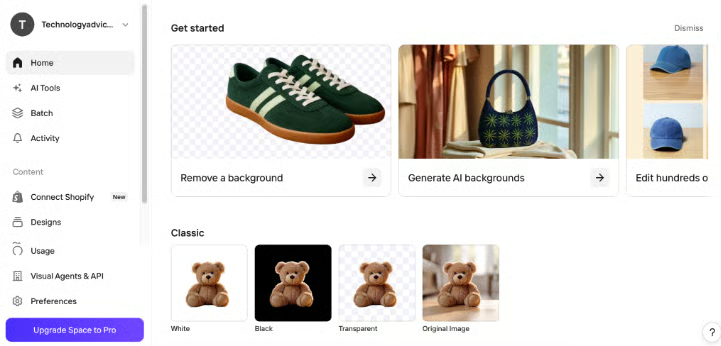
| Photoroom | Product imagery | Removes and generates backgrounds, stages products, edits images, and creates other ecommerce visuals | Any stage | Standalone workflow, API and ecommerce creative workflows |
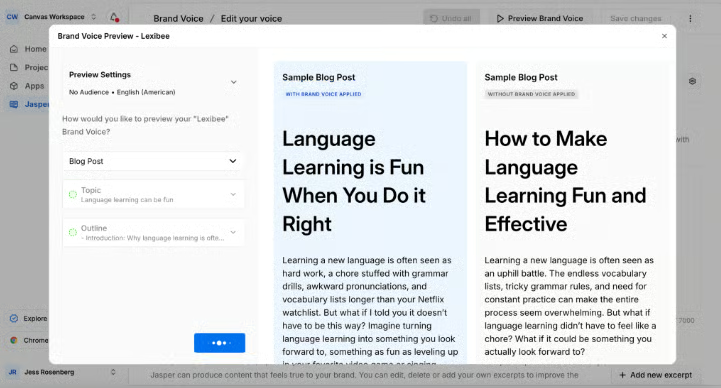
| Jasper | Content | Creates brand-controlled product, campaign, ad, email, and other marketing content | Growing businesses and content teams | Ecommerce and marketing workflows through apps, extensions and API connections |
| Rebuy | Conversion optimization | Personalizes recommendations, carts, bundles, upsells, cross-sells, search, and post-purchase offers | Growing Shopify stores with established traffic | Shopify |
| Prisync | Pricing intelligence | Tracks competitor pricing and stock, identifies price changes, and supports rule-based dynamic pricing | Growing businesses competing heavily on price | Ecommerce stores, marketplaces and product feeds |
Shopify Magic + Sidekick: Best overall AI tool for ecommerce
Shopify pricing
- Starter: $5 per month
- Basic: $39 per month, or $29 per month billed annually
- Grow: $105 per month, or $79 per month billed annually
- Advanced: $399 per month, or $299 per month billed annually
- Plus: Starts at $2,300 per month
You can read more about each plan in depth in my Shopify Starter review, my comparison reviews of Shopify plans and Shopify Plus.
Standout ecommerce AI features
- Sidekick: Uses your store context to answer questions, provide guidance, and help complete ecommerce tasks.
- Store analysis: Ask questions about sales, products, customers, inventory, and business performance.
- Content generation: Create product descriptions, blog content, emails, and other marketing copy.
- Image generation and editing: Create and modify product and marketing images.
- Store building: Get help creating and editing parts of your storefront.
- Customer segmentation: Use natural-language instructions to create customer segments.
- Marketing assistance: Generate email content and support campaigns using Shopify's built-in marketing tools.
- Workflow assistance: Use Sidekick alongside tools such as Shopify Flow to understand and automate store processes.
- Commerce guidance: Ask Sidekick how to accomplish tasks inside Shopify instead of searching through documentation yourself.
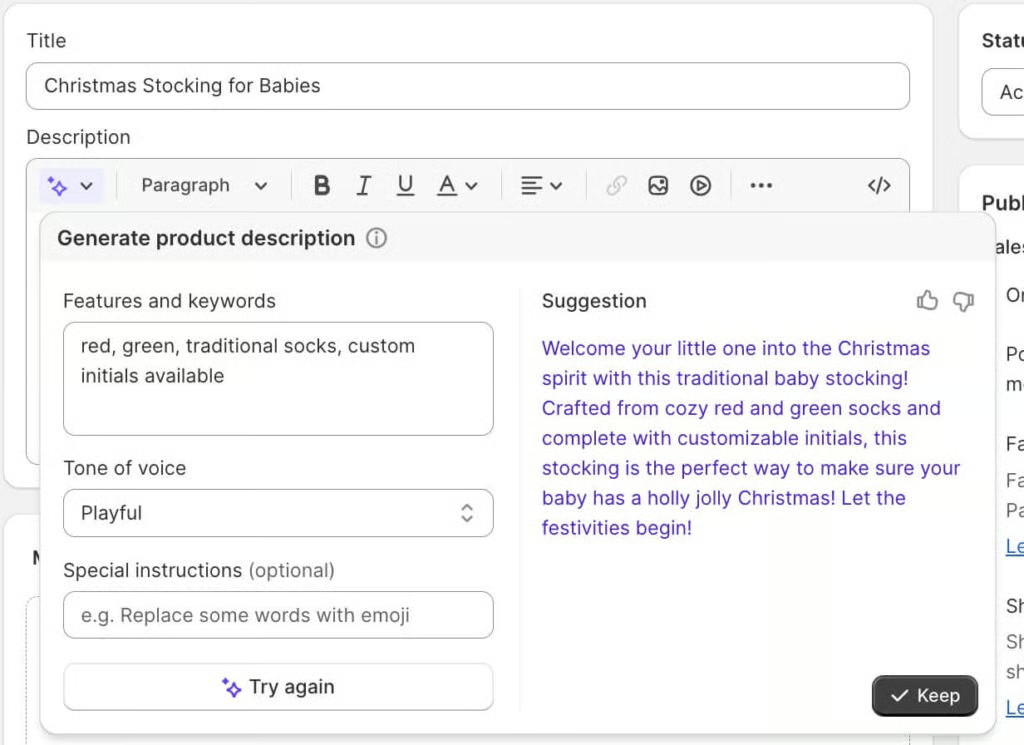
Shopify Magic can generate product descriptions from a few keywords and adjust the copy based on your preferred tone of voice. (Source: Shopify) 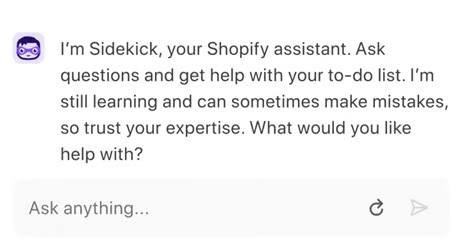
Shopify Sidekick works as an AI assistant inside Shopify, using your store context to answer questions and help complete ecommerce tasks. (Source: Shopify)


Doba + Doba Pilot: Best for AI-powered dropshipping operations
Doba pricing
- Limited ($29.99 per month): Includes 1 store integration, 30 one-click product listings, inventory list capacity, AI Pickr, 24/7 support, and a free .STORE domain.
- Basic ($59.99 per month): Adds 2 store integrations, 250 one-click listings, product downloads, AI Auto Lister, and advanced product research tools.
- Standard ($149.99 per month): Includes 5 store integrations, higher listing and inventory limits, more AI Pickr usage, API access, and dedicated account support.
- Enterprise ($299.99 per month): Supports high-volume sellers with 15 store integrations, larger product limits, higher AI usage, AI Auto Lister, and stronger API access.
Doba offers a 7-day trial for $0.99 on paid plans. Quarterly subscriptions get a 5% discount, while annual subscriptions get a 15% discount.
I tested Doba on the Basic plan. My demo account showed allowances for 2 storefront integrations, up to 250 storefront product listings, 600 products on the inventory list, 450 product exports, and 30 AI Auto-listings. I also used Doba Pilot for the research and sourcing tests. I was able to test its conversational AI interface and explore how it handles dropshipping tasks.
Doba sells additional AI tools and capacity separately, so access will depend on your plan and any add-ons you purchase. Current add-on options include:
- Doba Pilot: $19.99 per 30 days for 100 credits (current promotional price)
- AI Tool Hub: $19.99 per 30 days for 100 credits
- AI Store Builder: Free for Doba users
- AI Auto Lister: $19.99 per 30 days for 50 listings
- AI Listing Migrator: $19.99 per 30 days
Standout ecommerce AI features
- Doba Pilot: Conversational AI agent for product research, sourcing, listings, fulfillment, support, and scheduled operational tasks.
- Market Scout: Analyzes demand, competition, pricing, seasonality, and trends to identify product opportunities.
- AI Pickr: Recommends products by niche, sales potential, profitability, and emerging demand.
- AI Auto Lister: Selects and publishes products to Shopify and BigCommerce based on your categories, target margins, and listing frequency.
- AI Listing Optimizer: Creates search-friendly product titles and descriptions for Shopify, eBay, TikTok Shop, and other sales channels.
- AI Store Builder: Sets up a Shopify store with AI assistance. Wix and BigCommerce were marked as coming soon during my test.
- AI Image Studio: Helps improve product images for use in store and marketplace listings.
- AI Listing Migrator: Moves and optimizes listings between connected stores.
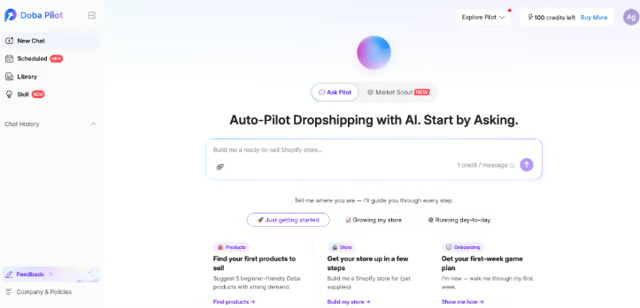
Doba Pilot uses a chat-based interface to help sellers research products, build stores, and manage dropshipping tasks with AI. (Source: Doba) 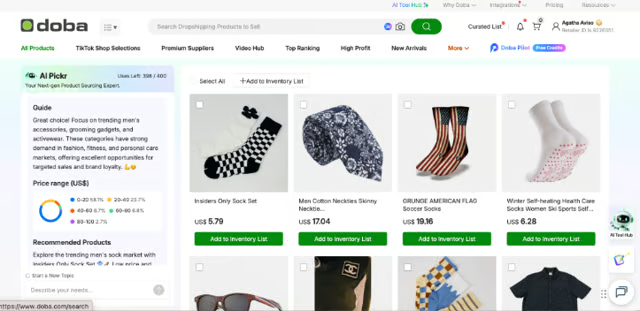
Doba Pilot lets sellers manage dropshipping tasks through natural-language prompts, with tools for research, store setup, scheduled tasks, and day-to-day operations. (Source: Doba) 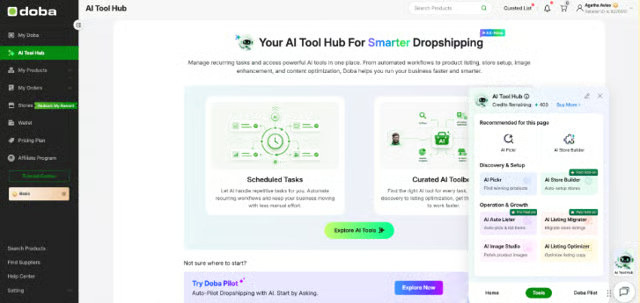
Doba’s AI Tool Hub brings its product discovery, store setup, listing, image, and automation tools into one dashboard. (Source: Doba)


Klaviyo AI: Best for ecommerce marketing automation
Klaviyo pricing
- Free: Supports up to 250 active profiles and 500 email sends per month. It also includes basic email templates, the drag-and-drop editor, an AI-powered subject line generator, and 10,000 Composer credits.
- Email: Pricing scales with your number of active profiles. For example, 1,500 active profiles cost $45 per month and include up to 15,000 email sends per month.
- Klaviyo Composer: Klaviyo's AI marketing agent is available as an add-on. At the pricing level shown during my research, 16,000 Composer credits cost $110 per month under Klaviyo's current introductory pricing.
Klaviyo's pricing can increase as your contact list grows, so the $45 per month example should not be treated as a flat starting price for every business. The free plan is much more useful for testing: small ecommerce businesses can try its core email tools and get 10,000 Composer credits before committing to a paid marketing plan.
Standout ecommerce AI features
- Klaviyo Composer: An AI marketing agent that analyzes campaign, segment, and flow performance to identify opportunities, then helps build the audience, content, and send strategy from a prompt.
- Predictive customer insights: Uses customer data to predict lifetime value, churn risk, and purchasing behavior, giving ecommerce businesses better signals for deciding whom to target.
- AI personalization: Personalizes audiences, content, products, channels, and timing using features such as product recommendations, Personalized Send Time, and channel affinity.
- Generative marketing tools: Helps create email copy, segments, automated flows, brand-aligned content, translations, and product imagery.
- AI campaign optimization: Tests and monitors campaigns using tools such as form optimization, flow anomaly detection, deliverability monitoring, and audience optimization.
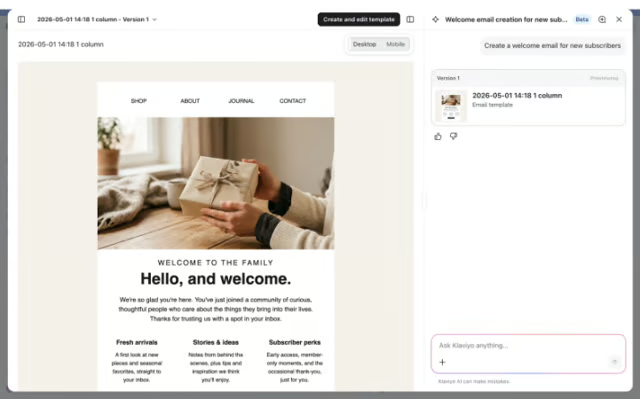
Klaviyo Composer can create and edit email campaigns from prompts, including generating a complete email template for a specific audience. (Source: Klaviyo) 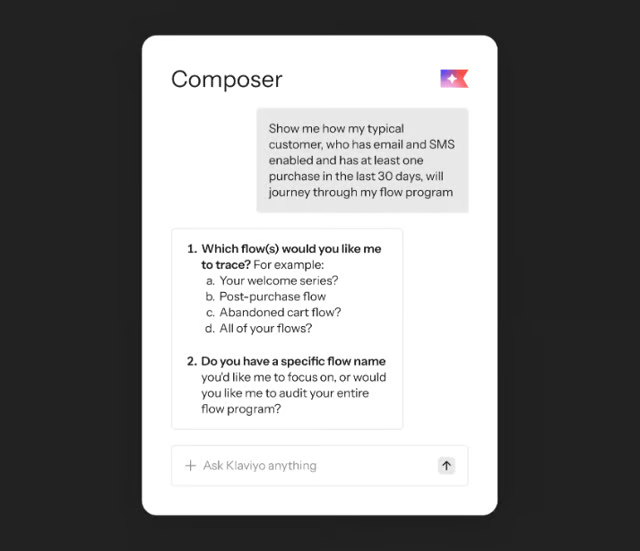
Klaviyo Composer lets marketers ask questions about their customer data and marketing flows using natural-language prompts. (Source: Klaviyo)


Gorgias: Best for AI-powered ecommerce customer support
Gorgias pricing
Gorgias combines its Helpdesk with AI Agent. Helpdesk pricing is based on monthly ticket volume rather than the number of support agents, while AI Agent usage is based on automated interactions.
- Starter: $40 per month for 50 tickets and 30 automated interactions. This includes $10 for Helpdesk and $30 for AI Agent. Additional AI interactions cost $1.50 each.
- Basic: $90 per month for 300 tickets and 30 automated interactions. Additional AI interactions cost $1.50 each.
- Pro: $550 per month for 2,000 tickets and 190 automated interactions. Additional AI interactions cost $1.50 each.
- Advanced: $1,430 per month for 5,000 tickets and 530 automated interactions. Additional AI interactions cost $1.50 each.
Standout ecommerce AI features
- AI Support Agent: Handles common ecommerce requests such as order tracking, returns, FAQs, refunds, and shipping updates, rather than simply answering questions.
- Shopping Assistant: Supports pre-purchase conversations with personalized product recommendations, discounts, and upsells using shopper and inventory data.
- Store-aware responses: Pulls real-time information such as order history, products, inventory, and customer tags from connected ecommerce platforms to personalize responses.
- Brand and policy training: Lets businesses provide help center content, documents, rules, policies, and brand guidance so the AI follows their preferred support processes and voice.
- AI performance monitoring: Tracks customer sentiment, resolution performance, conversion rates, and AI response reasoning, with feedback tools for improving future responses.
- Ecommerce integrations: Connects with more than 100 ecommerce tools, including Shopify, Recharge, Loop, Klaviyo, Yotpo, and Attentive, allowing the AI to take actions across connected systems.
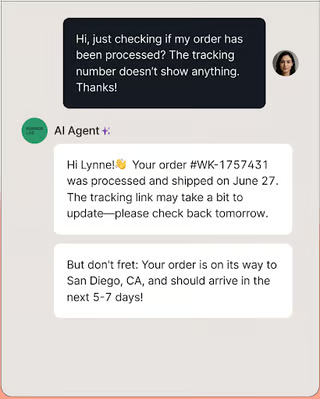
Gorgias AI Agent can use order information to answer post-purchase questions about shipping and delivery. (Source: Gorgias) 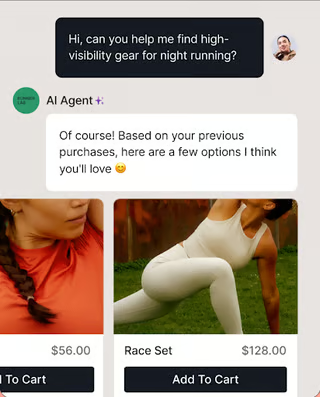
Gorgias AI Agent can also assist before purchase by recommending relevant products based on customer data and shopping needs. (Source: Gorgias)


Nosto: Best for AI personalization and recommendations
Nosto pricing
Nosto uses custom pricing based on factors such as your store’s GMV and traffic, the modules you select, and your support and scaling requirements. There is no separate AI fee, as Nosto includes its AI functionality within its modules.
Standout ecommerce AI features
- Personalized product recommendations
- Personalized ecommerce search
- Category merchandising
- Shopper intent analysis
- Content personalization
- Dynamic bundles
- Post-purchase upsells
- Customer behavior data engine
Triple Whale: Best for ecommerce analytics
Triple Whale pricing
Triple Whale bases its paid pricing on annual GMV. For businesses with less than $250,000 in annual GMV, the monthly pricing shown is:
- Free: $0 per month. Includes business performance tracking, AI visibility monitoring, blended ROAS, and attribution tools.
- Foundation: $219 per month. Adds multi-touch attribution, custom dashboards and metrics, first-party data activation, and Moby AI.
- Automate: $749 per month. Adds Moby-powered automations for recurring tasks such as reporting, KPI alerts, ad monitoring, creative preparation, purchase orders, and audience updates.
- Enterprise: Custom pricing. Adds more advanced measurement and AI orchestration, including MMM and incrementality.
Annual billing includes two months free. Pricing increases based on annual GMV, so these rates apply specifically to businesses earning less than $250,000 in annual GMV.
Standout ecommerce AI features
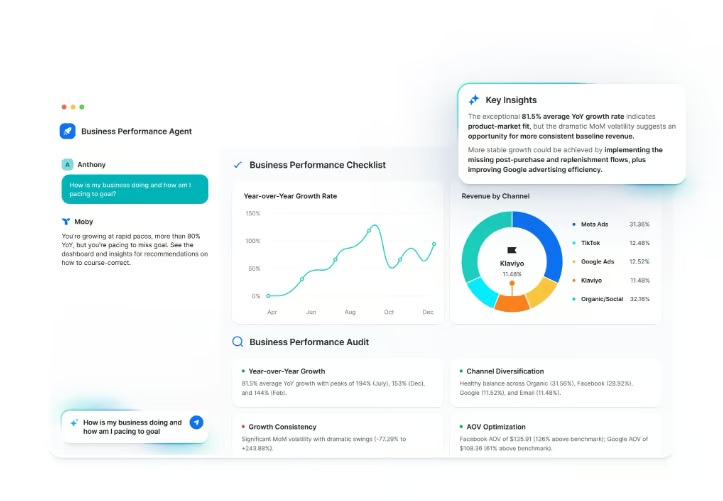
- Moby AI
- Natural-language business analysis
- Ecommerce and advertising data consolidation
- Attribution
- Automated reporting
- Benchmarks
- Product and customer analytics
- Marketing performance monitoring
Photoroom: Best for AI product photography
Photoroom pricing
- Free: $0 per month with limited access to Photoroom’s AI and image-editing features. The free plan is intended primarily for trying the platform and does not include commercial use.
- Pro: $12.99 per month with 8,000 AI credits and 1,000 exports. Best suited to solopreneurs and resellers.
- Max: $34.99 per month with 25,000 AI credits and 3,000 exports. Photoroom positions this plan for small businesses that need higher AI and export limits.
- Ultra: Starts at $99 per month with higher AI credits, batch export limits, and advanced AI workflows for higher-volume ecommerce businesses.
- Enterprise: Custom pricing for larger businesses.
Standout ecommerce AI features
- Background removal
- AI backgrounds and product staging
- Product beautification and editing
- Virtual fashion models
- AI shadows
- Object removal
- Batch editing
- Product image resizing
- Image animation and video functions on supported plans
One caution applies to any AI-generated product photo: inspect the product itself before publishing. AI can create a realistic-looking image while changing labels, product details, materials, or proportions.
Jasper: Best for ecommerce content creation
Jasper pricing
- Pro: $59/month billed annually or $69/month billed monthly
- Business: Custom pricing
- Free trial: Seven days for Pro
Standout ecommerce AI features
- Marketing content generation
- Product and category copy
- Brand Voice
- Knowledge assets
- Audience definitions
- Marketing AI agents
- Campaign content
- Team collaboration
- Custom agents on Business plans
Rebuy: Best for AI upselling and cross-selling
Rebuy pricing
- Rebuy Monetize: Free
- Build your own plan: From $25/month for one package
- Pricing changes according to monthly order volume and selected products
Standout ecommerce AI features
- AI product recommendations
- Smart Cart
- Cross-sell and upsell widgets
- Dynamic bundles
- Checkout offers
- Post-purchase upsells
- Smart Search
- Smart Collections
- Smart Flows
- A/B testing
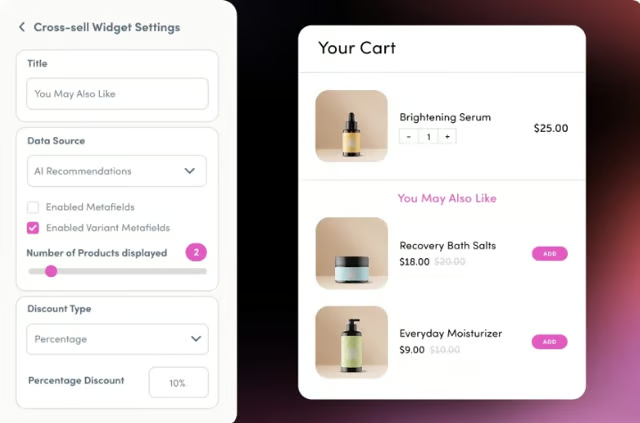
Rebuy uses AI recommendations to suggest complementary products and create personalized cross-sell offers in the cart. (Source: Rebuy) 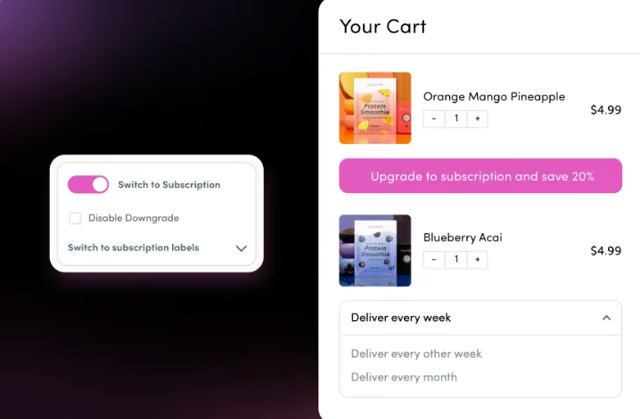
Rebuy can turn one-time purchases into subscriptions by presenting savings and delivery options directly in the cart. (Source: Rebuy) 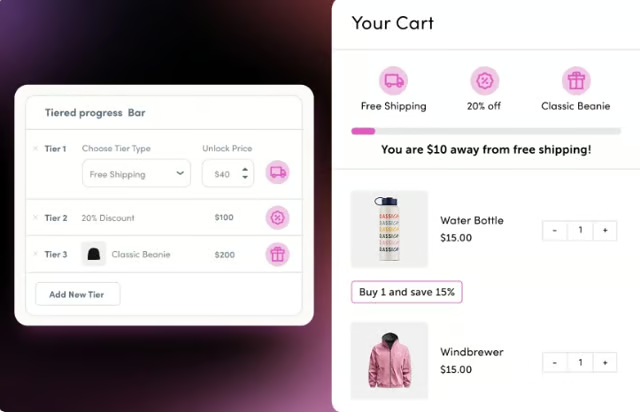
Rebuy Smart Cart can use tiered rewards to encourage shoppers to increase their order value. (Source: Rebuy)


Prisync: Best for competitor pricing
Prisync pricing
For URL-based competitor monitoring:
- Professional: $99/month for up to 100 products
- Higher plans add more products, dynamic pricing, marketplace tracking, and other functions
- 14-day free trial
Prisync also offers separate channel-based pricing, so costs depend on how competitors are monitored.
Standout ecommerce AI features
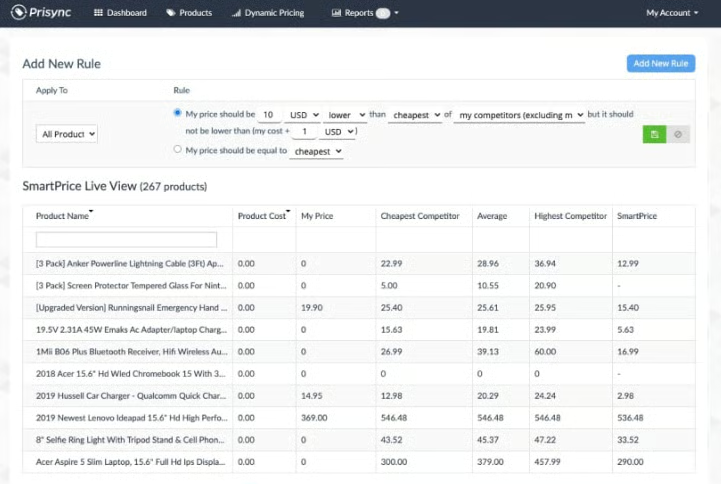
- Competitor price monitoring
- Price change detection
- Competitor stock tracking
- Dynamic pricing rules
- Competitive pricing recommendations
- Price history
- Price position comparisons
- Alerts and reporting
- Marketplace price tracking on supported plans
Which AI ecommerce tool should you choose?
You do not need all 10 tools. Start with the area of the business where manual work, missed opportunities, or weak information is costing you the most time or money.
- Choose Shopify Magic + Sidekick if you use Shopify and want AI built directly into your ecommerce platform.
- Choose Doba Pilot if you run a dropshipping business and want to connect product research, sourcing, listings, orders, and fulfillment work.
- Choose Klaviyo AI if customer retention, email, SMS, and lifecycle marketing are your priorities.
- Choose Gorgias if customer questions and repetitive support work are taking too much staff time.
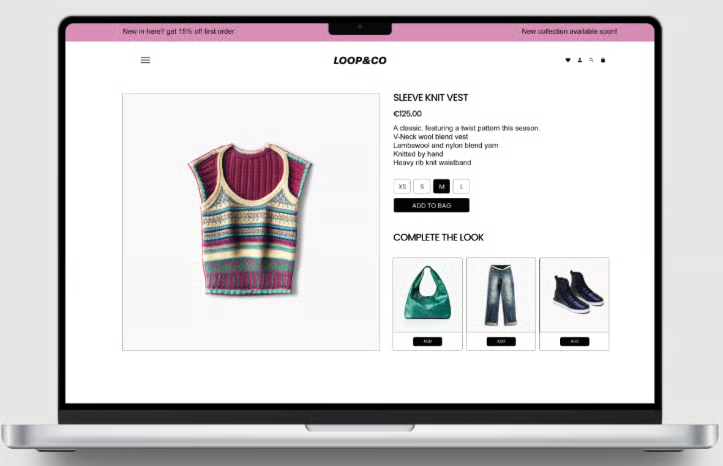
- Choose Nosto if you have a larger product catalog and want to personalize search, recommendations, merchandising, and onsite content.
- Choose Triple Whale if you struggle to interpret ecommerce, advertising, attribution, and marketing data spread across several systems.
- Choose Photoroom if creating and editing product images is slowing down listings, campaigns, or marketplace expansion.
- Choose Jasper if your business produces a large amount of product and marketing content and needs stronger brand consistency.
- Choose Rebuy if you already have meaningful Shopify traffic and want to increase upsells, cross-sells, and average order value.
- Choose Prisync if your products compete heavily on price and you need to monitor competitors without checking their stores manually.
How to choose the best AI ecommerce tools for small businesses
Buying an AI product because it has a long list of features is an easy way to add another subscription without removing much work. I recommend starting with the business problem first.
Step 1: Identify where you spend the most repetitive time
Review a normal week. Are you constantly researching products? Updating listings? Answering the same customer questions? Building emails? Editing product photos? Pulling reports? Checking competitor prices? That gives you a much better starting point than asking which AI platform has the most features.
Step 2: Check what AI you already have
If you use Shopify, Klaviyo, or another established ecommerce platform, you may already have AI functions included in your subscription.
Use those first when they solve the problem adequately. Another paid app should remove work or add functionality that your existing software cannot.
Step 3: Check your ecommerce integrations
An ecommerce AI tool becomes much more useful when it can work directly with your store, products, customers, orders, or sales channels.
Check compatibility with the systems you depend on, such as Shopify, WooCommerce, BigCommerce, Amazon, eBay, Walmart, TikTok Shop, your email platform, advertising channels, and fulfillment software.
Step 4: Calculate the cost at your future size
Many ecommerce AI products do not stay at one flat monthly price.
Pricing may increase based on:
- Active contacts
- Monthly orders
- GMV
- Website traffic
- Number of products
- AI usage or credits
- Support conversations
- Number of sales channels
- Selected modules
Calculate what the tool would cost at both your current size and where you expect the business to be in a year.
Step 5: Find out what the AI actually does
“AI-powered” can describe very different levels of automation.
One tool may generate text. Another analyzes your data and suggests what to do. Another can actually perform selected tasks once you approve them.
Before subscribing, identify whether the tool:
- Generates content
- Answers questions
- Analyzes business data
- Recommends actions
- Automates workflows
- Takes actions inside connected systems
The farther you move down that list, the more carefully you should review permissions and controls.
Step 6: Keep human review for high-impact work
AI can reduce repetitive work, but ecommerce decisions can affect money and customers quickly.
I would keep human review around pricing changes, refunds, supplier decisions, fulfillment problems, advertising budgets, product claims, and customer-facing content. Product images also deserve inspection, especially when AI is generating or modifying details shoppers rely on when making a purchase.
Frequently asked questions (FAQs)
What are the best AI tools for ecommerce?
The best AI ecommerce tool depends on what you need to automate. Shopify Magic and Sidekick are my best overall choice, while Doba is strongest for dropshipping operations, Klaviyo for marketing automation, Gorgias for customer support, Nosto for personalization, and Triple Whale for analytics.
Photoroom, Jasper, Rebuy, and Prisync are better choices for more specific tasks such as product photography, content production, upselling, and competitor pricing.
How is AI used in ecommerce?
Ecommerce businesses use AI for product research, sourcing, product descriptions, customer service, email marketing, recommendations, personalized search, analytics, merchandising, product images, dynamic pricing, and fulfillment support.
Some newer AI agents can also complete selected actions inside ecommerce software instead of simply generating content or recommendations.
What is the best AI tool for Shopify?
Shopify Sidekick is a good place to start because it is already included with Shopify plans and can work directly with store information. It can assist with analytics, products, orders, content, customers, marketing, design, and selected administrative tasks.
Specialized Shopify businesses may still need additional tools. For example, Rebuy focuses on upselling and personalization, while Gorgias focuses on ecommerce customer service.
What is the best AI tool for dropshipping?
Doba Pilot is my pick for AI-powered dropshipping operations because it spans product research, sourcing, listings, store connections, order fulfillment, and post-purchase work.
Its multichannel workflows currently include Shopify, eBay, Walmart, TikTok Shop, BigCommerce, and Wix.
Can AI run an ecommerce store automatically?
AI can automate parts of an ecommerce business, but I would not rely on it to run a store without oversight.
Product selection, pricing, supplier decisions, returns, customer issues, advertising spend, legal claims, and fulfillment problems can all affect revenue or customer trust. Even AI-agent products such as Shopify Sidekick and Doba Pilot retain review or operational boundaries rather than promising a completely hands-off business.
What is the best free AI tool for ecommerce?
The answer depends on the task. Shopify Magic and Sidekick are included with Shopify subscriptions, while Klaviyo and Triple Whale have free plans. Photoroom also has a free tier for basic product imagery.
Start with a free or already-included tool if it addresses your main problem, then upgrade once its limits start interfering with the work you need to do.
Should a small ecommerce business use several AI tools?
Eventually, maybe. I would not start there, though. Choose one manual or costly workflow, add one AI tool to address it, and measure what changes. Once you know it is saving time, reducing errors, improving conversion, increasing revenue, or giving you better information, look at the next problem.
Bottom line
There is no single AI tool that is best at every ecommerce job, which is why I recommend choosing software based on the part of your business you want to improve.
For a small ecommerce business, I would start with one problem and one tool. The best AI investment is the one that removes work you are actually doing today rather than simply giving you another piece of software to manage.
