





The best cash registers for small businesses help you ring up sales, accept payments, print receipts, store cash, and track daily transactions. For most businesses, that now means a POS-driven cash register with built-in payments, inventory tools, and reporting. Traditional electronic cash registers still work for cash-heavy or low-volume shops, but they lack the flexibility of modern POS systems.
I reviewed POS registers and traditional cash registers based on hardware cost, software fees, payment options, receipt printing, cash drawer setup, inventory tools, reporting, ease of use, and long-term value. You can find my top picks below:
| Cash register | Best for | Hardware price* |
|---|---|---|
| Square Register | Best overall POS cash register | $689-$1,799 |
| Toast Countertop | Restaurants and food service | $0-$1,000+ (hardware bundles vary) |
| Clover Flex | Flexible hardware and payments | $849-$1,899 |
| Lightspeed iPad POS hardware kit | High-volume and multi-location retailers | Quote-based hardware |
| SAM4S ER-180U | Mobile and low-volume sales | $164-$350 |
| SAM4S SAP-630R | Grocery and convenience stores | $1,499-$5,000+ |
| SAM4S ER-925 | Mid-volume retail stores | $499-$679 |
*Prices and features vary by provider and hardware bundle, but POS systems typically include both checkout hardware and business management software. Traditional ECRs cost less upfront but lack advanced reporting and inventory features.
- Cash registers for small businesses compared
- Best cash register by business type
- Square: Best touch-screen POS cash register for small businesses
- Toast: Best free cash register for restaurants
- Clover: Best for hardware and software flexibility
- Lightspeed: Best register for high-volume and multi-location retailers
- SAM4S ER-180U: Best portable cash register for mobile businesses
- SAM4S SAP-630R: Best electronic register for grocery and convenience stores
- SAM4S ER-925: Best ECR for low- to mid-volume retailers
- Methodology: How I evaluated POS and traditional electronic cash registers
- Traditional cash register vs POS register: Which do you need?
- How much does a cash register cost?
- How to choose a cash register for your business
- Frequently asked questions (FAQs)
- Bottom line
Cash registers for small businesses compared
| Register type | Monthly software fees | Built-in payments | Key limitation | |
|---|---|---|---|---|
| Square Register | POS register | $0-$149+ | Yes | Must use Square Payments |
| Toast countertop | Restaurant POS register | $0-$69+ | Yes | Restaurant-focused and requires Toast Payments |
| Clover Flex | POS register | $16-$240 for retail plans | Yes | Pricing and terms vary by reseller |
| Lightspeed iPad POS hardware kit | Retail POS register | $109-$339 for retail | Yes | Higher monthly cost |
| SAM4S ER-180U | Traditional ECR | None | No | Basic reporting and no built-in card reader |
| SAM4S-630R | Traditional or hybrid ECR | $1,499-$5,000+ | Optional | Expensive for a traditional register |
| SAM4S ER-925 | Traditional ECR | $499-$679 | Optional | Limited compared with modern POS systems |
Looking for more options? Check out our rankings of the best point-of-sale solutions for retailers and small businesses overall.
How I chose the best POS and cash registers
I reviewed more than 20 POS systems and electronic cash registers using a weighted rubric that compares pricing, register features, management tools, ease of use, and overall value, along with real-world usability and feedback from small business owners.
Best cash register by business type
| Business type | Best cash register | Why |
|---|---|---|
| New small business | Square Register | Free POS software, built-in payments, and affordable hardware |
| Restaurant or cafe | Toast POS | Restaurant-grade hardware, menus, modifiers, and kitchen tools |
| Retail store | Square or Lightspeed | Square is easier and cheaper, while Lightspeed is stronger for inventory |
| High-volume retailer | Lightspeed POS | Advanced reporting, inventory, and multi-location tools |
| Mobile or low-volume seller | SAM4S ER-180U | Low upfront cost and basic portable checkout |
| Grocery or convenience store | SAM4S SAP-630R | Keypad layout, PLUs, receipt printing, and grocery-style checkout |
| Businesses needing hardware flexibility | Clover POS | Multiple register, handheld, and countertop options |
Square: Best touch-screen POS cash register for small businesses
Why I chose Square
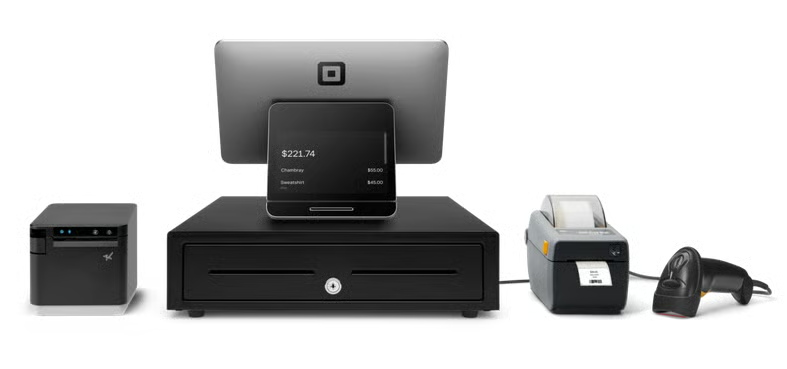
Square is the POS register I recommend most often because it’s affordable, easy to set up, and works for just about any small business. In fact, Square is my top choice for small business POS systems.
Square is a cloud-based system with low-cost hardware options, and it combines payment processing, POS software, and a cash register in one package. You can run it from a smartphone or tablet if you’re on the go, or use handheld devices and countertop registers if you’re running a physical storefront.
The tradeoff is that Square locks you into its own payment processing. You can’t shop around for merchant account rates, but the flat-rate fees are simple and transparent. Square also doesn’t charge startup or monthly fees for its baseline plan, which is rare. If you want the freedom to bring your own processor, an ECR might suit you better. And if you’re specifically looking for an iPad-based system with more payment integrations, Lightspeed is worth checking out.
Who should use it:
Small businesses of any type (retail, restaurant, or service-based) that want a complete suite of sales, payment, inventory, and business management tools for free — with affordable upgrade options.
Square pricing
Monthly software fees:
- Square Free ($0 per month per location)
- Square Plus ($49 per month per location)
- Square Premium ($149 per month per location)
- Square Pro (custom pricing for those that process over $250,000 per year)
Hardware:
- Square Stand Kit ($689 or $49 per month with financing)
- Square Stand Kit for Restaurants ($1,199 or $59 per month with financing)
- Square Register Kit ($1,189 or $58 per month with financing)
- Square Register Retail Kit ($1,799 or $88 per month with financing)
Payment processing fees:
- In-person: 2.6% + 15 cents
- Online: 2.9% + 30 cents
- Keyed-in: 3.5% + 15 cents
- Custom rates available for businesses processing over $250,000 annually
Key features
- Touch-screen cash register
- Versatile and easily expandable hardware
- Built-in credit card processing
- Track unlimited items and variations
- Track unlimited employees
- Specialized options for retail and restaurant businesses
- Easy and affordable to add gift cards, online ordering, employee timekeeping, marketing, loyalty, and more
Toast: Best free cash register for restaurants
Why I chose Toast
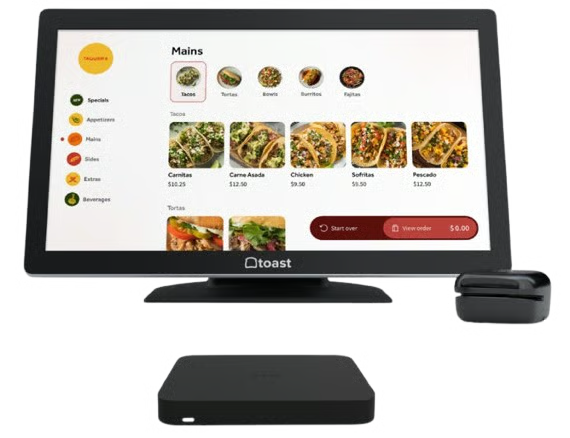
Toast stands out to me because it’s built specifically for restaurants. The hardware is designed for food service environments, with options like terminals, self-service kiosks, kitchen displays, and handheld devices for taking orders and payments.
I also like that Toast offers a $0 upfront hardware option, which makes it easier for new restaurants to get started. The catch is that you’ll pay higher processing fees if you go with the Pay-as-You-Go plan — but realistically, most small, independent restaurants face higher fees no matter which system they choose.
There are a couple of downsides. Toast requires a two-year contract, which is longer than other providers, and you’re locked into Toast Payments for processing. The good news is that Toast often matches or even beats competitor rates if you negotiate directly. If you’d prefer something with more flexibility and no long-term contract, I recommend Square instead.
Who should use it:
Restaurants of all types and sizes will do well with Toast.
Toast pricing
Monthly software fees:
- Restaurant:
- Starter Kit (for up to 2 POS stations in one restaurant location): From $0
- Point of Sale: From $69 per month
- Build Your Own: Custom pricing
- Retail:
- Point of Sale: $90 per month
- Build Your Own: Custom pricing
Hardware:
Countertop Starter Kit
- Pay upfront: From $1,024.10 + $69 per month (2.49% + 15 cents processing fee)
- Pay-as-You-Go: $0 per month (3.09% + 15 cents processing fee)
Key features
- Touch-screen operation
- Restaurant-supporting order screens
- Manages complex modifiers
- $0 upfront option for register hardware
- Built-in credit card processing
- Google online ordering integration
- Track unlimited items with modifiers
- Unlimited employee log-ins
Clover: Best for hardware and software flexibility
Why I chose Clover
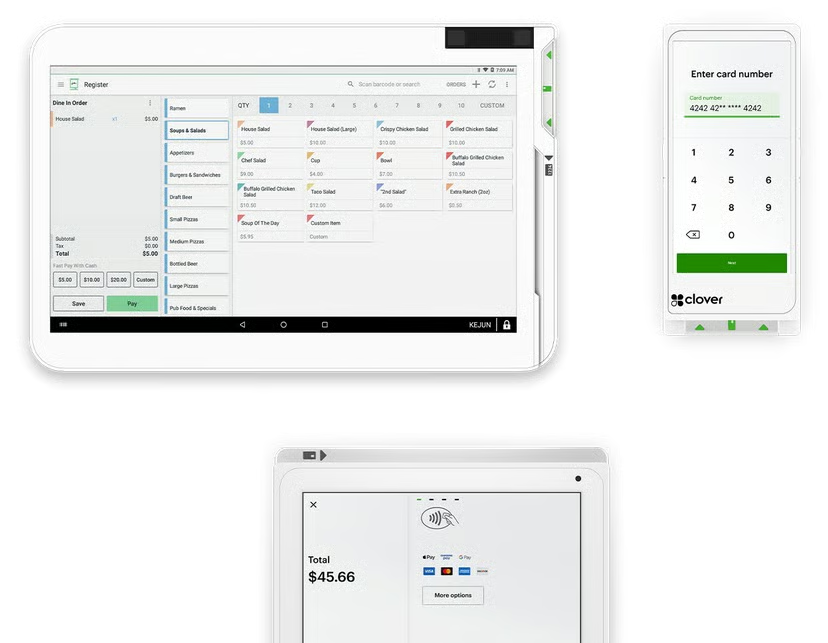
Clover is a flexible and feature-rich POS system that is suitable for retail shops, restaurants of any size, and service or appointment-based businesses. It is similar to Square in this way, except that Clover is also flexible with payment processing; its default payment processor is Fiserv, but it also allows you to choose a different one if you prefer. Clover also bundles its software offerings with its hardware subscriptions.
Clover does have a few downsides. Unlike Square, there is no long-term free plan, and you’ll need to upgrade for features like returns and exchanges, advanced reports, and item-level inventory management. Clover also has no built-in vendor management tools.
Who should use it:
Clover is ideal for retailers, small or large restaurants, and service businesses that want a variety of hardware and payment processing options.
Clover pricing
Clover’s pricing can get tricky because it depends on where you buy it. You can go directly through Clover’s website, but it’s also sold through a wide network of banks and merchant service providers in the Fiserv network. That means pricing often varies by reseller, which can make it harder to compare.
If you buy directly from Clover, here’s what you can expect:
- Monthly software fees: Start at $0; retail plans begin at $16 if bundled with hardware
- In-person processing fees: 2.3%-2.6% + 10 cents per transaction
- Online processing fee: 3.5% + 10 cents per transaction
Hardware:
As of this writing, here are the prices of hardware from Clover’s website:
- Mini (small countertop POS): $849 or $45 per month
- Station Solo (all-in-one countertop POS): $1,799 or $174 per month
- Station Duo (dual-screen countertop POS): $1,899 or $180/month
Key features
- Choice of payment processor
- Proprietary mobile and countertop hardware
- POS systems for retail, restaurants, and service businesses
- Virtual terminal with invoicing
- Free customer-facing loyalty app
Lightspeed: Best register for high-volume and multi-location retailers
Why I chose Lightspeed
Lightspeed, like Square, is a POS-driven cash register with a comprehensive set of store management tools. Users can track inventory in real time and manage purchasing, staff, and business tasks across multiple locations. Like Square, Lightspeed also connects in-store and online sales. As a POS-based register system, Lightspeed lets you set up several registers in one or many locations and connect all data within one centralized, cloud-based software system.
If you like Lightspeed’s touch-screen register but hate monthly fees, check out Square (which offers free register software). Restaurants should check out Toast’s Pay-as-You-Go plan. If you want to go electronic, the SAM4S SAP-630R is your best bet.
Who should use it:
Multi-location businesses needing networked or cloud-based systems and businesses requiring intensive inventory management and purchase ordering tools will find Lightspeed a great fit.
Lightspeed pricing
Monthly software fees:
- Lightspeed Retail
- Basic: $109 per month (annual pricing: $89 per month)
- Core: $179 per month (annual pricing: $149 per month)
- Plus: $339 per month (annual pricing: $289 per month)
- Lightspeed Restaurant
- Essential: $189
- Premium: $399
Hardware: Call for a quote
Processing fees (if Lightspeed Payments):
- Card present: 2.6% + 10 cents
- Keyed-in: 2.9% + 30 cents
Key features
- Multiple options for payment processing
- Operates on iPads or desktop computers
- Specialized software for retailers and restaurants
- Top-of-the-line inventory tracking and reporting
SAM4S ER-180U: Best portable cash register for mobile businesses
Why I chose SAM4S ER-180U
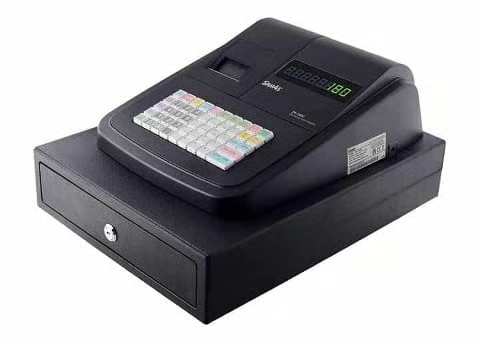
The ER-180U is SAM4S’s entry-level economy register. With brands like Casio and Sanyo no longer producing cash registers, SAM4S has become a reliable global leader. That matters because you can still count on replacement parts and customer support, unlike older used registers from discontinued brands.
That said, the ER-180U is basic. If you need real-time inventory tracking, I’d recommend a POS-driven register like Square or Lightspeed instead. For restaurants that need ingredient-level tracking, Toast is the stronger choice. If you’re willing to spend a little more, both Toast and Lightspeed also offer more advanced inventory modules.
Who should use it
I recommend the SAM4S ER-180U for very small operations with just a few staff. It only supports up to 10 cashier profiles, but at just 12 pounds, it’s lightweight and portable. It’s perfect for crafters, hobbyists, and retailers who sell at fairs or pop-up events.
Since it doesn’t have ports for an integrated card reader, this model is best for businesses that operate mostly in cash.
SAM4S ER-180U pricing
The Sam4S 180U can be purchased from multiple retailers for between $164 and about $350. This is a one-time payment with no ongoing monthly fees, making this system one of the cheapest register options on the market.
You will need to secure a separate credit card processor to accept card payments. You’ll also need to purchase a separate card reader to run card payments, as the 180U does not have a built-in card reader. This allows you the flexibility to choose whatever merchant services provider you like, but using a non-integrated card reader can increase your transaction times.
Key features
- 10 employee logins
- 500 supported price look-up (PLU) codes
- Four programmable tax rates
- Customizable receipts
SAM4S SAP-630R: Best electronic register for grocery and convenience stores
Why I chose SAM4S SAP-630R
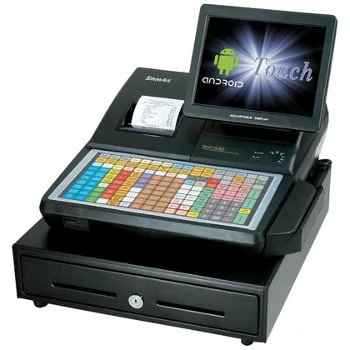
The SAP-630R is essentially a hybrid between a traditional register and a POS system. It combines a 9.7-inch Android touchscreen with a keypad, cash drawer, and receipt printer, so you get the feel of a register with the flexibility of POS software.
This is the most expensive register on my list, and you have to buy it through an authorized SAM4S dealer. The upside is that the purchase includes six months of technical support and setup assistance. For basic sales and inventory tracking, you’ll only pay the upfront cost — but if you want extras like loyalty or rewards, those features require monthly fees.
The SAP-630R is a good fit if you want a true ECR/POS hybrid and don’t mind dealer configuration. If you’d prefer something easier to install with built-in processing, I’d suggest going with Square or Lightspeed instead.
Who should use it
I recommend the SAM4S SAP-630R for grocery stores and convenience shops that need to manage large inventories. It can handle up to 100,000 items, and with the SAM4POS app, you can even connect a handheld Android tablet for floor sales or inventory checks. It also comes in a hospitality version (SAP-630F), which works well for food-service businesses.
SAM4S SAP-630R pricing
Prices vary by vendor and configuration but typically range from $1,499 to over $5,000. This is a one-time price. There are no monthly software fees unless you choose to enroll in the cloud reporting app. Additional features like loyalty or rewards cost around $250, according to third-party review sites.
The SAP-630 register does have an integrated card reader on the side, though you can opt to attach a peripheral reader as well for credit card processing. This option gives you the benefit of shopping for the lowest available processing rates, but this also increases your setup and transaction times.
Key features
- Touch-screen and keypad operation
- EBT processing
- Tobacco rebate and loyalty integration
- Tracks 100,000 UPC numbers
- Additional ports to connect: barcode scanner, scale, external card reader, external pole display, and Dallas key port
- Wi-Fi connectivity available for tablets, printers, and scales
- Cloud accessible reports
- Scheduled report emails to keep tabs on operations
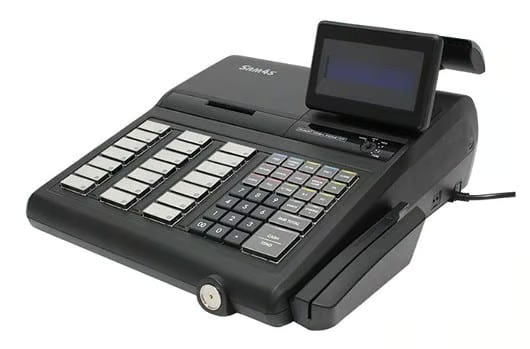
SAM4S ER-925: Best ECR for low- to mid-volume retailers
Why I chose SAM4S ER-925
Price-wise, the SAM4S ER-925 is a big step up from the much more affordable 180U, but it offers a lot more features, including customizable peripheral hardware.
You can attach a barcode scanner, scale, and external pole display. Also, you can choose from an integrated card reader or an external reader. To speed up service, you can add an optional Dallas Key reader, allowing cashiers to quickly log into the register by attaching a magnetic fob.
However, if you want to automatically collect customer emails for your marketing efforts, the ER-925 is not a great fit. Both Lightspeed and Square offer much more robust customer management tools (and Square’s are priced based on your actual use). Both also offer built-in payment processing, which speeds up your setup process.
Who should use it:
The SAM4S ER-925 is a sturdy electronic cash register built for retail businesses. It is popular with gift shops, ceramics studios, candy shops, and other mid-volume retailers.
SAM4S ER-925 pricing
From $499-$679 (price varies by vendor and add-ons). For payment processing, you will need to get a separate merchant services account. Rates will vary.
Key features
- Up to 15 employee logins
- Tracks up to 2,000 PLUs
- 100 mix-and-match discount options
- 6-line pre- and post-receipt messages
- Additional ports to connect: barcode scanner, scale, external card reader, external pole display, and Dallas Key port
Methodology: How I evaluated POS and traditional electronic cash registers
I reviewed more than 20 ECRs and POS-driven registers to identify the best options for small businesses. Each product was scored across four key areas:
- Pricing: Upfront hardware cost, monthly software fees, and payment processing rates.
- Register features: Ability to accept multiple payment types, print receipts, integrate with cash drawers, and support mobile or countertop use.
- Management tools: Inventory tracking, reporting, employee log-ins, and multi-location support.
- Ease of use: Setup process, learning curve, customer support availability, and quality of documentation.
I also assigned an expert score based on overall value, popularity with small business owners, and balance between affordability and capabilities.
Traditional cash register vs POS register: Which do you need?
| Option | Best for | Trade-off |
|---|---|---|
| Traditional cash register | Cash-heavy, low-volume, or simple retail businesses | Lower upfront cost, but limited reporting, inventory, and payment tools |
| POS cash register | Most small businesses that accept cards or need inventory/reporting | Higher hardware or software costs, but more flexible and scalable |
| Tablet or mobile register | Pop-ups, service businesses, and mobile sellers | Portable and affordable, but may need separate cash drawer or receipt printer |
How POS registers differ from traditional electronic cash registers
POS registers perform the same checkout functions but include additional software tools. They track inventory, generate sales reports, and manage employee permissions. Many also integrate with ecommerce and accounting systems. Traditional electronic registers focus mainly on recording sales and storing daily totals.
What a traditional cash register does
Traditional ECRs are simple machines that total sales, print receipts, and store cash. They are inexpensive and best suited for cash-only businesses with low sales volume. However, they lack modern features, and ongoing support is limited.
What a POS system does
POS systems, by contrast, combine payment processing with advanced features such as inventory tracking, employee management, and real-time reporting. They can run on iPads, smartphones, or dedicated hardware, giving small businesses more flexibility and scalability.
Most modern businesses benefit from POS-driven registers, since they offer more features and are easier to maintain long-term. Learn more about the differences between POS systems vs cash registers.
Related:
- What Is a POS System & How It Works: Small Business Guide
- Point of Sale (POS) Hardware Guide
How much does a cash register cost?
| Cost factor | What to check |
|---|---|
| Hardware | Register terminal, cash drawer, receipt printer, barcode scanner, customer display |
| POS software | Monthly subscription, register fees, add-ons, inventory tools, reporting |
| Payment processing | In-person, keyed-in, online, chargeback, and deposit fees |
| Installation | DIY setup, professional installation, hardware configuration, staff training |
| Support | Included support, premium support, warranty, hardware replacement |
| Accessories | Barcode scanners, label printers, kitchen printers, handheld devices |
| Contracts | Long-term agreements, cancellation fees, reseller terms, financing costs |
The cost of a cash register depends on the type of system you choose. Traditional electronic cash registers usually have lower upfront costs, while POS systems combine hardware, software subscriptions, and payment processing fees. Most businesses should account for three main costs: hardware, POS software, and payment processing.
How to choose a cash register for your business
The best cash register for your business depends on your checkout volume, payment needs, inventory requirements, and whether you want a traditional electronic cash register or a POS-driven register. If you plan to grow beyond a very small operation, a POS system is usually the better investment because it adds payments, inventory, reporting, and business management tools traditional registers do not offer.
Step 1: Start with your checkout volume
Low-volume, cash-heavy businesses may only need a traditional register. These work well if you mainly need to ring up sales, store cash, calculate tax, and print receipts.
Higher-volume stores usually need a POS register because it can handle card payments, product tracking, employee permissions, sales reports, and connected hardware.
Step 2: Decide how you accept payments
If you only accept cash, a basic register may be enough. If you accept credit cards, contactless payments, mobile wallets, keyed-in payments, or online orders, choose a POS-driven register.
Look for secure payment tools, including:
- EMV chip processing
- NFC and contactless payments
- Apple Pay and Google Pay
- Keyed-in payments
- Online or invoice payments
- Chargeback management
Also compare processing rates and whether the provider requires built-in payment processing or lets you use your own processor.
Step 3: Check hardware needs
Your register setup should match how your staff checks out customers. A small shop may only need a cash drawer and receipt printer, while a retail store may also need scanners, customer displays, or handheld devices.
Common hardware to compare includes:
- Cash drawers
- Receipt printers
- Barcode scanners
- Customer displays
- Card readers
- Handheld devices
- Kitchen printers
- Label printers
Make sure the system can grow with you if you add more checkout stations or locations.
Step 4: Review inventory and reporting tools
If you need to track products, sales trends, or reorder points, choose a POS register. POS systems update stock levels automatically when items are sold and can show which products are selling fastest.
Look for:
- Real-time inventory tracking
- Low-stock alerts
- Sales reports
- Product performance reports
- Employee sales reports
- Refund and void tracking
- End-of-day reports
If you sell online and in store, look for omnichannel inventory syncing so your stock stays accurate across all sales channels.
Step 5: Compare software fees and long-term costs
Traditional registers usually have no monthly software fee, but they also have fewer features. POS registers may charge monthly fees for advanced inventory, loyalty, ecommerce, marketing, or multi-location tools.
Compare the full cost, including hardware, software, payment processing, add-ons, support, and installation. A cheaper traditional register may cost less upfront, but a POS system can offer better long-term value if it reduces manual work.
Step 6: Check online and mobile selling needs
If you sell at events, online, or from multiple locations, choose a cloud-based POS register. This lets you access sales, inventory, and reports from anywhere.
Mobile and cloud POS systems are especially useful for pop-ups, service businesses, food trucks, farmers markets, and retailers with both ecommerce and in-store sales.
Step 7: Evaluate employee management and support
POS systems can track sales by employee, manage permissions, and monitor actions like refunds, discounts, and voids. These tools are useful if you have multiple staff members using the register.
Support also matters. Many POS providers include live support, help centers, and software updates. Traditional register support can be more limited, especially for older or discontinued models.
Step 8: Test ease of use
Before choosing a register, test the checkout workflow. Staff should be able to ring up sales, apply discounts, process returns, print receipts, close drawers, and run end-of-day reports quickly.
The right cash register should make checkout faster, reduce errors, and give you enough visibility into sales and inventory without adding extra work.
Frequently asked questions (FAQs)
These are some of the most common questions about the best cash registers for small businesses.
What is the best cash register for small business?
Square Register is the best cash register for most small businesses because it includes POS software, payment processing, touch-screen checkout, inventory tools, reporting, and affordable hardware options.
What is the difference between a cash register and a POS system?
A cash register records sales, stores cash, and prints receipts. A POS system does those tasks plus payment processing, inventory tracking, customer management, employee tools, and reporting.
How much does a cash register cost?
A cash register can cost around $100 to $2,000+ depending on whether you choose a basic electronic register or a full POS register. POS systems may also include monthly software fees, payment processing fees, hardware accessories, and support costs.
Do I need a cash register or POS system?
Choose a traditional cash register if you run a low-volume, cash-heavy business with simple checkout needs. Choose a POS system if you accept cards, sell online, track inventory, manage employees, or need business reports.
What is the best cash register for a restaurant?
Toast is the best cash register for restaurants because it offers restaurant-specific hardware, menu tools, modifiers, handheld ordering, kitchen display support, and payment processing.
Can I use an iPad or phone as a cash register?
Yes. You can use an iPad, tablet, or smartphone as a cash register by installing a POS app and connecting payment hardware, a receipt printer, and a cash drawer if needed.
What features should a cash register have?
A cash register should include fast checkout, receipt printing, tax settings, payment acceptance, daily sales reports, and a cash drawer. Growing businesses should also look for inventory tracking, customer profiles, staff permissions, and online sales tools.
Bottom line
Standalone electronic cash registers are still available, but they are limited in features and increasingly difficult to support. POS-driven registers give small businesses more value with payment flexibility, inventory management, and staff tools.
- ECRs like the SAM4S line are best for cash-only shops that want a low-cost, one-time purchase.
- POS systems such as Square, Toast, Clover, and Lightspeed provide more advanced tools and long-term support.
For most businesses, Square is the best overall option. It offers free software, affordable hardware, and all the tools needed to grow beyond simple cash handling. The right choice depends on your transaction volume, industry, and growth goals — but if you want a system that works now and scales with future trends, a POS-driven cash register is the smarter investment.
