





.jpg?w=288)


Square Payroll and QuickBooks Workforce (formerly QuickBooks Payroll) are both great for small businesses; they are widely used, offering full-service payroll (filing and paying your payroll taxes) and benefits like health insurance and retirement. Square Payroll is cheaper and ideal if you’re using Square POS. On the other hand, QuickBooks Workforce syncs seamlessly with QuickBooks accounting software and is a good fit if you’re looking for affordable contractor-only payroll.
Here’s when I recommend Square Payroll vs QuickBooks Workforce:
- Square Payroll: Best for Square POS users, retail shops, and restaurants
- QuickBooks Workforce: Best for QuickBooks Accounting users and low-cost contractor payments
Why You Can Trust Fit Small Business
- Square Payroll vs QuickBooks Workforce Compared
- When to Use Square Payroll and QuickBooks Workforce
- QuickBooks Payroll
- Best for Price: Tie
- Best for Pay Processing: Square Payroll
- Best for HR & Employee Benefits: QuickBooks Workforce
- Best for Reporting: Tie
- Best for Ease of Use & Customer Support: Tie
- Best in Our Expert Review: Tie
- Best for Popularity Among Users: Tie
- Bottom Line
Square Payroll vs QuickBooks Workforce Compared
 |  | |
|---|---|---|
| Visit Square Payroll | Visit QuickBooks Workforce | |
| Overall Payroll Software Evaluation Score | 4.51 out of 5 | 4.53 out of 5 |
| Starter Monthly Pricing | $6 per employee + $35 base fee | $50 per month + $6.50 per employee monthly |
| Contractor-only Plan($/Month) | $6 per worker | $15 for 20 contractors;plus $2 per additional contractor |
| Payroll Tax Filings and Year-end Reporting | Federal, state, and local | Federal and state; local with higher plans |
| Direct Deposit Processing Timelines | 4 days; instantly with Square’s Instant Payments | Next-day; same-day with higher plans |
| Time Tracking | ✓ | Included in higher tiers |
| Access to Health Insurance, Retirement, and Workers’ Comp | ✓ | ✓ |
| Employee Onboarding | ✓ | ✓ |
| Access to HR Advisers | Costs extra | Included in higher tiers |
| Customer Support | Phone, email, and chat | Phone and chat |
| Read our Square Payroll Review | Read our QuickBooks Workforce Review |
If you are looking for an alternative that is richer in HR features, check out our guide to the best human resource information system (HRIS).
When to Use Square Payroll and QuickBooks Workforce
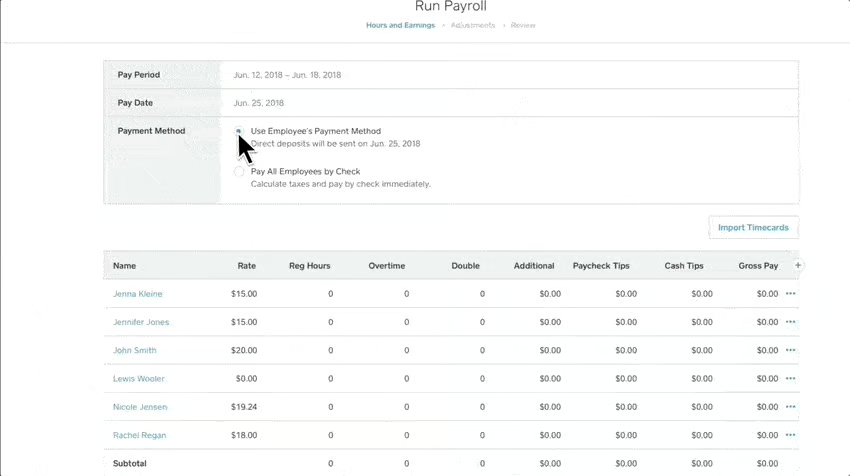
Square Payroll is the superior choice for retail shops and restaurants because of its excellent point-of-sale (POS) system. These two products integrate seamlessly, making processing commission and tip payments a breeze. Plus, if you’re using Square POS to track employee clock-ins/outs, you can import actual work hours into Square Payroll with just a few clicks. An added useful feature for restaurants and other seasonal businesses is its free seasonal inactivity feature that lets a business pause its account, and Square Payroll will still file taxes.
If you’re not a Square POS user, Square Payroll is still an excellent choice. It’s highly affordable, covers hourly and salaried employees, and handles taxes and deductions with ease. You can add up to 12 pay rates and roles per employee—useful for businesses with employees handling multiple jobs.
QuickBooks Workforce is optimal for small businesses that use QuickBooks Accounting. It integrates natively with its accounting module, making it easy for you to track payroll data for general ledger updates. Plus, through QuickBooks Accounting’s network of partner systems, QuickBooks Workforce can pull information from hundreds of other programs, which is a great help if you are paying commissions, mileage, or other payments tracked through third-party software.
Best for Price: Tie
| | |
|---|---|---|
| Score | 5 out of 5 | 5 out of 5 |
| New Client Promotions* | None, as of this writing | 30-day free trial or 50% off base fees for 3 months |
| Monthly Pricing | Full-service payroll: $6 per employee + $35 base fee |
|
| Contractor-only Plan | $6 per contractor monthly | $15 for 20 contractors monthly; plus $2 per additional contractor |
| Multiple State Tax Filings | Included in paid plan | All plans include 1 state filing Additional states: $12 for each additional state monthly for Core and Premium plan holders (Elite plan supports multiple state filings at no extra cost) |
| Employee Benefits Plans (Health, Retirement, and Workers’ Comp) | Additional plan fees may apply, depending on the provider | Additional plan fees may apply, depending on the provider |
| HR Advisory Services | $60 per location monthly | Included in Elite plan |
| *Special promotions may change from time to time. Check the providers’ websites for the latest promos on offer. | ||
While both received the same score (5 out of 5) in our evaluation, it’s difficult to compare Square Payroll vs QuickBooks Workforce for pricing because it depends on which package you plan to get. If you are using or plan to use QuickBooks Accounting, then getting QuickBooks Workforce makes more sense. Given the seamless integration between these two products, you won’t have to manually input or upload payroll-related data into your accounting system’s ledger.
QuickBooks’s contractor-only payments option is also more affordable than Square’s. If you pay 20 contractors, QuickBooks will only charge you $15 monthly, whereas paying 20 contractors with Square Payroll will cost you $120 monthly.
For employee and contractor payroll, Square is a better choice because you get all of its functionalities in its Full-service Payroll plan at a cost that’s more reasonable than QuickBooks
Payroll. With its starter Core plan, QuickBooks will bill you $50 + $6 per employee monthly. Square’s Full-service Payroll option is priced at only $35 + $6 per employee monthly.
Square vs QuickBooks Workforce: Compare Fees
Need a quick way to compare monthly and annual subscription costs? Use our online calculator to compute the estimated fees for Square Payroll vs QuickBooks.
Square Payroll vs QuickBooks Workforce Calculator
Best for Pay Processing: Square Payroll
 | | |
|---|---|---|
| Score | 4.5 out of 5 | 4.44 out of 5 |
| Unlimited and Automatic Pay Runs | ✓ | ✓ |
| Multistate Payroll | ✓ | ✓ |
| Calculates, Pays, and Files Payroll Taxes | ✓ | ✓(requires upgrading to its higher plans if you want local tax filing services) |
| Year-end Tax Reports(W-2s/1099s) | ✓ | ✓ |
| Direct Deposit Processing Timelines | 4 days; instantly with Square’s Instant Payments | Next-day; same-day with higher plans |
| Manual Paychecks* | ✓ | ✓ |
| Pay-on-Demand Feature | ✓(via Square’s Cash App) | ✕ |
| Wage Garnishments | ✓ | ✓ |
| Tax Penalty Protection Program** | Only for mistakes its representatives make | ✓ Also offers an advanced option that covers tax filing mistakes its clients may make |
| *You print paychecks yourself **Covers penalties and fines from tax filing errors and mistakes | ||
QuickBooks Workforce and Square Payroll allow you to run payroll as many times as you need in a month without having to pay extra. Both can also handle employee and contractor payments with ease, including the payroll tax and tax filing requirements (such as W-2/1099 reports at year-end) needed for both.
While these two providers are closely matched, Square beats out QuickBooks for payroll features, mainly because of local tax filings. QuickBooks Workforce calculates local taxes but will only file them if you subscribe to its higher plans.
Square Payroll also lets you pay employees instantly with its Instant Payment option. So, if your business accepts customer payments through Square and maintains funds in a Square account, you can pull payroll funds from your account (or associated credit card if you go over the amount in your account) to pay employees instantly, if you have a Cash App account, or otherwise, the next day.
If you’re not signed up for the Square Instant Program, payroll takes four days. QuickBooks offers next-day payroll or same-day with its more expensive plans, regardless of where you store your funds.
When to Consider QuickBooks Workforce
QuickBooks is a better choice than Square for payroll if you need fast payments. It comes with next-day direct deposit—same-day with its more expensive plans. If you need to track your employees’ work hours by project, QuickBooks Workforce’s Elite plan has project and time tracking tools, whereas Square doesn’t have project time tracking capabilities.
Plus, QuickBooks Workforce’s tax penalty protection program is more robust than Square’s. Both may be willing to pay the associated fines and penalties for their tax filing mistakes, but QuickBooks Workforce takes this up a notch. It provides an additional program that covers all tax filing error penalties (up to $25,000 a year) regardless of who made the mistake—provided you get its Elite plan.

Best for HR & Employee Benefits: QuickBooks Workforce
| | |
|---|---|---|
| Score | 4.25 out of 5 | 4.5 out of 5 |
| Employee Self-service Portal | ✓ | ✓ |
| Online Onboarding | ✓ | ✓ |
| State New Hire Reporting | ✓ | ✓ |
| Time Tracking | ✓(via Square POS or the Square Team app) | ✓(via QuickBooks Time) |
| Paid Time-off (PTO) Management | ✓ | ✓ |
| Workers’ Compensation | Pay-as-you-go plan | Pay-as-you-go plan |
| 401(k) Plan | ✓ | ✓ |
| Health Insurance Plan | ✓ | ✓ |
| Health Benefits Cover All 50 States | ✓ | ✓ |
| HR Advisory Services | Paid add-on | Included in Elite plan |
When comparing Square Payroll vs QuickBooks Workforce for HR and employee benefits, QuickBooks squeaks ahead because its higher tiers include access to HR support (through Mineral). Premium and Elite plan holders can get customizable job descriptions and onboarding checklists. In addition, Elite users are granted access to a personal HR Adviser they can call to consult regarding employee issues and ask for assistance in creating policies and handbooks. With Square, you need to pay extra to get similar HR services.
In terms of employee benefits, Square Payroll and QuickBooks Workforce are closely matched. Both offer health insurance, 401(k) plans, and workers’ compensation. Employees can also enroll in benefits online through their employee portal. With Square Payroll, however, employers using nonpartners for benefits have to send the payments themselves. In comparison, QuickBooks Workforce sends payments directly to the providers.
When to Consider Square Payroll
If you need scheduling tools, Square allows you to create work shifts for up to 10 days (QuickBooks doesn’t have this feature). Its HR support services are also a little bit more robust, providing access to HR advisory services, HR document templates, and an employee handbook builder.
Best for Reporting: Tie
| | |
|---|---|---|
| Score | 5 out of 5 | 5 out of 5 |
| Built-in Basic Reports | ✓ | ✓ |
| Report Customizations | ✓ | ✓ |
In our evaluation of Square vs QuickBooks Workforce on reporting features, we found they offer similar tools. Both providers let you create, customize, and download reports—plus, both have a sufficient set of standard reports that you can easily access.
While these providers may have similar reporting capabilities, QuickBooks has more premade payroll reports, including a greater capacity to create specialized reporting. If you are in a highly regulated industry or simply need more data crunching, QuickBooks Workforce is the best choice.
Best for Ease of Use & Customer Support: Tie
| | |
|---|---|---|
| Score | 4.38 out of 5 | 4.38 out of 5 |
| Ease of Use | Good | Good |
| Set Up Help | ✓ | Included in higher plans |
| How-to Guides | Very easy to understand | Some help articles are confusing |
| Third-party Software Integrations | Limited | Limited; requires QuickBooks Accounting to unlock its partner systems |
| Access to a Community Forum | ✓ | ✓ |
| Customer Support | Email, chat, and phone support (8 a.m.-8 p.m. Central Time) | Chat and phone (Monday to Friday, 6 a.m.-6 p.m. Pacific Time) |
Both received the same rating, but when it comes to ease of use, Square Payroll beats QuickBooks Workforce—but only by a small margin. Although both have live support, extensive help sections, and intuitive platforms, Square is the easier interface. Plus, it offers setup help, something QuickBooks only does in its Elite plan. Square Payroll’s how-to articles are also easier to understand and search. QuickBooks lumps together its help articles for all its products and versions, making it difficult to navigate.
Best in Our Expert Review: Tie
| | |
|---|---|---|
| Score | 4.38 out of 5 | 4.38 out of 5 |
| Cost is Affordable for Small to Midsize Businesses (SMBs) | ✓ | ✓ |
| Width and Depth of HR Features Are Ideal for SMBs | Basic (limited HR features) | Basic (limited HR features) |
| Width and Depth of Payroll Features Are Ideal for SMBs | ✓ | ✓ |
| Software Is Easy to Navigate for SMBs | ✓ | ✓ |
In my expert assessment, Square and QuickBooks offer solid payroll tools and a basic set of HR features that make it easy to handle simple new hire onboarding, store basic staff information, and track employee attendance.
When it comes to value for money, both have affordable options, depending on the plan selected. For full-service payroll, I recommend Square Payroll as it charges a monthly rate that’s lower than QuickBooks Workforce’s plans. But if you only pay contract workers, you get more savings with QuickBooks Workforce’s contractor payments package.
In terms of scalability, both have platforms that can support the payroll needs of small to midsize businesses (SMBs). However, I wouldn’t recommend Square and QuickBooks for rapidly expanding companies or those that plan to grow into a large business, as both don’t have a wide range of HR tools to help you manage employees.
Gusto or Rippling would be better options in this case, since these two have feature-rich platforms that can handle basic to advanced HR tasks, from hiring to performance reviews and even global recruiting and payroll through an employer of record (EOR) service. Learn more about these two platforms in our guide to the best HR software.
Best for Popularity Among Users: Tie
| | |
|---|---|---|
| Score | 3.75 out of 5 | 3.75 out of 5 |
| User Feedback | Mostly positive | Mostly positive |
| Average User Ratings* | 4.45 out of 5 | 4.10 out of 5 |
| Average Number of Reviews* | More than 300 | Over 460 |
| *Data from third-party review sites, such as G2 and Capterra. | ||
To compare Square vs QuickBooks Workforce on user popularity, we looked at each provider’s average overall ratings and the number of reviews on third-party review sites like G2 and Capterra. For user ratings, Square’s average score is slightly higher than QuickBooks’s (4.45 out of 5 vs 4.10 out of 5, as of this writing). However, QuickBooks Workforce’s average number of reviews online is higher—it has over 460 reviews compared with Square Payroll’s 300-plus reviews.
What Users Think
QuickBooks Workforce reviews on Capterra and G2 are mostly positive. Reviewers like its user-friendly tools that help them manage payroll and track employee time off. Some users appreciate its fast and easy direct deposits, including its automated payroll tax filings. However, several reviewers noted that it can get expensive, especially for small companies adding more employees to support growing business operations.
Methodology: How We Evaluated Square Payroll vs QuickBooks
To evaluate Square vs QuickBooks Workforce, we looked at the most common areas of concern for small businesses—from pricing and pay processing features to ease of use and user reviews. We also checked for additional tools, like HR features and access to experts in case you have questions about the HR and payroll compliances in your state.
Click through the tabs below for a detailed breakdown of our evaluation.
We checked to see if the provider has transparent pricing, zero setup fees, and multiple plan options with unlimited pay runs. Those priced at $50 or less per employee monthly were also given extra points.
We gave priority to those that offer multiple pay options, two-day direct deposits, tax payments and filings, year-end reporting (W-2s and 1099s), and a penalty-free tax guarantee.
Payroll service and software should be simple to set up, customizable, and have a user-friendly interface. We also looked at whether the provider offers live support and integration options with online tools that most SMBs use.
Online onboarding, which means giving employees the option to fill out forms like W-4s electronically, is the top criterion, followed by state new hire reporting and the availability of a self-service portal where employees can view pay stubs, edit information, and access forms. Extra points were also given to providers who offer expert HR support, benefits options, and health insurance plans that cover all US states.
In this criterion, we assess whether the software’s ease of use, pricing, and the width and depth of its payroll and HR tools are ideal for SMBs.
We considered user reviews, including those of our competitors, based on a 5-star scale; any option with an average of 4-plus stars is ideal. Also, any software with 1,000-plus reviews on any third-party site is preferred.
Preference was given to software with built-in basic payroll reports and customization options.
Bottom Line
When comparing Square Payroll vs QuickBooks for payroll, take stock of the features you want and whether its pricing fits your budget. Restaurant and retail shop owners will find Square Payroll good to use given its seamless integration with Square POS, making it easy to capture and process tip payments. Small businesses with seasonal highs and lows will also find Square Payroll’s inactivity feature a suitable option.
On the other hand, QuickBooks Workforce is optimal for small businesses that plan to or are already using QuickBooks Accounting. Its native integration with its accounting solution enables payroll accountants to easily track and record pay-related transactions in your company’s general ledger. It even offers fast direct deposits, with a next-day option available even in its starter Core plan. Plus, companies that only pay contract workers will get more savings with its low-cost contractor payments package.
