


Call centers lose valuable time and resources when customer calls are sent to the wrong agent or department — leading to repeated transfers, longer wait times, and missed service-level targets. These inefficiencies frustrate both customers and agents.
Intelligent call routing solves this by utilizing data and AI to match each caller with the most suitable agent or channel, resulting in faster resolution, shorter handling times, and higher satisfaction.
This guide explains what intelligent call routing is, how it works, and its key benefits. I’ll also walk you through the process of selecting the right solution and share some best practices to ensure a maximum return on your investment.
- What is intelligent call routing?
- How intelligent call routing works
- What are the pros and cons of intelligent call routing?
- Benefits of intelligent call routing for call centers
- Factors to consider when choosing an intelligent call routing solution
- Top contact center providers
- Frequently asked questions (FAQs)
- Bottom line
What is intelligent call routing?
Intelligent call routing uses data and decision logic to direct incoming interactions, such as phone calls, chats, texts, or emails, to the most suitable destination, whether that’s an agent, a queue, a self-service tool, or an automated workflow.
The system pulls data from several sources to make smarter routing decisions:
- Customer relationship management (CRM) systems: They contain customer history, account details, and past interactions.
- Contact center platforms: They supply real-time information about agent availability, skill sets, and current workload.
- Interactive voice response (IVR) and AI-powered tools: These capture caller intent and keywords during the initial interaction.
- Business rules and analytics platforms: They define priorities, like routing VIP customers faster or handling billing questions in a specific queue.
Unlike traditional automatic call disputers (ACD) or IVR systems that route based only on static menus or “next available agent” logic, intelligent routing uses these data points to choose the best path for each interaction.
Depending on the setup, it can range from basic if/then rules and skill-based matching to predictive AI models that estimate which agent or workflow is most likely to achieve your business goals — like faster resolutions, lower handle times, or higher customer satisfaction (CSAT) scores.
How intelligent call routing works
Instead of sending customers through endless menus or random transfers, an intelligent call routing system analyzes data in real time to make the best connection possible. Here’s how the process typically works in a call center environment:
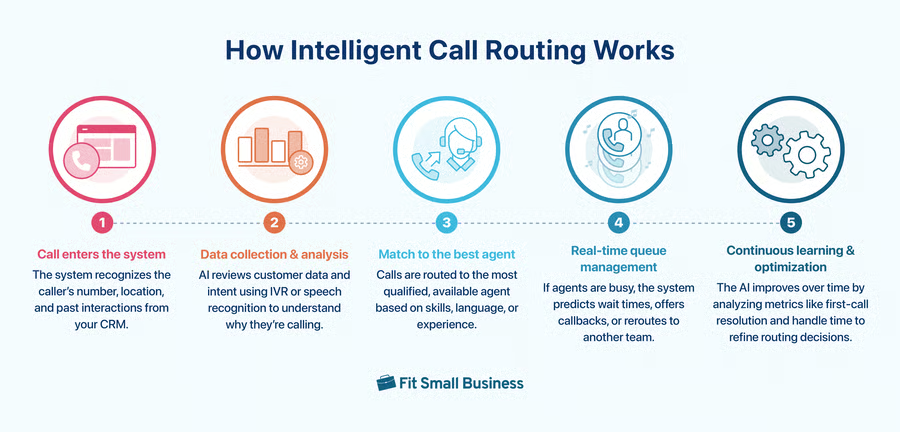
1. Call enters the system
When a customer calls your business or support line, the system receives the call. It immediately identifies key details, such as the caller’s phone number, location, and any past interactions stored in your CRM or contact center software.
2. Data collection and analysis
AI analyzes available data points (e.g., caller history, language preference, or account type) to determine the reason for the call and the customer’s intent. Some systems also utilize IVR or natural language processing (NLP) so that customers can express their needs in plain language (e.g., “I need to update my payment method”).
3. Matching the caller to the best agent
Using AI algorithms and skill-based routing, the system identifies which agent is most qualified and available to help. Factors can include agent skills, experience, language fluency, or even personality match if customer satisfaction data is available.
4. Real-time queue management
If no agent is immediately available, intelligent routing doesn’t just place the caller on hold. Instead, it can predict wait times, offer callback options, or even redirect the call to another qualified team. This minimizes frustration and optimizes agent workloads.
5. Continuous learning and optimization
One of the most significant advantages of AI-driven routing is that it learns and improves over time. The system tracks metrics like first-call resolution (FCR) and average handle time (AHT) to fine-tune routing logic and ensure better results with every interaction.
What are the pros and cons of intelligent call routing?
| Pros | Cons |
|---|---|
| Fewer transfers: Smarter matches reduce handoffs and repeat contacts. | Data dependency: Poor CRM or labeling produces poor routing decisions. |
| Lower operating cost per contact: Reduced AHT and fewer callbacks cut minutes billed and agent time. | Takes time to set up: Designing, integrating, and fine-tuning intelligent routing requires planning, testing, and a certain level of technical expertise. |
| Better agent fit and morale: Agents spend more time on work that matches their skills. | Risk of bias: AI models can unintentionally favor certain agents or outcomes; therefore, regular monitoring and governance are crucial. |
| Actionable data: Routing logs create datasets for coaching and workforce planning. | Complexity and provider lock-in: Highly customized routing setups may be difficult to migrate if you decide to change providers later. |
Benefits of intelligent call routing for call centers
Intelligent call routing delivers measurable improvements across quality, speed, and cost by matching each interaction to the best path for the desired outcome. Routing typically makes a significant impact in key areas like contact resolution, handle time, and contact transfers.
Higher first contact resolution (FCR)
Intelligent routing increases the likelihood that customers reach an agent with the right skills and context on the first contact, which directly raises FCR. When agents receive enriched context (i.e., CRM history, recent interactions, or intent), they can resolve issues without transfers or callbacks. Higher FCR reduces downstream workload and improves customer satisfaction metrics tied to resolution.
Lower average handle time (AHT)
Routing customers to the agent best suited for the issue shortens the time spent gathering context and reduces the number of handoffs. Agents spend less time transferring or looking up histories, so conversations move to resolution faster. Lower AHT reduces cost per contact and increases the number of interactions a team can handle without adding headcount.
Reduced transfer and repeat-contact rates
By matching callers to the proper queue or specialist initially, intelligent routing cuts unnecessary transfers that waste agent and customer time. Fewer transfers mean fewer dropped threads and less rework when customers must repeat details. That reduction in repeat contacts improves both operational efficiency and customer perception of competence.
Improved agent utilization and morale
When agents consistently receive contacts that fit their skills, occupancy and throughput improve because time is spent resolving — not chasing — issues. Better-fit work reduces the frustration of frequent transfers and increases agents’ confidence and job satisfaction. Over time, this can lower churn and make recruiting and training more efficient.
Stronger SLA compliance and peak handling
Intelligent routing can prioritize interactions by SLA, customer value, or urgency, helping centers meet response-time targets even during spikes. Built-in overflow and escalation rules enable teams to route excess load to overflow pools, virtual agents, or callback options, thereby avoiding breaches. This targeted prioritization preserves service quality without blanket increases to staffing.
Actionable data for continuous improvement
Every routing decision and outcome becomes a data point that fuels coaching, workforce planning, and model tuning. Logged inputs — CRM fields, intent, chosen route — and outcomes — FCR, transfers, CSAT — let managers identify training gaps and refine rules or models. That feedback loop turns routing from a static feature into an ongoing lever for operational gains.
Factors to consider when choosing an intelligent call routing solution
When selecting an intelligent call routing system, begin by identifying your specific use cases, the data you already have, and the tools it needs to integrate with. Then, focus on solutions that show measurable performance gains in a pilot test and meet your standards for speed, transparency, and reliability.
| Factors to consider | What to look for |
|---|---|
| Integrations | Works seamlessly with your CRM, help desk, and analytics tools, so customer data updates in real time |
| Routing types | Supports multiple routing options: rules-based, skill-based, priority, predictive, and omnichannel |
| Performance visibility | Includes clear dashboards and detailed logs showing how routing decisions are made |
| Ease of use | Simple admin tools that let non-technical staff create, test, and update routing rules |
| Security and compliance | Utilizes encryption, access controls, and complies with standards such as SOC 2 or ISO |
| Pricing and flexibility | Offers transparent pricing, pilot programs, and modular add-ons for AI or advanced routing |
| Speed and reliability (latency) | Provides fast routing decisions and guarantees uptime in its SLA |
| AI governance | Includes monitoring, explainability, and fallback options for predictive models |
| Fallbacks and incident handling | Has backup routing rules and clear rollback procedures during outages |
| Proof of concept (POC) | Allows testing with real or simulated traffic to measure FCR, AHT, and transfer rate improvements |
| Training and change management | Offers onboarding, user training, and guidance for rule or model updates |
| Support | Provides reliable support and works with experienced system integrators |
Top contact center providers
Below is a list of top contact center providers that include intelligent call routing in their platforms. Use this table to compare options and narrow down your choices, then request a demo or proof-of-concept to see how each solution performs with your own business data.
| Provider | Starting monthly price (per user) | Best for | Call routing functionalities |
|---|---|---|---|
| RingCentral (RingCX) | $65 | UC-first organizations | Omnichannel rules + integrations |
| Talkdesk | $85 | Teams wanting prebuilt AI workflows | Rules + predictive + packaged AI features |
| Genesys Cloud | $75 | Complex routing at scale | Advanced predictive and routing modes |
| Five9 | $119 | Established CCaaS environments | Skill/rules/predictive modules |
| Twilio Flex | $150 | Highly custom routing via developers | Programmable TaskRouter (API-driven) |
Frequently asked questions (FAQs)
How does intelligent call routing improve customer experience?
It reduces hold times and transfers by connecting callers with the right person the first time. Customers spend less time repeating information, and agents receive the context they need to resolve issues quickly, leading to higher satisfaction scores (CSAT) and better first-contact resolution.
What kind of data does intelligent call routing use?
It typically pulls information from your CRM, help desk, and call history, such as customer details, language preferences, or previous interactions. Some systems also use AI tools like natural language processing (NLP) to detect intent from spoken or typed input.
How can I tell if my business needs intelligent call routing?
If your team spends time transferring calls, missing SLAs, or handling repetitive inquiries, intelligent routing can help. It streamlines workflows, improves agent productivity, and ensures every caller reaches the right place faster.
Bottom line
McKinsey & Company’s survey found that up to 71% of Gen Z-ers believe live calls are the quickest and easiest way to reach customer care. In response to this, intelligent call routing helps call centers move from simply answering calls in order to strategically connect each caller with the right agent or solution.
By using data, rules, and AI, businesses can match customers to the best outcome — faster resolutions, shorter handle times, and higher satisfaction.
For small and midsize teams, the best approach is to start with a pilot program, track measurable KPIs, and choose a vendor that offers clear visibility, reliable backups, and transparent pricing. With the right setup, intelligent routing becomes a practical tool for improving performance and customer experience.
