







Business cell phone plans keep your team reachable in the field, the office, or at the airport — bundling voice, text, and data with the coverage and security tools a growing company needs. Finding the best business cell phone plans comes down to how much data your team burns through, how many lines you're managing, and whether you need carrier-grade coverage or a lighter VoIP-style setup layered onto phones you already own.
After comparing pricing, coverage, hotspot allowances, and business features across the best business cell phone plans, Verizon is my top pick overall. Its combination of nationwide network reliability, a 3-year price lock, built-in mobile security, and per-line pricing that drops sharply once you add lines makes it the safest default for most small businesses. That said, Verizon isn't the right fit for everyone: T-Mobile pulls ahead if your team burns through data, AT&T edges it out on customer support, and Grasshopper or Google Voice make more sense if you just need a business number on phones you already have instead of a full carrier plan.
Below, I have included an overview of the best business cell phone plans for small businesses:
Business cell phone plans | Best for | My Score (out of 5) |
| Verizon | Small businesses overall | 4.60 |
| T-Mobile | Unlimited data and high-volume usage | 4.49 |
| AT&T | Mobile security | 4.87 |
| RingCentral | VoIP call management | 3.98 |
| Grasshopper | Business messaging | 3.92 |
| Google Voice | Basic, affordable VoIP | 3.57 |
- How I evaluated the best business cell phone plans
- Best business cell phone plans compared
- Verizon: Best overall business cell phone plan
- T-Mobile: Best for unlimited data and high-volume usage
- AT&T: Best for mobile security
- RingCentral: Best for VoIP call management
- Grasshopper: Best for business messaging
- Google Voice: Best for basic, affordable VoIP
- Nextiva
- How to choose the right business cell phone plan
How I evaluated the best business cell phone plans
I compared seven business cell phone plans based on pricing, features, and third-party reputation. I used a six-category rubric to evaluate and score each provider, then ranked them by their weighted total.
- Pricing (20%): I examined each provider's per-line pricing across different line counts, since per-line costs typically drop as a business adds more lines. I gave more weight to providers with transparent, published pricing at every tier and line count, and factored in required add-ons or subscriptions (like Google Workspace for Google Voice) that affect the true cost of the plan.
- General features (30%): I compiled a list of capabilities small businesses typically need from a cell phone plan, including unlimited talk and text, mobile hotspot data, and coverage in Canada and Mexico. I checked what's included at each tier versus what requires an upgrade or paid add-on.
- Advanced features (15%): I looked for features that go beyond basic connectivity, such as built-in security tools, AI-powered call features, international roaming, network prioritization, and CRM integrations. Providers offering more of these at lower tiers scored higher.
- Ease of use (10%): I assessed how straightforward each plan is to set up and manage, including app quality, account administration, and whether adding or removing lines requires a sales call versus self-service.
- Customer support (10%): I looked at each provider's support channels, availability, and third-party satisfaction rankings, such as J.D. Power's business wireless and business internet satisfaction studies. Providers with 24/7 support and strong third-party recognition scored higher.
- Expert score (15%): After scoring each category, I weighed each provider's overall value for money, network reliability, and standout features against its limitations to determine how well it serves small businesses with different needs.
Best business cell phone plans compared
Business cell phone plans | Monthly starting price (per user/line) | Key features | Ideal business setup |
|---|---|---|---|
| Verizon | $65 |
| Mobile teams that need reliable nationwide coverage and want predictable, locked-in pricing as they scale |
| T-Mobile | $60 |
| Cost-conscious teams with heavy data use that also need coverage outside traditional cell range |
| AT&T | $50 |
| Businesses that want strong built-in security and are willing to trade some hotspot data for it |
| RingCentral | $20 |
| Remote and hybrid teams that want a business phone app instead of carrier-based cell plans |
| Grasshopper | $14 |
| Solopreneurs and small teams that want a business number on existing cell phones |
| Google Voice | $10 |
| Startups and small teams already using Google Workspace who need basic, affordable VoIP |
Verizon: Best overall business cell phone plan
My expert opinion
Verizon tops this list as the best business cell phone plan because it pairs the most reliable nationwide network with pricing that actually rewards growth. The 3-year price lock is a genuine standout, as no other carrier on this list guarantees your base rate won't move for that long, which matters if you're budgeting past this year. And the per-line price drops steadily as you scale: two lines bring it to $55, and by five or more lines you're down to $29 per line with AutoPay — a meaningfully better rate than where the plan starts.
Verizon's tradeoff is the base plan's hotspot allowance. Five gigabytes disappears quickly if your team tethers laptops in the field, and getting to a meaningful hotspot cap means adding the Premium Network Experience add-on for another $10 a month. If your team leans hard on hotspot data from day one, T-Mobile builds more of that into its starting tiers.
Pricing
My Biz Plan Lines | Per line/month (AutoPay + paper-free)* | Per line/month (without discount)* |
|---|---|---|
| 1 line | $65 | $70 |
| 2 lines | $55 | $60 |
| 3 lines | $40 | $45 |
| 4 lines | $34 | $39 |
| 5+ lines | $29 | $34 |
*Plus taxes, fees, and Economic Adjustment Charge.
What's included with every My Biz Plan line
- Unlimited talk, text, and 5G/4G LTE data: During network congestion, data may be temporarily slower than other traffic; 5G access requires a 5G-capable device and doesn't include 5G Ultra Wideband
- 5GB of 5G/4G LTE mobile hotspot data: After 5GB per line, hotspot speeds drop to 600 Kbps for the rest of the billing cycle
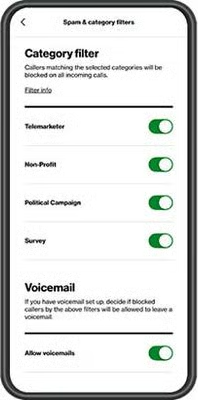
- Call Filter: Free spam-call screening, auto-blocking, and reporting; requires app download and activation
- Talk, text, and data in Canada and Mexico: Unlimited calls back to the U.S. and within Canada/Mexico, plus unlimited text; data gets 2GB of high-speed access per 24-hour period, then continues at 3G speeds
Note: Coverage does not extend to Puerto Rico, the US Virgin Islands, Guam, or other US territories.
Standout features
- 3-year price lock: Your base monthly rate for talk, data, and text won't change for three years, excluding taxes, fees, and add-ons. This is a rare guarantee among the carriers on this list.
- Business Mobile Internet Security: Included with every My Biz Plan line at no extra cost, helping protect devices from malware, ransomware, and phishing while connected to Verizon's network.
- BYOD and number porting: Bring your existing smartphone and phone number over to Verizon and activate it on My Biz Plan without needing new hardware.
T-Mobile: Best for unlimited data and high-volume usage
My expert opinion
T-Mobile earns the "best for unlimited data" spot because its top two tiers remove the trade-off Verizon and AT&T still require. ProMobile and SuperMobile both include unlimited premium data with no deprioritization, so a field team streaming video, syncing large files, or running payment terminals all day isn't watching a data meter the way they would on Verizon's base plan. The 5-year price guarantee is also the longest lock-in of any carrier here, two years past Verizon's.
However, T-Mobile pulls back on support and consistency. Its business customer support has consistently scored lower in third-party satisfaction surveys than Verizon's or AT&T's. And unlike Verizon, T-Mobile doesn't publish a clean per-line price table across every tier. Its headline numbers are anchored to a 6-line account, so smaller teams need to dig for the real 1- to 5-line cost. If dependable support is the priority over data headroom, AT&T is the stronger pick.
Pricing
Lines | CoreMobile | ProMobile | SuperMobile |
|---|---|---|---|
| 1 | $60 | $80 | $95 |
| 2 | $45 | $70 | $80 |
| 3 | $30 | $47 | $54 |
| 4 | $27 | $42 | $49 |
| 5 | $24 | $38 | $46 |
| 6 | $21 | $34 | $42 |
| 7 | $22 | $35 | $43 |
| 8 | $22 | $35 | $44 |
| 9 to 10 | $23 | $36 | $45 |
| 11 to 12 | $23 | $37 | $46 |
| 13+ | Contact T-Mobile for Business Sales expert | ||
Plus taxes and fees. AutoPay for lines 1-5 & 3rd line free for lines 3-12.
What's included by tier
CoreMobile | ProMobile | SuperMobile | |
|---|---|---|---|
| 5-year price guarantee | ✓ | ✓ | ✓ |
| Unlimited talk and text + up to 5GB high-speed data in Canada and Mexico | ✓ | ✓ | ✓ |
| Unlimited 5G/4G LTE data | ✓ | ✓ | ✓ |
| Premium (priority) data | 50GB | 200GB | Unlimited |
| Mobile hotspot | +5GB | +200GB | +300GB |
| Video streaming quality | Up to HD | Up to 4K UHD | Up to 4K UHD |
| Threat Protect (security) | Add-on ($1.99/line) | ✓ | ✓ |
| Nationwide network slice | — | — | ✓ |
| T-Satellite | Add-on ($15 regular rate; $10 discounted) | Included | Unlimited text |
| Scam protection | Scam Shield | Scam Shield | Scam Shield Premium |
| Dedicated business customer care | ✓ | ✓ | ✓ |
Standout features
- Largest 5G network by Ookla's analysis: T-Mobile cites independent testing showing its 5G network covers more ground than Verizon's or AT&T's, based on Ookla's Speedtest Intelligence data for the first half of 2026. This is a coverage claim none of the other carriers on this list currently make with third-party backing.
- Business All-In bundle: Combines connectivity, device management, and security into a single solution instead of managing them as separate purchases from separate vendors — a genuine convenience play for businesses that don't want to stitch together multiple providers.
- DIGITS multi-line app: Add a second business number to an existing device for separate calling, texting, and voicemail, so employees don't need to carry two phones to keep work and personal lines apart.
AT&T: Best for mobile security
My expert opinion
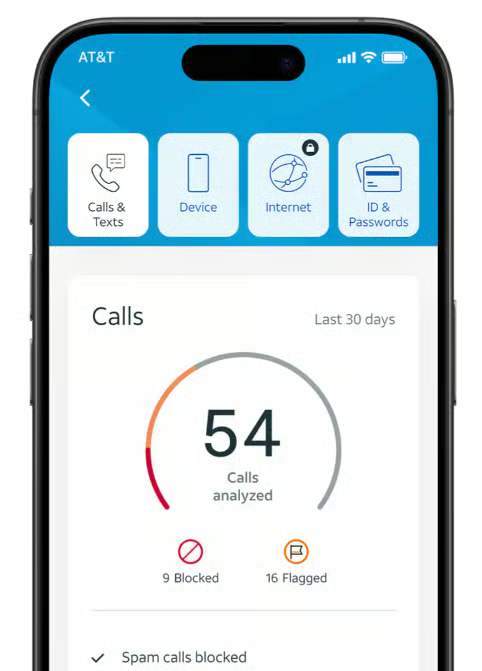
AT&T earns the security pick because ActiveArmor isn't an add-on here, but a standard on every tier, including the cheapest one. Plus, it includes spam risk detection and automatic fraud call blocking out of the box. That's a meaningfully different approach than Verizon, which includes basic Call Filter for free but reserves multi-line Caller ID upgrades for an extra $10.99/month. AT&T also backs that up with real third-party recognition: J.D. Power ranked it #1 in customer satisfaction for small-business wireless service in its 2025 US Business Wireless Satisfaction Study, which matters if support responsiveness is as important to you as the network itself.
Data headroom is the trade-off on the lower tiers. Standard 3.0's 5GB hotspot cap is the tightest of any plan on this list, and Advanced 3.0's single-line price is steep before the per-line cost drops at scale. If your team needs more data breathing room without jumping to AT&T's pricier tiers, T-Mobile's ProMobile plan offers roughly double the hotspot allowance at a comparable price point.
Pricing
Lines | Standard 3.0 | Advanced 3.0 | Premium 3.0 | Ultimate 3.0 |
|---|---|---|---|---|
| 1 | $50 | $70 | $85 | $110 |
| 2 | $45 | $60 | $75 | $100 |
| 3 | $35 | $50 | $60 | $85 |
| 4 to 24 | $30 | $40 | $50 | $75 |
| 25 to 50 | $25 | $35 | $45 | $75 |
Prices shown don't include taxes and fees. To get the full discount, you'll need AutoPay linked to a bank account plus paperless billing — a debit card gets a smaller discount, and a credit card doesn't qualify at all. These rates apply if you own your phone outright, are paying it off in installments, brought your own device, or aren't on a contract; if your line has a service commitment, the price is higher.
What's included by tier
Feature | Standard 3.0 | Advanced 3.0 | Premium 3.0 | Ultimate 3.0 |
|---|---|---|---|---|
| Hotspot data | 5GB | 100GB | 300GB | Unlimited (500GB, then 3Mbps) |
| Video streaming* | SD | HD | 4K UHD | 4K UHD |
| ActiveArmor mobile security** | ✓ | ✓ | ✓ | ✓ |
| AT&T Turbo for Business (network priority) | — | — | — | ✓ |
| Talk/text/data in Canada and Mexico | ✓ | ✓ | ✓ | ✓ |
| International calling discount | — | — | 50% off | 50% off |
| Roam Latin America | — | — | ✓ | ✓ |
| International Day Pass (free days) | — | — | 7 days | 10 days |
| Free tablet/wearable line | — | — | — | 1 tablet + 1 wearable |
*Video streaming: Resolution scales by tier, and the Video Management feature lets you actively control how much data streaming eats into, so you're not stuck watching your data allotment disappear passively in the background.
**ActiveArmor mobile security: Monitors for data breaches, protects your connection on public Wi-Fi, and blocks spam calls and texts before they reach you.
Standout features
- 5G Standalone Network: Built on a fully independent 5G core, not a 4G overlay, AT&T's SA network delivers lower latency and more consistent speeds, with 5G coverage now reaching over 320 million people across more than 27,000 cities and towns.
- Bundles with AT&T Internet Air for Business: Pair your wireless line with a fixed wireless internet option for backup connectivity or smaller locations. This is a resilience play none of the pure-VoIP providers on this list can offer since they don't control the underlying network.
- AT&T Next and AT&T Next Every Year: Split the cost of a new device into 30 or 24 monthly installments, with upgrade eligibility once you've paid off 80% (Next) or 50% (Next Every Year); genuine flexibility for outfitting a team without a big upfront hardware cost.
RingCentral: Best for VoIP call management
My expert opinion
RingCentral earns the VoIP call management pick because it packs genuinely advanced call handling, including automatic call recording, call monitoring, and custom call queues, into a platform priced comparably to far simpler tools like Grasshopper. For a remote or hybrid team that needs a real phone system and not just a business number layered onto personal cell phones, that's a meaningfully different value proposition than the carrier plans on this list.
However, the cost creep as you scale features. The jump from Core to Advanced doubles your CRM and custom-role access, and Ultra's recent 28.6% price hike makes the top tier a real commitment. If your team just needs a business number and basic call forwarding without the deeper call-center features, Grasshopper accomplishes that at a fraction of the cost.
Pricing
Plan | Annual billing | Monthly billing |
|---|---|---|
| Core | $20/user/month paid annually | $30/user/month |
| Advanced | $25/user/month paid annually | $35/user/month |
| Ultra | $35/user/month paid annually | $45/user/month |
Plus applicable taxes and fees.
What's included by tier
Feature | Core | Advanced | Ultra |
|---|---|---|---|
| Unlimited domestic calling | ✓ | ✓ | ✓ |
| HD video meetings | 300 participants | 300 participants | 300 participants |
| Call recording | On-demand | Automatic + on-demand | Automatic + on-demand |
| Toll-free minutes | 100/month | 1,000/month | 10,000/month |
| SMS | 25/user/month | 100/user/month | 200/user/month |
| CRM integrations & multi-site | — | ✓ | ✓ |
| Reporting/analytics | — | Core reporting & insights | Historical & real-time insights |
| Storage | Limited | Limited | Unlimited |
| Device analytics & alerts | — | — | ✓ |
| RingCentral Webinar | — | — | ✓ |
| AI Virtual Assistant | Captions, transcriptions, notes & summaries | + AI Writer | All features |
| AI Receptionist (AIR) | Add-on | Add-on | Add-on |
Standout features
- LLM plugins & MCP connectors, included from the entry tier: RingCentral supports Model Context Protocol connectors and LLM plugins across every plan, letting a business plug outside AI tools directly into their phone system — a capability most VoIP competitors on this list don't offer at all, let alone starting at the cheapest tier.
- 30-day money-back guarantee: A full refund window (excluding prepaid charges like toll-free minutes) gives businesses room to test the platform without full commitment risk.
- 99.999% uptime SLA: A carrier-grade reliability guarantee backed by a geo-redundant, fault-tolerant architecture, a formal commitment most VoIP competitors on this list don't publish.
Grasshopper: Best for business messaging
My expert opinion
Grasshopper earns the messaging pick because it strips business phone service down to exactly what a solopreneur or small team actually needs (e.g., a professional number, voicemail, and call forwarding) without charging per user the way RingCentral or Google Voice do. That flat-rate structure is a genuine advantage for a growing team: adding a fourth or fifth person to Solo Plus costs nothing extra, while every carrier and most VoIP competitors on this list would tack on another per-line or per-user fee.
The simplicity has a ceiling, though. Grasshopper has no CRM integrations, no API, and no AI features on any tier, and features that sound included (like a virtual receptionist) are actually a paid add-on routed through a third-party partner, Smith.ai, starting at $95/month. If your business needs those deeper capabilities baked in rather than bolted on, RingCentral is the stronger pick on this list, even though it costs more per seat.
Pricing
Plan | Billed annually | Billed monthly | Users | Numbers | Extensions |
|---|---|---|---|---|---|
| True Solo | $14/mo ($168/yr) | $18/mo | 1 | 1 | 1 |
| Solo Plus | $25/mo ($300/yr) | $32/mo | Unlimited | 1 | 3 |
| Small Business | $55/mo ($660/yr) | $70/mo | Unlimited | 4 | Unlimited |
Plus applicable sales tax.
What's included by tier
Feature | True Solo | Solo Plus | Small Business |
|---|---|---|---|
| Dedicated business number | ✓ (1) | ✓ (1, shared) | ✓ (4, shared) |
| Mobile + desktop app | ✓ | ✓ | ✓ |
| Business texting | ✓ | ✓ | ✓ |
| Custom greeting | ✓ | ✓ | ✓ |
| Voicemail greeting + voice-to-text | ✓ | ✓ | ✓ |
| Instant Response (auto text reply) | ✓ | ✓ | ✓ |
| Users | 1 | Unlimited | Unlimited |
| Extensions | 1 | 3 (shared) | Unlimited |
| Phone menu | — | ✓ | ✓ |
| Multi-user call routing | — | — | ✓ |
| Advanced call configurations | — | — | ✓ |
| Call recording | — | — | ✓ |
| Call tracking & analytics | — | — | ✓ |
Business texting requires a one-time $19.50 registration fee plus $1.50/month, billed separately on every plan.
Standout features
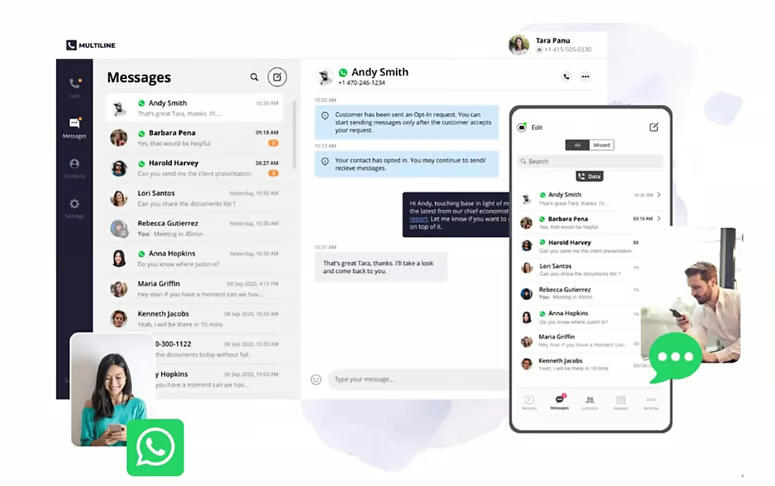
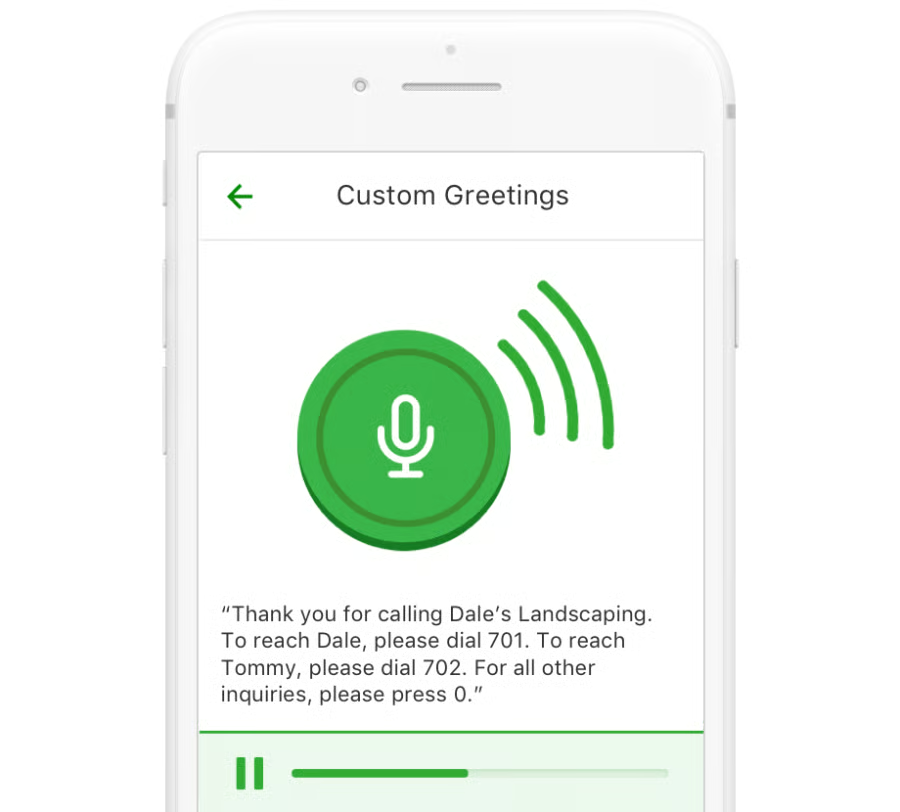
- Professionally recorded greetings, in English and Spanish: Order a custom voice recording for your greeting directly through Grasshopper — a polish-oriented touch most lightweight VoIP competitors on this list don't offer.
- Call forwarding across up to 15 numbers with simultaneous ringing (Solo Plus and up): Route an incoming call to your whole team at once instead of one line at a time, so no call gets missed while someone's tied up.
- 7-day free trial, no credit card required: A genuinely risk-free trial window, which is longer than many competitors offer, and without needing to hand over payment info upfront.
Google Voice: Best for basic, affordable VoIP
My expert opinion
Google Voice earns the affordable VoIP pick because, for a small team already living in Gmail and Google Calendar, it's the least disruptive way to add a business phone system. Voicemail transcription, spam filtering, and Meet integration are all there from the cheapest tier, and the app itself needs almost no learning curve. For a business that already pays for Workspace, adding Voice is genuinely just the $10 to $30 tier price, with no separate infrastructure required.
The honest complication is that the $10 headline price only tells part of the story. Google Voice isn't sold standalone — it requires an active Workspace subscription underneath it, so a business starting from zero is really looking at $17-plus per user once Workspace is factored in. And Starter's 10-user cap means growing past a small team forces an upgrade to Standard, which nearly doubles the Voice-specific cost. If your business wants a flat, predictable rate with no per-user math or platform prerequisite, Grasshopper's flat-account pricing is the simpler alternative on this list.
Pricing
Plan | Voice price | Workspace minimum (Business Starter, annual) |
|---|---|---|
| Starter | $10 | $7 |
| Standard | $20 | $7 |
| Premier | $30 | $7 |
What's included by tier
Feature | Starter | Standard | Premier |
|---|---|---|---|
| Users | Up to 10 | Unlimited* | Unlimited* |
| Calling locations | Domestic only | Domestic + regional | Domestic, regional + international |
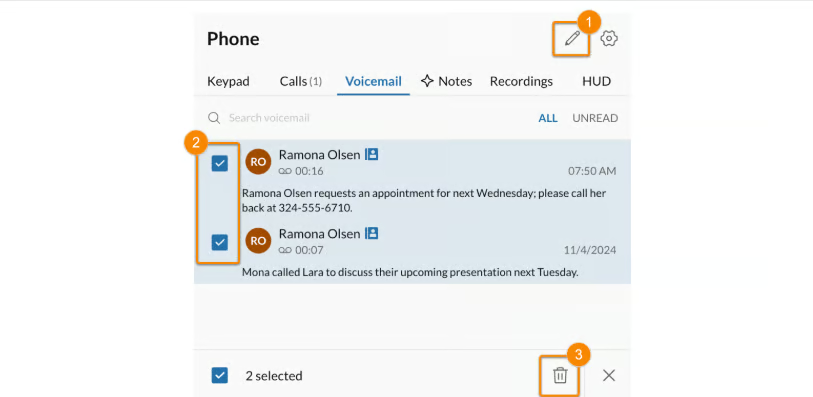
| Voicemail transcription | ✓ | ✓ | ✓ |
| AI spam filtering | ✓ | ✓ | ✓ |
| Google Meet/Calendar integration | ✓ | ✓ | ✓ |
| Call forwarding to linked numbers | ✓ | ✓ | ✓ |
| Multi-level auto attendant | — | ✓ | ✓ |
| Ring groups | — | ✓ | ✓ |
| Desk phone (SIP) support | — | ✓ | ✓ |
| Call recording | On-demand (managed accounts) | On-demand | Automatic |
| Advanced reporting (BigQuery) | — | — | ✓ |
| 24/7 support + SLA | ✓ | ✓ | ✓ |
*To exceed 50 users on Standard or Premier requires an upfront license payment.
Standout features
- Voicemail transcription on every tier, including the cheapest: Most competitors on this list reserve automatic voicemail-to-text on their entry plan; Google Voice includes it starting at $10/user.
- Do Not Disturb tied to Calendar working hours: Calls automatically route to voicemail outside your set working hours, without manually toggling availability, a small but genuinely useful automation none of the other providers here offer.
- AI spam filtering and call screening built in: Screens and filters likely spam calls automatically before they interrupt you, included from the Starter tier rather than sold as an upgrade.
.png)
How to choose the right business cell phone plan
The right business cell phone plan depends on how your team actually works day to day. A field crew burning through hotspot data needs something different than a two-person consultancy that just wants a professional number on phones they already own. First, pinpoint the problem you're actually trying to solve (e.g., data limits, no business number, poor coverage, high per-line costs). Next, list your must-haves based on team size, budget, and how much you rely on mobile data versus calls and texts. From there, match those requirements against the providers above.
Consider the following factors when comparing plans:
- Carrier vs. VoIP: Decide whether you need an actual cellular data plan (Verizon, T-Mobile, AT&T) or just a business phone number layered onto devices you already have (RingCentral, Grasshopper, Google Voice). A field team needs real mobile data; a remote office team often doesn't.
- Data and hotspot needs: Check each plan's premium data cap and hotspot allowance before you commit. A tight 5GB hotspot cap can throttle a team that tethers laptops in the field, while a generous unlimited tier costs more per line.
- Line count: Calculate the per-line cost at your actual team size, not the 1-line headline price. Carrier pricing drops significantly at higher line counts, and some providers price differently depending on whether you're at 3, 6, or 10+ lines.
- Hardware vs. BYOD: Confirm whether the plan supports bringing your own device or requires new hardware. Most carrier plans support BYOD, but device-financing terms and eligibility vary.
- Security features: Look for built-in protections like spam call blocking, malware protection, or phishing defense. Some providers include this at every tier; others reserve it for higher-priced plans or sell it as an add-on.
- International coverage: Review calling and data coverage in Canada, Mexico, and beyond if your team travels or has international contacts. Coverage terms vary widely, from unlimited regional data to per-minute international rates.
- Customer support: Check available support channels and hours, especially if you don't have in-house IT. 24/7 phone support matters more for a growing team than a solopreneur managing one line.
- Total cost beyond the sticker price: Factor in taxes, fees, add-ons, and any required subscriptions (like Google Workspace for Google Voice, or SMS registration fees for Grasshopper) that aren't included in the advertised monthly rate.
Frequently asked questions (FAQs)
Do I need a separate business cell phone plan, or can I use my personal plan?
You can run a business off a personal number, but a dedicated plan gives you work/personal separation, professional features like auto attendants, and often better multi-line pricing. If you don't need cellular data, a VoIP option like Grasshopper or Google Voice adds a business number to a phone you already own.
Is it cheaper to add a line to an existing carrier plan or get a separate business plan?
It depends on your carrier and line count. Business-specific plans often come with per-line discounts that scale with team size, plus features like security and support tailored to companies rather than families. Adding a line to a personal plan can work for a solo operator, but it usually means losing access to business account management, multi-user billing, and admin controls.
How many lines do I need for a small business?
Most small businesses start with one line per employee who needs to make or receive calls on behalf of the company, plus any shared lines for departments like sales or support. If you're unsure, start with fewer lines. Carrier plans let you add lines as you grow, and per-line pricing usually drops as your line count increases.
