






Every month, I search the internet for the best voice-over-internet-protocol (VoIP) phone system for small business owners that offers cloud-based communication features not found in traditional landlines, all at a low cost. While I prefer providers with advanced features and artificial intelligence tools, various services cater to different business needs.
For this article, RingCentral is my top VoIP service for small businesses because it combines advanced call management, unified communications, artificial intelligence, and more than 330 integrations into a platform that scales with a growing company. However, the best provider ultimately depends on how your team communicates.
Zoom Phone offers the most affordable entry point, GoTo Connect supports businesses with international calling needs, and Aircall is my recommendation for sales and support teams that want their phone system connected to customer relationship management (CRM) and help desk software. Compare my eight top picks below:
VoIP phone system for small businesses | Best for | Monthly starting price |
Small businesses | $30 per user | |
Customer communications | $23 per user | |
Affordability | $12 per user | |
Fluctuating call volume | $18 per user | |
International calling | Contact sales | |
Business messaging | $18 for one user | |
Call quality and reliability | $19.95 per user | |
Sales and support integrations | $40 per license; three-license minimum |
- Comparing the best small business VoIP services
- RingCentral: Best overall VoIP phone system for small business
- Nextiva: Best for customer communications
- Zoom Phone: Best for affordability
- Phone.com: Best for changing call patterns
- GoTo Connect: Best for international calling
- Grasshopper: Best for business messaging
- Ooma: Best for call quality and reliability
- Aircall: Best for sales and support integrations
- How to choose the best VoIP service for your small business
- How I evaluated the best small business VoIP service
- Bottom line
- You might also like
Comparing the best small business VoIP services
Best VoIP providers | AI features | Key features | My score (out of 5) |
Yes |
| 4.69 | |
Yes |
| 4.62 | |
Yes |
| 4.41 | |
Yes |
| 4.39 | |
Yes |
| 4.37 | |
Limited |
| 4.24 | |
Limited |
| 4.19 | |
Yes |
| 4.18 |
My expert opinion
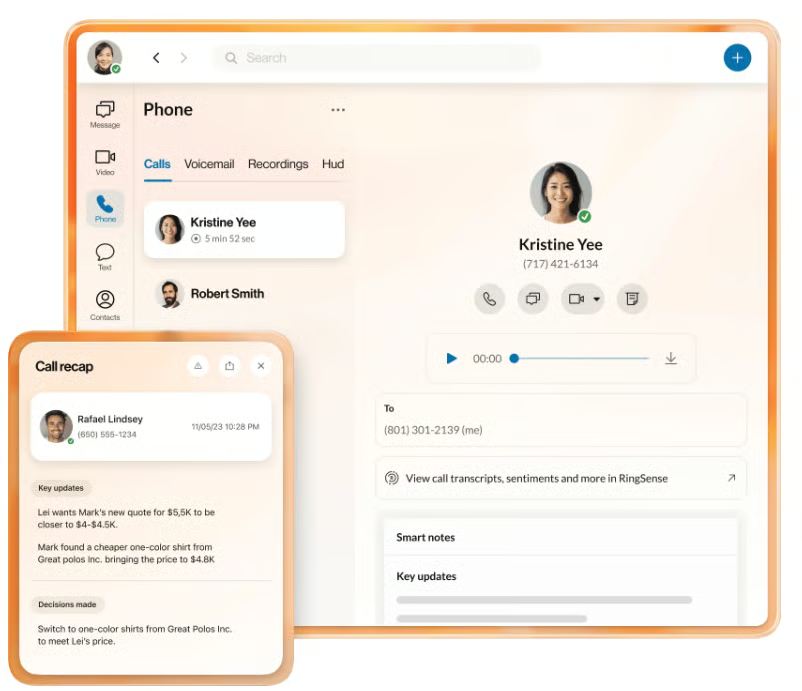
When it comes to small business VoIP services, RingCentral is always an industry leader. What sets it apart is its robust call management system, which streamlines inbound and outbound calls with exceptional efficiency. Even with its base plan, you receive a range of essential features for effective call distribution.
It also secured a spot on our list of the best business cell phone plans due to its essential call features, including call forwarding, call transfer, and answering rules. But if you find RingCentral’s features and integrations a little overwhelming for your needs, consider a straightforward alternative like Ooma. This provider prioritizes call quality and ease of use, making it an ideal choice for businesses seeking simplicity.
Pricing
| Plans and pricing (per user) | Monthly | Annual |
|---|---|---|
| Core | $30 | $20 |
| Advanced | $35 | $35 |
| Ultra | $45 | $25 |
| Customer engagement bundle | Contact sales for pricing. | |
Standout features
- Multilevel IVR: Set up routing menus with a visual IVR editor and route calls to voicemail, extensions, and external phone numbers. Each account supports up to 250 voice menus and submenus.
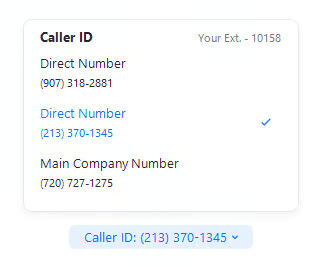
- Multisite management: Support the unique needs of all of your branch offices within a single account. Each site has its own outbound caller ID, call handling rules, user roles, and auto-receptionist.
- AI assistant: Paired with call recording, the AI features provide transcriptions, summaries, and notes, offering virtual assistance and feedback during business calls.
My expert opinion
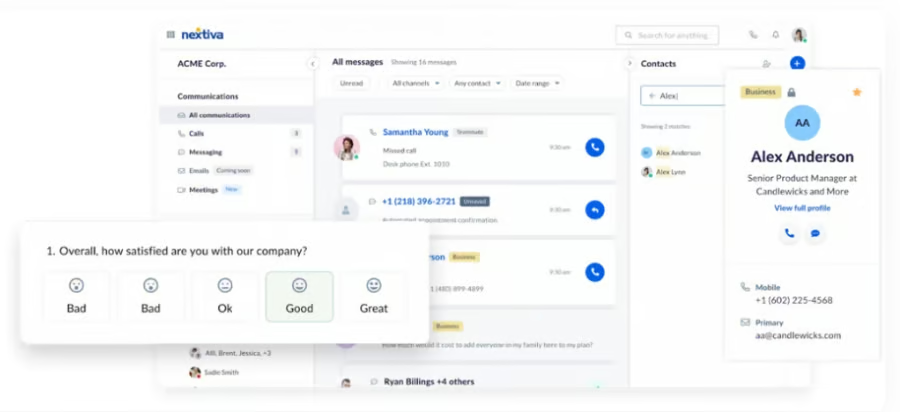
When it comes to customer experience (CX), Nextiva is my go-to choice. If you've had the chance to attend a Nextiva event, you know the company offers deep insights and reports that show how to elevate VoIP phone systems into a powerful multichannel customer experience platform. Nextiva also stays on the cutting edge of digital technology, offering access to an AI receptionist and agentic tools.
But even with its wide array of features, Nextiva limits SMS messaging credits on its small-business plans. If business messaging is key to your customer experience, then consider Grasshopper. It's one of our top picks for cheap VoIP services due to its unlimited business messaging across plans.
Pricing
Plans and pricing (per user) | Core | Engage | Scale |
Monthly | $23 | $50 | $75 per user, monthly |
Annual | $15 | $25 |
Standout features
- Call pop: This feature displays the caller’s details before you pick up the call. Customize it to display whatever customer information you need, such as sentiment or account value.
- Automation tools: Enhance service efficiency with features such as automated surveys, real-time suggestions, and automated follow-ups.
- Call flip: This feature transfers an ongoing call between devices without interruption. This feature works on desk phones, computers, and mobile phones.
My expert opinion
Before audio conferencing became the staple of remote work, Zoom was already making waves as a pioneer in video conferencing technology. But here’s something you might not know. Beyond its popular Workspace plans, Zoom Phone offers a range of calling options specifically designed for small business owners, featuring both metered and unmetered plans at affordable prices.
Unfortunately, Zoom Phone does not provide vanity numbers for businesses seeking to create a memorable impression with their customers. A great alternative is Grasshopper, our top virtual phone system provider, which offers toll-free number bundles and vanity numbers at no extra cost.
Pricing
Plans and pricing (per user) | Monthly | Annual |
US & CA Metered | $12 | $10.50 |
US & CA Unlimited | $18 | $16 |
Pro Plus | $24 | $20.50 |
Business Plus | $29 | $24.50 |
Standout features
- Call quality dashboards: View overall call quality and filter voice data for a specific user. It includes usage reports that display phone usage data for a specific user or call queue.
- Shared line groups: Share a phone number and extension with common-area phones or with a group of phone users. You can set routing rules and apply custom business hours.
- Call delegation: Assign a phone user to make and receive calls on behalf of another user. Both users can view the status of the shared lines and access the delegator’s direct phone numbers.
My expert opinion
Starting a new business comes with its own set of challenges, and selecting the right phone plan can feel overwhelming, especially when you’re unsure about call volumes or your clients' needs. That’s exactly why I chose Phone.com as one of the top choices for a VoIP phone system. Phone.com offers flexible plans that are tailored for small businesses with low or seasonal call volumes.
At the same time, Phone.com has relatively few integrations, limiting its ability to connect with third-party apps. If you're looking for a VoIP solution that seamlessly integrates with your existing app stack, consider RingCentral. It features a dedicated app gallery with over 300 business solutions for automation, CRM, and productivity.
Pricing
Plans and pricing (per user) | Basic | Plus | Pro |
Monthly | $18 | $27 | $40 |
Annual | $15 | $22.50 | $33.33 |
Standout features
- Call handling: Create rules to route incoming callers to the right destination. Options include forwarding, auto-attendant, dial-by-name directory, and scheduled routing.
- Live receptionist: Add live answering services to your Phone.com account to access professional phone operators to answer your business calls.
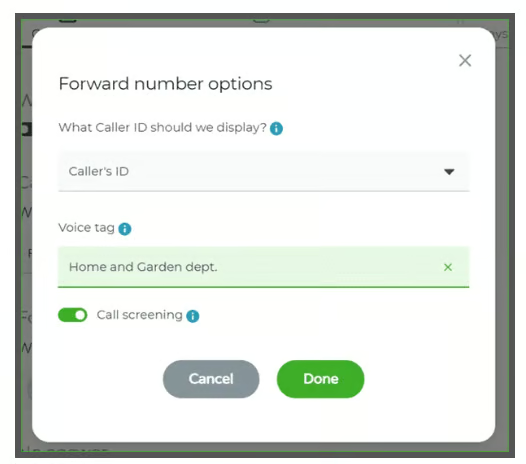
- Voice tagging: This feature announces which menu option the caller selected before the call is answered. It is helpful for businesses with multiple auto-attendant options that ring to the same number.
My expert opinion
Gone are the days when an international phone call could significantly impact your budget, making it challenging for businesses to tap into global markets. With GoTo Connect, you can enjoy unlimited calls to over 50 countries for a single monthly subscription. Unlike other providers, which limit access to business phone numbers, GoTo Connect offers toll-free and vanity phone numbers tailored to your business needs.
Additionally, it provides number porting services, helping you save time and money when transferring an existing phone number. But, as much as I enjoy GoTo Connect’s AI features and unified communications system, it still cannot outperform RingCentral, which excels with its powerful analytics, popular integrations, and superior call handling, making it my recommendation for growing businesses.
Pricing
Plans and pricing | Phone system | Customer experience (CX) | CX Complete | Contact center |
Subscriptions | Contact sales for pricing. | |||
Standout features
- Custom auto-attendants: Record unlimited customized messages and voicemail greetings with the GoTo Connect desktop or web app. Use it to share important updates and keep callers engaged while they wait in a queue.
- Team messaging: GoTo Connect enables you to send files and messages to team members, facilitating communication and collaboration on projects.
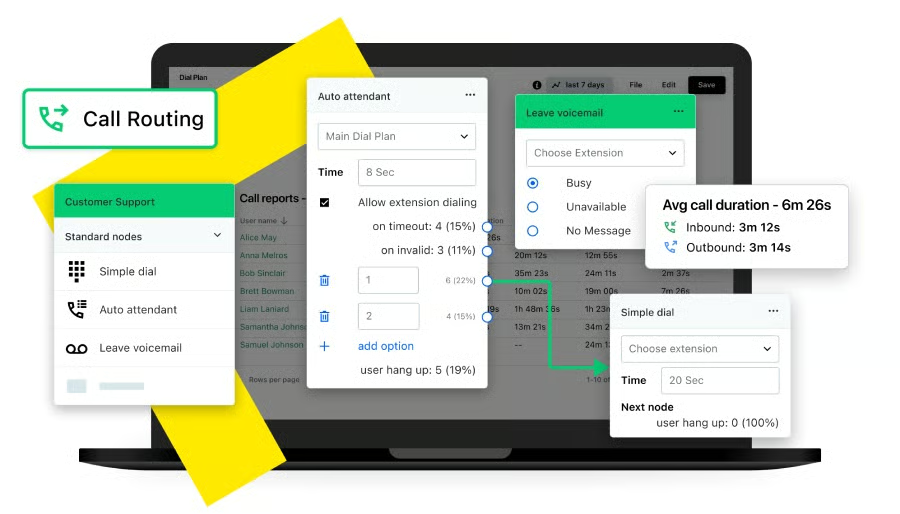
- Customized call flows: The drag-and-drop interface is an intuitive admin tool that enables you to edit, update, and modify call flows. It also allows you to set up multiple auto-attendants and track how calls are routed to extensions or departments.
My expert opinion
Among all the providers on this list, Grasshopper stands out as a top choice for small business owners. Specifically, Grasshopper has always stood out to me for its dedication to creating business phone plans designed for solopreneurs. To further enhance a business's professional image, Grasshopper offers toll-free vanity numbers at no cost, solidifying its reputation as one of the best free VoIP services.
While most VoIP providers charge a one-time setup fee for vanity numbers in addition to the monthly rate, Grasshopper allows you to choose a local or toll-free vanity number when you subscribe to a monthly plan. However, Grasshopper lacks features like video meetings and team chat. For businesses that require these tools for effective team collaboration, Nextiva is a better choice due to its comprehensive unified communications features.
Pricing
Plans & pricing | True solo | Solo plus | Small business |
Monthly | $18 | $32 | $70 |
Annually | $14 | $25 | $55 |
Standout features
- Call control: Grasshopper lets you screen incoming calls by blocking callers and setting custom schedules based on your business hours.
- Virtual receptionist service: Adding Ruby to your Grasshopper account gives you a professional phone answering service that will handle calls on behalf of your business.
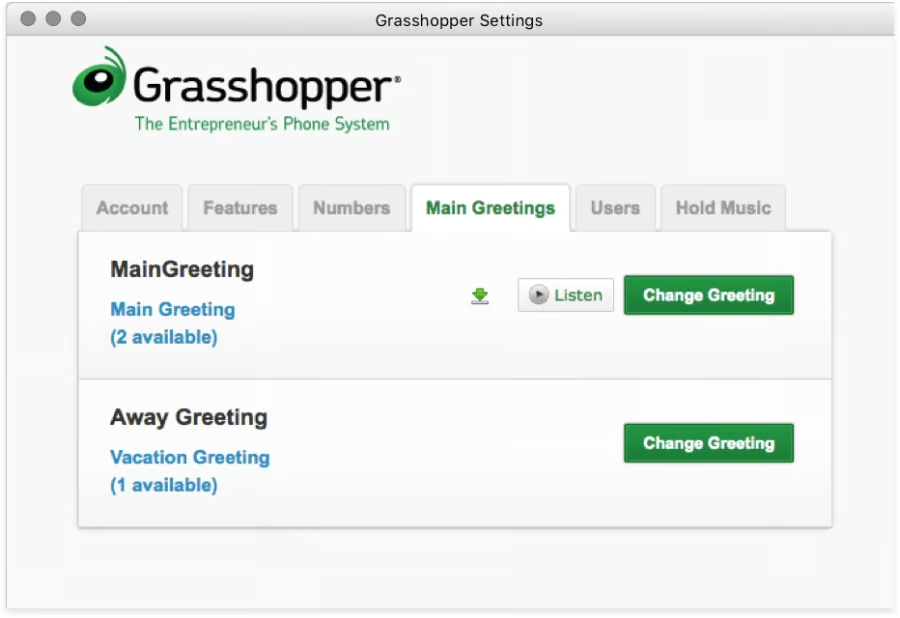
- Custom greetings: You can record phone greetings or have a professional voice actor record your script in Grasshopper’s voice studio.
My expert opinion
While some business owners thrive on a comprehensive suite of features, others simply need a dependable service that delivers exceptional call quality. That’s why I chose Ooma. The platform emphasizes essential functions, including call forwarding, voicemail, automated routing, hold music, and ring groups. Although it has limited collaboration tools and integration options, it is ideal for smaller teams looking to manage call traffic through an app.
Additionally, this platform earned a spot on our list of the best VoIP services for home offices, primarily for its free home phone service. But even with its video conferencing capabilities, Ooma’s collaboration tools are not as advanced as those provided by other VoIP services. For a more robust solution, I recommend Zoom Phone, which offers all the benefits of a business phone system and access to a suite of unified communication tools.
Pricing
Plans and pricing (per user) | Monthly |
Essentials | $19.95 |
Pro | $24.95 |
Pro Plus | $29.95 |
Standout features
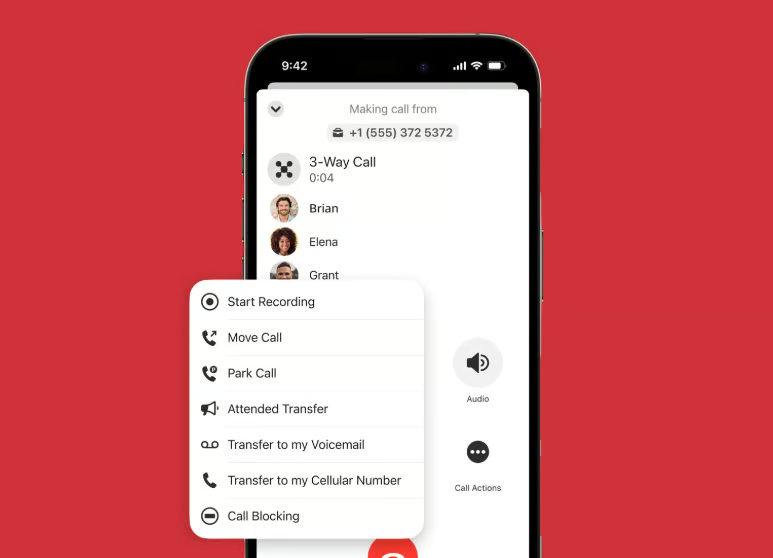
- Multidevice ring: This call forwarding type allows you to receive calls on any device and enables multiple devices to ring simultaneously when an Ooma user is called.
- Extension monitoring: This feature enables a user or receptionist to monitor the status of other phone extensions and perform various actions, such as call transfer or three-way calling.
- Distinctive ringtones: Add a unique ringtone to a call queue or ring group to notify team members about the nature of the incoming call.
My expert opinion
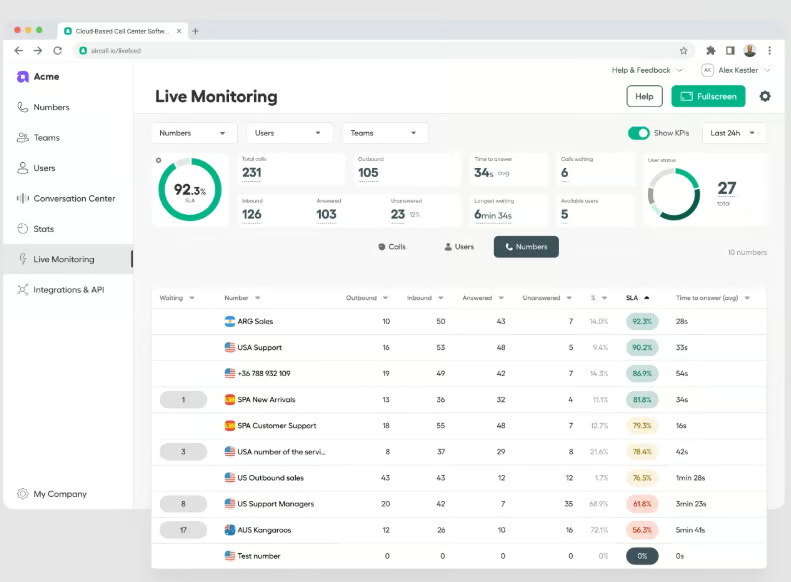
Aircall stands out for connecting business calls with the tools sales and customer support teams use every day. Its more than 250 integrations include HubSpot, Salesforce, Zendesk, Shopify, and Microsoft Teams. These connections can automatically log calls and customer details, giving employees more context without requiring them to switch repeatedly between their phone system, CRM, and help desk.
I also like Aircall’s balance of straightforward setup and advanced call management. However, Aircall is not the best fit for solopreneurs or teams looking for the least expensive VoIP service. Both standard plans require at least three licenses, resulting in a minimum monthly commitment of $90 with annual billing. Businesses that need an affordable service for one or two users should consider Zoom Phone instead.
Pricing
Plans and pricing | Monthly price per license | Annual price per license | Minimum licenses |
Essentials | $40 | $30 | 3 |
Professional | $70 | $50 | 3 |
Custom | Custom pricing | 25 | |
Standout features
- AI Assist: Generate call summaries, action items, sentiment insights, topic recognition, call scores, CRM updates, and follow-up emails. Standard AI Assist is included with Professional, while more advanced live coaching tools require AI Assist Pro.
- Advanced call routing: Build IVR menus and distribute incoming calls based on business hours, teams, availability, or routing rules. Professional adds smart routing and manual or automated queue callbacks.
- Sales productivity tools: Professional subscribers receive a power dialer, voicemail drop, mandatory call tagging, and advanced analytics for monitoring outbound sales activity.
How to choose the best VoIP service for your small business
The best VoIP service should support how your team handles calls today without limiting how the business can grow. I recommend comparing providers based on your actual call volume, team size, customer communication channels, and existing software rather than selecting the platform with the longest feature list.
Consider the following factors before choosing a provider:
- Calculate the total monthly cost: Compare the advertised price with minimum-user requirements, annual contracts, taxes, regulatory fees, usage charges, and paid add-ons. Our guide to VoIP costs explains how user counts, phone numbers, hardware, and premium features affect the final price. For example, Aircall starts at $40 per license with monthly billing but requires three licenses, bringing the minimum monthly commitment to $120.
- Identify your essential calling features: Determine whether your team needs IVR, call queues, extensions, call recording, voicemail transcription, business texting, virtual fax, or international calling. If automated menus and call routing are priorities, compare the capabilities available from the best IVR systems. Separating required features from optional ones can prevent you from paying for an unnecessarily advanced plan.
- Match the service to your call volume: Metered plans can reduce costs for businesses that make few calls, while unlimited plans provide more predictable pricing for teams with frequent inbound or outbound activity.
- Review integrations: Sales and support teams should confirm that the phone system connects with their CRM, help desk, and productivity applications. VoIP CRM integrations can automatically log calls, synchronize customer records, and reduce manual data entry. Aircall and RingCentral offer extensive integration libraries, while simpler virtual phone systems may support fewer third-party tools.
- Consider how employees work: Look for desktop and mobile apps if employees work remotely or frequently move between locations. Businesses that collaborate through meetings and team chats may benefit from a unified communications provider rather than a voice-only service.
- Evaluate support and reliability: Check service hours, support channels, uptime guarantees, and onboarding assistance. Businesses that depend heavily on phone calls may need 24/7 help and stronger service-level commitments.
- Test the platform: Use a free trial or demo to evaluate call quality, setup, navigation, and administrative controls. You can also review our guide to setting up a VoIP system to understand the internet, equipment, number-porting, and configuration requirements before switching. I recommend testing the system with the employees who will use it most often before signing an annual contract.
How I evaluated the best small business VoIP service
The best VoIP service for small businesses offers tools to efficiently handle both incoming and outgoing calls, making it suitable for a wide range of budgets. For this guide, I compared eight well-known providers of VoIP and unified communications solutions. Then, I analyzed them based on cost, key features, and performance.
To learn more about how I chose each provider, check out my evaluation criteria below:
- Pricing (25%): Small businesses have unique budget considerations when selecting a VoIP service provider. To evaluate the costs of various VoIP solutions, I looked at factors such as free trials, discounts, and lower annual pricing. I then assigned higher scores to providers offering more affordable options than their more expensive counterparts.
- General features (25%): Every VoIP provider should offer essential calling features to help users manage inbound and outbound calls. I reviewed a range of VoIP features, including visual voicemail, business texting, and call management capabilities. Additionally, I investigated whether each platform offers a desktop or mobile app.
- Advanced features (15%): I awarded points to providers that offered additional key features, including AI-powered tools, IVR, real-time analytics, and video conferencing. I also evaluated which systems support international calling.
- Ease of use (10%): I assessed each VoIP provider's usability by evaluating the technical expertise required to set up and operate their phone systems. I examined whether the platforms offered an intuitive interface and user-friendly admin settings.
- Customer support (10%): In this evaluation, I examined the customer support channels offered by each provider. These channels include live chat, phone, and email support. I awarded more points to providers that offer 24/7 support, while those available only during business hours received partial points.
- Expert score (15%): Based on my firsthand experiences with each provider, I created an expert score by evaluating their unique features and ease of use. Additionally, I considered user reviews to assess the popularity and value-for-money of the best VoIP services for small businesses.
Frequently asked questions (FAQs)
Is VoIP worth it for a small business?
Yes, VoIP is a valuable investment for small businesses seeking an efficient and affordable way to communicate with employees and customers. It offers excellent call quality, advanced call features, and the flexibility to work from anywhere without incurring high costs.
How do you set up VoIP for a small business?
The first step in setting up a VoIP system is to identify business needs, assess bandwidth requirements, and evaluate the budget. The remaining steps are to select a VoIP provider, transfer or obtain a business phone number, and set up your new VoIP system.
Do I need hardware to start using VoIP?
Yes. However, VoIP has less extensive hardware requirements than traditional analog phone setups. Since VoIP is software-based, it can be installed on any device that connects to the internet, including desktop computers, laptops, smartphones, tablets, and internet protocol (IP) phones.
Bottom line
RingCentral is my top VoIP service for small businesses because it combines advanced call management, AI assistance, team collaboration, and more than 330 integrations into a platform that scales with a growing company. It is particularly well-suited to businesses with high call volumes or teams that want to manage calls, messaging, and video through a single system.
However, it may offer more functionality than some businesses need. Zoom Phone is a better choice for affordability, GoTo Connect stands out for international calling, and Aircall is best for sales and support teams prioritizing CRM and help desk integrations. Before choosing a provider, compare its minimum commitment, required features, and integrations against how your team actually communicates.
You might also like
VoIP vs Landline: Pros & Cons, Pricing & Features
4 Steps to Set Up a VoIP System for Seamless Cloud Migration + Checklist
Can You Trace a VoIP Number? Steps to Identify Callers & Stay Secure
