







Barcode label printers—which help small businesses create price tag barcodes, shelf labels, or even armbands and tickets—range in price from $100 to thousands of dollars. They can support home-based businesses, retailers, restaurants, food producers, and warehouse operations. The best label printers integrate with point-of-sale (POS) systems and other business-supporting software to streamline small business operations.
Based on our evaluations, the best barcode label printers are:
- Zebra ZD410: Best overall barcode label printer
- Star Micronics TSP743II: Best high-speed barcode printer for retail and warehouses
- Epson TM-L90 PLUS: Best for restaurants
- Integrated Control i.Print: Best for barcode nutrition labels
- Epson P60II: Best for mobile businesses and services in the field
- DYMO LabelWriter 550: Best for small retailers
- Best Barcode Label Printers Compared
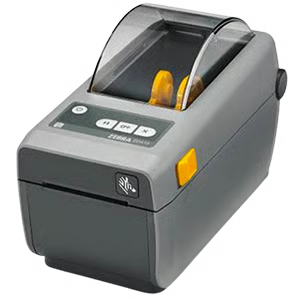
- Zebra ZD410: Best Overall Barcode Label Printer
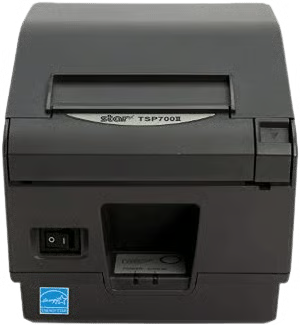
- Star Micronics TSP743II: Best High-speed Barcode Label Printer
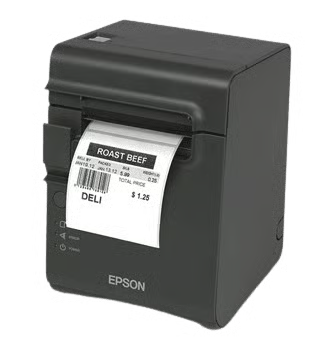
- Epson TM-L90 PLUS: Best for Restaurants
- Integrated Control i.Print: Best for Nutrition Labels
- Epson P60II: Best for Mobile Businesses
- DYMO LabelWriter 550: Best for Small Retailers
- Barcode Label Printer Frequently Asked Questions (FAQs)
- Bottom Line
Best Barcode Label Printers Compared
| Our rating | Price | Print speed | Resolution | Connection type | Warranty length | |
|---|---|---|---|---|---|---|
 | 4.20 | $250–$488 | 150 mm/s | 203–300 dpi | Serial, USB, Ethernet, Wi-Fi, Bluetooth | 2 years |
| Buy Zebra ZD410 | ||||||
 | 4.17 | $382–$479 | 250 mm/s | 203 or 406 dpi | Serial, Parallel, USB, PUSB, LAN, Ethernet, Bluetooth, WebPRNT, CloudPRNT | 2 years |
| Buy Star Micronics TSP743II | ||||||
 | 3.96 | $358–$511 | Up to 150 mm/s | 203 dpi | Serial, USB, Powered USB, Ethernet, Bluetooth, Wi-Fi | 1 year (limited) |
| Buy Epson TM-L90 PLUS | ||||||
 | 3.88 | Custom Quote | 150 mm/s | 203 dpi (or 300 dpi optional upgrade) | Serial, USB, Ethernet, Wi-Fi, Bluetooth | 1 year |
| Buy Integrated Control i.Print | ||||||
 | 3.79 | $369–$663 | 100 mm/s | 203 dpi | Bluetooth, Wi-Fi | 1 year |
| Buy Epson P60II | ||||||
 | 3.65 | $104–$160 | 75 mm/s | Up to 300 dpi | USB, Ethernet | 2 years (limited) |
| Buy DYMO LabelWriter 550 | ||||||
Zebra ZD410: Best Overall Barcode Label Printer
What We Like
Zebra’s ZD410 is a direct thermal printer compatible with multiple POS systems and with rugged models for healthcare settings that can withstand high-volume sanitizing. With the ability to print on virtually any thermal medium that fits its 2.36” width, this printer can support retailers, food service businesses, warehouses, event spaces, and healthcare facilities needing to print barcodes on multiple label types or even wristbands.
This printer earned high marks for accepting multiple label types and its reasonable price. It could have scored higher if it had a battery instead of needing to be plugged into an outlet at all times.
The ZD410 has several available connection options. You can get this printer with serial, USB, Ethernet, Wi-Fi, or Bluetooth connectivity. Just be sure the printer you purchase has the connection you need; not all models have all connections.
- Cost: $250–$488, depending on connection type
- Print Speed: Up to 152 mm/s (6 inches per second)
- Resolution: 203 dpi (standard); 300 dpi (optional upgrade)
- Label Types: Roll-fed, die cut, fan fold, continuous, wristbands
- Connection Types: Serial, USB, Ethernet, Wi-Fi, Bluetooth
- Integrations: Square, Lightspeed, Revel POS systems; all Windows computers
- Adjustable resolution: The ZD410 is the only printer on this list that allows you to choose 203 dpi resolution for fast printing, or shift to 300 dpi to print smaller, detailed labels like jewelry tags.
- Color-coded hardware: All moving pieces of the Zebra ZD410 are colored bright yellow, making it easy to identify where paper may be jammed and helping you identify damaged parts.
- Flexible connections: The ZD410 can connect to a computer or POS via serial connection, Wi-Fi, USB, Ethernet, or Bluetooth.
- Industry-grade: The ZD410’s rugged construction can withstand high-volume barcode printing in warehouses or stockrooms. There is also a healthcare version of the ZD410, designed to withstand frequent cleaning and sanitizing—making it a good fit for food and beverage businesses that also have high sanitation standards.
- Flexible labels: Use any label that fits the print width of 2.36 inches, whether it is die-cut, continuous, roll-fed, or fan-folded, from tiny jewelry tags, wristbands, and small shipping labels.
- Remote printer management interface: Zebra’s Print DNA software allows you to set up your printers and manage them from a central dashboard. You can set your printers to update their software automatically as updates become available and troubleshoot errors remotely.
The ZD410 is a powerhouse printer that supports all types of businesses, but it must be plugged into an electrical outlet to work. If you need a fully mobile solution for off-site sales or services, look at Epson’s P60II.
Star Micronics TSP743II: Best High-speed Barcode Label Printer
What We Like
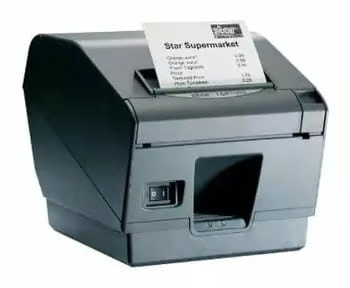
Star Micronics’ TSP743II prints faster than any printer on this list. At 250 mm/s (nearly 10 inches), it can keep pace in the busiest retail and warehouse environments. With multiple connection types and a rugged design to withstand high-volume use, it can support any business needing multiple barcode labels daily. Like the Epson TM-90L PLUS, it can print on thermal paper or sticky label paper—for receipts, coupons, or lottery tickets.
The TSP743II earned points for its massive speed, wide range of applications (businesses from warehouses to retailers and restaurants), and two-year manufacturer’s warranty. It could have scored higher if it accepted more label types (like top-ranked Zebra ZD410) or cost less than $400 (like DYMO LabelWriter).
- Cost: $382–$479 depending on connection type
- Print Speed: 250 mm/s (9.8” / second)
- Resolution: 203 x 203 dpi, or 406 x 203 dpi
- Label Types: Accepts off-brand paper and labels up to 80 mm wide
- Connection Types: Serial, Parallel, USB, Powered USB, LAN, Ethernet, Bluetooth, WebPRNT, CloudPRNT
- Integrations: Windows, MacOS, most retail and restaurant POS systems
- Adjustable resolution: You can use increased print speeds at the lower 203 x 203 dpi resolution, or use the increased 406 x 203 resolution when you need sharper graphics or smaller barcodes.
- Swap-a-Star: Star Micronics has its “Swap-a-Star” service agreement that sends a replacement printer overnighted to users if their existing Star printer fails. Selected printers have two- or three-year service agreement options. You’ll need to contact a Star sales agent to enroll.
- Universally compatible: This printer is compatible with Apple- and Windows-based devices, alongside a massive number of restaurant and retail POS systems. POS integrations can easily be built using the printer’s WebPRNT and CloudPRNT functions.
- WebPRNT and CloudPRNT functionality: Star Micronics printers support a wealth of software integrations via its WebPRNT and CloudPRNT functions. WebPRNT supports JAVA-coded connections between a web-based POS system (like Lightspeed) and your Star printers. Once the connection is built, WebPRNT-connected printers do not need internet connectivity to operate. CloudPRNT supports similar connections with cloud POS systems (like Revel Systems). CloudPRNT printers do need a strong, active internet connection to work, though.
- Rugged design and quiet operation: The TSP743II’s outer shell is sealed to repel debris and spills. Internal print mechanisms are buffered to reduce print noise.
The TSP743II is a rockstar printer, but if you don’t need to print hundreds of labels a day, it may be more machine than you need. For smaller operations, consider the DYMO LabelWriter. The TSP743II also needs a constant supply of electricity to work. If you want a portable barcode label printer to take to offsite sales or service locations, look at the Epson P60II.
Epson TM-L90 PLUS: Best for Restaurants
What We Like
Epson’s TM-L90 PLUS printer is the go-to printer for sticky labeling in restaurants. This rugged, dependable cube can print on regular thermal paper or sticky label paper—so you only need one printer for both receipts and sticky labels. It also integrates with virtually every restaurant POS system (check with your POS provider for compatibility), making it an excellent choice for restaurants.
This printer scored well for functionality and its multiple connection types. It lost some points for only having a one-year warranty (many competitors offer a two-year warranty) and because it needs to be actively plugged into an electrical outlet to work.
- Cost: $358–$511, depending on connection type
- Print Speed: Up to 150 mm/s
- Resolution: 203 dpi
- Label Types: 40 and 80 mm linerless label rolls, Epson or third party
- Connection Types: Serial, USB, Ethernet, Bluetooth, Wi-Fi
- Integrations: Epson printers integrate with virtually every available restaurant POS system
- Multiple installation orientations: The TM-L90 PLUS operates from multiple positions. So, no matter how tight your kitchen or restaurant service areas are, this printer will fit easily. It can sit flat on the countertop, stand on its side, or be wall-mounted.
- Multiple paper types: You can use standard thermal paper for receipt printing or use linerless, continuous thermal label paper to print labels of any length. This is ideal for printing sticky labeled receipts for takeout orders or printing barcoded tamper-evident seals for ready-to-eat foods. The printer is compatible with 40 mm or 80 mm paper and will automatically detect the paper size.
- Customized connections: The Epson TM-L90 PLUS comes in multiple connection types. You can get TM-L90’s with serial connections, Ethernet connections, Wi-Fi, USB, or Bluetooth. Just take care when purchasing, as not all printers have all types of connections. You’ll need to ensure that the printer you purchase has the connection type you need.
This Epson printer is really best for restaurant applications. If you need to print a high volume of barcode labels in a retail or warehouse environment, the Star Micronics TSP743II is a better option. If you need a high volume of food safety labels without POS integration—such as for food production or catering operations—Integrated Control’s i.Print will be more user-friendly.
Integrated Control i.Print: Best for Nutrition Labels
What We Like
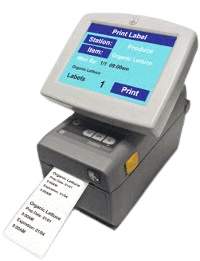
The i.Print from Integrated Control, which creates safety solutions for food service businesses, is a touch-screen barcode label printer built onto the high-performing Zebra ZD410 printer. The Zebra printer alone is our top scorer, so it makes sense that the i.Print would also perform well. The i.Print system allows you to store recipes, videos, and ingredient information to print detailed food labels with ingredients, allergens, and nutritional information in addition to barcodes.
It earned points for its ability to connect to computers and POS systems via Wi-Fi and for how easy it makes printing complicated food safety labels. This printer lost some points for price, though; it requires a custom quote and can only be purchased from Integrated Control. Though if you want a printer that is nearly as strong for food safety labeling and widely available, consider the Epson TM-L90 PLUS.
Integrated Control designed the i.Print on top of the Zebra ZD410 printer, so the printer performance is top of the line. Though the cost for the i.Print is higher than the Zebra printer alone and will require a custom quote.
- Cost: Custom quote
- Print Speed: 150 mm/s (6 inches per second)
- Resolution: 203 dpi (standard); 300 dpi (optional upgrade)
- Label Types: Roll-fed, die cut, fan fold, continuous
- Connection Types: Serial, USB, Ethernet, Wi-Fi, Bluetooth
- Integrations: None; printer is self-contained
- Product management: While the underlying Zebra printer integrates with several POS systems, the i.Print labeling functions don’t integrate; you’ll need to manage your labels directly in the i.Print touch screen. But you can easily import your product lists and recipes via an Excel file on a thumb drive or through the cloud.
- Comprehensive food safety labeling: With your product and recipe information stored in the i.Print, you can print a variety of food safety labels. If you need to internally track quantities of prepped items (as in a large-scale catering operation), you can print labels with time, date, and the cook’s initials. You can create expiration labels and detailed labels for retail ready-to-eat and ready-to-drink items.
- Multiple label types: The underlying Zebra printer accepts all types of labels, including continuous label rolls. So, you can print on custom labels that are pre-printed with your business logo or legally required disclaimers for safe food temperatures and refrigeration requirements. You can print on heat-resistant, dissolvable, linerless or removable labels based on your needs and use cases.
The i.Print is designed specifically for food service businesses. Non-food service businesses looking for similar print quality and print speed should look at the Zebra ZD410. If the ease of use is what attracts you, consider the Epson and Star Micronics printers on this list; with their wide range of POS integrations, you’ll get similar functionality.
Epson P60II: Best for Mobile Businesses
What We Like
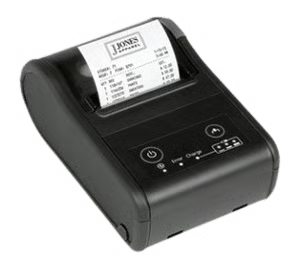
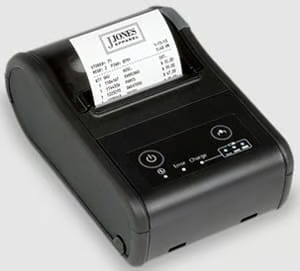
Epson’s P60II mobile printer is a belt-wearable label and receipt printer that operates via Wi-Fi or Bluetooth and for up to 46 hours on battery alone. You can print from iOS, Android, or Windows devices. It also integrates with Square and Revel POS systems. This printer is a great fit for independent service providers and solopreneur retailers.
The P60II’s mobility and flexibility earned high marks. It is the only option on this list that doesn’t need to be plugged into an electrical outlet to work. However, it lost some points due to its high price and limited connectivity.
Priced at $369 to $663, the cost of multiples of this printer can add up. And take care when you purchase, as some vendors sell the power cords and charging docks separately. If you see a price that seems too good to be true, make sure the printer includes the charger. The P60II also only connects via Bluetooth or Wi-Fi. For a more traditional desktop configuration, the Zebra ZD410 is a better choice.
- Cost: $369–$663
- Print Speed: 100 mm/s
- Resolution: 203 dpi
- Label Types: 58 or 60 mm label
- Connection Types: Bluetooth, Wi-Fi
- Integrations: Prints from any iOS, Android, or Windows device with Bluetooth or Wi-Fi connectivity; Square and Revel POS Systems
- Long-lived battery: The P60II has a battery life of up to 46 hours. If you are working in the field or labeling items at an offsite event or pop-up shop, this printer has you covered all day long.
- Compact design: The P60II is designed to be belt-worn to print labels while walking through your store or warehouse or print receipts on the sales floor or in the field. It can print on both thermal receipt paper or sticky-backed labels, so when you’re not printing labels, you can print receipts.
- Rugged design: This printer has been drop-tested from four feet and is industry-rated to withstand dust and water intrusion. Whether you need a mobile barcode printer to organize your storeroom, print price tags at a farmers market, or label products in the field, the P60II can handle whatever you throw at it.
- Label-taken sensor: The label-taken sensor on the P60II ensures that the printer won’t print another label until the previous one is removed from the cutter. So, you won’t have to worry about walking through your storeroom trailing label tape. Once you remove a label, the next label in the queue will automatically print.
The P60II packs a lot of power into a small barcode printer, but it is not the greatest for high-volume use. If you need to print hundreds of labels per day, you’ll be better off with the Star Micronics TSP743II. Or, if you want the ease of a Wi-Fi-connected printer in a high-volume setting, consider its sister Epson printer TM-L90 PLUS.
DYMO LabelWriter 550: Best for Small Retailers
What We Like
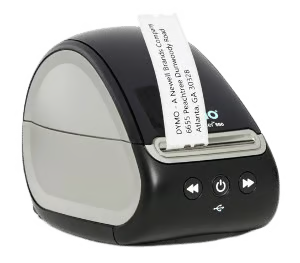
The DYMO LabelWriter 550 is a dynamic thermal label printer available in the $104–$160 range. This petite powerhouse offers a simple setup, minimal maintenance, broad compatibility, and many label printing options. It can process 62 labels per minute and in 18 different sizes, including tiny butterfly labels for jewelry and small accessories. The printer and labels are available through a variety of retailers—from Staples to Amazon.
This printer earned high marks for its affordable price, two-year manufacturer’s warranty, and integration with the popular Square POS. A few things holding the DYMO LabelWriter 550 back from a perfect score are the lack of mobile connections and users being tied to DYMO’s proprietary label products, which can be expensive.
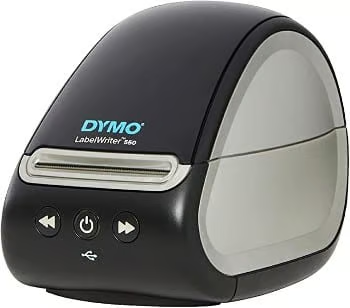
The DYMO LabelWriter 550 is one of the most widely available printers on this list. You can buy it from Amazon (like the others on this list). But unlike the others, you can grab one of these printers from your local office supply store if you need it right away.
- Cost: $104–$160
- Print Speed: 75 mm/s
- Resolution: Up to 300 dpi
- Label Types: DYMO branded 2” labels of all types
- Connection Types: USB, Ethernet
- Integrations: Windows devices, Square and Shopify
- POS and ecommerce integrations: One of the most exciting features of the DYMO LabelWriter 550 is that it integrates with small business favorite Square. The Zebra ZD410 does as well, but the DYMO LabelWriter has a lower price than the Zebra printer. If your shop operates with Square for Retail, you can create product barcode labels in the Square dashboard and then send them to print directly through the LabelWriter 550. Shopify users can also quickly transfer their product labels to print via the DYMO LabelWriter.
- Popular with small businesses: The DYMO LabelWriter series has been a popular choice for small businesses for several years. Customers who are just getting started with the DYMO LabelWriter will find massive numbers of user-generated how-to videos and blog posts about getting the most out of this well-liked printer.
- Widely available labels: You can find DYMO labels on Amazon and local office supply stores like Staples and Office Depot. The LabelWriter 550 also accepts a wide range of label sizes, from butterfly labels for small jewelry and accessories to standard barcode price tag labels. The LabelWriter 550 can only accept labels up to 2.25” wide, though. For 4”x6” shipping labels, you’ll need to upgrade to the LabelWriter 5XL, which retails for around $272.
- Auto label recognition: Only using DYMO branded labels has a benefit; your DYMO LabelWriter 550 will automatically recognize the label size when you drop new label paper into the printer. You won’t need to worry about reformatting anything in the printer itself; just add labels and go. This feature also tells you how many labels are left on a roll so you can re-order in plenty of time.
- Two-year warranty: DYMO offers a two-year limited warranty, which is longer than Epson TM-L90 PLUS, Epson P60II, and the i.Print. Users should be aware, though, the warranty gets voided if you use third-party labels with the printer.
If you want a label printer with more POS integrations than just Shopify and Square, try the Epson TM-L90 or Star Micronics TSP743II. If you use custom label paper branded with your logos or required disclaimers (as in veterinary offices or pharmacies), check out the Zebra ZD410.
Methodology: How We Evaluated Barcode Label Printers
We compared 18 barcode label printers based on what’s important to small, independent businesses. We looked at price, print speed, label resolution, flexible label size, and ease of use. We also considered our retail and restaurant experts’ personal evaluations of each printer. Click through the tabs below for our full evaluation criteria:
We looked for barcode printers priced below $550, giving extra points to printers that cost less than $400. We also considered the cost of label rolls, giving the highest marks to brands that use labels that cost less than $5 per roll.
We looked for barcode label printers that print on thermal paper, negating the need for pricey ink cartridges. We also considered print speed, image resolution, and available POS and ecommerce integrations.
The first thing we looked at was the length of each label printer’s warranty. We then considered available user manuals, training documents, and customer support. We also considered how each printer connects to other hardware—via Bluetooth, Ethernet, or USB. Finally, we considered whether each printer requires proprietary labels and if those labels are widely available. We also looked at available user reviews to see how typical users rated each printer’s functions.
We looked for standout features like long term warranties and a wide array of label types. We also judged whether each printer offered good value for the price. Finally, we judged each printer’s popularity with small retailers.
Barcode Label Printer Frequently Asked Questions (FAQs)
Expand the sections below to get insights on commonly asked questions about barcode label printers.
Do I need separate printers for receipts and barcode labels?
Not necessarily. Several printers from Epson and Star Micronics print both thermal receipts and thermal barcode labels interchangeably. Check out the Epson TM-L90 PLUS and P60II and the Star Micronics TSP743II listed above for more information on these types of printers.
Are there handheld barcode printers?
We like the Epson P60II for a handheld barcode printer; it is popular with pop-up sellers and service providers and integrates with Square POS systems. Printer brands Zebra and Star Micronics also make handheld, mobile barcode printers if you want to consider more options.
How much does a barcode printer cost?
Barcode label printers range in price from around a hundred dollars to over $1,000. The price will vary between retailers, as well as based on the connection type you need; if you need POS connectivity, you can expect to spend between $300 to $600 per printer. Desktop barcode printers tend to cost less, closer to the $100 to $250 range. Though mobile barcode printers run the gamut; consumer-grade barcode printers by Munbyn and Phomemo run around $60 to $180 each, while rugged, industry-grade mobile printers from Zebra can run up to $900 or higher.
How much does a barcode printer cost?
Barcode label printers range in price from $80 to over $1,000. The price will vary based on the connection type you need; if you need POS connectivity, you can expect to spend between $300 to $500 per printer. Desktop barcode printers tend to cost less, closer to the $100 to $250 range. Though mobile barcode printers run the gamut; consumer grade barcode printers by Munbyn and Phomemo run around $60 to $180 each, while rugged, industry-grade mobile printers from Zebra can run up to $900 or higher.
Bottom Line
Barcode labels keep information flowing and allow warehouses, event companies, healthcare providers, restaurants, and retailers to track products and people. We found the Zebra ZD410 to have the widest range of applications of any of the 18 printers we considered. With POS integrations, multiple connection types, and support for a wide range of third-party labels, the Zebra ZD410 prints everything from warehouse labels to price tags, shelf tags, and tamper-evident seals. Purchase from Amazon to get started with this user-friendly printer.
