





Square for Retail earned 4.7 out of 5 in my evaluation of retail POS systems, making it my top pick for small and growing stores. I assessed 16 data points across pricing, register functions, management features, ease of use, and hands-on testing. What I like most is how approachable it is for retailers moving beyond a cash register: you can start with straightforward checkout and integrated payments, then add purchasing and inventory tools as you need them.
Monthly pricing starts at $0, with more retail management features available on paid plans. At the time of my evaluation, users also rated it an average of 4.7 out of 5 across third-party review sites. My main reservations are the free plan’s limited inventory functions and the requirement to use Square for integrated card processing. For a new boutique, gift shop, or small storefront, though, I would put Square first on the shortlist because it covers everyday selling without requiring an elaborate setup.
- Why you can trust Fit Small Business
- Square for Retail at a glance
- Square for Retail alternatives and comparison
- Square for Retail reviews from users
- Square for Retail pricing
- Square Free vs Square Plus vs Square Premium
- Square for Retail new features and updates
- Square for Retail register and checkout features
- Square for Retail management features
- Square for Retail ease of use and customer support
- Square for Retail expert score
- Methodology: How I evaluated Square for Retail
- Bottom line
Why you can trust Fit Small Business
I review POS systems and payment services with a focus on the decisions small retailers need to make: what the software handles, which features require an upgrade, and how much the business will pay to use it.
For this update, I checked Square’s pricing, support documentation, product updates, and third-party customer feedback. My recommendations focus on store operations and total cost. You can read more about our standards in the Fit Small Business editorial policy.
Square for Retail at a glance
Pros | Cons | ||||||||||||||||||||
|---|---|---|---|---|---|---|---|---|---|---|---|---|---|---|---|---|---|---|---|---|---|
| Free entry-level option for basic selling | Inventory and purchasing needs can require a paid plan | ||||||||||||||||||||
| Paid plans connect purchasing and stock management | Integrated card payments use Square processing | ||||||||||||||||||||
| Mobile and countertop setup options | Hardware and accessories add to startup costs | ||||||||||||||||||||
| Connections for online and in-store selling | Advanced operations require careful plan and integration checks | ||||||||||||||||||||
Deciding factors
Use cases
Square for Retail’s industry uses Fit Small Business buying guides
| |||||||||||||||||||||
Square for Retail alternatives and comparison
Provider | Best for | Monthly software fee from | Hardware compatibility | Payment processing | Read full review |
|---|---|---|---|---|---|
| Lightspeed Retail | Inventory management | $89 | iPad, compatible computers, and supported accessories | Lightspeed Payments; other arrangements subject to terms | Lightspeed Retail review |
| Shopify POS | Multichannel retail and online-first businesses | $5 | Compatible iOS and Android devices | Shopify Payments or supported third-party providers | Shopify POS review |
| Toast | Food-based shops and retail/restaurant hybrids | $0 | Toast-supported hardware | Toast Payments | Toast POS review |
Square for Retail reviews from users
Square for Retail reviews generally favor its ease of use and convenient payment processing. The complaints I found focused on processing costs, hardware reliability, and customer support. Those are worth weighing alongside the overall ratings, especially if your store needs help outside regular business hours.
At the time of this evaluation:
- Apple App Store: 4.7 out of 5 from approximately 14,000 ratings.
- G2: 4.6 out of 5 from 1,212 reviews.
- Capterra: 4.7 out of 5 from 496 reviews.
G2’s rating covers Square Point of Sale broadly. App Store totals represent ratings, not exclusively written reviews. Review collections across sites may overlap.
I found the following themes in customer feedback:
Users like | Users dislike |
|---|---|
| Straightforward setup and an interface that is easy to learn | Some features lack the depth needed as operations grow |
| Convenient in-store and mobile payment acceptance | Processing fees and equipment costs can add up |
| Connected sales, inventory, and customer information | Integration setup and management can cause frustration |
| Accessible sales reports for monitoring daily performance | Difficulty reaching support or getting issues resolved |
My takeaway is that Square deserves its place on a small retailer’s shortlist, but I would test more than checkout. Use the trial to receive stock, process an exchange, and run your usual reports. That will tell you more about its fit than the overall rating alone.
Square for Retail pricing
Score: 5 out of 5
Square for Retail pricing now sits within the unified plans of the Square ecosystem, which includes Square Free, Square Plus, and Square Premium. If you are researching Square for Retail Free or Square for Retail Plus, check whether the material describes a legacy subscription. Square’s migration documentation says features have changed tiers, so existing sellers should compare their current subscriptions before switching.
Square Free vs Square Plus vs Square Premium
Cost | Square Free | Square Plus | Square Premium |
| Monthly subscription per location | $0 | $49 | $149 |
| In-person card payments | 2.6% + 15 cents | 2.5% + 15 cents | 2.4% + 15 cents |
| Online or invoice card payments | 3.3% + 30 cents | 2.9% + 30 cents | 2.9% + 30 cents |
| Manually entered or card-on-file payments | 3.5% + 15 cents | 3.5% + 15 cents | 3.5% + 15 cents |
Online API payments have a separate pricing category. Square Plus and Square Premium offer 30-day trials.
Square Free is the starting point for basic item and catalog management. Square Plus adds inventory management, while Square Premium adds further capabilities. Square’s current inventory page makes this distinction, so I would not choose Free on the assumption that it includes the complete retail stock workflow.
My recommendation is to choose the least expensive plan that handles the store’s actual tasks. For an inventory-led business, that means checking receiving, purchase orders, labels, and reporting before deciding that the free subscription is sufficient.
What Square could cost a small store
Consider one location processing $30,000 in monthly in-person card sales across 600 transactions. Using the published standard rates, the modeled cost is:
Monthly cost | Square Free | Square Plus | Square Premium |
|---|---|---|---|
| Percentage-based processing fees | $780 | $750 | $720 |
| Per-transaction processing fees | $90 | $90 | $90 |
| Subscription | $0 | $49 | $149 |
| Modeled monthly total | $870 | $889 | $959 |
Illustrative calculation using Square’s published processing fees and subscription prices. It excludes hardware, optional services, international-card surcharges, and custom rates.
At this volume, Plus saves $30 in processing fees but adds a $49 subscription. The store pays $19 more per month than Free, so the decision depends on whether its additional tools justify that difference.
For in-person processing savings alone, the $49 upgrade breaks even at approximately $49,000 in monthly card sales, assuming the transaction counts are identical and standard rates apply. Online sales change the calculation because the published rate difference is larger.
Other costs to include
Build the budget around the complete setup:
- Equipment: Register, mobile device, reader, printers, scanner, and cash drawer as needed.
- Locations: Account for each paid location.
- Additional services: Include separately billed products such as Payroll.
- Integrations: Confirm any subscription required by an outside provider.
- Payment mix: Include online, keyed, and international-card transactions where applicable.
Square sells hardware separately. Read my in-depth comparison guide to Square hardware.
Square for Retail new features and updates
- Inventory receiving and barcode tools: Edit prices and review margins while receiving stock. Compatible devices also support camera barcode scanning, while eligible paid plans add customizable barcode labels.
- Checkout and refunds: The refreshed checkout grid keeps the cart visible while staff select product options. Eligible plans also support refunds without an original sale recorded in Square, with staff permissions and refund limits.
- Bottle deposits: Set up per-item bottle deposits that apply automatically at checkout. This is useful for beverage retailers that need staff to collect deposits consistently.
- Reporting and Square AI: Reconciliation reports break down sales, refunds, fees, and deposits, while custom workweeks align reports with your schedule. Square AI, currently in beta, helps investigate business data and inform decisions.
- Wix and Shopify connections: Connect Wix to synchronize catalog information, inventory, orders, and discounts. Shopify synchronization uses Thrive Inventory, with Square serving as the source of truth.
- Product images and dark mode: Remove product-photo backgrounds directly within the POS app. The Retail app also supports dark mode that follows device settings or an independent appearance preference.
- Offline payments: Square has moved to enabling offline payments by default, subject to seller settings and compatible equipment. Upload deadlines still apply, and sellers remain responsible for declined offline transactions.
See Square’s retail feature releases and US feature log for availability and requirements. The updates above span 2025 and 2026.
Square for Retail register and checkout features
Score: 4.6 out of 5
Square for Retail earned high marks in my evaluation for its approachable checkout screen, product search, and flexible selling options. I especially like it for stores upgrading from a cash register: staff can organize the item grid around frequently sold products and categories, apply discounts, and save a customer’s cart for later.
The updated checkout grid keeps the cart visible while staff select product variations and modifiers. Compatible iOS and Android devices also support camera barcode scanning, giving occasional sellers an alternative to purchasing a separate scanner.
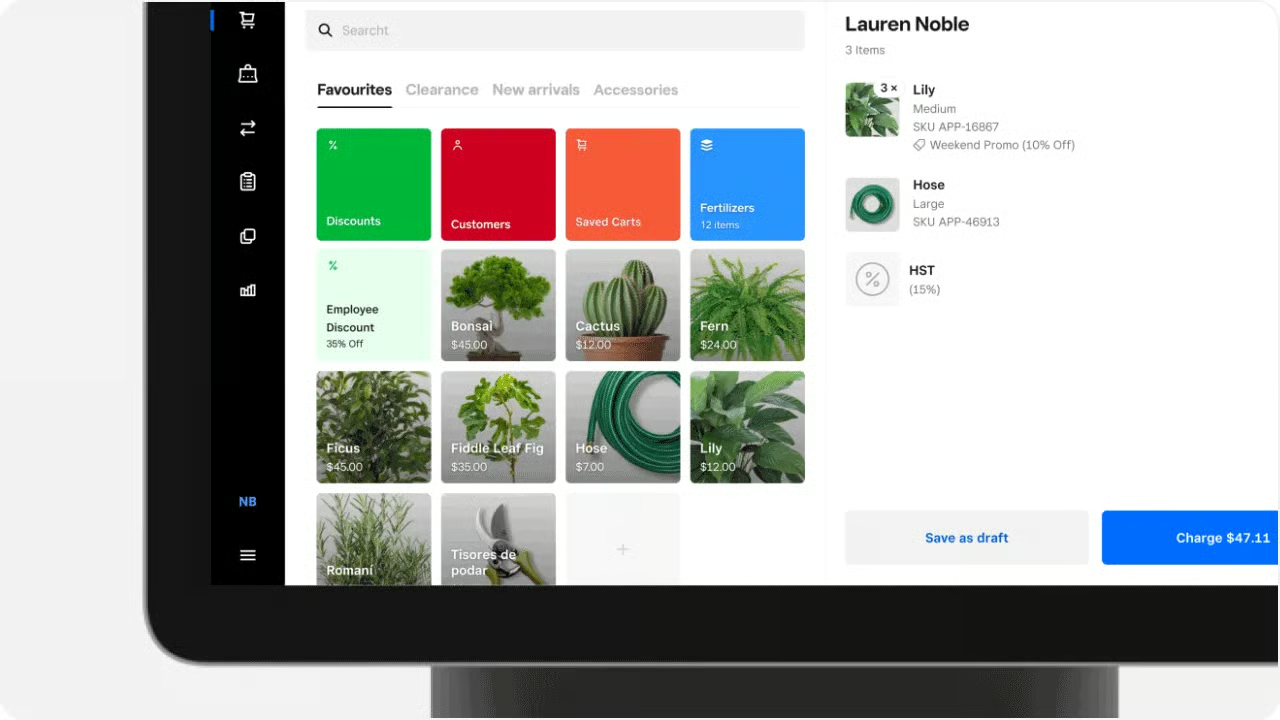
Staff can attach a customer to a sale and review information such as previous visits, frequently purchased items, preferences, and notes. This is useful for helping a returning customer find a previous purchase without maintaining a separate customer database.
Other checkout capabilities include:
- Payment options: Accept supported cards, digital wallets, Cash App Pay, Afterpay, card-on-file payments, and Square Gift Cards. Availability depends on the payment method and setup.
- Returns and exchanges: Square supports refunds, merchandise returns, and exchanges, with plan requirements for inventory-linked returns and other advanced workflows. Eligible paid plans also support unlinked refunds when the original sale is not recorded in Square.
- Mobile checkout: Use compatible mobile devices or Square hardware to take payments away from the counter. Check the required app, accessories, and retail functions before choosing equipment.
- Online order fulfillment: Connect online selling with in-store operations and offer supported pickup and shipping options. Test order notifications and fulfillment settings before accepting customer orders.
I would also check the following requirements before choosing Square:
- Store credit: Square supports refunds to physical or electronic Square Gift Cards without charging a gift-card load fee for that refund. If you need a separate credit balance attached to each customer account, confirm that requirement rather than treating gift-card credit as equivalent.
- Repair, assembly, and work orders: Have Square demonstrate any required repair tickets, parts tracking, assembly steps, or job-status workflow. Square Invoices offers project and billing tools, but you should not assume they replace specialized work-order software.
Processing payments
Square’s integrated card processing uses Square Payments. Published rates vary by subscription and payment method, while businesses exceeding $250,000 in annual sales can contact Square about custom pricing. I would compare a quote against the store’s actual transaction volume and average sale before choosing a plan for processing savings alone.
Square includes encrypted payments and dispute-management assistance. It does not charge a separate dispute management fee, but sellers remain responsible for chargebacks. These tools help businesses respond to disputes; they do not guarantee reimbursement for disputed sales.
For faster access to funds, eligible sellers can use instant or same-day transfers for 1.95% of the transferred amount, in addition to processing fees. Standard transfers are free and can arrive as soon as the next business day.
Eligible sellers can also offer Afterpay for supported online and in-person purchases. Square lists a standard Afterpay processing rate of 6% + 30 cents, so I would evaluate its cost separately from ordinary card payments.
If you move from a paid subscription to the current Square Free plan, its published in-person rate is 2.6% + 15 cents. Existing sellers on legacy subscriptions should check their account’s pricing before changing plans.
Offline payments
Square can accept supported card payments during an internet outage or Square service disruption using eligible hardware. Support extends beyond magstripe to chip and contactless payments on compatible equipment. However, phone-based Tap to Pay, manually entered cards, Afterpay, Cash App Pay, and Square Gift Cards are excluded from offline acceptance.
The acceptance window depends on the equipment. Certain Reader and Stand setups have a 24-hour offline session limit, while pending payments must be uploaded within 72 hours of the session’s start. Square recommends reconnecting within 24 hours to reduce the risk of declined or expired payments.
Payments upload automatically after reconnection. Sellers bear the loss if an offline payment expires, is declined, or is disputed. I would prepare an outage procedure for the exact register setup and avoid assuming inventory management or customer-directory functions will remain available offline.
Invoicing
Square Invoices is useful for retailers collecting payment outside a normal counter sale, such as a special order or a larger customer project. It supports one-time and recurring invoices, payment tracking, reminders, and customer-facing billing documents.
Depending on the subscription and settings, retailers can:
- Request payment: Send invoices and let customers pay through supported payment methods.
- Collect deposits: Request an initial payment before collecting the remaining balance.
- Automate repeat billing: Set up recurring invoices and authorized card-on-file payments.
- Track projects: Organize related invoices, estimates, and supporting documents.
- Offer payment schedules: Use eligible paid plans for milestone-based billing.
- Present purchasing options: Send multi-package estimates through an eligible paid invoicing subscription.
Milestone payment schedules require Square Plus, Square Premium, or legacy Square Invoices Plus. I recommend checking the selected plan before promising customers staged billing or several package options. For a shop handling occasional special orders, these tools may cover the billing requirements. If the business also needs production scheduling, repair tracking, or parts allocation, I would evaluate those processes separately.
Square for Retail management features
Score: 4.6 out of 5
Square’s management tools are a major reason I recommend it for small and growing retailers. Square Free covers basic selling and catalog needs, while Square Plus adds purchasing and inventory tools. Square Premium adds capabilities for more involved operations, including staged transfer orders between locations.
For a store receiving regular supplier deliveries, I would start by evaluating Plus. I would compare Premium if the business needs to track stock shipments between stores or use its additional reporting features.
Square Dashboard
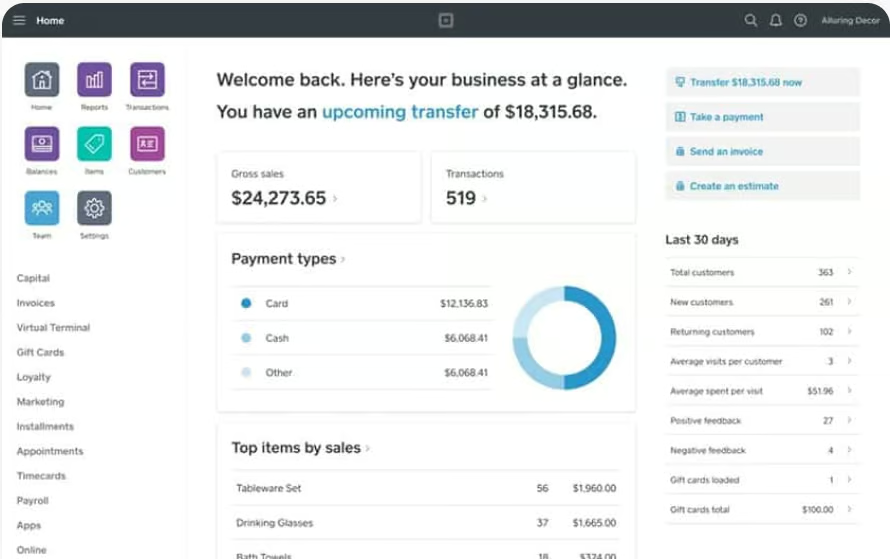
Square Dashboard brings together sales, orders, customer information, subscriptions, and the management tools available with your plan. Eligible users can manage inventory, create purchase orders, receive stock, and review business performance from a web browser.
I like having purchasing and reporting connected to the same product catalog used at checkout. However, the available functions depend on your subscription, staff permissions, and enabled capabilities. Payroll remains a separately billed service.
Inventory management
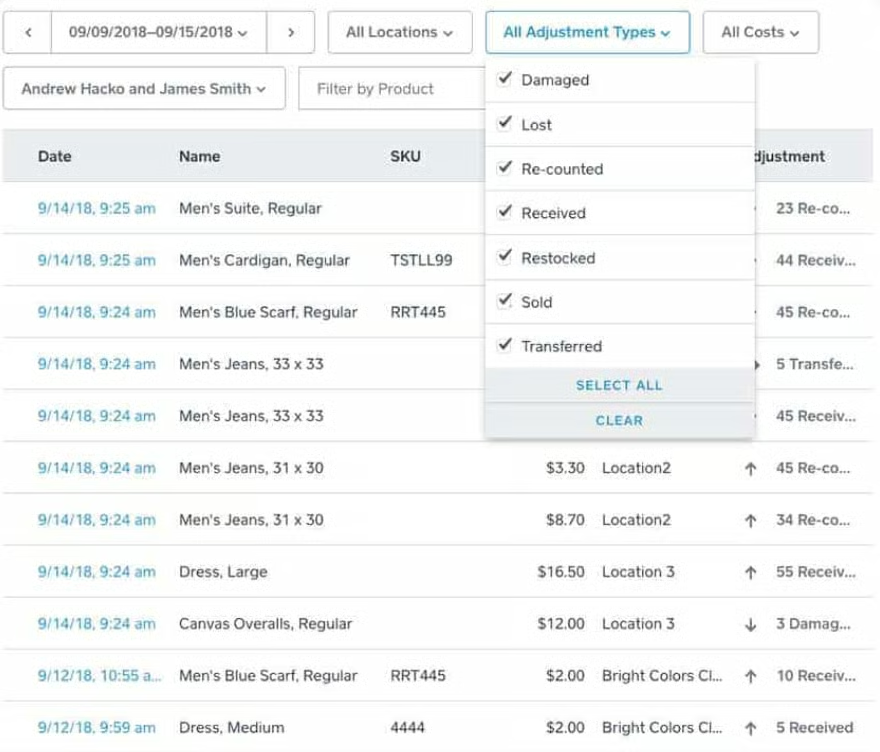
Square supports product categories, item variations, and barcode-based product identification. Its paid inventory tools add stock counts, unit costs, adjustment history, purchasing, and reporting.
Purchase orders let you select products, assign a vendor, record costs, and receive the delivery. Square Plus and Square Premium support this workflow when the relevant inventory capabilities are enabled. Barcode-label printing is also available through eligible paid plans and compatible equipment.
Inventory management by plan
Feature | Square Free | Square Plus | Square Premium |
|---|---|---|---|
| Basic item and catalog management | Included | Included | Included |
| Inventory counting tools | Not included | Included | Included |
| Unit-cost tracking | Not included | Included | Included |
| Inventory adjustment history | Not included | Included | Included |
| Vendor management and purchase orders | Not included | Included | Included |
| Barcode label printing | Not included | Included | Included |
| Cost of goods sold reporting | Not included | Included | Included |
| Staged transfer orders between locations | Not included | Not included | Included |
Paid inventory features may require enabling inventory capabilities. Device and accessory requirements apply.
Transfer orders deserve a separate check for businesses with several stores. Square Premium supports creating orders in Dashboard and tracking stock as it moves between locations. Items must be available at both locations, and staff need the appropriate permissions.
I would test a partially received delivery and a stock discrepancy during the trial. Those situations reveal more about the inventory workflow than receiving an order that arrives exactly as expected.
Ecommerce
Square includes an entry-level online site, with paid plans adding custom-domain connection and expanded design options. Its shared item library connects product information across the register and website, while enabled inventory tracking updates stock for supported sales activity.

Online selling by plan
Feature or fee | Square Free | Square Plus | Square Premium |
|---|---|---|---|
| Monthly subscription per location | $0 | $49 | $149 |
| Standard online or invoice card processing | 3.3% + 30 cents | 2.9% + 30 cents | 2.9% + 30 cents |
| Website builder with basic SEO tools | Included | Included | Included |
| Connect a custom domain | Not included | Included | Included |
| Expanded site customization | Not included | Included | Included |
These are the current Square subscriptions, not additional online-store subscription charges. Domain registration, processing, and optional services can add costs.
For a retailer adding online sales, I would check how pickup, shipping, returns, and stock updates work together before publishing the full catalog. The goal is to avoid creating a second set of products that staff must maintain separately.
You can also collect payments without building a full website. Square supports payment links that can be shared through email, text, or social posts, along with payment buttons and QR codes.
Team management
Square’s current subscriptions separate basic staff access from scheduling, time tracking, and labor reporting. Time tracking is not included with Square Free, so I would not choose that plan on the assumption that it covers employee timecards.
Staff management by plan
Feature | Square Free | Square Plus | Square Premium |
|---|---|---|---|
| Employee timecards, breaks, and overtime tracking | Not included | Included | Included |
| Shift scheduling and time-off management | Not included | Included | Included |
| Labor cost reporting | Not included | Included | Included |
| Unlimited custom permission sets | Not included | Included | Included |
For a small shop, I would configure permissions before adding everyone to the register. Decide who can issue refunds, edit products, adjust stock, and view reports. Scheduling and time tracking then become useful additions as the team grows.
Customer relationship management and marketing
Square Customer Directory stores customer information, purchase history, preferences, and notes. Staff can attach customers to transactions and review previous activity when helping them at checkout.
Square Messages brings together supported customer texts, emails, and feedback. Square Free users can reply to inbound messages and send payment links. Square Plus and Square Premium add the ability to start new conversations and use a dedicated business number.
Marketing and loyalty are also part of the current paid-plan offering. Eligible subscribers can create email campaigns and loyalty programs, while text marketing has plan-based allowances and additional usage charges. These should be evaluated as subscription benefits rather than automatically treated as separate add-ons.
I would start with a specific goal, such as encouraging a second visit, before building a campaign. Customer records are more useful when staff collect accurate information and the business has a clear reason to contact shoppers.
Reporting
Square’s sales reporting helps you review performance by item, category, time period, and location. Paid inventory reporting adds information about stock costs, sell-through, and profit potential.
Reports worth evaluating include:
- Cost of goods sold: Review recorded inventory costs associated with sales.
- Inventory sell-through: Compare selling activity with stock movement.
- Projected profit: Review the potential profit represented by unsold inventory.
- Adjustment history: Investigate receiving, recounts, losses, and other stock changes.
Square AI
Square AI provides conversational analysis of business data, and its current page labels that feature beta. It also describes charts that update with fresh data and contextual information such as local weather and events.
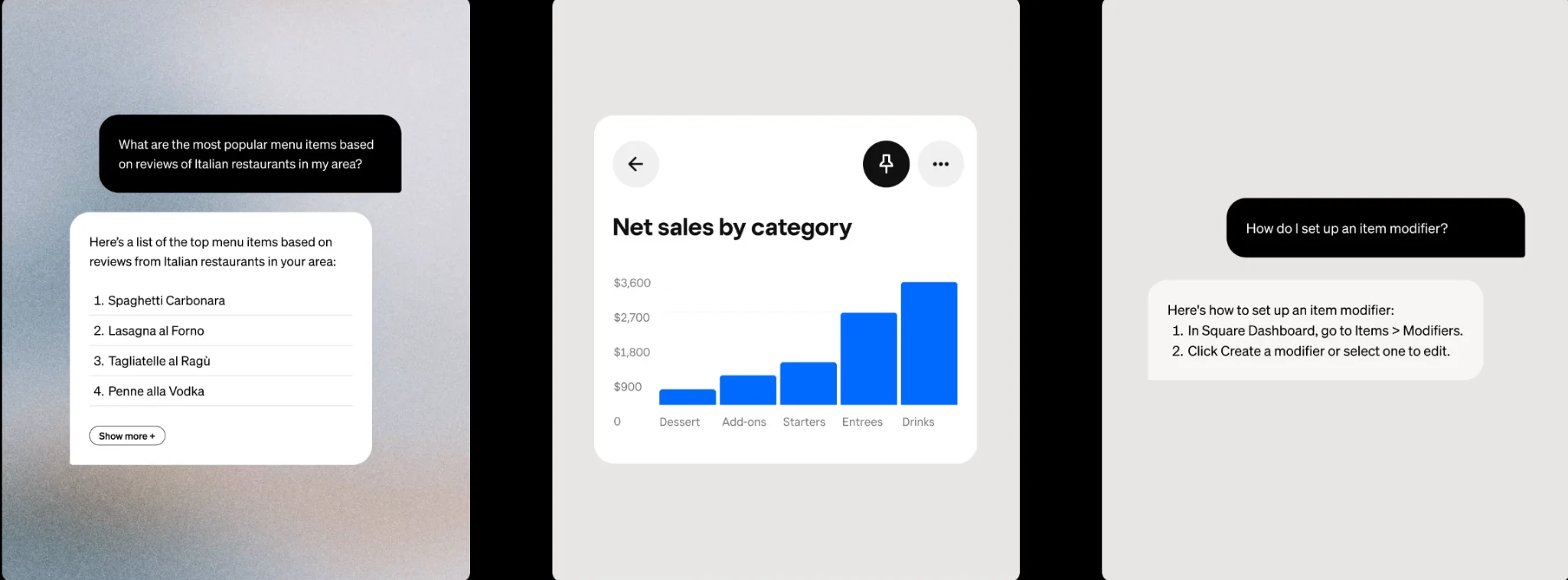
I would use AI-generated findings as a starting point for questions. Check the underlying report, date range, and item costs before changing an order or promotion.
Square’s reconciliation report separately breaks down sales, refunds, fees, and deposits to help match activity to bank deposits.
Integrations
Square’s App Marketplace connects the platform with outside tools for accounting, inventory, ecommerce, fulfillment, and other business needs. Each integration should be checked for its own pricing, requirements, and supported workflows.
For example, Square describes connecting Shopify through Thrive Inventory and synchronizing a Wix store with its catalog. These are different arrangements, so I would confirm which system controls product information and how stock changes and returns move between them.
Square for Retail ease of use and customer support
Score: 4.5 out of 5
Setting up a Square for Retail account only takes minutes, and because it uses in-house payment processing, there’s no extended approval process necessary. The system itself guides you through sign-up, and once the account is confirmed, a step-by-step guide helps you complete the setup so that you can start selling right away.
Once you’re set up, you can also use Square’s iOS mobile app to sell on the go. And if you need additional features, Square has a large and varied set of extra tools that you can get for affordable monthly fees, or even for free in some cases.
Square also has an active community forum where you can find answers to both standard and not-so-common questions that real-life users have. The website hosts an extensive support center, where sections are divided by product, topic, and most popular articles. There is also in-app support with quick tutorials and Square’s YouTube channel with online videos.
However, the one area Square for Retail falls short is customer support. You can access customer service (by phone, messaging, and email) only once you log in to your account. Phone support is not always available unless you are subscribed to one of Square’s paid plans, and support hours are generally only available to active customers. These limitations can be problematic if your account is suspended or otherwise locked out, or if you are using the free plan and need access to support quickly.
Since many retailers operate on the weekends, we would prefer to see weekend support hours as well.
Plan | Published phone support |
|---|---|
| Square Free | 6 a.m. to 6 p.m. Pacific, Monday through Friday, for the first 90 days |
| Square Plus | 6 a.m. to 6 p.m. Pacific, Monday through Friday |
| Square Premium | 24/7 |
Working through an outage
Square supports offline payments on eligible setups, but the payment methods and timing rules vary. Tap to Pay on iPhone and Android is excluded from offline acceptance. Sellers remain responsible for expired, declined, or disputed offline payments.
I would write a short outage procedure before launch: which device staff should use, which payments they can accept, and how to reconnect and upload pending transactions.
Square for Retail expert score
Score: 5 out of 5
Here, we considered any unique or standout features, as well as the overall value the POS provides, user reviews, and feedback based on our own experience testing the system.
Overall, Square for Retail offers incredible value and all the basic features a retail operation needs. The software is one of the most intuitive and easy-to-use of all the programs we’ve tested. And, users love it, which you’ll see from the high user ratings below.
However, if you’re serious about ecommerce, you’ll likely find the online store functions lacking (in which case, consider Shopify). And, while the inventory features are sufficient for small to medium operations, if you have a complex product assortment, you might be happier with a system that has matrix inventory management (like Lightspeed).
Finally, Square for Retail is locked into Square Payments, which does not work with high-risk businesses (with the exception of CBD vendors). So, businesses like firearm retailers and multi-level marketing retailers cannot use the software. If you’d like more flexibility with your payment processor, consider Clover instead.
Methodology: How I evaluated Square for Retail
I tested Square for Retail using the same approach I apply to other POS systems. I evaluated affordability and the features retailers need for daily operations, including checkout, transaction management, customer records, stock tracking, employee management, and reporting. I also considered ease of use, customer support, and overall value.
I use these criteria when comparing the best overall POS systems, but adjust them for specific needs, such as retail inventory management or mobile selling. This is why a POS system may receive different scores across Fit Small Business guides.
Below are my retail POS evaluation criteria.
Pricing: 15% of the overall score
I awarded points for starter plans costing less than $75 per month, with extra credit for free plans. I also considered transparent processing fees, affordable rates, and volume discounts. I deducted points for limits on users, products, transactions, or sales that require an upgrade.
Square’s free starting plan and published processing rates contributed to its pricing score. I also considered its requirement to use Square Payments for integrated card processing.
Register features: 20% of the overall score
I evaluated customizable checkout shortcuts, product lookup, returns, and mobile selling on the sales floor or at curbside. I also checked payment options, including contactless payments, gift cards, store credit, layaway, loyalty, and order-ahead capabilities.
For retailers handling repairs or special orders, I considered whether the system supports custom, work, or service orders. Square’s accessible checkout and selling tools contributed to its score, while specialized work-order requirements warranted closer consideration.
Management features: 30% of the overall score
I placed the most weight on inventory management, including low-stock alerts, product variations, purchase orders, stock counts, and receiving. I also evaluated customer management, marketing, employee tools, online selling, and reporting.
For Square, I considered both the available features and the subscription needed to access them. Purchasing, inventory reporting, and multilocation workflows were part of that assessment.
Ease of use: 20% of the overall score
I evaluated installation, training resources, support availability, and offline functionality. I also considered hardware compatibility so retailers could choose equipment suited to their stores.
My hands-on experience informed this category, including how easily I could find tools and complete common tasks. For Square, I also considered differences in phone support by subscription and the conditions attached to offline payments.
Expert score: 15% of the overall score
I assessed Square’s full feature set, standout tools, value for money, popularity, customer feedback, and reliability. I also considered my experience using the interface and how well the software suits different retail operations.
My assessment favored Square’s usability and value for small retailers. I also weighed situations where a business might need more specialized inventory, ecommerce, or operational tools.
Frequently asked questions (FAQs)
Can I use Square for Retail with Shopify?
Yes. Square describes connecting its catalog and inventory with Shopify through Thrive Inventory. Confirm the connector’s current pricing, supported fields, and synchronization rules before relying on it for daily operations.
Can Square accept payments without the internet?
Eligible Square setups support offline card payments, subject to device and upload requirements. Tap to Pay on iPhone and Android is excluded, and the business bears the risk of declined or expired offline payments.
Can I keep my existing card processor with Square for Retail?
No, you can’t. Square’s integrated payment service processes card transactions within its retail system. If keeping your existing processor is a requirement, make that an early screening question when comparing POS providers.
Can I use my existing barcode label printer?
Possibly, if the model, connection, and label sizes match Square’s supported setup. Check the compatibility list before switching, since owning a barcode printer does not guarantee it will work with the selected device.
Bottom line
I recommend Square for small storefronts that want integrated checkout and retail management, particularly when the selected paid plan handles their purchasing and stock needs. Before committing, run a trial using real products and a supplier delivery, then calculate the cost using your own card volume. Choose the plan that supports those tasks at a cost the store can sustain.
