







To sell on TikTok in the US, open a TikTok Shop or connect your online store, add compliant product listings, tag SKUs in videos and Lives, and manage orders in Seller Center. Shoppers can buy from tagged posts, your Shop tab, Lives, creator posts, ads, and synced store integrations. Plan for category referral fees and payment processing, choose your fulfillment method (own couriers or Fulfilled by TikTok), and follow the step-by-step guide below.
Update: US TikTok policy is active and subject to change; confirm the latest enforcement timeline and seller rules before you launch.
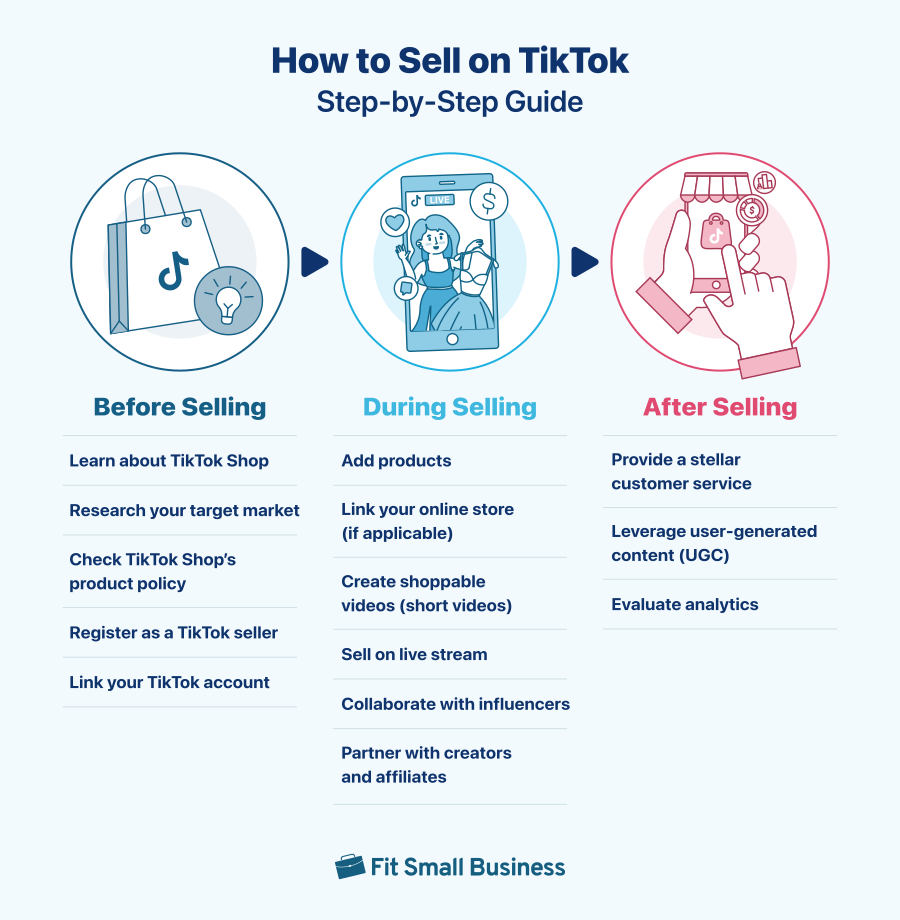
- Before you sell on TikTok
- Step 1: Register as a seller
- Step 2: Add your products
- Step 3: Create engaging content
- Step 4: Collaborate with influencers
- Step 5: Go LIVE!
- Step 6: Leverage TikTok’s paid ads
- Step 7: Perform after-sales support, promotion, and analytics
- How much does it cost to sell on TikTok?
- TikTok fulfillment and shipping options
- Ways users can shop your products on TikTok
- Frequently asked questions (FAQs)
- Bottom line
Before you sell on TikTok
Selling on TikTok starts with learning the platform, your audience, and what actually sells.
Learn about the platform
TikTok Shop is an in-app storefront where shoppers can buy from your profile, in tagged videos, and during Lives — orders are managed in Seller Center. One-third of US adults now use TikTok, with usage concentrated in younger adults.
Check out my guides to learn more about TikTok Shop and selling on TikTok:
- What Is TikTok Shop? Everything You Need to Know
- TikTok Shop Fees Guide
- TikTok Shop Reviews from Sellers
Find out more about your target market
Check whether your buyers are on TikTok and how often they use it. In 2024, 62% of US adults ages 18 to 29 use TikTok, 40% of those 30 to 49, 26% of those 50 to 64, and 10% of those 65 and older. Among teens, roughly six in 10 use TikTok and close to half say they’re online almost constantly.
And take note, most US adults mainly watch rather than post, so your shoppable videos need to do the heavy lifting. If you sell to Gen Z and younger millennials, TikTok is a strong match. If that’s not your target market, however, don’t cross TikTok off your list just yet; even among adults 30 to 49, reach is about four in 10.
Determine which products sell well
Start with what already sells on TikTok Shop, then check policies and your margins. For example, health and beauty leads US TikTok Shop sales, and apparel and accessories are also sizable. Live shopping also surges during retail events, with TikTok Shop topping $100 million in US Black Friday sales in 2024 and fashion and beauty among the top categories.
TikTok doesn’t provide a list of allowed sellable products, but it lists prohibited items. A quick look at trending videos can give you an idea of what types of products are an excellent fit for the platform. You can look at TikTok’s successful business case studies and explore the #TikTokMadeMeBuyIt hashtag for ideas.
I made things easier for you and rounded up 25 TikTok viral products to sell.
Step 1: Register as a seller
Eligibility and documents
Before you list anything, make sure you qualify and have the right documents. This speeds up approval and prevents rework later.
TikTok has these basic requirements for TikTok Shop sellers:
- You must be at least 18 years old and reside in the US.
- You must have a valid US passport or driver’s license.
- You must use a phone number and email address not already used to open another Shop.
- Politicians are prohibited from becoming TikTok Shop sellers.
| For Individuals | For Businesses | |
|---|---|---|
| Documents | US Driver's license or passportSSN
| EIN |
| Payment and Tax Information | Merchant category codeW9/W8-BEN FormUS TIN | Merchant category codeW9/W8-BEN FormRelated person's informationEntity Type |
Note:
- Company or personal information cannot be changed after submission. These will also be shown in your TikTok Shop Seller profile. Ensure the documents are filled and uploaded correctly.
- If the address listed is your residential address, select the ‘Certify’ checkbox on the page so that the platform will only display partial addresses.
Create a TikTok Seller account
Navigate to the TikTok Shop Seller Center. Ensure your region is in the US because, once verified, your shop can only operate in your registered region. Visit this link.
You can also sign in with your existing TikTok account to apply as a TikTok seller. We recommend using a TikTok account solely for your business and not linking your personal TikTok account to your TikTok Shop.
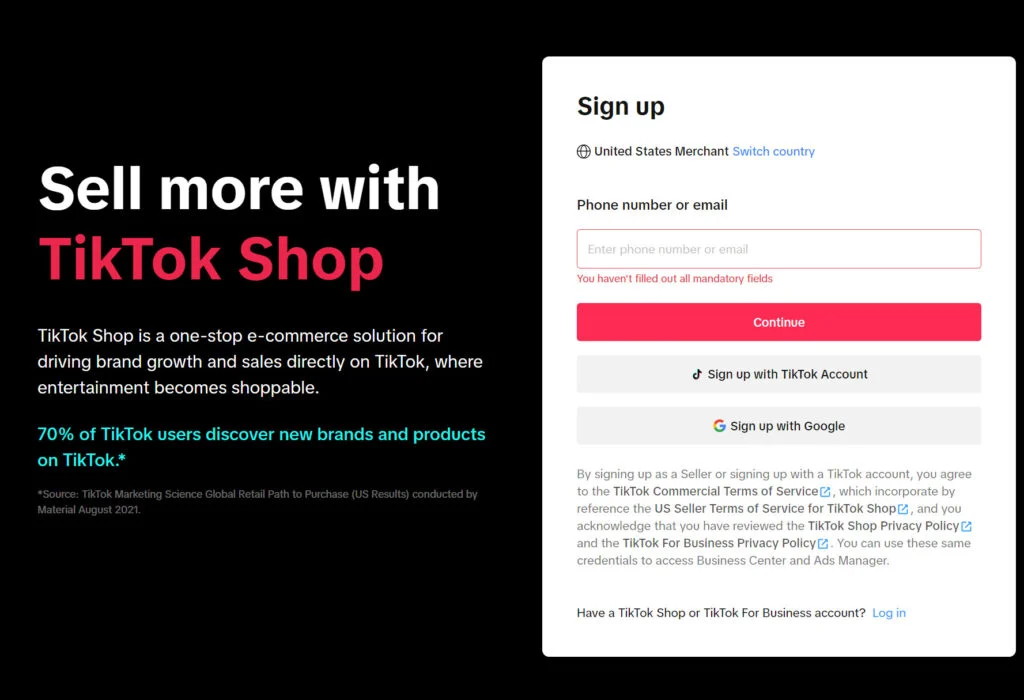
You will then need to submit your documents for verification, as discussed earlier.
Set up your Shop preferences
After you have registered as a seller, you can go ahead and set up preferences for your TikTok Shop such as its name while waiting for approval.
When creating a Shop name, remember the following:
- You can use letters, numbers, and special characters for your Shop name, but you cannot use numbers or special characters exclusively.
- Avoid names that do not make sense, go with a name that befits or describes your brand and products.
- You cannot use “official,” “flagship,” “authorized,” or “brand” in the name. You cannot use trademarked names as well, such as Disney and Nike. Comparisons or exaggerated descriptions, such as “the best” or “vs.” are also not allowed.
- You cannot mention “TikTok” without TikTok Shop’s authorized permission or any third-party platforms such as Amazon, Instagram, and Facebook, without authorized permission.
- Choose a primary product/service type and set the category that best describes the products you sell. Do not worry—this will not affect your future business activities and will only be used for completing the registration process.
- Add contact information for verification purposes.
- You can change your shop name later if necessary.
Payouts, taxes, and policies
Add your payout and tax details in Seller Center before you list, then review policies so nothing gets rejected. In Seller Center, enter your bank account for payouts, complete the tax interview under Finances → Taxes, and review Prohibited and Restricted Products.
US sellers typically submit Form W-9 with an SSN for individuals or an EIN for businesses; if TikTok cannot verify your tax info, it may request IRS documentation. The IRS requires platforms to collect valid tax information before payments; if you do not provide it, TikTok may withhold 24 percent. You can update tax details later if your name, address, or TIN changes.
- Add or update your bank account in Seller Center so payouts are not delayed. Only the shop owner can change payout banking.
- Open Finances → Taxes to submit Form W-9 (US) or the appropriate W-8 (non-US), then electronically certify.
- Read the Prohibited Products Policy and the current Restricted Products Policy so you do not create listings that get taken down.
Your tax info must match the details you used when you created the account. If it matches, a W-9 is generated. If not, TikTok may ask for IRS-issued proof of your name and TIN.
Link your TikTok account
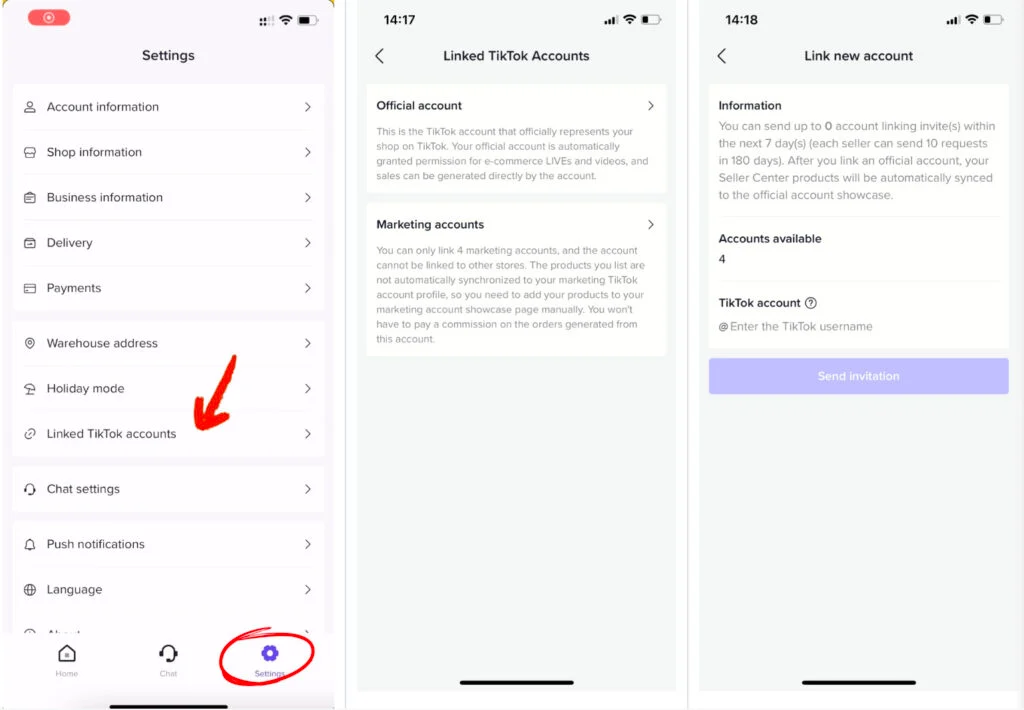
The next step in registering as a TikTok Shop seller is to link your TikTok account to the Shop. This is important so that you can add your products to your TikTok Showcase, and sell products via LIVE or short video.
- In your TikTok Seller dashboard (desktop or mobile app), go to Settings > Linked TikTok Accounts
- Select the account type, enter the username, and click Send invitation.
- From the TikTok Account you are linking, go to Inbox
- Click on New profile views and from TikTok > Monetization: New Request
- Click Accept request
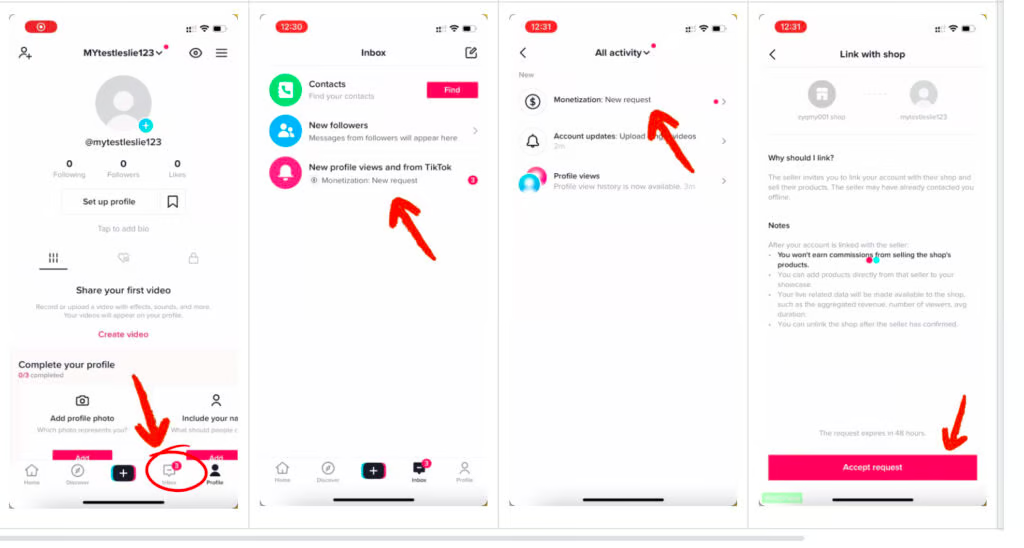
**You link up to five TikTok accounts to your Shop.
Step 2: Add your products
After you optimize your profile, you can start listing products or connect your ecommerce store. You may add products while your seller application is under review; they will show as Reviewing and will not appear live in your Shop until you are approved.
Reminder: When you publish a video, tap Tag products and select the exact SKU so the post is buyable.
Did you know? You can also dropship products on TikTok! Read our resources to learn more:
- TikTok Dropshipping: Ultimate Guide for SMBs
- What Is Dropshipping & How It Works
- How to Start a Dropshipping Business
Link your online shop to your TikTok account (optional)
If you have an existing online store through an ecommerce platform, you can link it to your TikTok account to enable the Shop tab, where you can showcase and sell your products. You can do it in two ways, installing the ecommerce app from the TikTok Shop App store to your Shop or connecting TikTok from your ecommerce dashboard.
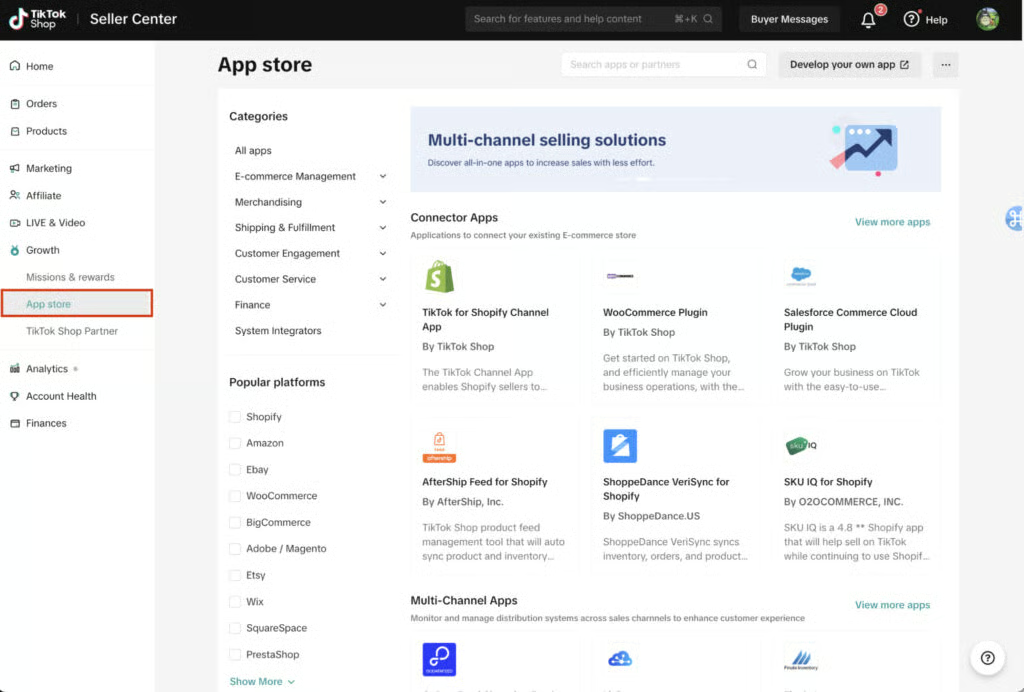
Through the TikTok Shop App Store
The TikTok Shop App Store can integrate your existing ecommerce store with TikTok Shop to showcase your products for selling and sync inventory and orders seamlessly.
As of this writing, the following have apps in the TikTok Shop App Store:
- Shopify
- Adobe/Magento
- BigCommerce
- WooCommerce
- And more
To install the app, navigate to the TikTok Shop App Store and search for the app, click Install Now, and set up the app within your TikTok Seller dashboard.
Through your ecommerce store dashboard
Below, we detail instructions on connecting a Shopify, BigCommerce, Square Online, WooCommerce, and Ecwid store. Once you connect your ecommerce platform to your TikTok, you can:
- Sync your store’s product catalog to TikTok and feature a shopping tab on your TikTok profile
- Include product links in your TikTok videos that point directly to product pages in your store so customers can make a purchase
- Run optimized ads by installing the TikTok Pixel
The TikTok Pixel is a piece of code that you install on your website so when you run paid ads, you can share website visitor events to TikTok for tracking. All the ecommerce platforms we outline below make it easy for you to install the Pixel on your store.
Connecting Shopify to TikTok
Shopify makes it easy for you to connect your store to TikTok. Just add the TikTok app from your Shopify dashboard. Once installed, follow the prompts to associate your TikTok business account. The integration also lets you run and manage TikTok ads directly from Shopify.
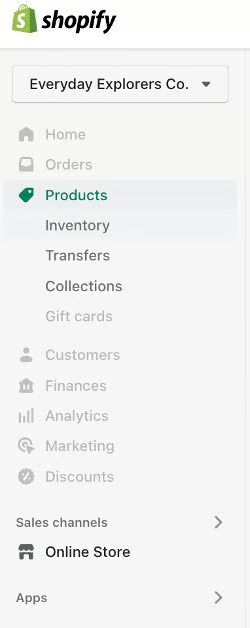
To install the TikTok for Shopify app, click Apps from your Shopify dashboard and search for TikTok. 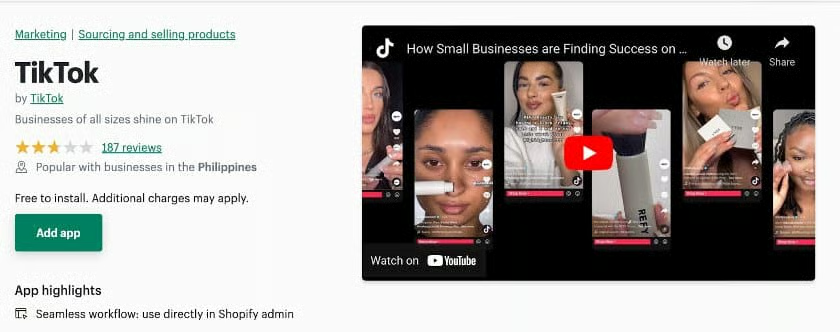
Click on Add app. 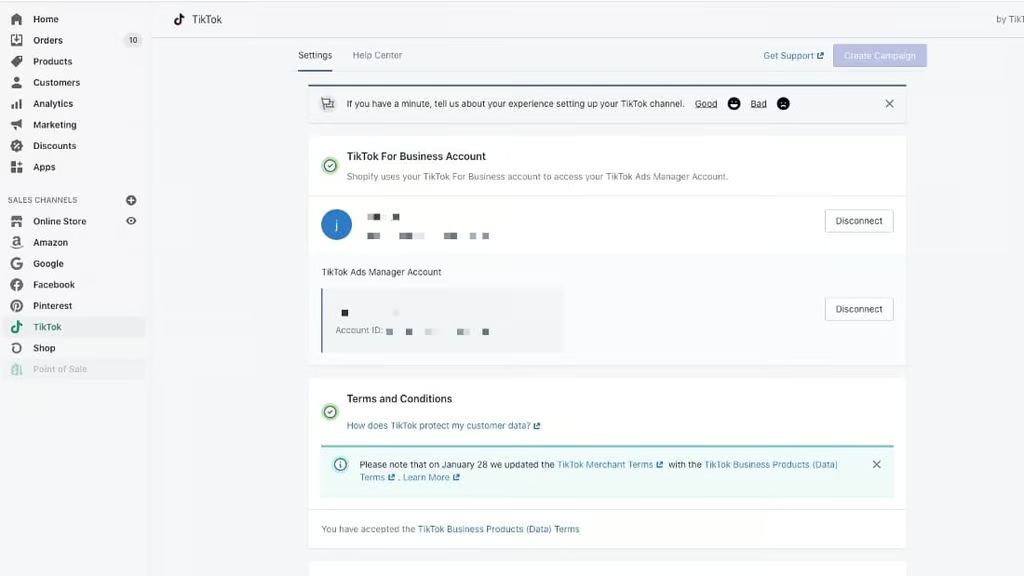
Once installed, you will see TikTok added as one of your sales channels. Connect your TikTok account.


Connecting BigCommerce to TikTok
You can connect your BigCommerce store to TikTok by following these steps:
- Step 1: Install the TikTok For Business app from the Channel Manager, under Ads and social.
- Step 2: Connect and authorize your TikTok Business account.
- Step 3: Once you connect your account, create or connect your TikTok Business Center account (this is different from your TikTok Business account) and TikTok Ad account.
- Step 4: Set up TikTok Pixel.
- Step 5: Set up your catalog. Under the Catalog section, click Create New to sync your existing BigCommerce catalog with your TikTok profile.
- Step 6: Set up TikTok Shopping.
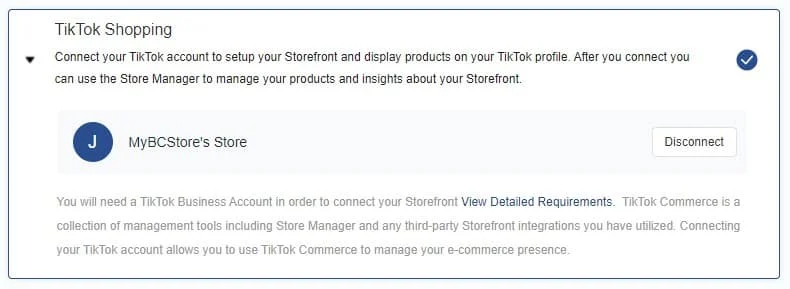
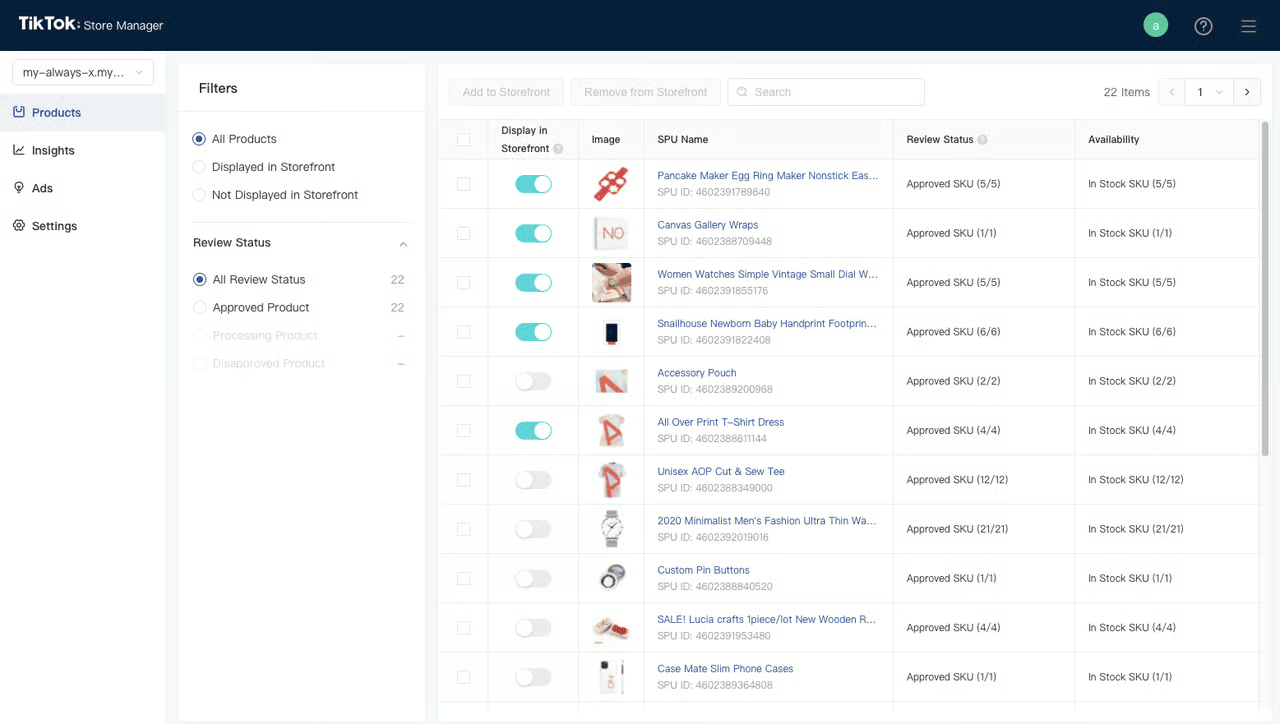
To add BigCommerce products to your TikTok storefront, click Manage under the TikTok Shopping section. You’ll be redirected to TikTok’s Store Manager.
- Step 1: Within the Store Manager, click on your Store Name.
- Step 2: Click on the Product tab.
- Step 3: Find your target product by using filter options or the search function.
- Step 4: Once you’ve found your desired item, toggle Storefront Status to on. Add items in bulk by selecting the check box for multiple items and clicking In Storefront at the top of the page. To remove an item, toggle Storefront Status to off.
You can also add products in-app (from TikTok).
- Step 1: Go to your TikTok profile, click on the Shopping icon, then Manage Showcase.
- Step 2: Click on the three dots to edit a product or click on Add Products to create more listings.
Your TikTok app interface should look something like the image below:
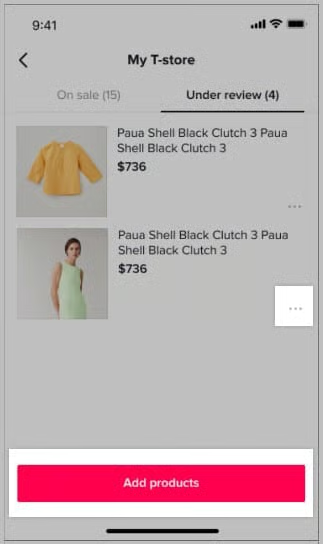
Once you add products to your store in-app, they will be under review before getting listed in your Shopping tab.
(Source: BigCommerce)
Connecting Ecwid to TikTok
- Step 1: Go to the TikTok page from your Ecwid dashboard.
- Step 2: Specify your mobile phone number in the phone number section of the TikTok Business Tools field.
- Step 3: Click + Connect TikTok Account.
- Step 4: Log in to the TikTok For Business account (not your TikTok account), then click Connect. If you don’t have an account yet, click Sign Up to create one.
- Step 5: In your TikTok for Business account, set up the Business Center by adding the name and clicking Create New.
- Step 6: Set up a TikTok Ad Account; enter the name for your ad account and click Create New.
- Step 7: In Data Sharing, enter the name for your Pixel and click Create New.
- Step 8: In the Catalog, enter the name for your catalog and click Create New.
- Step 9: Click Finish Setup.
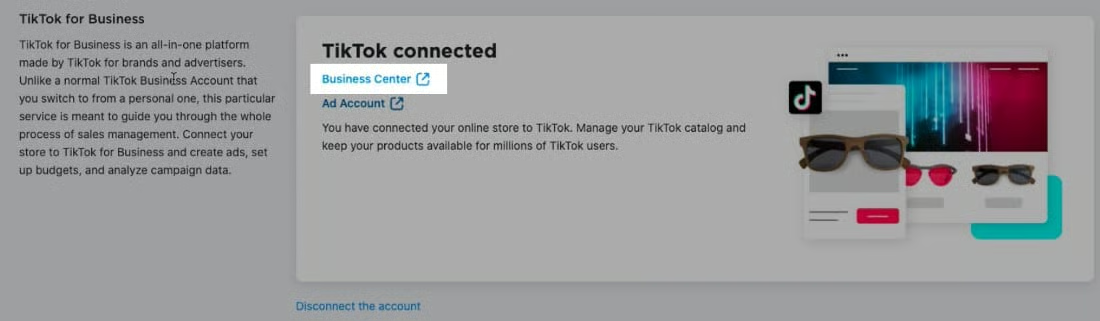
Product review may take up to several hours, but you can check its status in the Products on TikTok section in your Ecwid dashboard. All approved products will appear in the “Listed products” column.
Once approved, your catalog will appear in your TikTok Business Center. Catalog syncing automatically happens twice a day. Ecwid has a guide on how to manage your product listings in TikTok.
Connecting WooCommerce to TikTok
WooCommerce is a recent ecommerce integration (May 2022) to the TikTok platform. Simply download the TikTok for WooCommerce plugin from your WordPress dashboard and activate.
If you don’t yet have an online store, read our guide to see which ecommerce platform is best for you.
Add products in your Seller dashboard
You can easily add new products from your TikTok Seller Center dashboard via desktop or mobile app. If it’s your first time setting up a TikTok Shop, you will also get a setup wizard where you go through the basic steps of managing your products.
- From your Homepage or Seller Center dashboard, click Add products.
- Upload product images.
- Enter your product name.
- Write the product description.
- Choose the category from the dropdown.
- (Optional) Upload a short product video.
- Add sales attributes and variants, then generate SKUs.
- Click Publish.
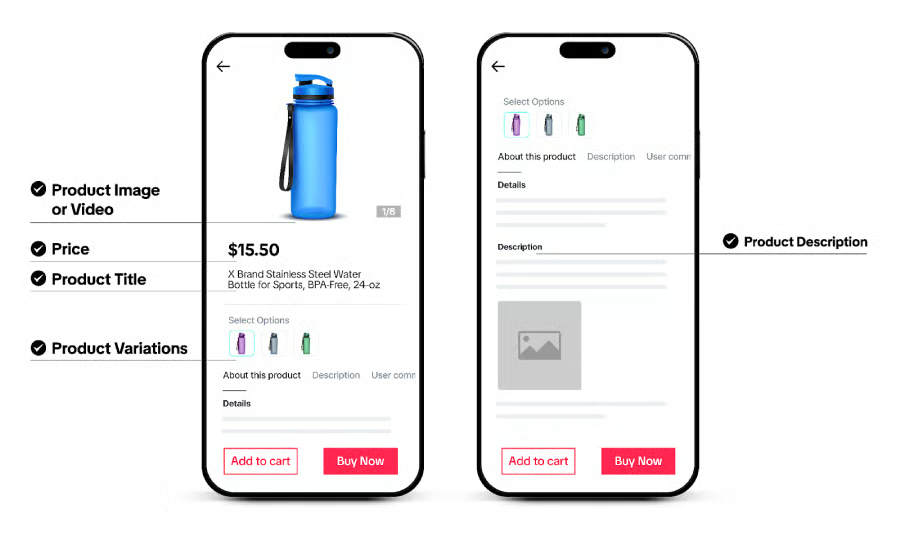
After you publish: The product moves to Reviewing. When approved, it appears under Live.
TikTok listing rules to pass review
- Images: Upload five to nine high-quality images. Make the first image a single product on a clean background with no text, borders, or watermarks. Use at least 600×600 and include multiple angles or detail shots.
- Title: Keep it concise and accurate. Put the core keyword first. Avoid clickbait and references to inventory or variant counts.
- Description: Use short paragraphs or bullets to cover what it is, what’s included, specs or materials, size or care, and key benefits. Avoid duplicate text and broken links.
- Category and attributes: Choose the most accurate category and complete all required attributes. Missing category details can limit reach.
- Listing quality: Aim for a “Good” quality rating by meeting title, image, description, and category standards. Use your product optimizer or checklist before you publish.
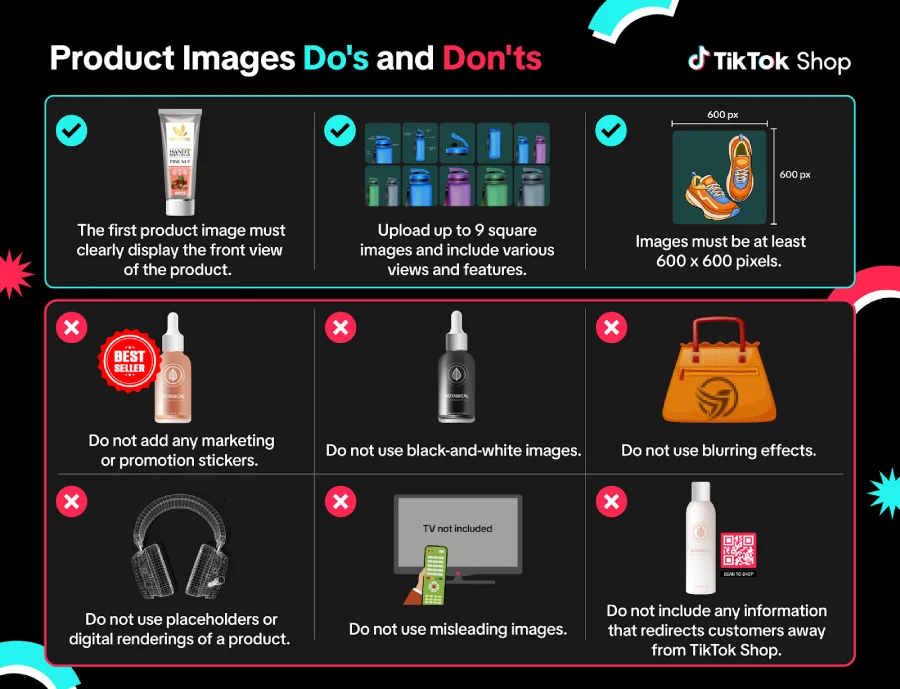
Tiktok listing name and description guidelines
- Product name: More than 25 characters is required; 80 characters or fewer is recommended. Use title case except for conjunctions, articles, and prepositions. Example: “Ceramic Nonstick Frying Pan, 10-Inch, PFOA-Free, Dishwasher Safe”
- Description: Break selling points into short paragraphs. Keep each bullet or paragraph under 250 characters and add auxiliary images where helpful.
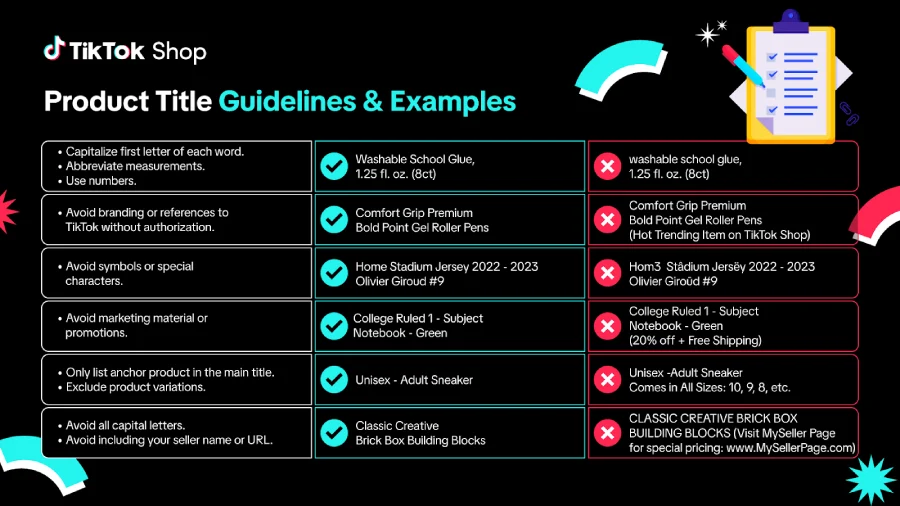
Good TikTok product listing examples
Use these TikTok Shop US listings as models for structure and clarity. Each one puts the right blocks above the fold: a clean title, strong image gallery, variants visible, price and reviews near the top, and clear specs plus shipping and returns. Mirror the parts that fit your product, then keep the copy short and specific.
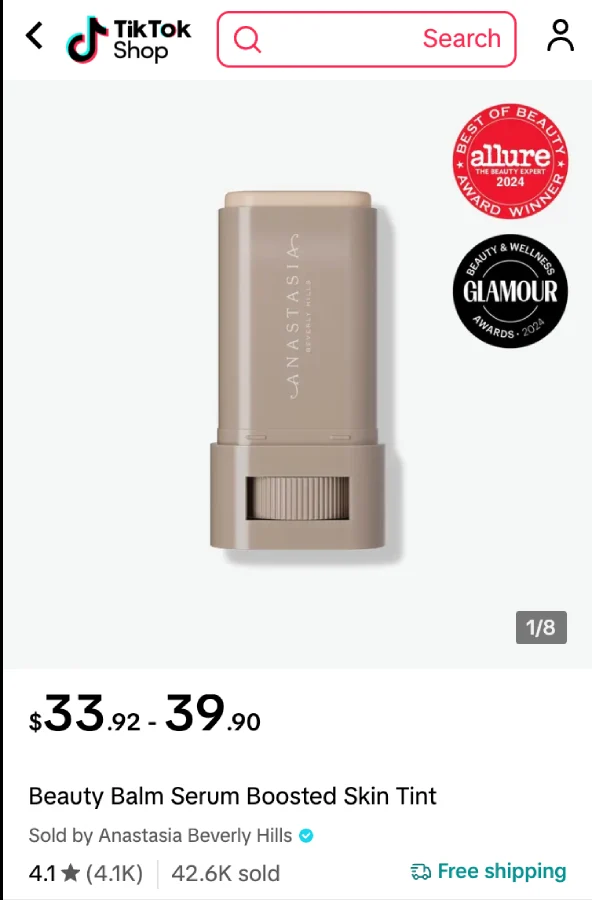
Anastasia Beverly Hills: Beauty Balm Serum Boosted Skin Tint
This works because shoppers can choose a shade immediately; the variant selector sits above the fold next to price and ratings. The first image is a clean product shot, the gallery adds detail angles, and the specs section covers ingredients and basics buyers ask about. Together, it reduces friction and speeds decisions.
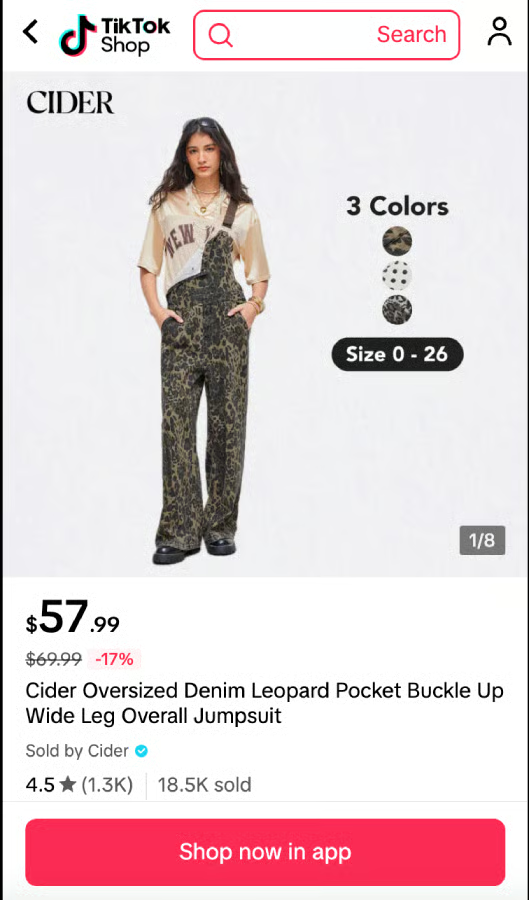
 Cider: Oversized Denim Leopard Pocket Buckle Up Wide Leg Overall
Clear pricing and a visible promo badge draw the eye, while review count and “sold” volume add proof right where buyers decide. Variant tiles show color and size at a glance, and the protections panel builds trust. It is a strong template for apparel titles, options, and measurements.
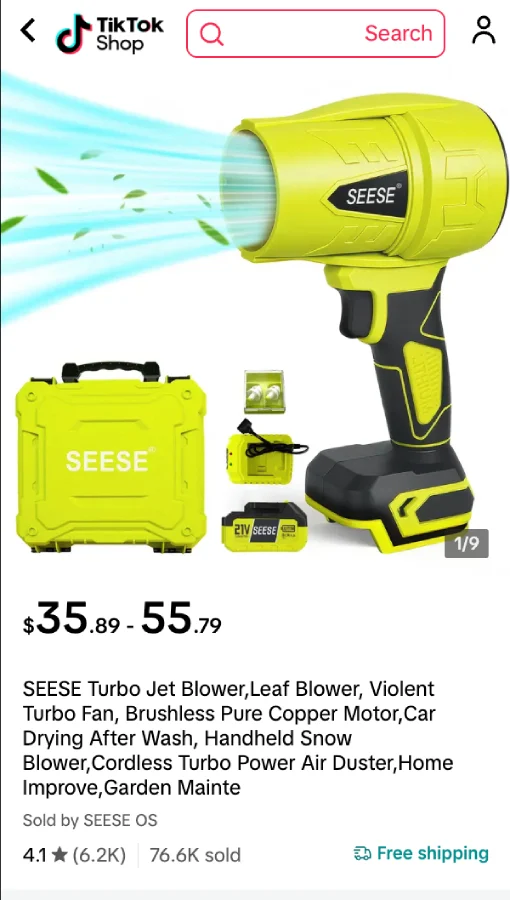
High “sold” volume and ratings sit close to the price, which signals demand and quality. Creator videos on the product page show the item in use, giving the quick demo shoppers expect. The similar items row also suggests alternatives, which helps keep buyers on-page if the hero SKU is not a fit.
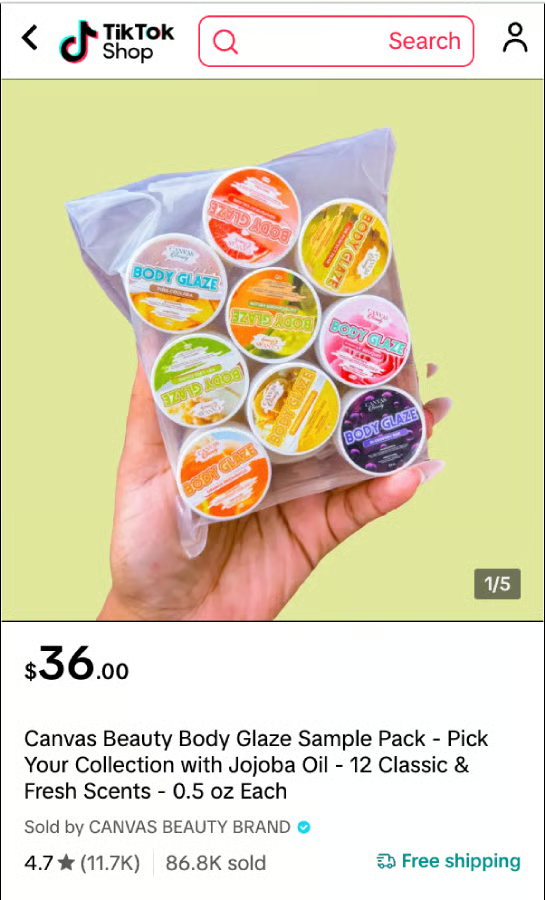
Canvas Beauty: Body Glaze Sample Pack
The bundle is framed clearly, with set contents and use cases spelled out in a short description. Variants are simple to pick, and the page keeps specs and shipping easy to scan. It is a good reference for kits or multi-piece offers where clarity beats long copy.
Build your shipping templates
Set this up once, then copy it across products.
- Choose your shipping method. In Seller Center, go to Orders → Shipping Template. Pick TikTok Shipping if you want to buy and print USPS, UPS, or FedEx labels inside Seller Center using platform rates. Use Seller Shipping only if you must ship on your own terms. TikTok Shipping supports drop-off or pickup and auto-updates tracking.
- Add speeds and set handling time. Offer Standard by default and add Express only if you can hit fast delivery. Your Estimated Delivery Time (EDT) equals handling time plus shipping time, and it shows on the product page. Set a realistic handling time in Fulfillment Settings. You can adjust it later if needed.
- Express target delivery is about 3 business days, with high on-time delivery to keep eligibility.
- Standard delivery is typically up to 6 business days, depending on service.
- Price your shipping. Use the shipping calculator in Shipping and Delivery Settings to preview label costs before you set rates. Accurate weight and dimensions prevent adjustment charges after pickup.
- Create zones, carriers, and rules. Add US zones you will serve and select the carrier service per speed. Set handling times you can meet every business day. Add a free shipping threshold if your margin supports it. For large or heavy products, review size and dimensional weight rules to avoid surcharges.
- Test and publish. Place a small test order to confirm label printing, tracking updates, and that your EDT matches reality. If an item will be late, extend handling time for that order and message the buyer from Seller Center.
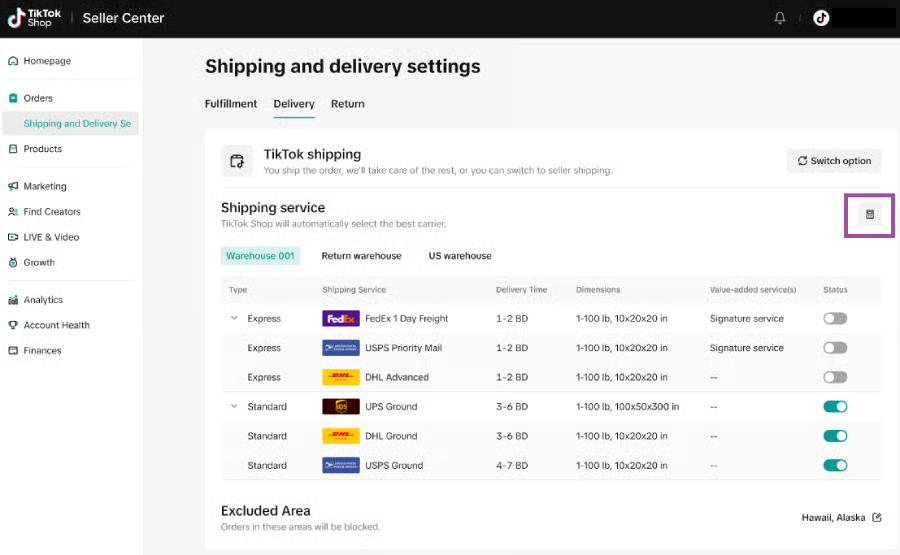
Generally, here are good service picks to start:
- Standard: USPS Ground Advantage or UPS Ground for most small parcels.
- Express: UPS 2nd Day Air or a comparable express service if you can hand off the same day.
Step 3: Create engaging content
Now that you have connected your online store to your TikTok account, it’s time to get creative and promote your products. This is where you turn views into product clicks. Keep videos short, show the product in use, and make every post shoppable. Your weekly goal is simple: publish a few clear clips, tag products, and scale the winners.
Use these quick tips to make scroll-stopping clips that drive product clicks and orders.
- Start with the first 3 seconds. Open with the product in action and a clear hook, then move straight to the payoff.
- Keep it short. Aim for quick cuts in a 9-20 second range for most products; one hook, one benefit, one proof.
- Tag or link at publish. Add a Product tag for a single SKU, or link your Shop/Category/Collection when the clip features multiple items. Then add a direct CTA in the caption.
- Show, don’t tell. Use simple demos, before/after, or side-by-side results so viewers “get it” without extra narration.
- Borrow what’s working. In the Shoppable Video hub, use Get Inspired to scan trending videos, accounts, songs, and hashtags in your category, then adapt those angles to your product.
- Use templates to move faster. Start with ready-to-use layouts and customize in CapCut; test the AI auto-generate flow to produce a few variants you can compare.
- Post consistently. Create a light content calendar and refresh winners; frequent high-quality posts drive new traffic and awareness.
You can read my TikTok ecommerce strategy guide for an in-depth approach to marketing and promotion, and follow the next steps.
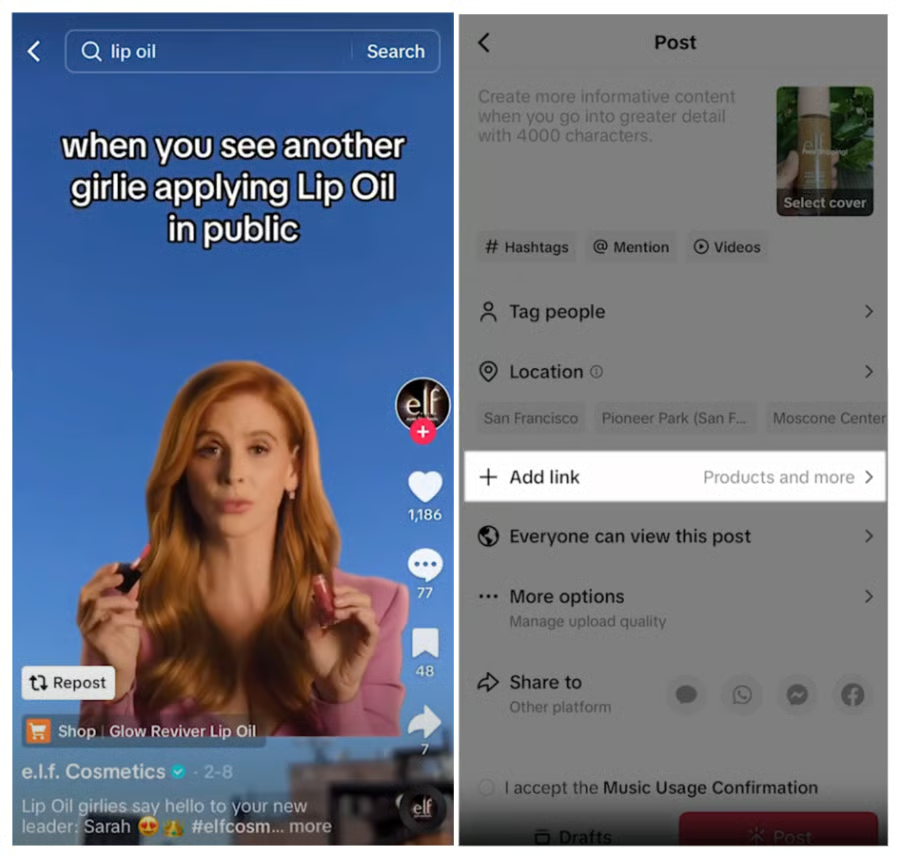
Make posts shoppable (tag or link)
Your posts should be shop-ready at publishing. You can tag a single SKU or link your Shop, a Category, or a Collection when a clip features multiple items.
- Record or upload your video, then on the final screen tap Add link.
- Choose Product to tag a single SKU, or choose Shop to link your full Shop, a Category, or a Collection. Preview, then publish.
- Add a direct call to action in the caption, for example, “Tap the tag to see sizes.”
- Pin the hero SKU if the clip centers on one item.
- Reply to common questions with quick comment videos and tag or link again.
Engaging TikTok content examples
Take a look at how these brands leveraged user-generated content to launch strategic partnerships with influencers and brand collaborations.
GAP
American clothing brand GAP didn’t have an official TikTok account then when this went viral, but user-generated content (UGC) has certainly helped them, being a mainstay favorite among influencers.
Gen Z influencers such as Emma Chamberlain and Barbara Kristofferson were just a few of the influencers that sported a vintage brown spell-out hoodie, providing completely free TikTok marketing. The hoodie hasn’t been released since, but due to demand, GAP obliged by sending out free hoodies to continue the hype, even reissuing the piece for limited edition pre-orders to all customers.
Crocs
Crocs is famous for its bulky, bright, but comfortable rubber footwear. Gen Z creators are surprisingly huge fans of the brand, giving it indirect TikTok marketing. Crocs is smart enough to jump on the trend, using its resurging popularity to showcase novelty products and collaborations, even doing a bizarre collaboration with KFC.
The brand’s biggest strategic partnership has been the #ThousandDollarCrocs challenge, encouraging users to customize their Crocs with extreme bling, which has been viewed more than three billion times as of this writing.
Crocs even had a demand for its Disney’s Pixar Cars: The Movie kids’ collection to be made available in adult sizes, and they complied.
Promote your posts
Once you have created engaging content, you can promote a video and drive traffic toward your online store (or linked product page). Here’s how:
- Tap Me to go to your profile. Click on the three dots in the top right of your screen to go to Settings.
- Tap Creator Tools, then Promote.
- Under the Promotions page, tap the video you aim to promote (must not contain copyrighted music).
- Choose a goal for your video: view, visits, or followers. If you choose more website visits, add a URL and choose a call-to-action button (such as Learn More, Shop Now, or Sign Up).
- Tap the circle next to the audience you’d like to reach, then tap Next. You can choose from Automatic (TikTok chooses your audience) or Custom (set up a demographic).
- Set your budget duration, add payment information, and then tap Start Promotion.
Step 4: Collaborate with influencers
Since TikTok is a creator-focused platform, partnering with influencers provides exposure for your brand and serves as social proof. One way to find influencers that fit your brand is through the TikTok Creator Marketplace. The platform houses thousands of TikTok creator profiles, and you can filter them to find ones that fit your target audience.
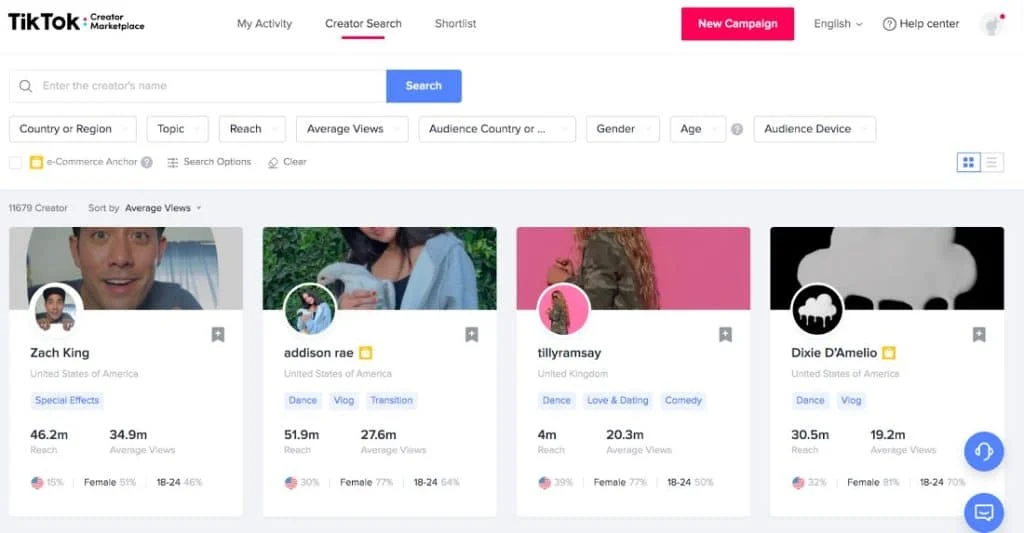
Creators help you reach new buyers and generate content you can reuse. Start simple: open your affiliate program, set clear terms, and give partners an easy brief tied to specific SKUs.
Turn on affiliate and commissions
Make it easy for creators to sell your products and get paid.
- Set a commission percent by product and add a minimum cart value if needed.
- List eligible SKUs in your affiliate catalog and mark bestsellers first.
- Open applications or invite specific creators. Approve partners whose audience matches your price point and category.
- Share samples and a short product facts sheet.
- Require product tagging or a Shop link in every post or Live.
- Track clicks, orders, and payouts in your affiliate dashboard.
- Use unique links or codes per creator to prevent mix-ups.
- Refresh commission rates for seasonal pushes and retire low performers.
Create partner campaigns
Partner campaigns let you team up with an agency or run your own creator push from the Affiliate Center. Use them to list eligible SKUs, set commission offers, and recruit creators at scale.
Option A: Seller-initiated partner campaign
Run this when you want control over products, commissions, and creator criteria.
- Open Affiliate Center → Partner Campaign → Seller Initiated.
- Add basics: campaign name, dates, budget notes, contact.
- Select products and set commission by SKU. Add a higher rate for priority items.
- Set creator preferences: niche, language, posting requirements, minimum metrics.
- Add creative notes and usage rights. Attach demo clips or a product facts sheet.
- Review and publish. Monitor applications and approve creators.
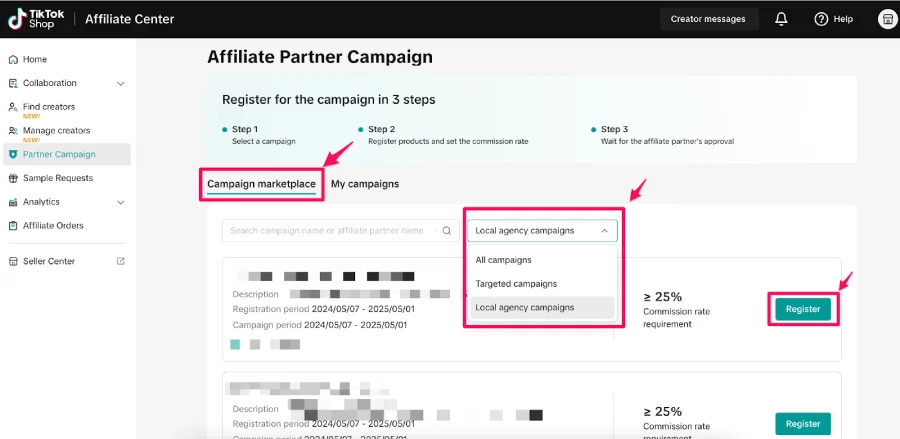
Option B: Join an agency-initiated campaign
Use this when a vetted agency is recruiting creators for your category.
- Open Affiliate Center → Partner Campaigns.
- Filter for your category and register eligible products.
- Set your commission and confirm inventory.
- Wait for partner confirmation and creator matching
TikTok influencer campaigns examples
Benefit Cosmetics
When popular makeup brand Benefit Cosmetics released its new Brow Microfilling Pen, it used the TikTok Creator Marketplace to launch an awareness campaign. Through the marketplace, they partnered with 22 Gen Z and millennial creators and required them to replicate a brow dance set to an original music track, which of course, featured the product.
The 22 videos were launched in users’ timelines and generated 3,500+ hours of views and 1.4 million impressions, all of which were from just 4.5 minutes of creator content.
Newton Baby
When Newton Baby, a brand known for its award-winning crib mattress, planned an awareness campaign highlighting parenting moments in a fun and wholesome way (while also featuring their product), they went with the TCM, setting up strict criteria for followers and average views per video. Three videos were finished and resulted in an enormous engagement rate of 19.44% across all videos. This allowed the brand to easily measure the impact of the post and gain insights for future campaigns.
Step 5: Go LIVE!
Livestream shopping is gaining momentum in the US and is primarily driven by the LIVE feature of TikTok. TikTok introduced TikTok Live Shopping, an immersive and engaging experience for brands to promote and sell their products and for viewers to buy these products.
Being able to leverage the real-time opportunities of engaging with your audience during a TikTok LIVE helps sell more products. Moreover, live shopping events create a sense of urgency and trigger a fear of missing out (FOMO) among viewers.
Live selling works when your offers are easy to find and the show has structure. Plan a short run, pin the right products, and make it obvious how to buy. If you’re using the Seller Center app, you can find LIVE selling under the LIVE tab on the homepage.
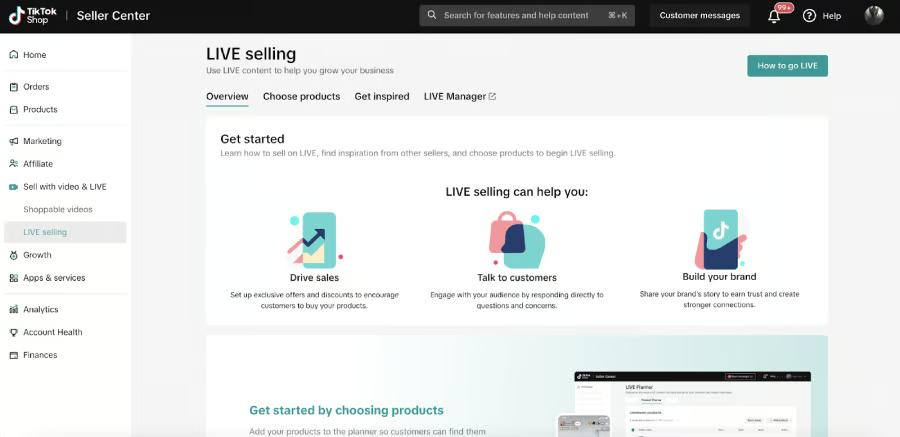
You can access LIVE selling from the LIVE & Video tab within Seller Center on your desktop. 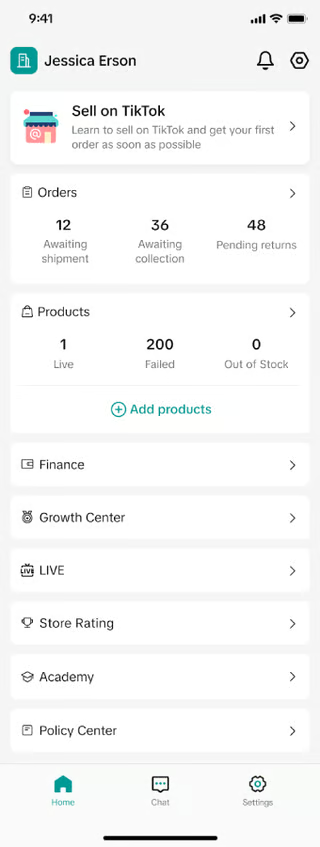
If you’re using the Seller Center app, you can find LIVE selling under the LIVE tab on the homepage.


Pin products and run-of-show
Line up your products in Seller Center’s LIVE tools, then keep viewers focused on one action at a time. Bind your TikTok account to your shop, select the products you will feature, and follow the on-screen steps to go live and pin items for faster conversions. Tease the stream with a short video and simple hashtags to drive traffic. During the stream, rotate pins, time your drops, and recap your offer often so late joiners catch up.
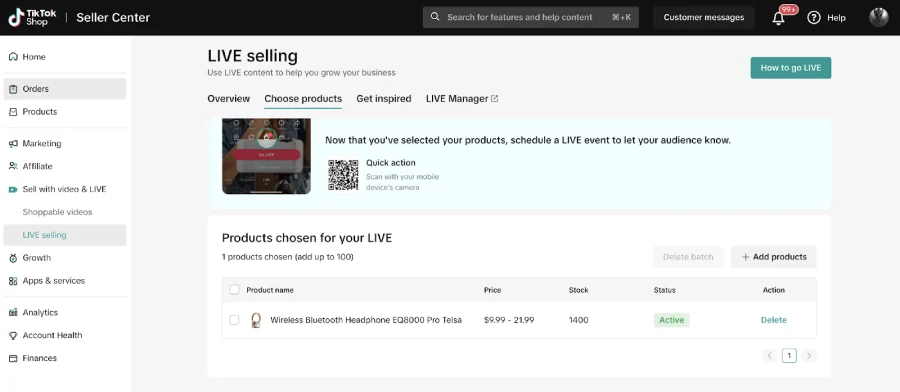
Here are some tips I recommend:
- Pin priority SKUs before you start; rotate pins as you change segments.
- Run 20-40 minutes with 3-5 segments; drop a stream-only bundle or code early and again near the end.
- Assign a moderator to answer questions, manage chat, and flag FAQs for you to address on camera.
- Prep two or three comment scripts for size, materials, shipping times, or returns; paste as needed.
- Post a teaser the day of your Live with time, hook, and “see details in bio.”
- After each segment, restate the offer and tell viewers to tap the pinned product.
After the Live
Turn the Live into more sales by repackaging it and checking results. Save the replay with product pins, clip the best moments into shoppable videos, and review your Live analytics (views, GMV, and more) to refine the next run. TikTok’s Live tools can also autogenerate clips you can publish as shoppable video.
Quick follow-up
- Save replay; clip 2-3 highlights into new shoppable posts.
- DM top commenters with a thank-you and product link where allowed.
- Review Live performance metrics in Seller Center and keep what worked for the next show.
Step 6: Leverage TikTok’s paid ads
Apart from creating engaging content, partnering with influencers, and displaying products in your videos, feature your products in TikTok ads so that customers can buy your products right away. It is a great way to tap into this exciting new market.
When creating an ad, TikTok content has the following requirements:
- Image files: JPG or PNG only
- Video files: MP4, MOV, MPEG, 3GP or AVI
- Aspect ratio: 9:16, 1:1 and 16:9 (Vertical)
- Image resolution: 1200×628 (Recommended)
- Video resolution: 720×1280 pixels, 640×640 pixels or 1280×720 pixels
- Video duration: 5 to 60 seconds
- Brand name: Limited to up to 20 characters
- Ad description: Limited to up to 100 characters, no emojis
Types of TikTok Ads
You can run ads in the following formats: in-feed, top-view, branded hashtag challenge, branded lenses, and brand takeovers.
In-feed native video
In-feed videos are shown before a user-uploaded video starts—similar to what happens on YouTube. However, TikTok always gives the user the option to skip the ad. With this type of ad, you can include a link to a website or an app download.
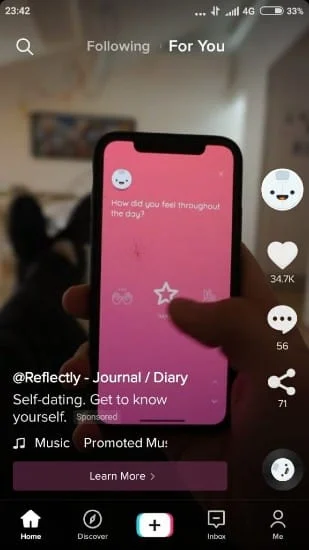
Case Studies:
Top view ads
This type of ad appears at the top of users’ “For You” page when they first open the app. This ad format allows your video ad to be up to a minute long. A perfect example of this ad is the Galaxy Note 20 ad by Samsung.
Case Studies:
Branded hashtag challenge
These hashtag sponsorships last between three and six days and appear in the Discovery tab. When you run a hashtag challenge, you invite the TikTok community to make videos about the topic and mark them with the hashtag. For example, NYX’s #ButterGlossPop hashtag challenge generated more than two million UGC videos and experienced a 42% increase in brand awareness.
Case Studies:
Branded lenses
Brand takeovers
These are ads that are shown as soon as a user opens the app. These ads take up the entire screen and are usually animations. This ad guarantees exclusivity because there can only be one brand takeover per category and country per day.
Case Studies:
Step 7: Perform after-sales support, promotion, and analytics
With your TikTok Shop up and running, it’s important to proactively keep a pulse on its performance. Customer experience, user-generated content, and audience engagement are key metrics to consider.
Provide a stellar customer experience
It’s not providing great customer service these days, it’s about the customer experience. Retail trends show that customers now evaluate brands based on their overall experience interacting with the business — before, during, and after a purchase.
Ensure you take care of the post-sales experience by using TikTok’s tools to manage customer support easily. TikTok Shop has a suite of communication tools that help you engage with your buyers across the selling journey (before and after purchase).
- Buyer message tools in Seller Center: Accept messages from customers through the chat feature. Access it from the Seller Center located in the top right corner of your dashboard, in Manage Orders, or in the purchase order in Order Details.
- Save frequently used answers to respond to messages faster: You can create commonly used reply templates and use them when replying to buyer messages. This is also helpful if you are assigning a different person to handle your customer support.
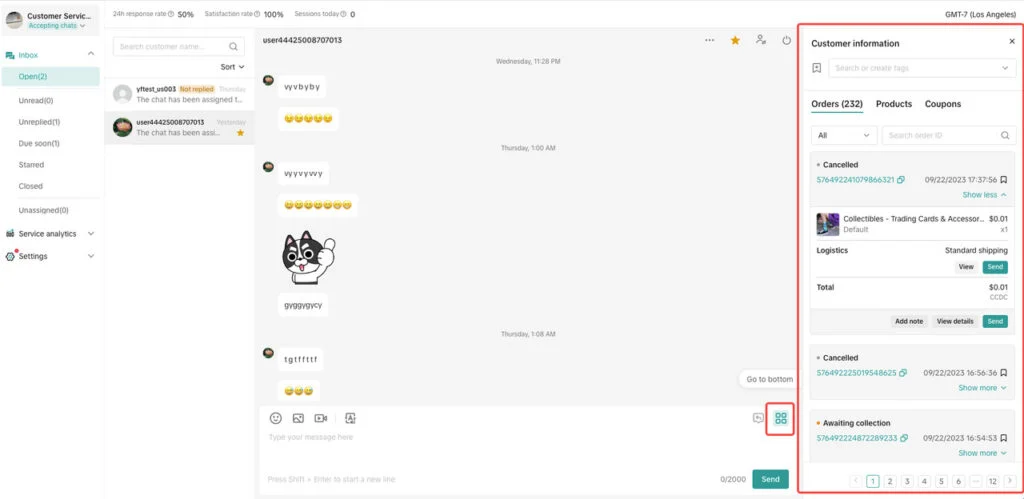
- Master the Customer Service Workbench: This TikTok Shop Seller feature allows you to communicate with buyers and easily find their orders, product inquiries, and other information you need to serve them faster.
Capitalize on user-generated content
One of the goals of creating content on TikTok is to drive lots of UGC. Since TikTok is primarily creator-driven content, you won’t have a hard time finding campaign-worthy videos.
Here are some ideas to get you started:
- Launch a simple hashtag challenge. Keep it short, easy to spell, and tied to a clear action.
- Activate existing customers. Include a card in every order that invites them to post a short clip and tag your Shop. Offer a small discount on their next purchase.
- Ride timely moments. Tie your product to holidays, seasonal trends, or a current sound.
- Run a lightweight contest. Reward the best tutorial, before-and-after, or unboxing clip.
Utilize audience insights
TikTok has a business tool called Audience Insights to help you plan and evaluate your ad campaigns better.
Here are ways you can utilize the tool to help promote content:
- Use the range of available filters to explore audience information during planning through interest hashtags, interactions with hashtags, creators, and videos, and TikTok Customer Audiences. You also segment data by language, country, device, and price.
- Validate and learn about your audience. Use demographics based on age, gender, and location to get a high-level view of what your targeted audience may be interested in or are posting about.
- Find inspiration for targeting and creative strategies. Once you learn about your audience, you might find surprising ideas that can help you strategize better. For example, if you are interested in promoting ads about beauty and skincare, and learn that eyebrow care (how-to’s, products, and makeup) are trending among your audience, you can use this knowledge to expand your content strategy.
- Explore top hashtags and interest categories to plan your content. With Audience Insights, you can view the top ten hashtags and top ad interest categories that resonate with your audience. Consider incorporating these hashtags or interests when targeting a campaign or using these hashtags in your video content.
How much does it cost to sell on TikTok?
Selling on TikTok Shop has four main cost buckets. Referral fees vary by category, payment processing applies per order, Fulfilled by TikTok (FBT) is optional and charged per item, and ads or creator commissions are optional growth costs. Keep fees in mind when you price so your margin holds. I discuss these in detail in my TikTok Shop fees guide.
| Cost item | What it is | Where to see it |
|---|---|---|
| Referral fee | A percentage of the order total that varies by product category | Order details → Fees; Seller Center fee breakdown |
| Payment processing | A per-order payment handling charge | Order details → Fees |
| Fulfilled by TikTok (FBT) | Optional pick, pack, ship, and storage fees when TikTok fulfills your orders | FBT dashboard; monthly statements |
| Ads or creator commissions | Optional spend for Shop ads and the percent you set for affiliates or creators | Ads Manager; Affiliate Center |
Note: Fees and policies change. Confirm current rates and rules in Seller Center before you launch or update listings.
TikTok fulfillment and shipping options
You have two practical ways to ship TikTok Shop orders. You can handle fulfillment yourself with your own couriers, or you can use Fulfilled by TikTok (FBT). Pick the path that fits your products, margins, and staffing, then set your shipping templates in Step 3.
Fulfillment options: pros and cons
| Option | Pros | Cons |
|---|---|---|
| Use your own couriers |
|
|
| Fulfilled by TikTok (FBT) |
|
|
Use your own couriers (in-house fulfillment)
Best for: Brands with an in-house team or 3PL, custom packaging needs, bulky or special-handling items, or a single warehouse for all channels.
How it works:
- Build shipping templates in Seller Center. Set zones, services, and handling time.
Buy and print labels in Seller Center or ship on your own accounts. Upload tracking on every order. - Pack to your standards. Include a short insert with return instructions and a UGC invite.
- Mark orders shipped. Tracking updates for the buyer.
Best practices:
- Set your handling time to what you can meet every business day.
- Have a standard delivery target of 2 to 5 business days for most parcels.
- Clear return window and conditions on your PDP and in the parcel.
Fulfilled by TikTok (FBT)
Best for: Small to mid-size SKUs where faster shipping improves conversion and you want predictable SLAs without staffing a warehouse.
How it works:
- Create a send-in plan in Seller Center and prep units per guidelines.
- Label if required and ship inventory to the assigned fulfillment center.
- TikTok stores, picks, packs, ships, handles tracking, and basic support.
- Fees appear in your FBT dashboard and statements.
Best practices:
- Send enough inventory before events and Lives.
- Use FBT for top sellers first, then expand if margin holds.
- Keep listings updated so delivery windows stay accurate.
Service levels to aim for
- Handling: Same-day or next-day on stocked items, with a clear daily cutoff.
- Delivery: Standard 2 to 5 business days for most parcels, express only if you can meet it reliably.
- Quality: Valid tracking on every order, high on-time rates, simple return instructions in the parcel and on your PDP.
Ways users can shop your products on TikTok
Shoppers can buy from several touchpoints inside the app. Hit more than one each week so bestsellers stay visible.
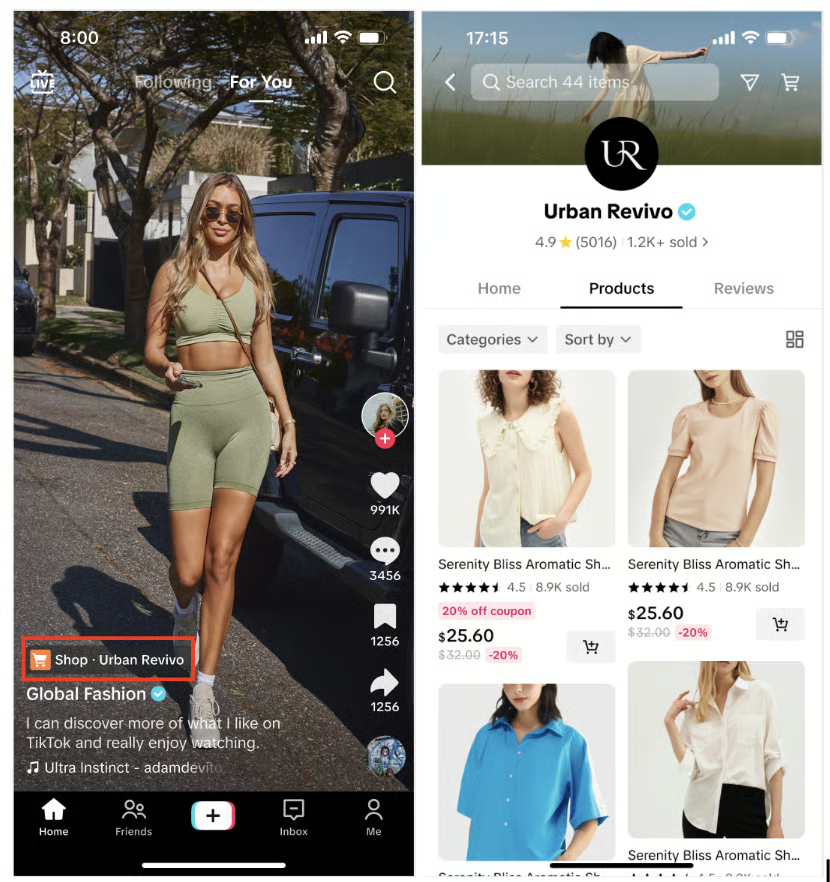
- In-video product tags: add a product tag on the publish screen so viewers can tap and buy without leaving the video.
- Shop tab on your profile: pin bestsellers and bundles in your Product Showcase to capture profile visitors.
- Live Shopping streams: demo products in real time, pin SKUs, and use limited-time offers to drive urgency.
- Creator and affiliate posts: partner content that tags your products and reaches new audiences.
- Shop ads formats: boost your top organic clips so they open the product page inside TikTok.
- Store integrations: sync catalog and orders from your ecommerce platform so inventory and pricing stay accurate.
- Discovery on the For You page: when posts are tagged correctly, products can surface to new buyers through recommendations.
Linking your Shop, Category, or Collection in a video helps promote multiple items at once and drives higher-quality traffic from the For You Page.
Frequently asked questions (FAQs)
Click through the sections below to get answers to your commonly asked questions on how to use TikTok for business.
Is it free to sell on TikTok?
No. Expect a referral fee by category and payment processing per order. Optional costs include Fulfilled by TikTok (FBT) fees, ads, and creator commissions.
Do I need 1,000 followers to sell on TikTok?
No. You don’t need a follower minimum to list and sell. Some creator programs and features have eligibility requirements, but sellers can open a shop and tag products without hitting 1,000 followers.
Can I sell on TikTok without TikTok Shop?
Yes, but results are better with TikTok Shop. Without a Shop, you can drive traffic off-platform, but you lose native product tags, in-app checkout, and Shop surfaces like the Product Showcase and Live pins.
How do I list products and make posts shoppable?
Add products in Seller Center (or sync from your ecommerce platform), then when you publish a video tap Tag products and select the exact SKU. Use a clear CTA in the caption and pin the hero product.
How long does TikTok Shop approval take?
Most new shops finish review within a few days once documents, bank details, and tax forms are complete and match. You can add products during review; they go live after approval.
What can’t I sell on TikTok?
Prohibited items vary by category (for example, certain health products, hazardous items, and regulated goods). Check the Prohibited and Restricted lists before you list; some categories need extra documents.
Is TikTok getting banned in the US?
Not today. The law requiring a sale or a shutdown remains in place, and the Supreme Court upheld it on January 17, 2025. The White House has delayed enforcement until December 16, 2025, so TikTok Shop and ads continue to work. Recheck the timeline before major campaigns.
Bottom line
Whether you are a retailer looking into selling online, an established online store, or a budding entrepreneur, selling on TikTok Shop is a good idea. Once you learn the ropes on how to sell on TikTok, focus on marketing your products on the platform.
TikTok releases plenty of updates and guides in its Business Center and Seller Academy to help TikTok Sellers leverage the platform and know more about its audience. Visit TikTok to learn more.
