






Holiday sales aren’t just about deep discounts anymore. Shoppers are looking for memorable experiences, smooth checkout, and reliable delivery. The good news: even small retailers can stand out with the right mix of holiday marketing ideas that balance creativity and practical execution.
In this guide, I’ll walk through proven holiday marketing tips and strategies that retailers of any size can use this season to boost sales and delight customers.
And when you need printed materials to support your promotions, like flyers, signage, or custom loyalty cards, tools like VistaPrint make it affordable and fast to get professional-quality assets in hand before the holiday rush.
- Holiday marketing ideas I’m seeing work for retailers in 2025
- Proven holiday campaign ideas you can try
- The holiday promo tactics I recommend most often
- Retail tech I love that simplifies holiday promotions
- My recommended holiday marketing calendar (2025)
- Holiday marketing plans by budget level
- The holiday marketing mistakes I see retailers make most often
- Don’t forget these post-holiday strategies that drive retention
- Frequently asked questions (FAQs)
- Bottom line
Holiday marketing ideas I’m seeing work for retailers in 2025
This year, discounts just won’t cut it for consumers. The holiday marketing I have been noticing doesn’t even revolve around discounts or sales (although price is still a big factor). I see big retailers experimenting with creative campaigns that blend in-store experiences, digital tools, and customer service to stand out during the busiest shopping season.
The good news is you don’t need a national chain’s budget to make these ideas work for your own store. Here are seven holiday marketing campaign ideas I’ve seen retailers use this year and how small businesses can adapt them for their own promotions.
1. Host in-store demos to create buzz
What I am seeing: Target is rolling out in-store toy demos and printed holiday catalogs to engage kids directly. Letting children play with products drives excitement and convinces parents to buy.
Why it’s a holiday hit: Gift buying is emotional, and seeing kids interact with products creates holiday magic that online listings can’t replicate. Demos transform shopping into an event rather than just a purchase.
What you can do: Even at a small scale, host holiday demo events. A toy shop might set up a weekend play table, a kitchen store could offer cookie-decorating demos, or a bookstore might run holiday story hours. Share these events on social media and encourage attendees to post with a seasonal hashtag.
2. Make shopping an experience, not just a transaction
What I am seeing: Retailers are doubling down on “retailtainment,” blending in-store events with digital discovery to make shopping more engaging.
Why it’s a holiday hit: Shoppers are flooded with discounts in November and December. Experiences cut through the noise, make visits memorable, and often increase basket size.
What you can do: Turn your store into a holiday destination. Host a “sip-and-shop” night with cocoa, create a festive photo corner, or run a kids’ scavenger hunt. If you’re online-only, consider livestreaming unboxings or holiday prep sessions, or hosting interactive gift-guide webinars.
In action: Rebel Nell ran a “Design Your Own Jewelry” in-store event to bring in foot traffic and engage customers. They also launched a holiday collection tied to local heritage (Fox Theatre materials). These experiences gave customers a reason to visit and invest in unique, meaningful gifts.
3. Tap Pinterest ads to reach Gen Z holiday shoppers
What I am seeing: Pinterest has expanded its retail media network, and Gen Z now uses the platform like a search engine, curating gift boards and wish lists.
Why it’s a holiday hit: Pinterest is one of the few places where shoppers actively want to discover products. During the holidays, users are searching for gift inspiration, making it a prime channel for influencing purchases.
What you can do: Promote your most giftable products with modest ad spend. Use seasonal keywords like “holiday gift guide” or “Christmas gifts under $50.” Invest in lifestyle photos over plain product shots. Pinterest users engage more with inspirational visuals.
4. Make reliability part of your holiday marketing
What I am seeing: Analysts warn that supplier performance and inventory availability will make or break the 2025 holiday season. Customers quickly switch brands if items are out of stock or deliveries are late.
Why it’s a holiday hit: Shoppers want certainty during the holidays. Promoting reliability, like accurate stock levels or guaranteed delivery, can be as powerful as offering a discount.
What you can do: Highlight shipping cutoffs clearly, feature “ready to ship” items in promotions, and push digital gift cards when inventory runs low. For local retailers, advertise same-day pickup or delivery to capture last-minute buyers.
5. Incentivize reviews to build credibility
What I am seeing: Sephora has piloted incentivized reviews, rewarding customers for leaving feedback on products. Reviews heavily influence gifting decisions, especially in categories where buyers aren’t the end users.
Why it’s a holiday hit: During the holidays, shoppers often buy outside their usual categories. Reviews give them the confidence to purchase gifts they can’t test themselves.
What you can do: Offer loyalty points, coupons, or small discounts for verified reviews. Highlight customer feedback in gift guides and product pages. Authentic social proof can tip hesitant buyers into making a purchase. (See also: User-generated Content for Ecommerce: Ultimate Guide)
6. Treat staffing as part of your holiday marketing strategy
What I am seeing: Retailers face uneven holiday hiring — some are cutting back, while others are rushing to add staff. Poor staffing directly impacts service and customer experience.
Why it’s a holiday hit: Shoppers notice long lines, stressed employees, and closed registers. A well-staffed, cheerful store becomes a marketing advantage in itself.
What you can do: Showcase service as part of your brand promise. Promote extended hours, offer personal shopping appointments, or introduce team members on social media. These small touches reassure customers that you’re ready for the holiday rush.
7. Rethink checkout as part of the customer experience
What I am seeing: Target is testing accessible self-checkouts for blind and low-vision shoppers, while other retailers are experimenting with AI-powered instant checkout. The push is toward making transactions faster and more inclusive.
Why it’s a holiday hit: The average online cart abandonment rate hovers around 73%, and long lines in-store are just as damaging. A smooth checkout reduces lost sales during the busiest season.
What you can do: Upgrade your checkout experience before the holidays. In-store, make sure your POS supports Tap to Pay and mobile readers. Online, enable one-click checkout options, such as Shop Pay or Apple Pay. Even shaving a few seconds off the process can improve conversion.
Proven holiday campaign ideas you can try
There’s no single formula for holiday marketing success, but certain campaign types consistently deliver results. Big retailers have tested these strategies and seen measurable returns, and small businesses can adapt them at their own scale. Here’s a breakdown of proven holiday campaign tactics, why they work, and examples of brands that used them successfully.
1. Gift guides and curated bundles
Gift guides simplify shopping for customers who don’t know what to buy. Create categories like “Gifts under $50,” “For Teachers,” or “Best for Families.” You can also package complementary products together into bundles with a small discount, encouraging larger purchases.
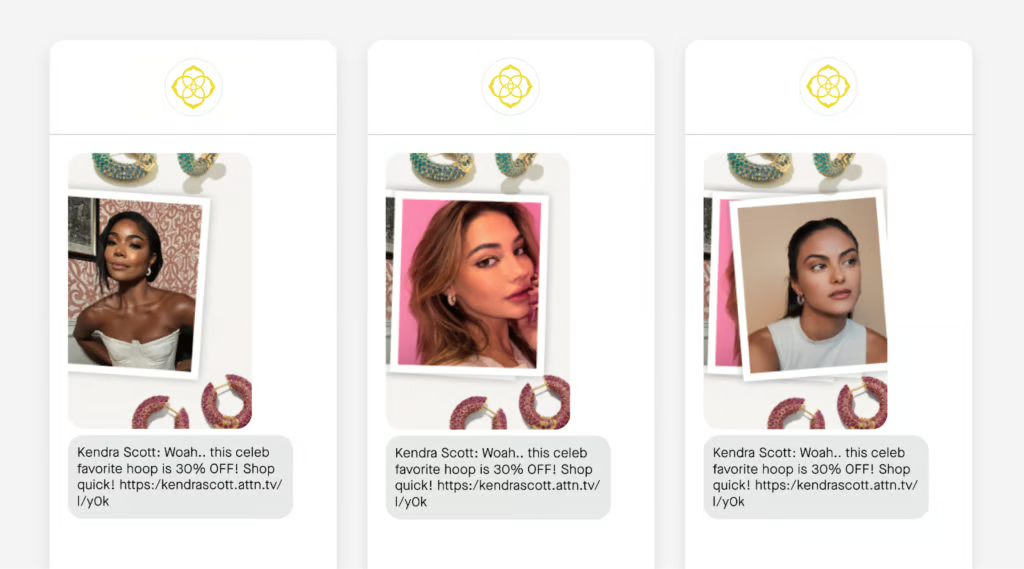
In action: Jewelry brand Kendra Scott ran a personalized holiday gift guide via SMS. Shoppers replied with their budget and received tailored product suggestions, which not only made gift discovery easier but also captured data for future campaigns.
See also: How to Create a Holiday Gift Guide to Drive Sales
2. Flash sales and limited-time offers
Short-term promotions create urgency. Run 12-hour or one-day flash sales advertised via email and social media. Add countdown timers on your product pages to show how much time is left to claim the deal.
In action: A grocery retailer amplified its holiday weekly deals using Swiftly’s digital circular ads. The campaign drove $33,000 in incremental revenue per store with a 5.5× return on ad spend during the competitive holiday period.
3. Buy more, save more bundles
Encourage larger orders by offering tiered discounts such as “Buy 2, Save 15%” or “Buy 3, Save 30%.” This works especially well for consumable items or small gifts.
In action: When the holiday season shortened, owner Roberta Perry (ScrubzBody) started a “Buy One, Get One Free” promotion early (the Friday before Black Friday) to build buzz and reduce fulfillment strain. She also offered free gift wrapping and cards for Small Business Saturday and extended store hours. This approach helped her beat the rush and attract early buyers.
4. Free shipping thresholds (or buy online, pickup in store)
Customers expect free shipping, but you don’t have to absorb the full cost. Set your threshold just above your average order value so shoppers add an extra item to qualify.
In action: Nearly 90% of consumers are more likely to complete a purchase if free shipping is offered, and retailers who set thresholds just above AOV consistently see bigger basket sizes.
5. Loyalty perks and early access
Reward your most loyal customers with special treatment. Give them early access to sales or exclusive discounts. Send personalized emails to your VIP list so they feel valued.
In action: Epsilon helped a national retailer run a loyalty-based holiday campaign that achieved a 7:1 incremental ROAS (Return on Ad Spend), contributing to $696 million in holiday sales. While on a large scale, the principle is the same for small retailers — treat VIPs like insiders.
6. Gift cards and e-gift campaigns
Gift cards are a lifesaver for last-minute shoppers. Promote both physical and digital gift cards, especially during the final shipping days when customers may have no other option.
In action: According to Capital One Shopping, 60% of consumers spend more than the value of their gift card, creating additional sales beyond the initial purchase. Gift cards are consistently among the top holiday sellers across categories.
7. UGC and social engagement campaigns
Invite customers to share photos of their purchases or holiday moments using your products. Featuring this content builds trust and community.
In action: Fitness brand Gymshark runs UGC-driven campaigns where customers post workout photos in their gear. These authentic posts build credibility and often outperform influencer ads. Retailers can run seasonal spins on this, such as “holiday moments” contests.
8. Themed countdowns
Create excitement with daily reveals like “12 Days of Deals” or an advent-style campaign. Each day highlights a new product or discount, encouraging customers to come back repeatedly.
In action: Amazon has repeatedly used a “12 Days of Deals” countdown during the holiday season, driving return visits and sustained engagement throughout December. The tactic builds anticipation and gives customers a reason to keep checking back.
The holiday promo tactics I recommend most often
Every retailer has different goals during the holidays — some want to move inventory quickly, others want to build loyalty, and many simply want bigger baskets. To make it easier, I’ve mapped out the most common holiday promo tactics in a quick comparison table. Use this as a guide to match your campaign goals with the right tactic, channel, and success metric.
| Goal | Tactic | Where (site/store/social) | Asset needed |
|---|---|---|---|
| Simplify shopping and boost basket size | Gift guides & curated bundles | Website, email, social | Product photos, gift guide design, bundle discount setup |
| Drive urgency and conversions | Flash sales / limited-time offers | Website, email, social | Promo copy, countdown timer widget, ad creative |
| Increase order size | Buy more, save more bundles | Website, in-store | Discount rules, signage, product grouping |
| Lift cart size without cutting profit | Free shipping thresholds | Website, checkout | Shipping rules, promo messaging |
| Reward loyal customers and drive repeat purchases | Loyalty perks & early access | Email, app, POS | Segmented email lists, VIP codes |
| Capture late shoppers | Gift cards & e-gifts | Website, email, in-store | Gift card setup, promotional graphics |
| Build trust and engagement | UGC campaigns | Social media, website | Branded hashtag, contest rules, moderation plan |
| Keep shoppers returning throughout the season | Themed countdowns (e.g., 12 Days of Deals) | Website, email, social | Daily promo assets, automation workflow |
Many of these campaigns need supporting assets, like flyers for in-store promos, signage for bundles, or printed loyalty cards. Tools like Vistaprint make it affordable and fast to get professional materials designed and shipped before the holiday rush.
Retail tech I love that simplifies holiday promotions
Since most holiday campaigns have a lot of moving parts — from creative assets, messaging, promotions, inventory, and more — take advantage of tech tools to keep things running smoothly and efficiently. This way, you don’t miss opportunities during the busiest shopping season.
Email automation platforms
Why it matters for the holidays: Timing drives sales. With inboxes packed in November and December, automation ensures your message gets delivered at the right time, whether it’s a shipping deadline, abandoned cart reminder, or early access promo.
What to use: Platforms like Mailchimp let you set up workflows for cart recovery, segmented promotions, and countdown reminders. (See also: Best Email Marketing Platforms)
How to use it in holiday campaigns:
- Segment loyal customers for early access offers.
- Schedule cutoff alerts like “Order by Dec 18 for guaranteed Christmas delivery.”
- Add urgency with dynamic countdown timers.
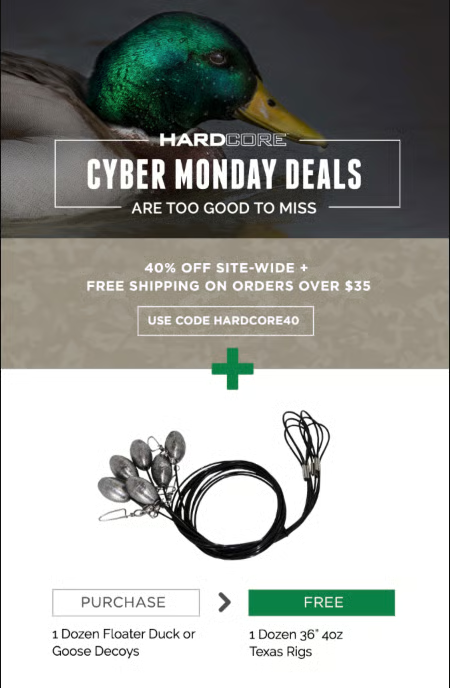
In action: Outdoor apparel brand Hard Core Waterfowl restructured its email marketing ahead of the holidays, shifting from constant discount blasts to a segmented, automated strategy. By using automation for abandoned carts, targeted holiday reminders, and fulfillment updates, the brand avoided subscriber fatigue while staying agile during peak demand.
The approach paid off. Black Friday sales topped $50,000 directly from email, even with a newly cleaned subscriber list.
AI content generators
Why it matters for the holidays: Holiday campaigns require a flood of creative assets — email subject lines, promo slogans, captions, and that’s just scratching the surface. For businesses with solo or lean teams, AI helps scale content production without burn out.
What to use: Tools like ChatGPT can generate email subject lines, festive slogans, or themed captions instantly. (See also: Best AI Content Generation Tools and Best AI Content Writers for Small Business Marketing)
How to use it in holiday campaigns:
- Draft multiple subject lines for a Black Friday email and A/B test them.
- Generate product descriptions for holiday bundles.
- Create variations of slogans like “12 Days of Deals” or “Countdown to Christmas.”
In action: Digital agency Trivera used its AI assistant “Webster” to power a holiday email with an interactive snowglobe concept. The campaign achieved record-high open and click rates for that client.
POS and ecommerce integrations
Why it matters for the holidays: Customers expect gift cards, discounts, and loyalty rewards to work across every channel. Inventory missteps or checkout issues can ruin holiday sales and customer trust.
What to use: Integrated platforms like Square sync loyalty programs, gift cards, and discounts between online and in-store.
Related reads:
How to use it in holiday campaigns:
- Highlight “ready to ship” or “in stock now” items.
- Sync loyalty points across channels so rewards feel seamless.
- Use POS data to retarget customers who bought specific holiday products last year.
In action: During the 2024 Black Friday Cyber Monday weekend, Shopify merchants generated $11.5 billion in sales, a 24% increase year over year. A key driver of that growth was the ability for businesses to integrate online and in-store sales through Shopify’s POS and ecommerce systems, creating a seamless customer experience across channels.
For small retailers, this shows how unified systems can make a major impact during the holidays. With Shopify, inventory, discounts, and loyalty programs sync automatically, so customers see consistent promotions whether shopping online or in person. The result is fewer stock issues, smoother checkouts, and the ability to scale holiday promotions alongside larger competitors.
My recommended holiday marketing calendar (2025)
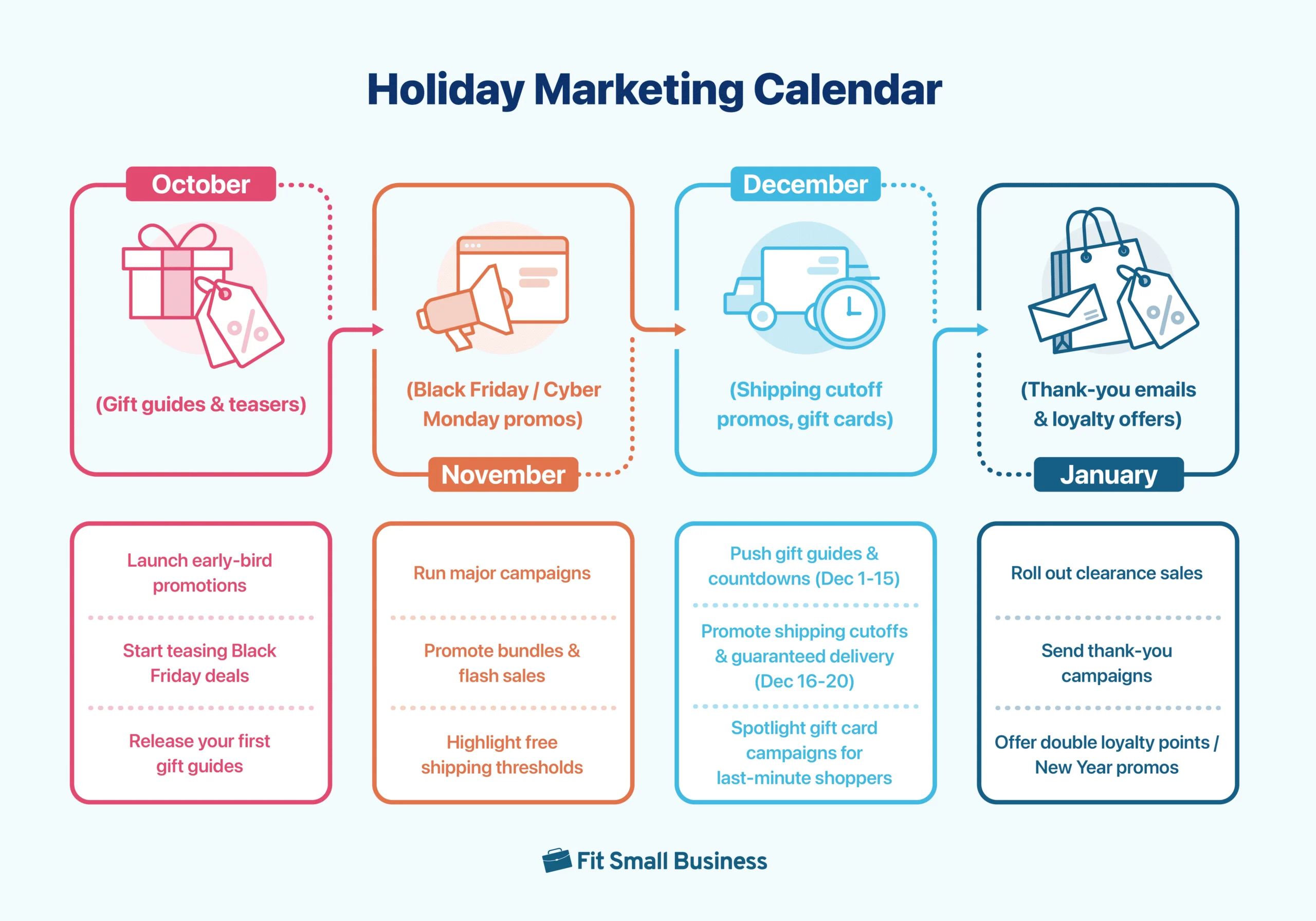
Holiday marketing works best when you map out campaigns in advance. I mapped out a calendar below to help you see what to launch and when, so you can maximize exposure without overwhelming your team. Use it as a guide, then adjust based on your business type and customer habits.
October: Set the stage
Goal: Capture early spenders and warm up your audience.
Channels to focus on: Social media, email, and blog content.
What to do this month:
- Launch early-bird promotions: Shoppers are buying sooner, and early promotions capture attention before inboxes get crowded.
- Tease Black Friday deals: Drop hints on social media and email newsletters about what’s coming. Teasers build curiosity and give customers a reason to stay tuned.
- Publish your first gift guides: Curated lists (“Gifts Under $50” or “Top Picks for Teachers”) are highly shareable and help customers plan.
November: Peak sales events
Goal: Drive maximum sales volume.
Channels to focus on: Website banners, email blasts, and paid ads.
What to do this month:
- Black Friday (Nov 28) and Cyber Monday (Dec 1): These two days are still the heaviest hitters. Run your biggest sitewide discounts or flash sales here.
- Promote bundles and limited-time offers: Tiered discounts and countdown sales work especially well this month.
- Highlight free shipping thresholds: Push these alongside your big promotions to raise average order value.
December 1-15: Maintain momentum
Goal: Sustain momentum after Black Friday and capture mid-December shoppers.
Channels to focus on: Email automation, loyalty program notifications, and social campaigns.
What to do this month:
- Push gift guides: Keep promoting your guides as customers search for the “perfect gift.”
- Run themed countdowns: Campaigns like “12 Days of Deals” encourage repeat visits.
- Offer loyalty perks: Reward your best customers with early access or bonus points to keep them coming back.
December 16-20: Last-minute push
Goal: Convert last-minute buyers.
Channels to focus on: Email reminders, homepage alerts, social ads.
What to do this month:
- Highlight guaranteed delivery cutoffs: Let customers know the exact date they must order by for on-time delivery. Include reminders in your checkout flow and emails.
- Promote gift cards: E-gift cards are perfect for procrastinators and can be sold right up to Christmas Eve.
December 26-January 5: Keep the momentum going
Goal: Retain holiday buyers and start the new year strong.
Channels to focus on: Email, retargeting ads, loyalty program messages.
What to do this month:
- Roll out clearance sales: Move unsold inventory with deep discounts on holiday or seasonal items.
- Send thank-you campaigns: Thank customers for shopping with you and include a small discount for January to encourage repeat purchases.
- Launch New Year promotions: Frame your products as part of fresh starts, resolutions, or “new year, new you” campaigns.
Holiday marketing plans by budget level
Not every retailer has the same budget for holiday marketing, but effective campaigns can be built at any level. Below are three approaches so you can choose the one that matches your resources.
Lean plan (under $300/month)
If you’re just starting out or running a very small shop with little to no marketing budget, a lean plan keeps costs low while maintaining visibility during the holidays. The focus here is consistency and creativity over paid reach.
- Estimated cost: $0-$300/month
- Best for: Solopreneurs, pop-ups, and very small shops
- Action plan:
- Use Canva for graphics: Free or $15/month for Canva Pro
- Post daily on social media: Free to execute; optional $50-$100/month for boosting posts.
- Send two email blasts per week: Most email tools (Mailchimp, Brevo) are free up to 500-1,000 subscribers.
- Why it works: Even without ad spend, consistent visibility builds awareness and keeps you top of mind. During the holidays, frequent social and email touchpoints remind customers you’re ready for their gift needs.
Standard plan ($500-$2,500/month)
For independent retailers and growing ecommerce shops, the standard plan adds paid reach, automation, and better creative assets. This level balances affordability with scale, making it ideal if you want measurable growth during the holiday season.
- Estimated cost: $500-$2,500/month
- Best for: Independent retailers and ecommerce shops with moderate budgets.
- Action plan:
- Run paid social or Google ads: Allocate $300-$1,500/month.
- Automate abandoned cart reminders: $50-$100/month for tools like Klaviyo or Omnisend. Cart recovery emails can recover up to 18% of lost sales.
- Create curated gift guides with product photos: $200-$500 for photography, or free if DIY
- Why it works: Paid ads expand reach, automation recovers lost sales, and polished guides make shopping easy. Together, these tactics can help you scale sales without overwhelming your resources.
Advanced plan ($3,000+/month)
Larger retailers or ecommerce brands ready to scale can use the advanced plan. This level focuses on multi-channel integration, influencer partnerships, and AI-driven tools to maximize visibility and customer engagement.
- Estimated cost: $3,000-$10,000+/month
- Best for: Multi-location retailers and scaling ecommerce brands
- Action plan:
- Partner with influencers: $500-$2,000+ per influencer, depending on reach.
- Run AI-driven ad campaigns: $1,000-$5,000/month (ad spend + software). AI optimizes bids daily to maximize ROI.
- Offer omnichannel experiences (BOPIS, loyalty): $100-$500/month for POS + ecommerce integrations. Research shows BOPIS can increase order value by 35% when customers add items during pickup.
- Why it works: Advanced tactics let you compete with national retailers by offering seamless, personalized shopping experiences that blend online and in-store.
The holiday marketing mistakes I see retailers make most often
Even the best holiday campaigns can fall short if you miss these common pitfalls. Here are the mistakes I see most often and what you can do instead.
- Launching campaigns too late: Majority of consumers start their holiday shopping as early as September, according to Bazaarvoice, with most starting in October. Waiting until Black Friday to promote means you’ve already missed many early spenders. Start rolling out teasers in October with gift guides or early-bird promotions so customers know to keep you in mind once they’re ready to buy.
- Over-discounting without tracking margins: Blanket discounts may generate traffic, but if you don’t calculate margins, you risk shrinking profits even as sales volume rises. Tie each promotion to a specific goal, such as clearing old inventory, acquiring new customers, or raising average order value, and track performance daily so discounts help rather than hurt.
- Ignoring mobile shoppers: Nearly 80% of BFCM traffic last year happened on mobile. A slow mobile site or clunky checkout leads directly to abandoned carts. Test every promotion on mobile devices before launch and enable one-click checkout options, such as Apple Pay, Shop Pay, or PayPal Express, to make purchasing seamless.
- Neglecting post-holiday follow-up: January is a prime time for re-engagement, with shoppers using gift cards and seeking “new year” deals. If you go dark after December, you miss out on repeat purchases when competition is lower. Send thank-you emails with early-year discounts, offer double loyalty points, and retarget December shoppers with personalized product recommendations — I list more in detail in the next section.
Don’t forget these post-holiday strategies that drive retention
- Send a thank-you email with a discount: Holiday buyers are often one-time shoppers, but a timely thank-you note can turn them into repeat customers. Pair your message with a small discount valid through January to encourage a second purchase.
- Offer double loyalty points in January: Loyalty members spend more when given extra incentives. Recent research found that 66% of consumers say the ability to earn rewards changes their spending behavior. Offering double points in January rewards holiday shoppers while giving them a reason to return when sales typically slow down.
- Retarget holiday shoppers with new product recommendations: Shoppers acquired in December can become repeat buyers if you guide them toward their next purchase. Using transaction data, recommend complementary items (e.g., accessories for holiday gifts) or promote “new year” themes like fitness, organization, or productivity.
Frequently asked questions (FAQs)
What is a holiday marketing campaign?
A holiday marketing campaign is a set of promotions — such as discounts, bundles, or gift guides — timed around shopping holidays, like Black Friday or Christmas. The goal is to boost sales, attract new customers, and keep your business top of mind during peak spending periods.
What are the best holiday promotions for small businesses?
The best holiday promotions for small businesses include gift guides, flash sales, free shipping thresholds, and loyalty rewards. These ideas are low-cost to set up, appeal to a wide audience, and work across both online and in-store channels.
How can service businesses run holiday marketing campaigns?
Service businesses can run holiday campaigns by offering seasonal packages, limited-time discounts, or gift certificates. Pair promotions with email and social media campaigns. For example, a salon can market “holiday glam packages,” while gyms can sell discounted New Year memberships as gifts.
What are some creative holiday promotion ideas?
Creative holiday promo ideas include “12 Days of Deals” countdowns, personalized gift bundles, themed contests on social media, and exclusive VIP shopping events. Adding urgency with timers or scarcity messaging can make these promotions more effective.
How do I create a holiday marketing strategy?
Start by setting clear goals, such as boosting sales or increasing customer retention. Build a campaign calendar from October to January, choose tactics that match your audience (gift guides, flash sales, loyalty perks), and promote across multiple channels. Always review last year’s data to refine your approach.
What are examples of the best holiday marketing campaigns?
Some of the best holiday marketing campaigns effectively combine storytelling with promotions, as seen in Coca-Cola’s Christmas ads and Starbucks’ seasonal drinks. Small businesses can adapt this by tying products to emotional themes, offering shareable experiences, and running community-driven contests that spotlight customers.
When should I start holiday marketing?
Holiday marketing should begin as early as October, as nearly half of shoppers start their shopping before November. Launch early-bird promotions, tease Black Friday deals, and publish gift guides to capture early buyers. Ramp up with flash sales, loyalty perks, and last-minute gift card pushes as December progresses.
Bottom line
Holiday marketing doesn’t have to be overwhelming. The most successful retailers keep things simple: plan ahead, highlight irresistible offers, and create experiences that feel personal. With gift guides, bundles, loyalty perks, and well-timed promotions, even small retailers can capture attention, boost sales, and keep customers coming back after the holidays.
