







There are many ways employees steal company time—and ultimately company money—from their employers. Time theft is when an employee gets paid for time they did not work, anything from taking extended breaks to modifying time sheets or having a co-worker punch in for them.
One of the best things you can do to prevent and discourage time theft in your business is to implement time clock software. Electronic time clocks, like Homebase (an all-in-one employee scheduling, time tracking, and HR solution), offer employers the ability to better control their workers’ hours, saving the company time and money. Try the free plan for one business location (with up to 20 employees) today.
Now, let’s explore the different forms of time theft, measures you can take to prevent it, and legal considerations you need to be aware of.
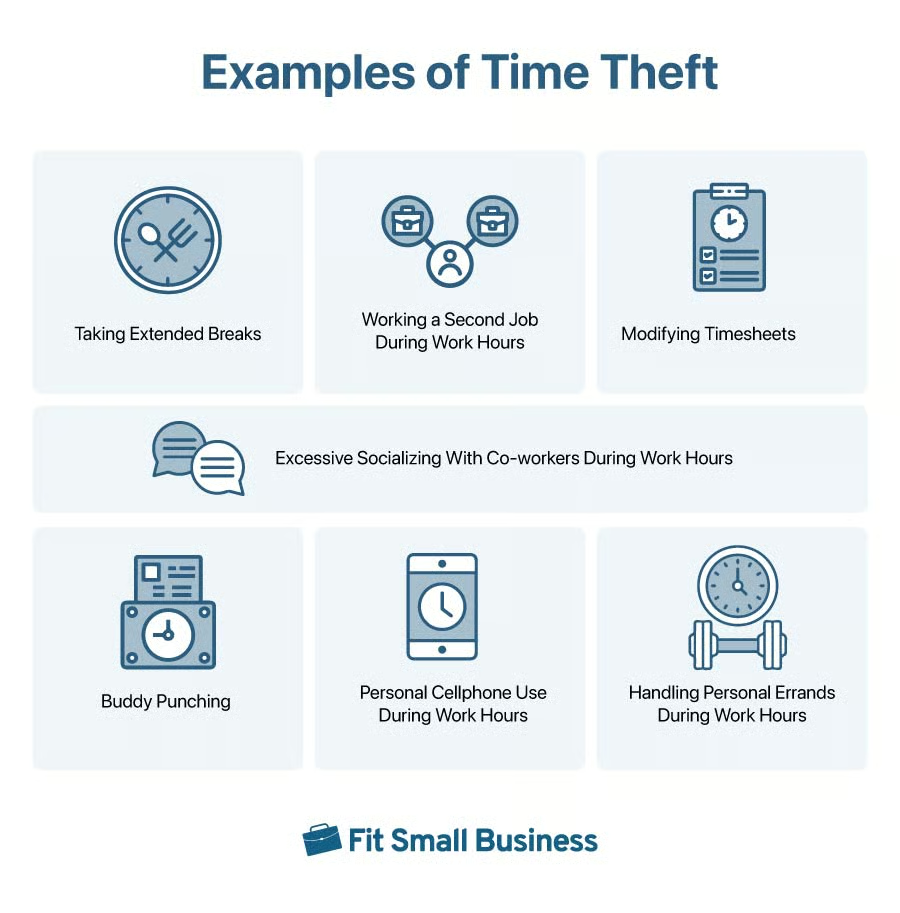
- 1. Taking Extended Breaks
- 2. Working a Second Job on Company Hours
- 3. Modifying Employee Time Sheets
- 4. Buddy Punching
- 5. Cellphone Use During Work Hours
- 6. Excessive Socializing With Co-workers During Work Hours
- 7. Attending to Personal Errands During Work Hours
- How to Prevent Time Theft
- Legal Considerations
- Bottom Line
1. Taking Extended Breaks
Many employees take extra or extended breaks during the day, leaving early for a break or coming back late. Employees may not have to clock out for short paid breaks—and when they take advantage of this, they steal time and money from your company by getting paid without working. This also decreases your company’s productivity by reducing the amount of time work gets done.
For example, if you pay an employee $10 per hour and they regularly work 40 hours per week but are taking an extra 12-minute break per day, you’re paying that employee $10 extra each week. For the year, that’s an extra $520 you’re paying to the employee without them working, and that’s before you factor in all the taxes you’ll pay for the higher wage.
When it’s just a few minutes, the employee thinks nothing of it—but that doesn’t make it right or fair to the company or other employees.
2. Working a Second Job on Company Hours
In today’s work climate, many people hold more than one job to supplement their income or follow their passions. If this is allowed in your company policies, it is not a problem when an employee works their second job outside of company hours.
However, it is considered time theft when an employee lets their side hustle bleed into their day job—delaying doing the work they’re getting paid for—or tandem-works the two jobs during the workday.
We recommend having a clear policy (typically part of your employee handbook) that outlines the types of jobs that are allowed, along with the intent that these additional jobs will not interfere or coincide with the employee’s workday with your company. Below is an example of the type of wording you may use:
You may hold outside employment so long as you meet the performance standards of your job with ABC COMPANY. You will be evaluated by the same performance standards and will be subject to scheduling demands, regardless of any existing outside work requirements.
Any outside employment that appears to conflict with or compromises the interests of the company is not permitted. Employees also may not receive any income or material gain from individuals outside the company for materials produced or services rendered while performing their jobs with the company.
3. Modifying Employee Time Sheets
Many companies today still use pen and paper or spreadsheets for their employees’ time sheets. This “honor system” is ripe for not only innocent mistakes but employees taking advantage of their employer’s goodwill. Workers may exaggerate their hours, adding just a few minutes here and there.
Employees also frequently round their hours. For example, if they leave the office at 4:52 p.m., they may round that to 5 p.m. That may not seem like much—but it quickly adds up, especially if those extra few minutes push the employee into overtime.
This is also a concern when employees (or independent contractors) provide an invoice for the time spent working for your business. These invoices typically come in for payment with a whole number of hours reported (e.g., 20 hours for the week.) The likelihood is that the employee rounded their time to the nearest hour when reporting on their invoice.
4. Buddy Punching
Employees can also game the system with the help of their colleagues—it’s called buddy punching. For example, an employee might be stuck in traffic, so they ask a colleague to clock them in on time, even though the employee doesn’t arrive for a while. This coordination between employees is time theft and results in economic losses for your company.
Another example is an employee who remains on the clock when they leave the office early. They have another employee clock them out at their scheduled time when they have not worked their full schedule.
5. Cellphone Use During Work Hours
In this digital age, it is rare to see a person without a cellphone. Your employees are likely spending quite a bit of their day scrolling through social media, talking on their phone, or texting. Some employees may even be bolder and look for other jobs during work hours.
If your employees work in-office, we recommend having a cellphone use policy as part of your employee handbook that limits the amount of time employees may use their phones. Example wording for this policy may include:
Per company policy, all cellphones must be off or silenced during working hours, as to limit the amount of disruptions during business hours. Additionally, cellphone use must be limited to emergency situations only or during breaks only.
6. Excessive Socializing With Co-workers During Work Hours
It’s good for your employees to have a sense of camaraderie with their co-workers. But, when small talk turns into hours of chatting, it takes away from the work they should be doing. This socialization could be standing around at each others’ desks, meeting up at the coffee machine, hanging around the breakroom, or spending additional time in the restroom.
Remote workers are guilty of this as well and may spend a good portion of their workday on messaging apps talking with their co-workers about things other than work.
7. Attending to Personal Errands During Work Hours
When you send employees out of the office to run a work errand, chances are they are also handling their personal errands at the same time. This is a form of time theft, as they are being paid to run their personal errands.
Additionally, remote workers will spend a portion of their day taking care of their households (e.g., laundry, cleaning, grocery shopping, etc.). While this is a perk of remote work, if employees spend too much time doing things other than their job, it can lead to time theft and decreased productivity.
How to Prevent Time Theft
The best way to combat time theft is to prevent it with policies, tools, and procedures. You might think you just need to install office cameras or spy software on your company computers—however, while you can do that, it doesn’t eliminate the core problem.
Here are some actions you can take to prevent time theft from occurring in your workplace altogether.
Create Attendance Policies
An attendance policy is an important piece of communication letting your employees know when they’re expected at work. It may also include a time theft clause discussing how it is against company policy to modify your own time sheet or clock in or out for someone else. When your employees violate the policy, you’re able to hold them accountable per your policy.
Use an Electronic Time Clock or Time Tracking Software
The best way to eliminate time theft is to use software that prevents it for you. With an electronic time clock system, you can prevent your employees from having a colleague clock them in or restrict them from changing their time sheets. Employees clock in and out electronically with their unique login information, creating a trail that, unlike pen and paper, can only be modified with your approval. If you plan to purchase a time clock, visit our guide for the best employee time clocks.
Time clock software can:
- Restrict where employees can clock in and out
- Prevent buddy punching
- Require regular time tracking updates on projects
- Restrict employee’s ability to modify their time sheets
- Run detailed reports on employee productivity, attendance, tardiness, and labor costs
Boost Employee Morale
A solid company culture will help prevent time theft because employees will be engaged, driven, and want to work. When you have a positive culture, it’s magnetic. This makes employees feel respected and more likely to respect your policies in return, including rules against time theft.
When you boost employee morale, it can have a trickle effect that leads to increased productivity, reduced turnover, reduced absenteeism, and better customer service.
Train Managers
Because managers set their employees’ schedules, they’re the best ones to monitor whether an employee is stealing time. Managers should receive training on how to review all time sheets before the employee getting paid. They may not catch everything, but a manager will be able to spot glaring errors that could be an example of time theft by an employee. Catching it before your team runs payroll gives you the chance to speak with the employee to gauge whether it was intentional or accidental and take appropriate action.
Some managers are diligent, whereas others are inattentive and sign off on time sheets without verifying whether an employee worked. Simple training on employee management can help managers stay on top of their time-tracking duties.
You may not want to get involved in a time-consuming legal battle with a now-former employee, but that’s a substantial amount of money your company has lost, and other employees may take advantage of the situation if you don’t make clear that your company will not stand for this type of behavior.
Establish a Process
Through a robust performance management process, you can reduce and prevent time theft. When employees have regular and structured check-ins with their manager, the manager is immediately aware of any issues in the employee’s performance. If they’re consistently not meeting their goals, that could be a clue that they aren’t spending their time on work.
Proving an employee is stealing time is hard to do, but conducting regular performance reviews helps with two things:
- It alerts you that the employee might be stealing time because they aren’t meeting goals.
- It creates documentation for potentially terminating the employee.
That second point is important because you may need to cut ties with an employee who you suspect (but can’t prove) has been engaged in time theft. By documenting their underperformance, you have a non-discriminatory and legitimate business reason for terminating them.
Legal Considerations
Time theft itself is not a crime. While you may be able to sue your employee to recover losses, you will need to provide clear evidence that the employee falsified their timesheet and you overpaid them. In most cases, litigation simply is not worth your time and money. If, however, an employee has stolen lots of time, then you may consider a lawsuit to attempt to recover substantial funds paid to the employee.
Laws on fraud vary among jurisdictions, but it’s generally the idea that one person intentionally deceives another person or company for their financial gain. Fraud lawsuits can be both criminal and civil, although only prosecutors can file criminal charges.
For a civil claim against an employee, you will need to prove that the employee falsified their time sheets. If you can prove that, the court may order your employee to pay your company restitution, court and attorneys’ fees, and maybe even additional damages.
But, your attorney fees can quickly get high, something you’ll need to cover to start. Even if you get a favorable outcome, the employee may not be able to pay the judgment. That’s why most employers choose a disciplinary route instead of a legal route, except in extreme cases.
We know in exceptional circumstances you may have legal options to pursue compensation from your employee. Many employers understandably do not want to go down that route and would rather handle the issue in-house. Disciplining the employee per your company policies is the right move in this situation, but make sure you pay attention to wage and hour laws.
The FLSA requires employers to pay employees for any hours the employee works. If you suspect an employee is not working for part of their shift, you might conclude that you can deduct pay. While you’re right that you only need to pay employees for hours worked, you may have difficulty proving the employees didn’t work all the hours they reported on their time sheets. If you have no evidence, it’s not worth your time to deduct pay. You may quickly find yourself in a costly wage and hour lawsuit.
Even if you do have evidence the employee falsified their timesheet, if it doesn’t amount to substantial funds being stolen, it’s simply not worth the risk on your part to deduct pay from the employee. The best way to recover from time theft by employees is to prevent the practice.
Bottom Line
When you suspect employees of time theft, there are few options for you. By taking steps to ensure employees understand the expectations you have for them, following the laws, and working with your managers to hold employees accountable, you can shift your culture to one where time theft ceases to exist.
Add to the mix the right time clock software, like Homebase, and you can take control of your employee’s time, proactively uncovering and eliminating time theft. Homebase offers a free unlimited scheduling plan for businesses with a single location (and up to 20 employees).
