






The cost of starting an online business can be anywhere from $50 to $10,000+, depending on your model, niche, and how polished you want to look at launch. A freelancer can get started with little more than a domain name and a website, while a subscription box or online course business may need thousands for inventory, design, or production.
In this guide, we’ll break down exact startup costs, hidden ongoing expenses, and real-world examples by business model and niche. You’ll also see what a lean “bare-minimum” launch looks like versus a growth-ready setup, plus tips to keep first-year costs under control.
Core startup costs for any online business
No matter which type of online business you start, a freelance service, a dropshipping store, or a subscription box brand, a few essential costs are required just to get launched. These are mostly one-time or upfront expenses that form the baseline of getting up and running.
| Expense | What it covers | Cost range |
|---|---|---|
| Business registration & legal setup | Registering your business name, getting an LLC or sole proprietorship set up, and securing any licenses | $50–$500, depending on your state and whether you file yourself or use a service |
| Domain name & website hosting | Your business’ web address (domain) and a place for your website to live (hosting) | $10–$20/year for a domain; $5-$40/month for hosting |
| Website & branding basics | A website builder or ecommerce platform (like WordPress, Shopify, Wix), logo design, and templates | $0–$500+, depending on whether you DIY or hire a designer |
| Payment processing setup | Setting up Stripe, PayPal, Square, or your platform’s built-in processor so you can accept payments | Usually free to set up (fees apply only when you make sales) |
| Marketing & sales tools | Email marketing platforms, social scheduling tools, SEO plugins, or even a small ad budget | $0–$500/month, depending on how aggressive you are with paid ads |
| Productivity & back-office tools | Tools that keep you organized behind the scenes, such as accounting software, invoicing apps, project management, and cloud storage | $0–$50/month when starting lean (e.g., Wave for accounting, Trello for project management), up to $200+/month if you add bookkeeping software or premium platforms |
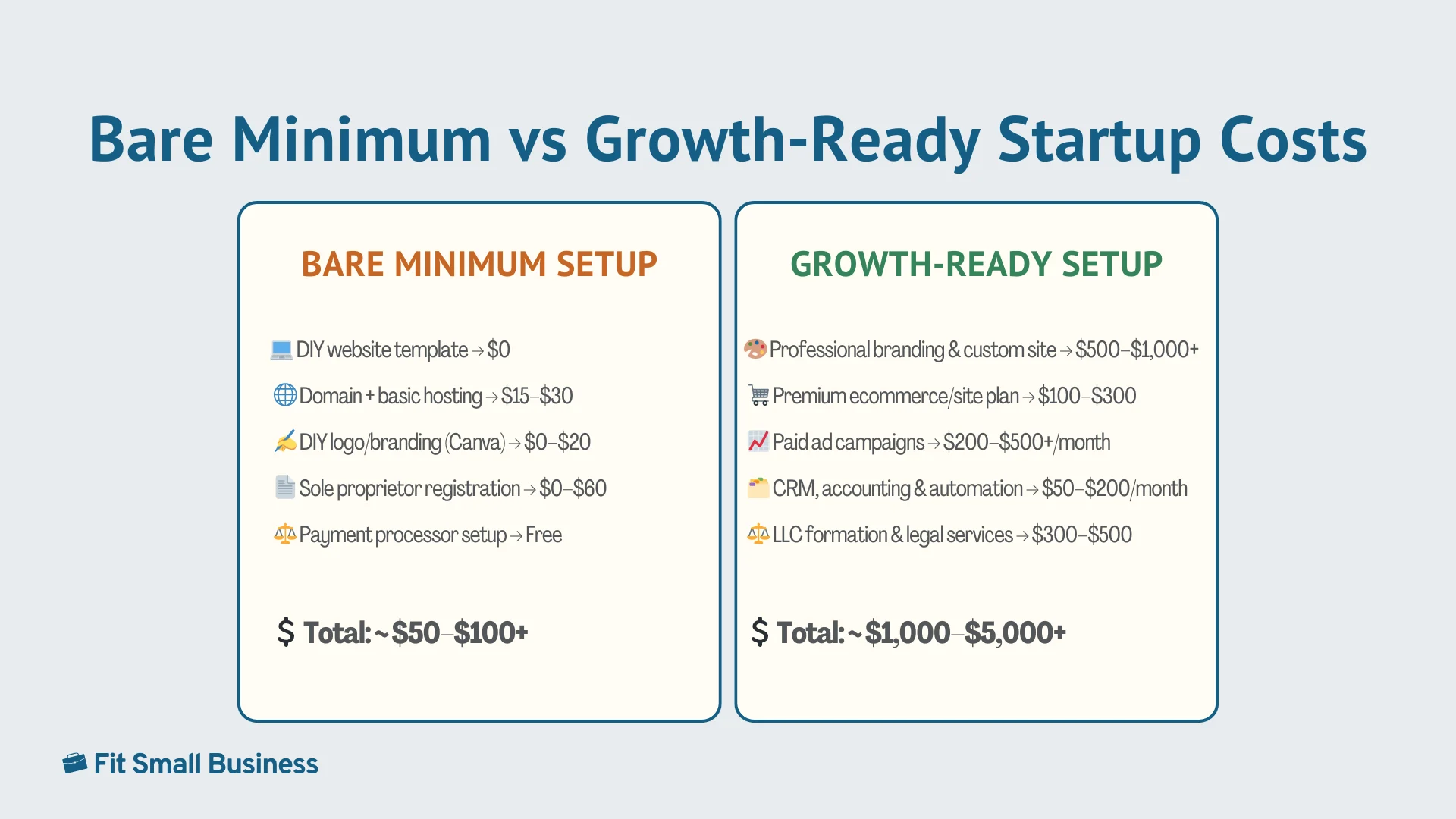
While the table breaks down each launch expense individually, it helps to zoom out and see what a real launch might look like at different levels. Some entrepreneurs get scrappy and launch with just the essentials, while others invest in branding, professional design, and legal support from day one.
Here’s a side-by-side comparison of what a bare-minimum launch versus a growth-ready launch typically costs.
Need help covering startup expenses? If your budget feels tight, financing options can give you the runway to launch and grow. Explore our guides to:
- Startup Business Loans: 7 Best Ways to Fund Your Startup
- How to Get an SBA Startup Loan in 6 Steps
- How To Get a Startup Business Loan With No Money
Hidden & ongoing costs of running an online business
Getting your business off the ground is only the first step. Once you’re live, a new set of recurring costs kicks in; some expected, others less obvious. These expenses don’t show up in your launch budget but can quickly become your biggest line items if you don’t plan for them.
| Expense | What it is | Typical cost | Why it matters |
|---|---|---|---|
| Transaction fees | Payment processors like Stripe, PayPal, or Shopify Payments take a cut of every sale | ~2.9% + 30¢ per transaction | High-volume or low-margin businesses feel the squeeze the most |
| Advertising spend | Paid traffic on Google, Facebook, TikTok, or via influencer marketing | $100–$2,000+ per month | Can quickly become the single largest ongoing cost |
| Software & subscription | Paid plans for email marketing, CRMs, analytics, design, or scheduling tools | $50–$300 per month | Free plans only go so far; most businesses upgrade as they grow |
| Customer support & outsourcing | Virtual assistants, designers, editors, or dedicated customer service reps | $10/hour up to $1,000+/month | Saves you time but adds fixed costs you’ll carry month to month |
| Inventory cycles (for product businesses) | Restocking products, packaging, storage, or fulfillment | $500–$5,000+ per cycle | Cash is tied up in stock; poor planning here leads to cash flow crunches |
Launching may cost only a few hundred dollars, but staying in business is where most of the money goes. Recurring costs like ads, subscriptions, and transaction fees often exceed your initial startup spend within the first year.
Need flexible funding to cover startup or first-year costs? Bluevine Financing offers small business lines of credit you can draw on as needed, so you only pay for what you use.
Cost examples by business model (startup + first year)
Every online business has different cost dynamics. A freelancer can launch with less than $200, while a subscription box founder may need thousands just to cover inventory. Below are startup and ongoing costs for popular online business models, plus what that means for your first year of expenses.
Dropshipping
Dropshipping avoids inventory expenses, but platform fees and advertising can make it more expensive than people expect.
- Startup costs:
- Ecommerce platform (Shopify, etc.) → $29–$79/month
- Domain + hosting → ~$20–$40/year
- Dropshipping apps (DSers, Spocket) → $0–$50/month
- Total startup: $200–$500+
- Ongoing costs (monthly)
- Paid ads → $200–$2,000+
- Apps & premium plugins → $20–$100
- Transaction fees → 2.9% + 30¢ per sale
- First-year total estimate: $2,500–$20,000+
Recommended readings:
- What Is Dropshipping & How It Works
- How to Start a Dropshipping Business in 10 Steps
- How to Set Up a Shopify Store for Dropshipping in 5 Steps
Freelance services (writing, design, VA)
Freelancers mostly need skills and a laptop, but costs rise if you invest in a polished website, branding, or marketing.
- Startup costs:
- Domain + website builder → $50–$200
- Branding/logo → $0–$200
- Portfolio/design tools → Free–$100 initial setup
- Total startup: $50–$500+
- Ongoing costs (monthly):
- Marketing tools (email, LinkedIn Premium, outreach software) → $20–$200
- Optional advertising → $50–$500+
- First-year total estimate: $500–$5,000
Print-on-demand (t-shirts, mugs, merch)
Like dropshipping, you don’t hold inventory, but design software, product samples, and marketing can add up.
- Startup costs:
- Ecommerce platform (Shopify, Etsy, Wix) → $29–$79 for first month
- Domain + hosting → ~$20–$40/year
- Design tools → Free–$20 starter assets
- Product samples → $100–$500
- Total startup: $200–$800+
- Ongoing costs (monthly):
- Ads or influencer marketing → $200–$1,000+
- Apps & design software upgrades → $20–$50
- Transaction fees → 2.9% + 30¢ per sale
- First-year total estimate: $3,000–$12,000+
Recommended readings:
- What Is Print on Demand? Small Business Guide
- How to Start a Print on Demand Business
- The Ultimate Guide to Print on Demand for Etsy
Subscription box business
Subscription boxes require an upfront investment in products, packaging, and fulfillment, far higher than most digital models.
- Startup costs:
- Initial inventory & packaging → $1,000–$5,000+
- Ecommerce platform (Cratejoy, Shopify) → $30–$100 for first month
- Branding & packaging design → $500–$1,500
- Fulfillment setup (storage, shipping materials) → $500–$2,000
- Total startup: $2,000–$10,000+
- Ongoing costs (monthly):
- Inventory restock → $500–$3,000+
- Fulfillment & shipping fees → $200–$1,000+
- Marketing & ads → $200–$1,000+
- First-year total estimate: $8,000–$30,000+
Recommended readings:
- What Is a Subscription Business Model & How Does It Work?
- How to Start a Subscription Box Business in 7 Steps
Online coaching & consulting
Coaching is low-cost if you stick to free tools, but many coaches invest in pro branding, scheduling, and funnel builders.
- Startup costs:
- Website & branding → $200–$1,000
- Scheduling software setup → $15–$30 first month
- Video tools (Zoom, Riverside) → Free–$50 upgrade
- Total startup: $500–$2,000+
- Ongoing costs (monthly):
- Funnel/CRM software → $50–$200
- Ads & lead generation → $100–$1,000+
- First-year total estimate: $2,000–$12,000+
Recommended reading:
Online courses & learning platforms
Courses can be costly upfront because of production, but once content is made, it can be sold repeatedly at a low extra cost.
- Startup costs:
- LMS platform setup (Teachable, Kajabi) → $39–$200 first month
- Video equipment or editing software → $500–$2,000+
- Branding & course assets → $500–$1,000
- Total startup: $1,000–$5,000+
- Ongoing costs (monthly):
- LMS fees → $39–$200
- Marketing & ad spend → $200–$1,500+
- Affiliate payouts (if used) → % of sales
- First-year total estimate: $5,000–$20,000+
In general, service-based businesses (freelancing, coaching) remain the cheapest to launch and run, while product-based models (subscription boxes, courses, print-on-demand, dropshipping) demand higher ongoing investment. The first-year budget is often five to ten times the startup cost.
How niche choice affects startup costs
Even within the same business model, your niche has a significant impact on what you’ll spend to get started. Some niches require a higher upfront investment in equipment, packaging, or branding, while others are more cost-effective to launch but rely heavily on marketing. Here are a few examples:
| Niche | Cost drivers | Impact on startup costs |
|---|---|---|
| Fitness coaching | Video equipment, branded apps, and liability insurance | Higher startup costs than career or life coaching |
| Career coaching | Branding, professional website, client acquisition tools | Lower upfront, but ongoing marketing spend is key |
| Food subscription box | Perishable packaging, storage, compliance/licensing | One of the most expensive subscription niches |
| Beauty subscription box | Premium packaging, strong branding, influencer marketing | Higher branding costs but higher profit margins |
| Pet print-on-demand | Niche designs, smaller but loyal audience | Moderate startup, often lower ad costs |
| Fashion print-on-demand | Highly competitive, requires strong branding & influencer partnerships | Higher ad spend and design investment |
| Tech online courses | Polished video production, advanced LMS features | More expensive upfront due to quality expectations |
| Wellness online courses | Lower production cost but heavy marketing needed | Easier to start lean, higher marketing costs later |
Your business model sets the structure of your costs, but your niche fine-tunes them. Two people can both run “online coaching” businesses, yet one may need $500 to launch while another needs $5,000 because of their niche.
Tips to minimize startup and first-year costs
Starting an online business doesn’t have to break the bank. With some planning and smart choices, you can launch lean and keep your first-year expenses under control.
- Start with free or low-cost tools. Use free plans from platforms like Mailchimp, Trello, Wave, or Canva. Most businesses don’t need premium features until they’re generating steady income.
- DIY your branding and website. Instead of hiring a designer right away, use free themes and Canva to create a simple, professional look. You can always invest in custom design once sales pick up.
- Leverage free trials and discounts. Many SaaS tools offer 14 to 30 day free trials. Plan your setup so you can take advantage of these windows. Student, startup, or nonprofit discounts may also apply.
- Focus on one marketing channel at a time. Instead of spreading ad dollars thin across platforms, double down on the one that fits your audience best, whether that’s TikTok, SEO, or email.
- Outsource only what you can’t do yourself. Hiring VAs or freelancers for one-off tasks (like logo cleanup or a landing page) is cheaper than ongoing contracts or agencies.
- Bootstrap inventory and fulfillment. For product-based businesses, start with small batches, pre-orders, or print-on-demand before committing to bulk orders and storage costs.
- Reinvest profits strategically. Put early revenue back into the tools or services that will directly drive more growth (like upgrading from a free CRM to a paid automation tool).
The quick takeaway here is to start as lean as possible, prove your concept, and let customer demand, not assumptions, dictate where to invest next.
Related:
- How Much Does a Newspaper Ad Cost in 2025?
- How Much Does a Billboard Cost?
- How Much Does Television Advertising Cost in 2025?
Bottom line
The cost of starting an online business ranges widely, from as little as $50 to $100 for a lean freelance setup to $10,000 or more for product-heavy models like subscription boxes or professional online courses. But the bigger picture is that your first-year operating costs often exceed your startup costs. Ads, software subscriptions, transaction fees, and outsourcing can multiply your budget by five to ten times once you’re running.
The smartest move is to start lean, test your idea, and reinvest profits strategically. That way, you’ll keep risk low while giving your business room to grow. There’s no single “right” number; the appropriate budget depends on your model, your niche, and your goals. What matters most is planning realistically so you’re not surprised by hidden expenses.
