





.jpg?w=288)

Payroll compliance refers to the legal obligation businesses have to adhere to local, state, and federal laws related to employee compensation. It’s not just about paying your employees on time. You must also withhold and pay the correct taxes, calculate wages properly, maintain required records, and comply with applicable labor laws.
When you have remote workers, you must comply with the payroll laws of their city and state, which may be different from where your business is located. Make sure you’re prepared by understanding the laws you need to follow. You can use this downloadable payroll compliance checklist to help ensure you don’t miss anything important.
Disclaimer: This article provides general information and is not legal or tax advice. Consult a qualified professional when applying payroll laws to a specific situation.
Key payroll compliance requirements
1. Calculate and deposit payroll taxes correctly
When doing payroll, you must withhold the correct amounts of payroll taxes from employee paychecks and pay them as required (monthly, quarterly, or annually). There are federal and state payroll taxes, and you’ll need to determine the appropriate tax rates to ensure your calculations are correct.
Employers also pay their share of Social Security and Medicare taxes, commonly called FICA taxes, as well as federal unemployment tax (FUTA) when applicable. Review the current rates, wage limits, and withholding guidance in the IRS’s employer’s tax guide.
Payroll tax deposit deadlines are separate from payroll tax return filing deadlines. Federal employment tax deposits generally follow a monthly or semiweekly schedule, while the related returns may be filed quarterly or annually. Check the IRS’s employment tax due dates and use documented payroll internal controls to verify calculations, approvals, deposits, and filings.
2. Carry workers’ compensation when required
Another important law that affects your payroll compliance is the workers’ compensation insurance requirement. Most states require employers to provide coverage for medical expenses and lost wages resulting from work-related injuries or illnesses. However, employee-count thresholds, industry rules, exemptions, and coverage options differ by state.
Workers’ compensation is regulated at the state level, and coverage may be purchased through a private insurer or state fund. Some businesses may also qualify to self-insure. Check the applicable state workers’ compensation agency before hiring employees.
There are very few exceptions to the workers’ comp requirement—and Texas is the only state in which employers can opt out of purchasing the insurance. So, if you are a new business that doesn’t operate out of Texas, do not skip this step. Many payroll services give you the option to purchase workers’ comp through one of its partners or its own in-house products.
3. Process wage garnishments exactly as directed
There may be times when you receive a court order to withhold funds from an employee’s paycheck to cover a debt. This is serious, and you must act quickly, or you could be responsible for paying the funds later.
You’ll typically receive an income withholding order, also called payroll garnishment, if an employee is behind on child support or student loans. You can also receive an earnings withholding order for other debts that other parties have been awarded in a lawsuit.
If an employee disputes the debt, direct them to the court or agency that issued the order. Do not stop or change the deduction unless you receive updated instructions from an authorized source.
4. File payroll tax forms by their deadlines
Employers must report the taxes they withheld and paid to the IRS and other tax agencies so that they can verify. Some reports must also show total income paid out—in particular, the year-end W-2 forms that are required to be mailed out by January 31.
If you’re using contractors, you’ll need to send 1099 forms. Ensure that each of your employees is classified properly. To do so, make sure you know the differences between W-2 employees and 1099 contractors. There are many other payroll forms employers may need—some at the beginning of an employment relationship and others more regularly, like quarterly.
5. Keep payroll records for the required period
You are responsible for several recordkeeping requirements for payroll. One best practice many employers follow is to keep all payroll records, like paycheck stubs, year-end tax forms, new hire tax forms, time sheets, and payroll registers, for at least four years. The law allows you to keep some of them for a minimum of three years, but some states may require longer. All of this falls under your payroll accounting, a crucial component of your business operations.
Employers may use any timekeeping method they want to, but records must be complete, accurate, and untampered with by the employer, aside from a supervisor sign-off.
Employers may not alter timecards, but can correct missed punches and other timekeeping errors. However, corrections should not erase or reduce hours an employee actually worked. Keep an audit trail showing what changed, why the correction was needed, who approved it, and when it occurred.
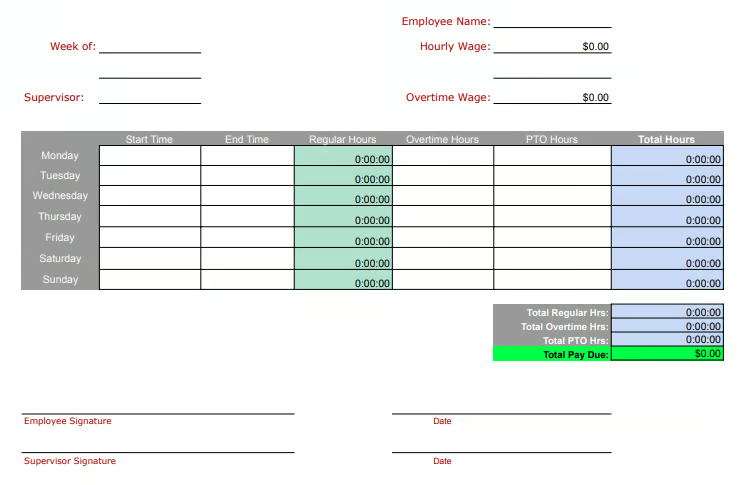
The following is a sample time card format employers can use. Be sure to include the total hours worked, meal and rest times, and the employee’s signature.
6. Pay minimum wage and overtime when required
Federal law requires you to pay employees extra if they work overtime. In addition, there are minimum wage amounts you must pay to each employee depending on which state you’re operating in or, if you have remote workers, the state or city where those employees live and work. There are overtime and minimum wage exemptions, so you’ll need to familiarize yourself with them to ensure the employee situation you’re considering is eligible.
You’ll need to distinguish between exempt and nonexempt employees. Nonexempt employees generally must receive overtime when they work more than 40 hours in a workweek. This includes many hourly employees, but salaried employees may also be nonexempt.
Overtime pay is paid at the time-and-a-half rate (1.5 times their regular hourly rate). If you neglect to acknowledge overtime when required, you will be in violation of the Federal Labor Standards Act and have to repay the money plus late fees and penalties. You’ll also have to pay additional taxes on the wages. Learn more about how to calculate overtime pay—we even provide a calculator to make things easier for you.
You can’t just pay employees what you think they’re worth; the federal government and many states have established a minimum wage amount you must pay to maintain payroll compliance. The federal minimum wage is $7.25 an hour, but many states have even higher rates—some up to $15.00 an hour and beyond. Also, note that some cities have enacted even higher minimum wages.
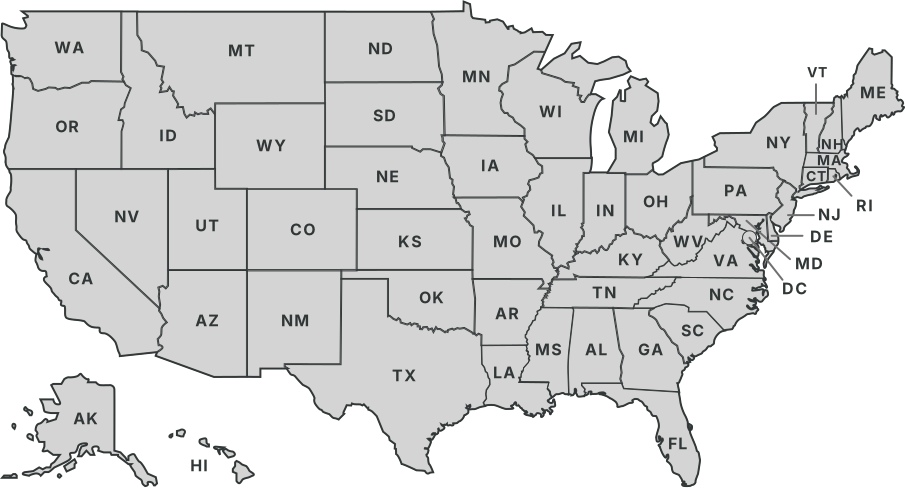
For more information on overtime and minimum wage on a state-by-state basis, check out our state guides to running payroll. Just click on the state you operate in on the map below:
State Payroll Directory
7. Pay employees on the required schedule
When you start paying employees, set a regular payroll schedule that meets the pay-frequency requirements in each state where you have workers. Weekly, biweekly, and semimonthly are the most common pay periods, but some businesses pay out monthly. Each state has its own minimum pay frequency requirements, so be sure to check yours.
Many states also have final paycheck regulations dictating when to pay an employee should they voluntarily leave or be terminated. States like New York and Washington give employers until the next scheduled payday to square up any owed monies, while California requires that all pay due is paid to employees at the time of termination.
8. Follow wage-payment method rules
Usually, employers have autonomy in determining their preferences on how to pay employees, whether that be by paper check or direct deposit. There is no requirement that companies must pay their employees via direct deposit. Most employers offer it as it is easier to process payroll and allows employees to get their money faster. Nearly 93% of employees receive their pay via direct deposit, according to PayrollOrg's 2025 survey. However, since the use of pay cards is starting to increase, some states have passed laws requiring employers to offer an additional pay option beyond just that.
Also, contrary to what some believe, employers can pay employees in cash. The important thing is to learn how to pay employees cash legally. Proper documentation is one of the most important factors that will help you avoid fines and penalties.
9. Follow the rules for tipped employees
If you operate within the restaurant industry and some of your employees receive tips or are part of a tip pool, you need to understand tip reporting, minimum cash wage, tip-credit, notice, and tip-pooling requirements.
Under federal Fair Labor Standards Act (FLSA) rules, an employer that qualifies to take the full federal tip credit may pay as little as $2.13 per hour in direct cash wages and apply up to $5.12 in tips toward the $7.25 federal minimum wage, provided all requirements are satisfied. If wages plus tips do not reach the applicable tipped minimum wage,
State rules can be considerably more protective. DOL currently identifies Alaska, California, Minnesota, Nevada, Oregon, Washington, and certain Montana employers among those that must pay the full applicable state minimum wage before tips rather than taking a traditional tip credit.
If you have no idea how restaurants payroll works, ask for some legal advice to understand the specifics.
Common small business payroll mistakes
Small businesses can face severe consequences when payroll mistakes occur. Here are a few of the most common errors and their potential costs.
- Employee misclassification: Sometimes businesses misclassify workers as independent contractors instead of employees to save on taxes and benefits. However, this can result in heavy fines and penalties from the IRS. For example, if a worker is misclassified as an independent contractor, the IRS can charge the business $50 for each W-2 the company failed to file, along with payroll tax liabilities and penalties. In many cases, businesses are also responsible for back pay, back overtime, and back taxes for both the company and the employee.
- Incorrect tax withholdings: If a business fails to withhold the correct amount of taxes from an employee’s paycheck, it could lead to underpayment or overpayment of taxes. Underpayment can result in penalties from the IRS, while overpayment can lead to disgruntled employees who may feel cheated out of their hard-earned money.
- Late payroll taxes: If payroll taxes are not paid on time, the IRS can impose a penalty of up to 15% of the unpaid tax. States also have the authority to levy penalties against employers that don’t pay their state payroll taxes on time. This can add up quickly and put a significant financial strain on a small business.
- Inaccurate payroll records: Keeping inaccurate payroll records can lead to lawsuits from employees claiming unpaid wages. These lawsuits can cost businesses a lot in legal fees, settlements, and damage to their reputation, which can indirectly lead to high turnover rates.
How to remain current with payroll compliance laws
Payroll laws can change at the federal, state, and local levels. A change in an employee’s location, compensation, classification, or job duties may also create a new compliance requirement even when no new law has taken effect.
If you have chosen not to employ a payroll service to assist you with these regulatory responsibilities, you’ll need to learn how to do payroll yourself. Plus, you’ll have to stay on top of payroll laws that change frequently.
I recommend taking the following actions regularly:
- Hire an auditor to review your payroll records, processes, and procedures. You can also conduct your own payroll audit and should regularly do payroll reconciliation.
- Sign up for the e-newsletter from the Small Business Administration (SBA).
- Visit the Department of Labor (DOL) website, which offers useful, easy-to-find payroll regulatory information on the FLSA and other payroll-related laws.
- Although you will need to maintain an annual membership, check the Society of Human Resource Management (SHRM), which retains a wealth of knowledge regarding payroll compliance laws, including details of the FLSA. An annual SHRM membership starts at $299.
- Check out the PayrollOrg (formerly American Payroll Association) website, which provides solid resources listed that no small business owner should be without. For example, we like the Compliance Calendar, which outlines critical payroll filing dates that are challenging to find anywhere else. It is a great tool that can help your team stay on top of the many evolving tax filing rules and their dates throughout the year.
Agencies that regulate payroll laws: IRS & DOL
Several government agencies oversee different parts of payroll compliance. The Internal Revenue Service (IRS) administers federal employment taxes, while the Department of Labor (DOL) enforces federal wage-and-hour laws. State and local agencies oversee their own income taxes, unemployment programs, wage-payment rules, workers’ compensation requirements, and other employment regulations.
If you have tax-related questions regarding payroll, then visit the IRS website. It outlines everything related to what taxable income is for employees, how to maintain tax records properly, how payroll taxes are affected by company mergers, how to report the payroll tax of a deceased employee, and more.
If you have questions about federal minimum wage, overtime, hours worked, recordkeeping, tipped employees, youth employment, and the ever-expanding FLSA, then visit the DOL website. It also administers federal protections related to wage garnishments and certain government contracts.
The DOL does not administer state payroll laws. State requirements may offer greater employee protections than federal law, so you need to check both.
For example, in the states of Alabama, Arkansas, Florida, Georgia, Louisiana, Mississippi, Ohio, South Dakota, and Tennessee, employers are not required to offer pay stubs to employees, while approximately 41 other states do require that employers provide pay stubs to employees. A copy of employee pay stubs may also be kept in the employee’s personnel file for record retention purposes.
International payroll considerations
The globalization of business has opened up a world of opportunities for small businesses to outsource work internationally. However, with these opportunities come complex challenges in paying international employees.
Employee classification: As with domestic workers, proper classification is crucial. However, the standards for determining whether someone is an employee or contractor vary by country. Misclassifying workers can lead to penalties and fines, so it’s essential to understand local labor laws.
Common geography-specific challenges: Businesses often face difficulties when dealing with different time zones, languages, and cultures. You must also consider salary, benefits options, and leave entitlements—not just for compliance, but for competitiveness as well.
Compliance with local payroll laws: When employing staff overseas, businesses must comply with the local payroll laws of the respective country. This includes understanding and adhering to tax withholdings, contributions, and Social Security requirements. For example, in some countries like Brazil, Switzerland, and Germany, employers are required to contribute to a worker’s healthcare and retirement funds. Failure to comply with these laws can result in severe financial penalties.
Small business payroll compliances FAQs
What are the main payroll compliance requirements?
Payroll compliance requirements include calculating wages correctly, withholding and depositing payroll taxes, following minimum wage and overtime rules, filing required tax forms, paying employees on time, processing lawful deductions and garnishments, and keeping required payroll records. State and local rules may add additional requirements based on where employees work.
Why is employee classification important for payroll compliance?
Classification determines which payroll rules apply. Employee-versus-independent-contractor status affects tax withholding and reporting, while exempt-versus-nonexempt status affects minimum wage and overtime requirements. Misclassification can lead to back taxes, unpaid wages, penalties, and correction filings.
How often should I review payroll laws and tax requirements?
Review payroll requirements before each calendar year and monitor regulatory changes throughout the year. You should also perform a fresh compliance check when you hire in a new state or city, change an employee’s classification or duties, introduce a new pay practice, or switch payroll providers.
Can payroll software keep my business payroll compliant?
Payroll software can help automate tax calculations, filings, payments, recordkeeping, and compliance alerts, but it does not remove the employer’s responsibility for accurate setup. Incorrect work locations, classifications, pay rates, or tax settings can still produce compliance problems even when payroll is automated.
Bottom Line
Payroll compliance can feel like a lot, but it becomes more manageable when you build the right checks into your regular payroll process. Keep employee details current, review payroll before each run, and revisit federal, state, and local requirements whenever your workforce or pay practices change.
Whether you run payroll yourself or use a service, a consistent process can help you catch mistakes early and keep payday running smoothly.
