







Helcim and Stripe are both powerful merchant service providers that offer zero monthly fees and accept a wide number of payment types. When it comes to Helcim vs Stripe, Helcim is the cheaper option with its low interchange-plus pricing and automatic volume discounts, while Stripe is an excellent online payment processor with numerous integrations.
In our evaluation of the best merchant service providers for small businesses, Helcim came out as the cheapest and earned an overall score of 4.32 out of 5. On the other hand, Stripe got an overall score of 3.89 out of 5 and came out as the best for online payments.
When it comes to choosing between Stripe or Helcim, we recommend:
- Helcim: Best for low interchange-plus pricing and out-of-the-box solutions
- Stripe: Best for customizations and wide integrations
Helcim vs Stripe Quick Comparison
Helcim Is Best For
- Dedicated merchant account: Helcim is one of the few all-in-one payment processors that come with a dedicated merchant account.
- Low-cost payment processing: Helcim offers interchange-plus pricing and automatic volume discounts. It topped our list of the cheapest credit card processors for small businesses. Helcim also has a surcharging feature that lets merchants pass on the processing fees to their customers.
- B2B payments: Helcim’s invoicing and recurring billing do not come with additional fees, and it has Level 2 and Level 3 processing, which helped it earn the top spot in our guide for the best B2B payment solutions.
- Code-free setup: Helcim is a more suitable choice if you’re looking for a provider that is easy to use and does not require any coding or integrations.
Stripe Is Best For
- Wide integrations and powerful APIs: Stripe has one of the most extensive lists of integrations. If you have specific software you need to integrate payments with, Stripe is likely to have it.
- Scalable, customizable online checkouts: Although full use of Stripe requires some coding skills, Stripe makes it easy for the layperson to create a simple custom checkout page.
- International payments processing: With support for 135+ currencies and 40+ languages, Stripe earned the top spot in our list of the best international merchant accounts.
 |  | |
|---|---|---|
| Read Helcim Review | Read Stripe Review | |
| Overall Score | 4.32 out of 5 | 3.89 out of 5 |
| Merchant Account | Dedicated | Aggregated |
| Monthly Fee | $0 | $0 |
| In-person Transaction Fee | Interchange plus 0.15% + 6 cents–0.4% + 8 cents | 2.7% + 5 cents |
| Online Transaction Fees | Interchange plus 0.15% + 15 cents–0.5% + 25 cents | 2.9% + 30 cents |
| Keyed-in Transaction Fees | Interchange plus 0.15% + 15 cents–0.5% + 25 cents | 3.4% + 30 cents |
| Invoice Fee | Interchange plus 0.15% + 15 cents–0.5% + 25 cents | + 0.4% to 0.5%; 25 per month free |
| Average Payout | 2 business days | Instant Payout: 1% fee Standard: 2 business days |
| POS Hardware | Helcim card reader, all-in-one POS terminal | Offers precertified card readers only |
| Integrations | Extensive, via the Helcim Payment Extension | 688 in areas of payments, operations, marketing, and finance |
| Offline Payments Processing | No | Yes |
| Ease of Use | Very good | Good |
| Customer Service |
|
|
| Free Trial | No | No |
| Visit Helcim | Visit Stripe |
Stripe and Helcim are both well-known, powerful payment processors, but one major difference between them is the type of merchant account they provide. Stripe offers an aggregated merchant account whereas, Helcim provides a dedicated merchant account. If you need a merchant account that you can set up and use in a matter of hours, an aggregator like Stripe is best for you. However, if your priority is account stability and do not mind a stricter application process, Helcim is the better option.
Dedicated Merchant Account vs Aggregated Merchant Account
Businesses need a merchant account to start accepting payments. A dedicated merchant account is an individual account that is unique to the business. On the other hand, an aggregated merchant account is a shared account for multiple businesses under a single account held by a payment facilitator.
A dedicated merchant account is a safer and more stable solution for businesses but usually involves a more stringent application and underwriting process. It is often much easier to open aggregated merchant accounts, although they are prone to account freezes and fund holds.
Helcim scored higher in our evaluation, mainly for its interchange-plus pricing and wide availability of payment types. Stripe is still an excellent option, especially if you want a provider that offers a lot of integrations and is highly customizable.
Both Helcim and Stripe are included in many of our buyer’s guides:
- Best Merchant Accounts
- Best Free Merchant Accounts
- Best international merchant accounts
- Best PayPal Alternatives
- Best B2B Payment Solution
When to Use an Alternative
Both Stripe and Helcim are popular merchant service providers but if you are looking for something different, such as more flexible POS systems, easy integrations, or subscription pricing, consider the alternatives below.
 |  |  | |
|---|---|---|---|
| Square Review | Payment Depot Review | PayPal Business Review | |
| Best for | Free flexible POS system | High-volume merchants with large transaction amounts | Occasional sales |
| Monthly fee | $0 | $79 | $0 |
| Card-present transaction fee | 2.6% + 10 cents | Interchange + 8 cents | 2.29% + 9 cents |
| Keyed-in transaction fee | 3.5% + 15% | Interchange + 18 cents | 3.49% + 9 cents |
| Ecommerce transaction fee | 2.9% + 30 cents | Interchange + 18 cents | 2.99% + 49 cents |
| Visit Square | Visit Payment Depot | Visit PayPal |
Helcim vs Stripe Pricing
| | |
|---|---|---|
| Score | 4.56 out of 5 | 3.94 out of 5 |
| Ecommerce Transaction Fees | Interchange plus 0.15%–0.5% + 15–25 cents | 2.9% + 30 cents |
| Virtual Terminal Transaction Fees | Interchange plus 0.15%–0.5% + 15–25 cents | 3.4% + 30 cents |
| In-person Transaction Fees | Interchange plus 0.15%–0.4% + 6–8 cents | 2.7% + 5 cents |
| ACH/E-check Transaction Fees | 0.5% + 25 cents per transaction | 0.8% per transaction capped at $5 per transaction |
| Invoice Fees | Interchange plus 0.15%–0.5% + 15–25 cents | + 0.4%–0.5% |
| Recurring Billing Fees | Interchange plus 0.15%–0.5% + 15–25 cents | + 0.5%–0.8% |
| International Transaction Fees | Card issuer fees only | +1.5% |
| Chargeback fees | $15 (refundable) | $15 (non-refundable) |
| Card Reader | Starts at $199 | Starts at $59 |
| Helcim Review | Stripe Review |
Helcim offers a competitive pricing structure with interchange-plus pricing and automatic volume discounts. This means that as your business grows and processes more payments, you can benefit from reduced transaction fees, making it an attractive choice for growing businesses with increasing transaction volumes. Learn more about interchange fees.
Stripe, on the other hand, has a simple flat-rate pricing model, which may be more straightforward for smaller businesses. However, it’s worth noting that this flat-rate fee may be less cost-effective for businesses with larger transaction volumes.
Both Helcim and Stripe offer solid invoicing and recurring billing, but Stripe charges add-on transaction fees. This additional cost can be significant for small businesses accepting payments through these methods.
When it comes to chargeback fees, Helcim and Stripe charge the same amount, but Helcim refunds the fee if you win the dispute.
For businesses that would like to pass on the credit card processing fees to their customers, Helcim has a surcharging feature called Helcim Fee Saver. It lets merchants include processing fees, convenience fees, and service charges in the final transaction amount, which effectively provides free credit card processing for the merchant.
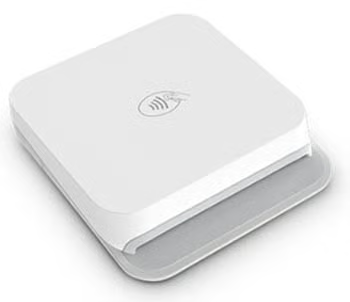
If your business needs to process in-person payments, Stripe’s lowest-priced card reader is cheaper than Helcim’s. However, Stripe’s card readers are not out-of-the-box solutions. You will need to configure the hardware to work with your POS system or with Stripe Terminal using Stripe’s application programming interface (APIs). On the other hand, Helcim’s card reader is designed to work straight out of the box with the Helcim mobile POS app.
 |  |
|---|---|
| Stripe Reader M2Swipe, Dip, Tap$59 | Helcim Card ReaderDip, Tap, Pin$199 |
| The Stripe Reader M2 (left) can accept swipe, dip, and tap payments, while the Helcim Card Reader (right) can accept dip, tap, and PIN payments. (Source: Stripe and Helcim) | |
Helcim vs Stripe Payment Types
| | |
|---|---|---|
| Score | 5 out of 5 | 3.75 out of 5 |
| Ecommerce | Built-in website builder;Food ordering app | Easy integration or with coding |
| Mobile POS | ✓ | With API integration |
| Invoicing | ✓ | ✓ |
| Recurring Billing | ✓ | ✓ |
| Virtual Terminal | ✓ | ✓ |
| Payment links | ✓ | ✓ |
| ACH Processing | ✓ | ✓ |
| International Support | 2 currencies, 2 countries | 135+ currencies, 47+ countries |
| Helcim Review | Stripe Review |
Both Helcim and Stripe offer a wide range of payment types, making them suitable for various businesses. However, Helcim scored higher in this category, mainly for ecommerce and mobile payments.
Helcim offers a free website builder and proprietary point-of-sale (POS) application, Helcim Payments—two major things that Stripe does not provide without any integration or coding. Helcim’s Online Checkout is a full end-to-end ecommerce store that you can use for free, while Stripe only allows you to create a custom online checkout page.
When it comes to POS systems, Stripe requires integration with a third-party POS or your custom-built application. On the other hand, the Helcim Payments app is a free-to-use POS system that can be used on desktop or mobile devices.
A major edge that Stripe has over Helcim in this category is its wider international support. Helcim is only currently available in the US and Canada while Stripe is available almost anywhere.
Helcim vs Stripe Features
| | |
|---|---|---|
| Score | 3.19 out of 5 | 3.25 out of 5 |
| Deposit Speed | 1-2 business days | Instant Payout: 1% feeStandard: 2–3 business days |
| Chargeback Protection | ✕ | + 0.40% per transaction |
| Chargeback Fee | $15 refundable | $15 non-refundable |
| Fraud Prevention | Helcim Fraud Defender(CVV, AVS, IPV) | Stripe Radar(CVV, AVS, IPV) |
| PCI Compliance | ✓ | ✓ |
| Customer Service |
|
|
| Buy Now, Pay Later | ✕ | ✓ |
| Helcim Review | Stripe Review |
Stripe narrowly beats Helcim in this category with its instant payout option and 24/7 customer support.
Helcim typically offers two business days’ deposit speed, which is standard in the industry. In contrast, Stripe provides an instant payout option for a fee, which can be advantageous for businesses needing quicker access to funds.
Both Helcim and Stripe offer customer support, but there are differences in their availability. Helcim provides support during specific hours, while Stripe offers 24/7 support, which can be crucial for online businesses or those operating globally.
Stripe offers chargeback protection with an additional fee, while Helcim does not have a specific chargeback protection feature. Helcim instead offers a dispute management tool and refunds fees for disputes won, so it is more ideal for businesses that prefer to dispute chargebacks as they occur.
Businesses with a higher risk of chargebacks may need to consider this when choosing a provider. If you go for Helcim, make sure to learn how to dispute a chargeback to increase your chances of disputing a chargeback.
Another advantage Stripe has over Helcim is the availability of Buy Now, Pay Later (BNPL) options. Stripe offers BNPL through Affirm, Afterpay, Klarna, and Zip. Read our guide to Buy Now, Pay Later to learn more about this payment option.
Helcim vs Stripe Expert Score
| | |
|---|---|---|
| Score | 4.06 out of 5 | 4.69 out of 5 |
| Pricing | Low interchange-plus pricing with automatic volume discounts | Affordable option for lower transaction amounts |
| Ease of Use | User-friendly | Developer-friendly |
| User Reviews | Well-known and trusted platform | Well-known and trusted platform |
| Integrations | Extensive, via the Helcim Payment Extensions | Easy integrations with popular platforms, powerful APIs |
| Helcim Review | Stripe Review |
In our expert score evaluation, Stripe still stands out for its deep, developer-first ecosystem, with extensive APIs, SDKs, and native integrations that support highly customized payment flows and complex use cases. It remains the better option for businesses with in-house development resources or those building fully custom payment experiences.
Helcim has closed much of the integration gap with the launch of its Helcim Payment Extension, which allows businesses to use Helcim’s payment tools directly within the web-based software they already rely on. Rather than building custom integrations, Helcim uses a no-code, browser-based overlay to support in-person and keyed payments inside ERPs, CRMs, appointment systems, and other industry-specific platforms. This gives Helcim a level of flexibility that is closer to Stripe’s, without requiring technical setup.
If you already have a custom website or want complete control over checkout flows, Stripe offers more advanced customization through its APIs and developer tools. Helcim is better suited for businesses that want to keep their existing systems, avoid development work, and still gain broad software compatibility along with transparent interchange-plus pricing.
Methodology—How We Evaluated Stripe vs Helcim
We test each merchant service provider ourselves to ensure an extensive review of the products. We then compare pricing methods and identify providers that offer zero monthly fees, pay-as-you-go terms, and low transaction rates. Finally, we evaluate each according to various payment processing features, scalability, and ease of use.
The result is our list of the best merchant services providers. However, we adjust the criteria for specific use cases, such as for different business types and merchant categories. This is why every provider has multiple scores across our site, depending on the use case you are looking for. For this in-depth analysis, we looked closely at how Helcim and Stripe performed.
Click through the tabs below for our overall merchant account evaluation criteria:
We awarded points to merchant account providers that don’t require contracts and offer month-to-month or pay-as-you-go billing. Additionally, we prioritized providers that don’t charge hefty monthly fees, cancellation fees, or chargeback fees and only included providers that offer competitive and predictable flat-rate or interchange-plus pricing. We also awarded points to processors that offer volume discounts, and extra points if those discounts are transparent or automated.
The best merchant accounts can accept various payment types, including POS and card-present transactions, mobile payments, contactless payments, ecommerce transactions, and ACH and e-check payments, and offer free virtual terminal and invoicing solutions for phone orders, recurring billing, and card-on-file payments.
We prioritized merchant accounts with free 24/7 phone and email support. Small businesses also need fast deposits, so payment processors offering free same-day or next-day funding earned bonus points. Finally, we considered whether each system has affordable and flexible hardware options and offers any business management tools, like dispute and chargeback management, reporting, or customer management.
We judged each system based on its overall pricing and advertising transparency, ease of use―including account stability―popularity, and reputation among business owners and sites like the Better Business Bureau (BBB). Finally, we considered how well each system works with other popular small business software, such as accounting, POS, and ecommerce solutions.
Helcim vs Stripe Frequently Asked Questions (FAQs)
Is Helcim cheaper than Stripe?
Yes, Helcim is generally considered cheaper than Stripe for payment processing due to its interchange-plus pricing model and automatic volume discounts, making it a cost-effective choice for many businesses.
What does Stripe offer that Helcim does not?
Stripe offers several features and capabilities that Helcim does not, including extensive integrations, customizations, instant payouts, Buy Now, Pay Later payment options, and wider international support.
What is the difference between Helcim and Stripe?
The main differences between Helcim and Stripe are in their pricing models and merchant account types. Helcim offers interchange-plus pricing with automatic volume discounts, making it a cost-effective choice, especially for growing businesses. It provides dedicated merchant accounts for added stability.
In contrast, Stripe uses a flat-rate pricing model, which may be simpler for smaller businesses but potentially less cost-effective as transaction volumes increase. Stripe offers aggregated merchant accounts, making setup faster but potentially less stable. Additionally, Stripe excels in customization, extensive integrations, instant payouts, and international support, catering to businesses with diverse needs.
Bottom Line
In the matchup of Helcim or Stripe, the choice ultimately boils down to your business’s unique needs and priorities.
Helcim is a cost-effective option with low interchange-plus pricing and automatic volume discounts, ideal for budget-conscious businesses. Its dedicated merchant accounts ensure stability. On the other hand, Stripe excels in customization and integrations, making it suitable for businesses needing tailored solutions and global reach. It offers instant payouts and 24/7 support for added convenience.
Consider your business’s size, growth trajectory, technical requirements, and global presence when making your decision on Stripe vs Helcim. Whether you prioritize cost-effectiveness and stability (Helcim) or customization and integrations (Stripe), both providers offer robust solutions for your payment processing needs.
