







Wave is cloud-based accounting software that allows you to manage your bookkeeping, invoicing, and payment processes in one place. What I like most about it is that it is easy to set up and that it has a free plan with all the basic features that many businesses need. However, I wish it had more advanced accounting features, like project management and inventory accounting.
If you’re interested in the program after reading my detailed Wave review, you can sign up for the free plan (Starter) or upgrade to the paid tier (Pro) for $16 monthly.
Why You Can Trust Fit Small Business
Deciding Factors
| Pricing |
|
|---|---|
| Free Trial |
|
| Payment Processing |
|
| Payroll | Deeply integrates with Wave Payroll (read our review of Wave Payroll for more information)
|
| Assisted Bookkeeping | Wave Advisors (starts at $149 monthly) will classify transactions, reconcile accounts, and provide monthly financial statements. |
| Standout Features |
|
| Scalability |
|
| Customer Support |
|
| Average User Review Rating |
Use Cases
- Small service businesses: I find Wave, our top-recommended free accounting software, suitable for small service businesses needing to invoice customers, track unpaid bills, and compile their income and expenses for a tax return. It also allows users to print a balance sheet, which is important for LLCs, partnerships, and corporations.
- Business with many in-person purchases: Wave’s affordable receipt scanning option allows users to take a picture of receipts, categorize the expenses, and upload them to Wave—all on the mobile app.
- Businesses with lots of small credit card sales: Pro subscribers don’t have to pay a per-transaction fee on credit card sales, making it profitable to accept even the smallest credit card charge.
- Small businesses with employees: Wave Payroll is an affordable integration to pay your employees and all have the accounting entries automated.
Wave Alternatives & Comparison
| Monthly Pricing | Users Included | Banking | Inventory | Usability | |
|---|---|---|---|---|---|
 | $0 or $16 | 1 or unlimited | 2.4★ | ✕ | 2★ |
 | $38 to $275 | 1 to 25 | 5★ | 3.9★ | 4.5★ |
| Visit QuickBooks Online | |||||
 | $0 to $275 | 1 to 15 | 4.9★ | 4.7★ | 2.7★ |
| Visit Zoho Books | |||||
 | $23 to $70 or custom | 1 | 1.3★ | ✕ | 1.5★ |
| Visit FreshBooks | |||||
| Rating Explanation: 5★: Excellent; 4★: Very good; 3★: Good; 2★: Fair; 1★: Poor; ✕: Feature unavailable | |||||
Best For | Learn More | |
|---|---|---|
| Businesses with inventory: Wave lacks inventory accounting, which is a big deal for retailers and wholesalers. QuickBooks Online, our overall best small business accounting software, will help you manage your inventory and calculate your COGS in real time. | Read our QuickBooks Online review |
| Companies with no in-house bookkeeper: Unless you’re a dedicated in-house bookkeeper, you probably don’t spend all day at a desk. Wave’s mobile app is limited to invoicing customers, accepting payments, and capturing receipts. However, Zoho Books’ mobile app has all the same features as the online version. It is the best-in-class app, leading our list of the best mobile accounting apps. | Read our Zoho Books review |
| Service-based businesses seeking strong project accounting features: Wave is lacking when it comes to project accounting features, so if you work on a project basis or bill clients by the hour, consider FreshBooks. It has a built-in timer for recording time and allows you to assign time and expenses to customers. | Read our FreshBooks review |
Our Comparisons of Wave vs Other Software
Wave Reviews From Users
4.38 / 5
| PROS | CONS |
|---|---|
| Easy to set up | Invoices are not that customizable |
| Great basic accounting features | No live support in the free plan |
| Includes payroll | Reports are poorly structured and lack customization |
Below, I summarized the Wave reviews I gathered from users and shared my expert opinions:
- Easy to set up and use: Some reviewers mentioned that Wave has a nice and user-friendly interface and layout, making it easy to set up even for those without accounting experience. I also find Wave extremely easy to set up and use, even for the paid Pro version.
- Great basic accounting features: Many users are satisfied with the basic accounting features offered in the free tier, including invoicing and income and expense tracking. However, it’s a bit of a letdown that Wave no longer lets you connect bank accounts in the free plan.
- Payroll is included: One reviewer likes that Wave includes built-in payroll. I agree that it’s a great integration, but I want to note that it’s excluded from the price. While it’s very affordable, you will need to pay extra.
- Invoices are not that customizable: One user wishes that they could customize the invoices—but they’re pretty much limited. Wave allows you to upload your company logo and choose the theme color, and I believe you can still make decent invoices out of this. Invoices in the paid plan have more customization features than the free tier.
- Limited customer support in the free plan: Some dislike that Wave has no customer support options in the free version—unless users enroll in a paid service. I’m happy that Wave includes free live chat and email support in its paid plan. Overall, users on Software Advice awarded Wave 4 out of 5 stars for customer support—which I think is pretty good considering the limited support channels available.
- Reports are poorly structured and lack customization: Some users don’t think the reports are very good—and I completely agree. They’re functional in that you can get the numbers you need to prepare your tax return or fill out a loan application; however, they are very unprofessional-looking, and, honestly, I’d be a bit embarrassed to give them to a vendor or bank.They don’t allow for any customization other than you can specify the period covered. Worst of all, the balance sheet excludes beginning and ending numbers—which is a pretty sure sign it wasn’t designed by an accountant.
Here are Wave’s average scores from third-party review sites:
- Software Advice[1]: 4.4 out of 5 based on over 1,600 reviews
- G2[2]: 4.3 out of 5 based on around 300 reviews
Fit Small Business Case Study
Using our internal case study, I compared Wave with my top recommended alternatives—QuickBooks Online, Zoho Books, and FreshBooks. I summed up the results in the chart below.
Wave vs Competitors
Touch the graph above to interact Click on the graphs above to interact
- WAVE PRO $16 PER MONTH
- QUICKBOOKS ONLINE PLUS $99 PER MONTH
- ZOHO BOOKS PRO $50 PER MONTH
- FRESHBOOKS PREMIUM $60 PER MONTH
As seen in the chart above, Wave’s strength lies in value. It earned a higher score than QuickBooks Online but is slightly behind Zoho Books. Despite having a free plan, Wave lost to Zoho Books and FreshBooks because my Value evaluation is based on cost and the value it provides to users.
While Zoho Books and FreshBooks cost more than Wave, they deliver extra features that justify their price. Additionally, Wave lost to its competitors in all the feature-specific categories, like A/P and A/R management, inventory, and project accounting.
Wave Pricing
Wave would have nailed this category if cost were the only basis of my evaluation, which isn’t the case. As mentioned earlier, I also considered the value and quality it provides to users. I docked a few points because the free plan only supports a single user—plus, you can’t connect your bank accounts unless you upgrade to the paid version. Also, there is no introductory discount or free trial for those interested in the paid plan.
The free (Starter) and paid (Pro) tiers offer basic features, such as invoicing, income and expense tracking, and payment processing. Pro has additional inclusions, as outlined in the Wave pricing table below.
| Pricing & Features | Starter | Pro |
|---|---|---|
| Our Value Score (out of 5) | 2.72 / 5 | 2.43 / 5 |
| Monthly Pricing($/Month) | $0 | $16 |
| Annual Pricing($/Year) | $0 | $170 |
| Credit Card Processing |
| |
| Maximum Number of Users | 1 | Unlimited |
| Wave Receipts (Unlimited Receipt Scanning) | $8 per month or $72 per year | ✓ |
| Access Live Chat & Email Support | Requires any paid add-on | ✓ |
| Issue Unlimited Invoices | ✓ | ✓ |
| Track Bills | ✓ | ✓ |
| Print Financial Statements | ✓ | ✓ |
| Upload Bank Statement Transactions | ✓ | ✓ |
| Connect Bank & Credit Card Accounts | ✕ | ✓ |
| Automated Overdue Invoice Reminders | ✕ | ✓ |
| Recurring Invoices and Credit Card Charges | ✕ | ✓ |
| Attach Files to Customer Invoices | ✕ | ✓ |
| Track 1099 Payments for Independent Contractors | ✕ | ✓ |
Add-ons:
- Wave Payroll: Fixed monthly cost of $40 for tax service states
- Wave Advisor: Starting at $149 a month for bookkeeping support, including classifying transactions, reconciling accounts, and providing financial statements
- Accounting and payroll coaching: One-time fee of $379 for two hours of live coaching and 30-day email access to your coach
General Features
Wave took a hit in my assessment of general features primarily due to its weak transaction management features. For example, it doesn’t let me classify transactions by class or location or create custom tags to attach to transactions. Additionally, I can’t set a closing date to lock prior-year transactions, which would help prevent unauthorized changes to my financial data.
Another useful feature I wish it had is the ability to use account numbers in the chart of accounts. For freelancers and solopreneurs, account numbers probably aren’t necessary; but for companies with a bigger chart of accounts, account numbers can help organize the accounts and make data input much faster.
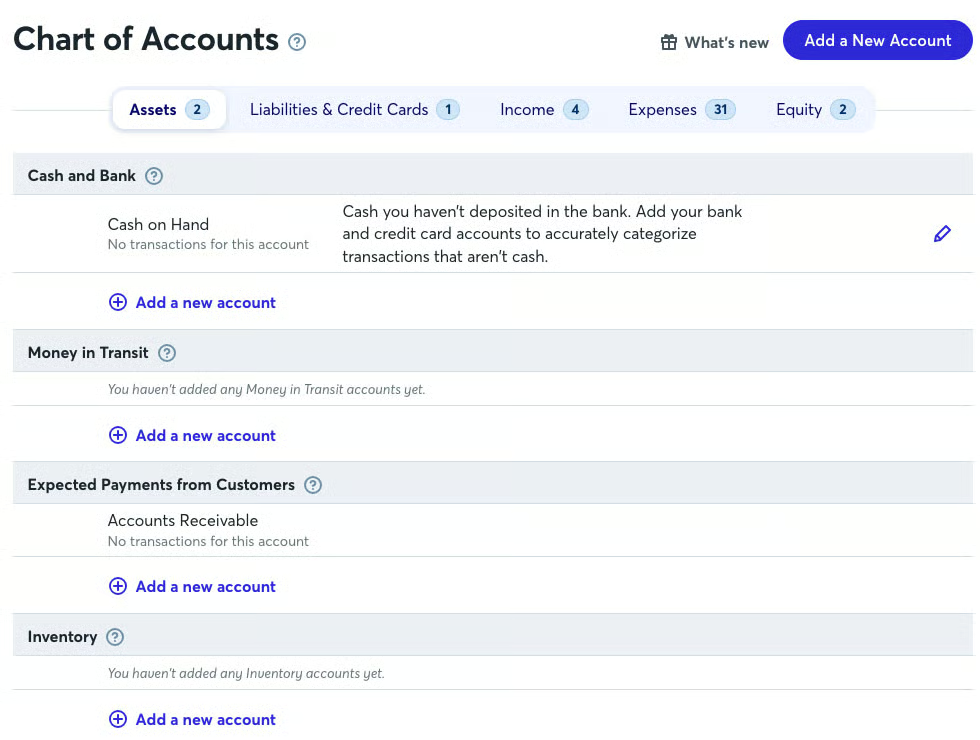
Nevertheless, Wave still provides plenty of ways to properly set up and organize your data. For instance, I can set up my chart of accounts based on common accounts and categories, but I can add other accounts if necessary.
Banking and Cash Management
Wave scored poorly for banking and cash management because it doesn’t allow users to print checks, and I don’t find the bank reconciliation feature as functional as those in other software like QuickBooks Online. The reconciliation doesn’t allow for entries in the books that have not yet cleared the bank, like outstanding checks. This presents a challenge if I need to write many paper checks as I will be unable to reconcile my account until all outstanding checks have cleared the bank.
Additionally, the free Starter plan does not allow me to connect a live feed to my bank or credit card accounts. However, it’s a good thing that I’m able to upload my bank statements from CSV or Excel files and perform bank reconciliations.
During the reconciliation process, Wave attempts to match manually inputted transactions to transactions imported from your bank and does a pretty good job. However, if it fails, it doesn’t allow you to manually match the imported transaction to the manually inputted transaction. You’ll need to watch for this carefully and then delete the imported transaction to avoid duplication. It’s not ideal, but Wave does clearly indicate imported transactions that have to be dealt with.
A/P Management
Wave is one of our best A/P software because of its ability to record unpaid bills, even with the free Starter plan. I couldn’t award it a higher mark, though, because I found some weaknesses, such as the inability to input vendor credits, create purchase orders, track transactions by vendor, and attach receipts to unpaid bills.
Nevertheless, I am impressed with how easy it is to manage unpaid bills in Wave. I can easily manage my A/P transactions from the Purchases menu, which consists of all the features I need to record purchases: Bills, Vendors, and Products and Services.
Depending on your subscription, you can snap a photo of your expense receipt and upload it to Wave through the mobile app. All users can attach a receipt to transactions in the desktop interface, although you can’t attach them to unpaid bills.
To record a bill in Wave, click on the Create a Bill button, and then the Add bill screen will appear:
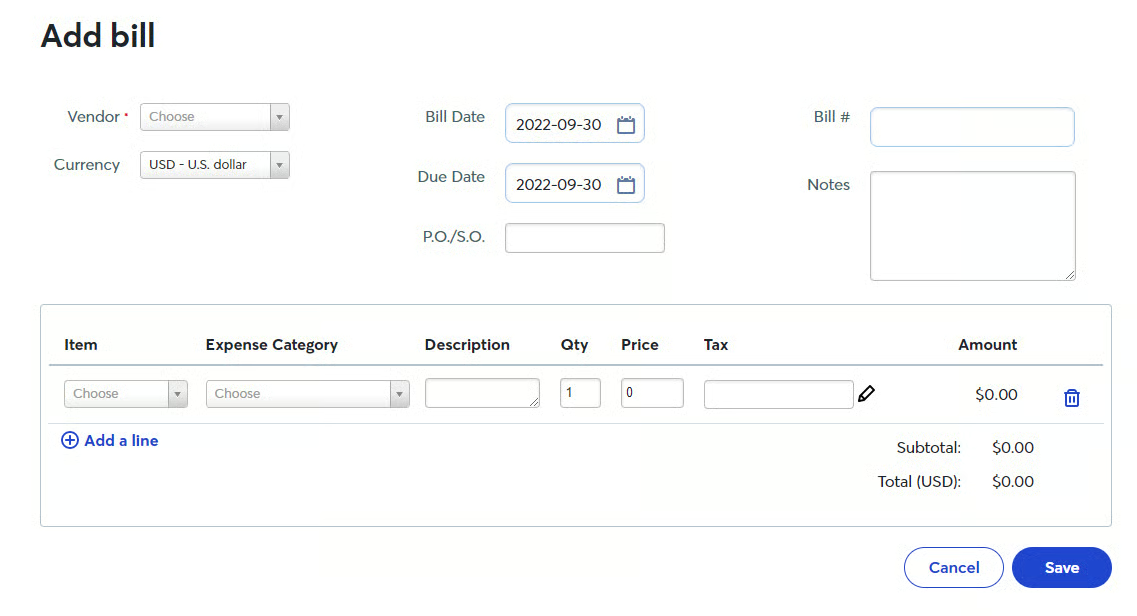
Unfortunately, Wave doesn’t allow users to create a recurring transaction directly from the bill, which is possible in other software like QuickBooks. It also won’t let you set up recurring expenses and create and send purchase orders.
A/R Management
The program did fairly well in A/R management. It provides decent invoicing features, but I hope to see some advanced A/R functionality in the future.
Invoicing
I find Wave adequate for basic invoicing, and I like that the invoices in the paid version can be customized to look professional. My only concern is that it doesn’t allow me to add custom fields to my invoices.
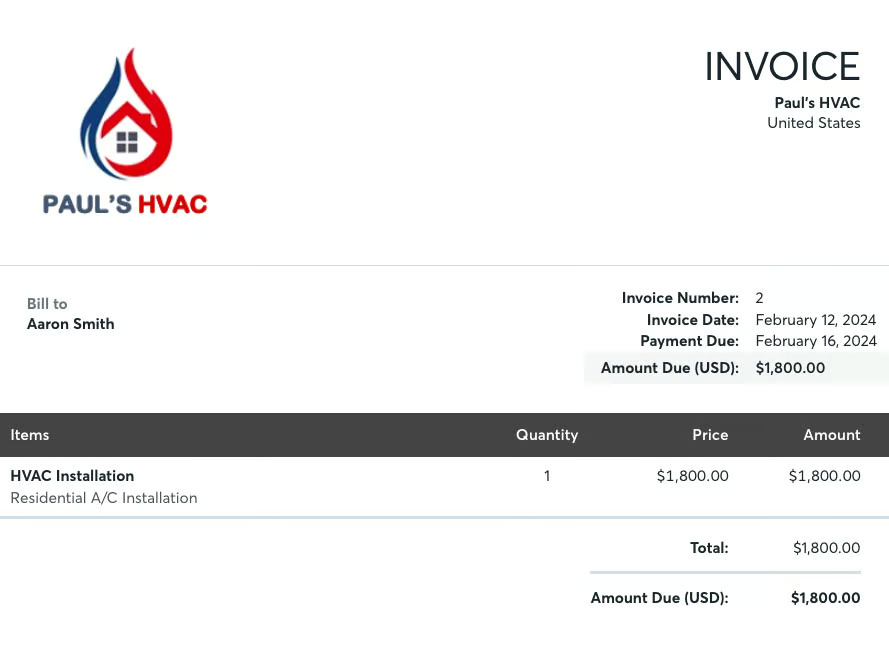
Once an invoice is created, you can email it directly to your customer in the paid tier. The free plan doesn’t let you do that, but it provides you with a link to your invoice so that you can include it in your own email.
Another benefit of the paid Pro tier is that you can attach documents to your customer’s invoice. With a subscription to Wave Payments, you can include a payment link in your customer’s invoice.
Advanced A/R Management
The lack of advanced A/R features is mainly what cost Wave points in my assessment of A/R. For instance, I can’t issue a sales receipt for an immediate customer payment and track and add labor and expenses to my invoices. I also hope the provider considers adding a customer portal where customers can easily track their invoices and process their payments.
Project Accounting
Wave lacks a feature to accumulate costs by project, so it’s not great for project-based businesses. It allows me to create customized estimates for project bids, but there is no way to compare actual costs to the estimate automatically. These are why I couldn’t award Wave more points in this criterion.
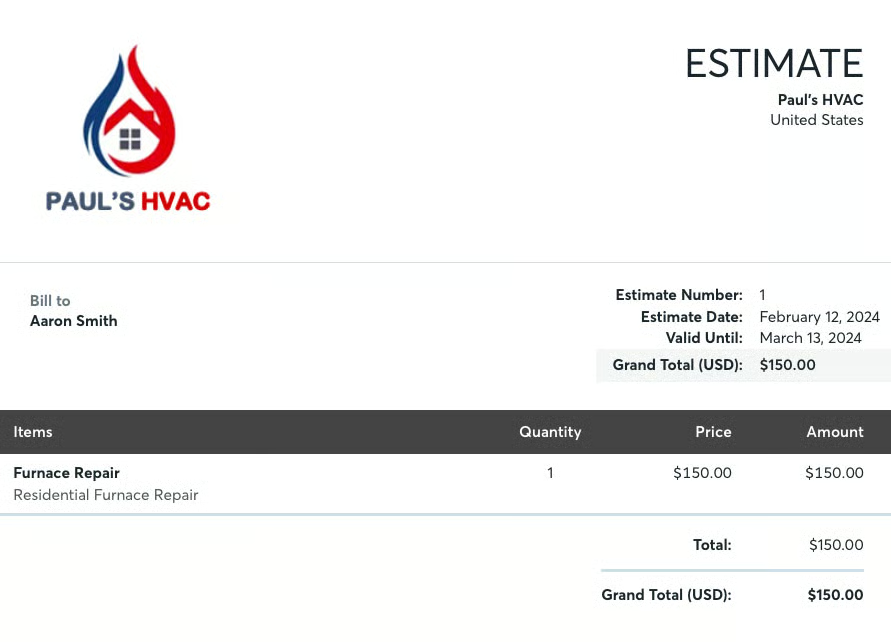
You might find Wave’s estimate feature helpful, but I recommend you check out our roundup of the best project accounting software for more comprehensive project accounting features.
Sales & Income Tax Management
Wave provides the basics, like adding sales taxes to invoices, estimates, and invoice transactions. Whenever I enter a transaction with a sales tax, it records the amount automatically in the sales tax liability account. However, there’s no way to file tax returns, which explains its low score in this category.
On the bright side, I like that Wave allows users to track payments and generate 1099s for their independent contractors. However, this feature requires either the Pro plan or a subscription to Wave Payroll. Another key functionality missing in Wave is the ability to automatically calculate sales tax rates based on the customer’s location—a feature I really appreciate in QuickBooks Online.
Note: The sales and income tax features are evaluated across our other categories, so there is no dedicated video.
Inventory Management
Wave lacks inventory management features, so if you’re a product-based business, consider QuickBooks Online. You can add a product or service but not the quantity purchased or sold. This means that Wave can’t calculate your COGS, which is important if you deal with inventory.
Note: I examined Wave’s inventory management feature across the other categories, mostly in A/R and A/P, so there is no separate video for inventory.
Reporting
Wave received a relatively good score in this category because it provides all the basic financial reports users need to file their tax returns. Specifically, you can generate the following:
- P&L statement
- cash flow statement
- A/P aging
- A/R aging
- general ledger
- trial balance
- transaction list by customer
- expense by vendor
However, while the reports are accurate, I don’t find them very professional looking—especially the balance sheet that doesn’t provide a beginning and an ending balance. The reports also lack any customization options.
Mobile App
As seen in my rubric score, the Wave app is pretty limited, especially for Starter subscribers. The most useful features are the ability to send invoices and estimates and collect payments. Users can also add customers and items to their products and services list.
Pro subscribers, as well as Starter subscribers with a Receipts add-on, can scan receipts and classify income and expense transactions directly within the app. There are some basic overview charts to see the financial status of your company, but no complete reports.
If having a good mobile app is important to you, I highly recommend Zoho Books—which aced our mobile app category.
Integrations
Wave took a hit in my integration evaluation because I can’t connect it to time tracking and electronic bill pay processors. For comparison, QuickBooks actually has electronic bill pay and time tracking built into all its plans except Simple Start.
Wave has some useful integrations, like Google Sheets and BlueCamroo, but all others must be made through Zapier. If you have a Zapier subscription, you can integrate many other apps—but it will be more difficult than having a deep integration, such as those offered in other accounting software.
On the positive side, Wave integrates with its payroll and payment processing services, Wave Payroll and Wave Payments, which are crucial functions for most businesses.
Usability
I assessed Wave’s usability based on these four major aspects:
A lot of manual data entry is required to set up a company file for existing businesses. When I set up my sample company for our case study, I had to manually input the chart of accounts, service items, and beginning account balances. Even worse, the only way I found to enter beginning account balances was with a large journal entry. None of these really matter if you’re setting up a brand new company—but it can take considerable time for established companies.
I did find a few bright spots in setting up my company, though. Wave lets you import a CSV file of customers and vendors. It also has a new company wizard that walks you through the setup process and prompts you for the basic information needed.
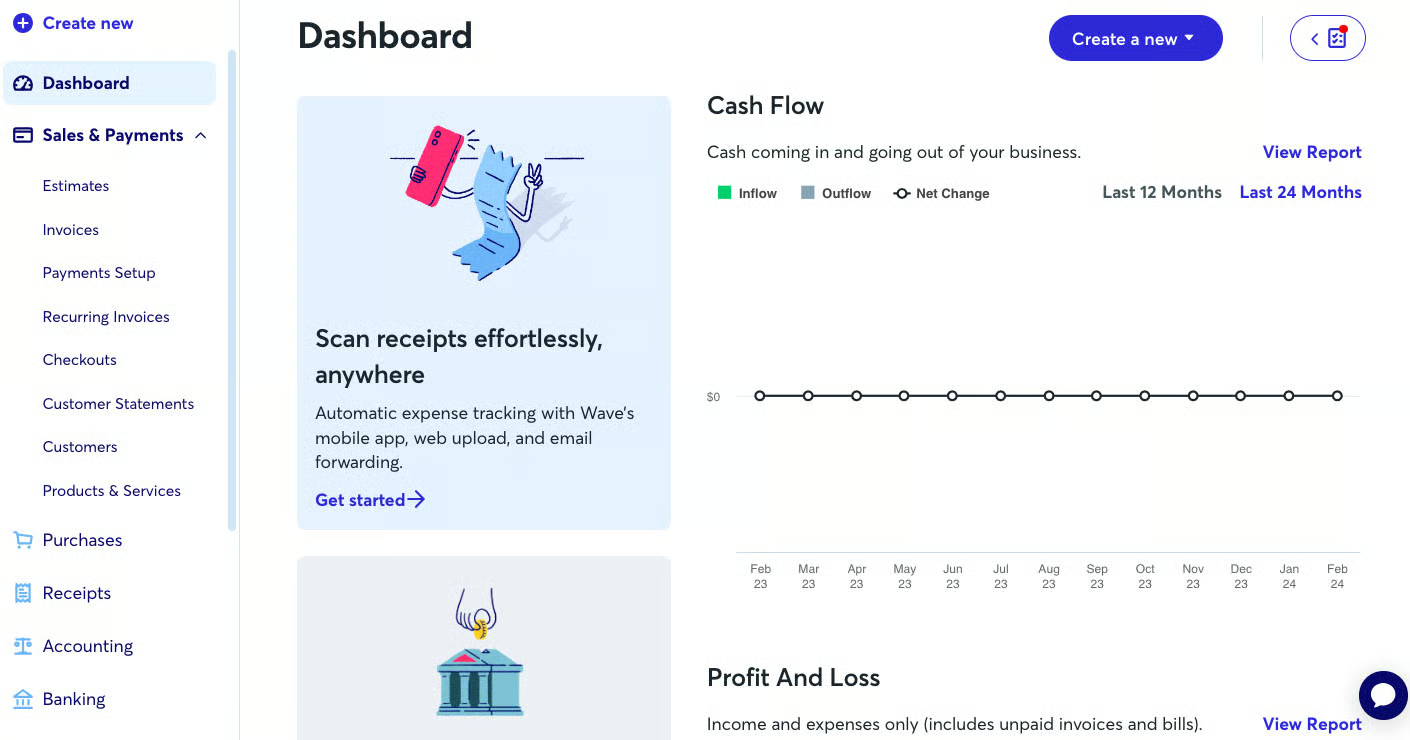
Wave is easy to use and has a shallow learning curve, whether you’re using the free or paid version. The interface is clean and not overwhelming, and you can easily find your way around. The dashboard includes shortcut buttons so that you can easily create new transactions, like bills, estimates, and invoices. Even if you don’t have accounting experience, you can familiarize yourself with the features of Wave in less than a week.
Wave has limited customer service in the Starter plan. Your only support is through an automated chatbot or self-help resources. If you need access to email and live chat support, you must purchase any add-on—like Payroll or Payments—or upgrade to the paid Pro tier.
You can access personalized support through the Wave Advisor program, where you can get coaching and year-round advice from a Wave expert starting at $149 a month. While that is very reasonable for the services delivered, it’s only a starting price—and Wave doesn’t publish any additional pricing information.
The Wave Advisor program is an in-house bookkeeping, accounting, and tax service from Wave. The advisors are trained employees of Wave who will assist you with your bookkeeping needs.
The program has two options:
- Bookkeeping support: This package starts at $149 per month. Bookkeeping pros from Wave manage your bank fees, classify transactions, reconcile your accounts, and produce monthly financial statements. Basically, they’ll do everything you need except invoice your customers.
- Accounting and payroll coaching: This is available with a one-time payment of $379, unlike bookkeeping support, which is a month-to-month contract. This program is ideal for business owners or freelancers wanting to learn Wave so that they can do their own bookkeeping. Your payment provides you with two hours of one-on-one training and 30 days of follow-up support via email.
How I Evaluated Wave Accounting
I was able to assess and rate Wave using our rubric. The criteria are as follows.
I evaluated pricing by looking at transparency, upgrade costs, and the overall value delivered at each tier. I reviewed vendor pricing pages to confirm whether full pricing, add-ons, and plan limitations are publicly disclosed or gated behind sales conversations. I also compared the cost of upgrading between tiers using a cost-per-feature formula that estimates how much additional functionality each upgrade unlocks relative to price increases.
In addition to subscription costs, I assessed free trials, cancellation policies, and available discounts to understand how easy it is for businesses to test and exit a platform. These factors help determine whether the software delivers clear, predictable pricing and reasonable value as companies grow.
I analyzed how reliably each platform performs essential accounting tasks such as maintaining the general ledger, managing payables and receivables, reconciling bank transactions, tracking inventory, handling fixed assets, and calculating sales tax. I examined whether the system enforces true double-entry accounting, updates financial reports in real time, and provides audit trails for transaction changes.
I also looked at how efficiently businesses can manage vendor bills, issue invoices, reconcile bank feeds, and generate tax or financial reports without manual workarounds. When possible, I reviewed product documentation and walkthroughs to understand how these workflows function in practice. Platforms scored higher when they automate core accounting tasks while maintaining reliable financial accuracy.
I evaluated how effectively each platform reduces manual accounting work through automation. This included reviewing approval workflows, recurring transactions, bulk processing tools, AI-powered features, and the ability to consolidate multiple entities. I looked for tools that automate routine processes such as recurring invoices, scheduled journal entries, or batch transaction imports.
I also examined whether AI tools provide meaningful operational insights, predictive categorization, or anomaly detection rather than simple rule-based automation. Systems scored higher when automation reduced repetitive accounting tasks while maintaining transparency and user control.
I compared reporting capabilities by analyzing how easily businesses can generate financial statements, analyze performance trends, and build custom reports. I reviewed the flexibility of standard financial reports such as the balance sheet, income statement, and cash flow statement, along with the ability to filter, segment, and export data.
I also evaluated dashboard tools, KPI tracking, and the ability to drill down from summary reports into transaction-level details. For more advanced analytics, I looked for forecasting tools, profitability analysis, and integrations with external analytics platforms. Platforms scored higher when reporting tools supported both daily financial oversight and deeper business analysis.
I reviewed how each system protects financial data and maintains accountability within accounting workflows. This included evaluating audit trails, user permissions, period locks, and authentication methods such as two-factor authentication or single sign-on.
I also looked at how clearly systems track user activity and prevent unauthorized changes to financial records. Platforms with stronger monitoring tools, access controls, and compliance readiness scored higher in this category. These features help ensure financial accuracy while protecting sensitive accounting data.
I evaluated how easily each accounting platform connects with other business tools and scales as operational complexity grows. This included reviewing integrations with payroll systems, expense tracking tools, banking providers, e-commerce platforms, and CRM software.
I also examined whether the platform supports multi-currency transactions, APIs for custom integrations, and multi-entity accounting structures. Platforms that integrate easily with operational systems and support higher transaction volumes scored higher. These capabilities help ensure the software can continue supporting a business as it expands.
I assessed usability by examining how easily non-accountants can complete common accounting tasks. I looked at the number of steps required to create invoices, enter bills, reconcile bank accounts, and generate reports. I also reviewed interface design, navigation clarity, mobile capabilities, and the availability of prompts or error guidance during workflows.
Platforms scored higher when they allowed users to complete common accounting tasks quickly with minimal training. These usability factors are important for small businesses that manage accounting internally.
Frequently Asked Questions (FAQs)
Is Wave Accounting still free?
Yes—and it still has the best of all free accounting software that I’ve reviewed. It also has a paid version that you’ll need if you want to connect your bank account, have multiple users, and scan receipts, plus a few other nice features.
Is Wave Accounting secure?
Yes. Wave uses 256-bit transport layer security (TLS) encryption for data security, and all accounting data are stored in servers monitored 24/7. Your credit card numbers are also not stored in Wave.
Does Wave offer a payment processing solution?
Yes, Wave offers payment processing through Wave Payments. You only need to pay for the processing fees: 2.9% plus 60 cents per transaction for Visa, Mastercard, and Discover; and 3.4% plus 60 cents for American Express. When you upgrade to the Pro tier, the 60 cents per transaction is waived.
Does Wave have a feature for tracking sales tax?
Yes, Wave includes a sales tax tracking feature. You can set up multiple sales tax rates, apply them to invoices, and generate reports to help with tax compliance.
Bottom Line
Despite several limitations, Wave has plenty to offer small businesses. It offers essential functionality that will help you pay bills, invoice customers, and track your expenses—even in the free Starter plan. You’ll need to upgrade to the Pro tier for $16 a month if you want live customer support and more features like bank feeds, recurring invoices, and automated invoice reminders.
User review references:
[1]Software Advice
[2]G2
