







The best virtual terminal should let you take card-not-present payments without forcing your business into unnecessary monthly fees, complicated contracts, or a payment setup that does not fit how you sell. I compared leading providers based on virtual terminal costs, keyed-in processing rates, ACH and recurring payments, B2B tools, funding speed, account setup, and overall value for small businesses.
Square Payments is my top choice for most small businesses because its Virtual Terminal has no monthly fee, works directly from a browser, and connects with Square’s invoicing, customer, recurring payment, and POS tools. Square currently charges no monthly Virtual Terminal fee and 3.5% + 15 cents for manually entered transactions.
Here are my picks for the best virtual terminal credit card processing providers for 2026.
- Best virtual terminals at a glance
- Best virtual terminals compared
- How I chose the best virtual terminals
- Why you can trust Fit Small Business
- Square Payments: Best overall virtual terminal for small businesses
- Helcim: Best for B2B payments and Level 2/3 processing
- Payment Depot: Best for interchange-plus pricing with terminal choice
- PayPal: Best for international remote payments
- Chase Payment Solutions: Best for free same-day funding
- Clover: Best for restaurants already using Clover POS
- PaymentCloud: Best for high-risk businesses
- Finix: Best for growing businesses with complex payment workflows
- Stax: Best for higher-volume businesses wanting predictable processing costs
- What is a virtual terminal?
- How to choose the best virtual terminal for your business
- Methodology: How I evaluated the best virtual terminals
- Bottom line
Best virtual terminals at a glance
Provider | Best for | Virtual terminal monthly fee** |
|---|---|---|
| Square Payments | Overall small businesses virtual terminal | $0 |
| Helcim | B2B payments and Level 2/3 processing | $0 |
| Payment Depot | Interchange-plus pricing with terminal choice | $0 |
| PayPal | International remote payments | $30 |
| Chase Payment Solutions | Free same-day funding | From $9.95 |
| Clover | Restaurants already using Clover POS | $0 |
| PaymentCloud | High-risk businesses | $15-$45 |
| Finix | Growing businesses with more complex payment workflows | $0 |
| Stax | Higher-volume businesses wanting predictable processing costs | $0 |
**Note: Virtual terminal fees shown do not include any separate monthly software, merchant account, gateway, POS, or platform fees that may be required by the provider.
Best virtual terminals compared
Provider | Key features | Keyed-in pricing | ACH/e-check | My score out of 5 |
|---|---|---|---|---|
| Square Payments | Free VT; recurring billing; POS integration | 3.5% + 15 cents | Via invoices | 4.28 |
| Helcim | Level 2/3; card vault; volume discounts | Interchange + 0.15%-0.50% + 15-25 cents | Yes | 4.24 |
| Payment Depot | Terminal choice; recurring billing; next-day funding | Interchange + $0.15 CNP fee | Yes, add-on | 4.05 |
| PayPal | International payments; invoices; account integration | 3.39% + 29 cents | Available through PayPal services | 3.98 |
| Chase | Same-day funding; Orbital; payment links | 3.5% + 10 cents | Varies by solution | 3.94 |
| Clover | POS-linked VT; stored cards; refunds | Based on processing agreement | Varies | 3.88 |
| PaymentCloud | High-risk placement; gateway choice; fraud tools | Custom | Available with supported gateways | 3.83 |
| Finix | ACH; Level 2/3; fraud screening | Interchange-based/custom | Yes | 3.77 |
| Stax | Subscription pricing; recurring billing; stored cards | Interchange + 15 cents | 1%, $10 cap | 3.77 |
How I chose the best virtual terminals
I started with a broader set of payment processors and narrowed the list to nine providers that offer a true virtual terminal or browser-based manual payment workflow and a clear advantage for a specific small business use case. I then compared virtual terminal fees, keyed-in processing costs, merchant account requirements, ACH and recurring billing, Level 2/3 support, funding speed, dispute management, setup, integrations, and overall value for small businesses. See my full methodology below.
Why you can trust Fit Small Business
I have more than four years of experience evaluating payment processors, merchant services, and POS systems for small businesses. Fit Small Business follows a strict editorial process, and my recommendations combine provider research with hands-on testing, product demonstrations, pricing analysis, and my experience evaluating how payment tools work for real businesses.
For this update, I compared virtual terminal providers using consistent criteria covering pricing and contracts, keyed-in processing costs, ACH and recurring billing, B2B processing, funding speed, disputes, account setup, integrations, and ease of use.
Why I chose Square Payments
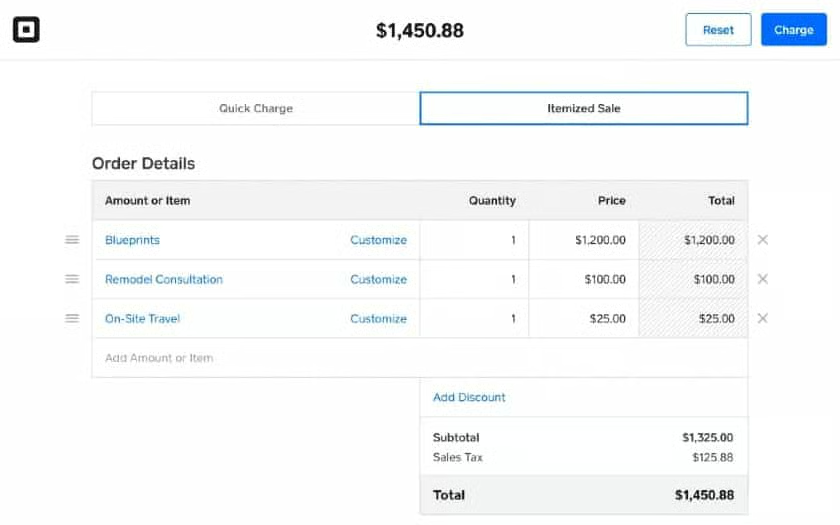
Square is my top virtual terminal for most small businesses because there is very little friction between signing up and getting paid. The Virtual Terminal works from the Square Dashboard, costs $0 per month, and lets you manually enter cards, use stored cards, or send payment links. You can also add item information, discounts, taxes, tips, and service charges to a transaction.
Square makes the most sense for lower or variable transaction volumes where simple flat-rate pricing matters more than getting the absolute lowest possible processing cost. If your business processes a large amount in keyed payments every month, or regularly accepts commercial cards, I would compare Square against Helcim or Payment Depot before deciding.
Also read: Best Free Merchant Account Providers
Square Payments pricing
- Monthly subscription fee: $0
- Virtual terminal monthly fee: $0
- Keyed-in (virtual terminal) transaction fees: 3.5% + 15 cents
- Card-on-file transaction fees: 3.5% + 15 cents
- In-person (swipe, dip, tap) transaction fees: 2.6% + 15 cents through Virtual Terminal
- Payment link transaction fees: Varies by Square plan
- ACH/bank transfer fees: 1% through Square Invoices, $1 minimum
- Custom pricing: Available for some businesses processing over $250,000 annually
Note: Square charges a higher rate for manually entered and card-on-file transactions because they are card-not-present payments and carry greater fraud risk than card-present transactions.
Square Payments standout features
- Free browser-based Virtual Terminal: You can take card payments from a computer without purchasing a terminal or paying a separate monthly Virtual Terminal subscription.
- Flexible remote payment collection: Square supports manual entry, stored cards, and payment links, giving you options when a customer is paying by phone, email, or text.
- Connected business tools: Transactions feed into the same Square environment as your customers, items, reporting, POS, and other Square products, reducing duplicate recordkeeping.
Why I chose Helcim
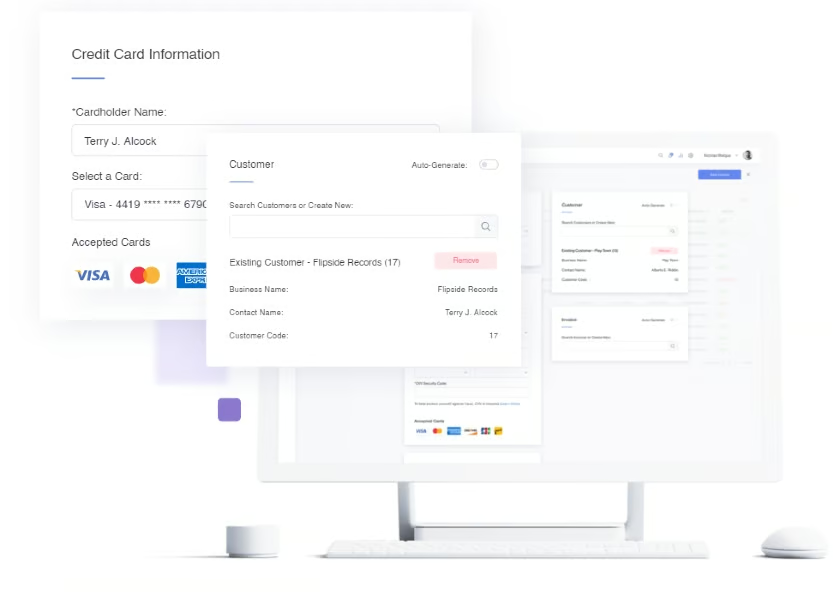
Helcim is my preferred virtual terminal for B2B businesses because its pricing and transaction tools can directly affect processing costs. It uses interchange-plus pricing and automatically lowers its markup as your processing volume increases. For businesses taking commercial or purchasing cards, Level 2 and Level 3 data can also help qualifying transactions receive better interchange treatment.
Helcim also lets you process ACH directly through its Virtual Terminal, store bank information securely in the customer vault, and automate recurring ACH payments. Those features make it a better fit than Square for many invoice-heavy professional services, wholesalers, and other B2B sellers.
Also read: Best B2B Payment Solutions for Small Businesses
Helcim pricing
- Monthly subscription fee: $0
- Virtual terminal monthly fee: $0
- Keyed-in (virtual terminal) transaction fees:
- Under $50,000 monthly volume: Interchange + 0.50% + 25 cents
- $50,000 to $100,000: Interchange + 0.45% + 20 cents
- $100,000 to $500,000: Interchange + 0.35% + 20 cents
- $500,000 to $1 million: Interchange + 0.25% + 15 cents
- $1 million to $5 million: Interchange + 0.15% + 15 cents
- Ecommerce transaction fees: Same card-not-present interchange-plus rates listed above
- ACH/bank transfer fees: 0.5% + 25 cents, capped at $6
- Chargeback fee: $0 if won; $15 if lost
- Contract term: Month-to-month
- Cancellation fee: $0
Helcim standout features
- Level 2 and Level 3 processing: Businesses accepting eligible commercial cards can submit additional transaction data that may qualify those payments for lower interchange categories.
- Automatic volume discounts: Helcim reviews a rolling three-month processing average and automatically moves merchants into lower markup tiers as volume increases.
- Virtual Terminal ACH: You can enter and securely store customer bank details, then process ACH payments directly from the Virtual Terminal.
Why I chose Payment Depot
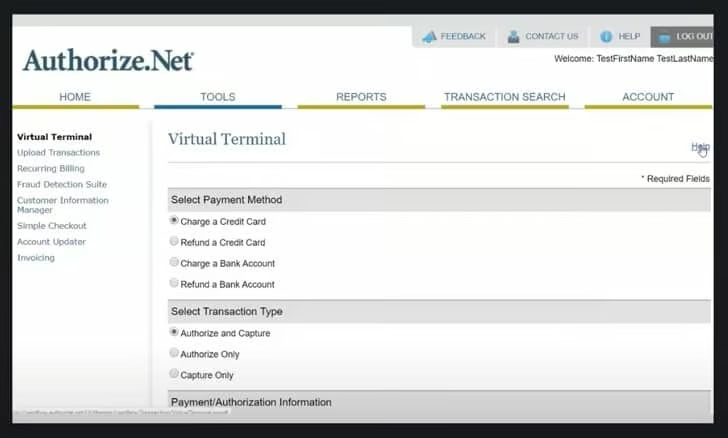
Payment Depot stands out because you are not necessarily locked into a single proprietary Virtual Terminal. Its current gateway environment includes Authorize.net, NMI, PayTrace for B2B payments, and SwipeSimple, which gives businesses more room to choose the interface and payment features that fit their operations.
I would consider Payment Depot if you want interchange-based pricing but prefer more terminal choice than Helcim offers. The tradeoff is that features such as Level 2 and Level 3 processing may depend on the gateway you select rather than being uniform across the whole service.
Also read: Cheapest Credit Card Processing Companies
Payment Depot pricing
- Monthly subscription fee: Contact sales
- Virtual terminal monthly fee: Varies by gateway and pricing arrangement
- Keyed-in (virtual terminal) transaction fees: Interchange + 15 cents per transaction
- Card processing markup: From 0% markup on interchange
- ACH/bank transfer fees: 1% per transaction, capped at $10
- Cancellation fee: $0
- Terminal protection plan: $19 per month, optional
- Other processing arrangements: Variable processing margins may range from 0.2% to 1.95%
Note: Payment Depot currently emphasizes interchange-based pricing rather than publishing a standard monthly subscription price. Actual rates and fees depend on the merchant's pricing arrangement.
Payment Depot standout features
- Choice of virtual terminals: Payment Depot works with several gateway and payment interfaces, including options aimed at general and B2B payment use.
- Interchange-based pricing: Card-not-present transactions use the underlying interchange cost plus the processor's applicable fee instead of a single flat percentage.
- Recurring and stored payments: Supported gateway options provide recurring billing and tokenized card storage for repeat customers.
Why I chose PayPal
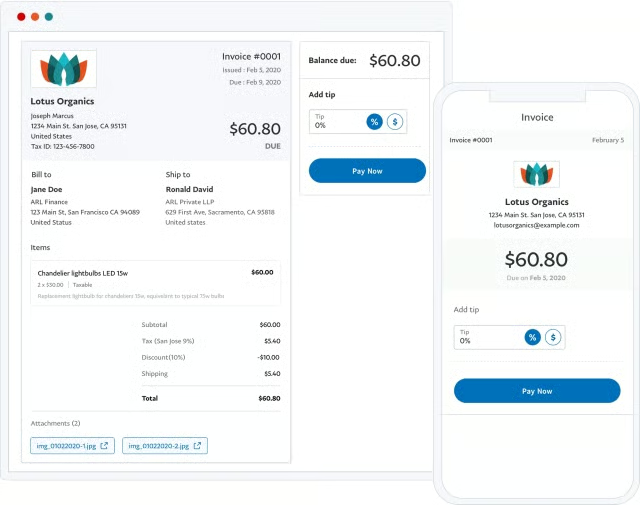
PayPal is my pick for businesses that regularly take remote payments from customers outside their immediate local market. Its Virtual Terminal works from a browser and lets you manually process major debit and credit cards without requiring customers to have a PayPal account. PayPal says approved Virtual Terminal funds typically appear in the merchant's PayPal account within minutes.
Its 3.39% + 29-cent Virtual Terminal rate is easy to understand, but businesses processing large monthly volumes should compare the effective cost with Helcim, Payment Depot, or Stax. PayPal's advantage is convenience and international reach rather than having the lowest keyed-in rate.
Also read: 9 Cheapest Credit Card Processing Companies; Best Payment Gateways
PayPal pricing
- Monthly subscription fee: $0
- Virtual terminal monthly fee: $0
- Keyed-in (virtual terminal) transaction fees: 3.39% + 29 cents
- Invoice transaction fees:
- PayPal, Venmo, or PayPal Guest Checkout: 3.49% + 49 cents
- Credit/debit cards, Apple Pay, or other third-party wallets: 2.99% + 49 cents
- ACH/bank transfer fees: 1% through PayPal Invoicing, capped at $10
- ACH Services fees: 0.80%, capped at $5 per transaction
PayPal standout features
- International payment reach: PayPal is widely available and supports cross-border transactions and currency conversion.
- Quick access to PayPal funds: Approved Virtual Terminal payments are typically reflected in the merchant's PayPal account shortly after processing.
- Connected payment options: Businesses can pair Virtual Terminal with PayPal invoicing, checkout, payment links, Venmo, and other PayPal payment products.
Why I chose Chase Payment Solutions
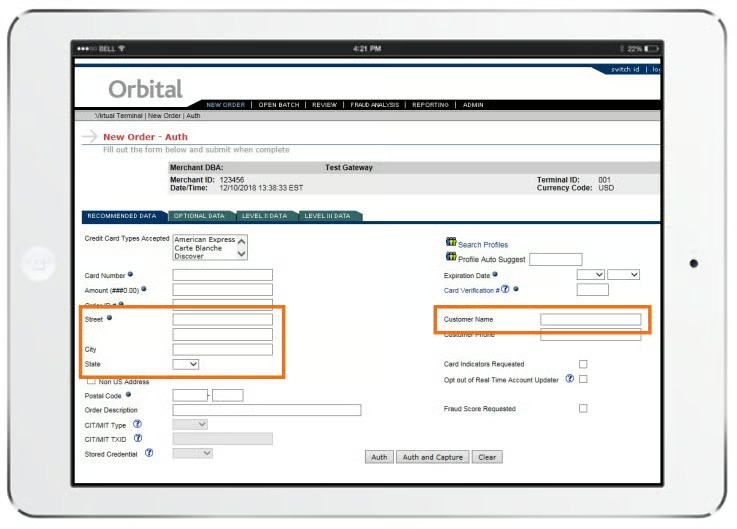
Chase is my recommendation for a business where access to processed funds matters as much as the transaction rate. QuickAccept is built into Chase Business Complete Banking and offers same-day deposits at no additional cost for qualifying payments directed into the account. Its browser Virtual Terminal supports both payment links and manually entered card details.
Chase also offers Orbital Virtual Terminal as a separate merchant services option, starting at $9.95 per month. That makes it necessary to determine which Chase payment setup you are evaluating before comparing costs. If you do not want to tie payment processing to a business checking relationship, Square is simpler.
Also read: Best Merchant Services for Small Businesses
Chase Payments Solutions pricing
- Monthly subscription fee: $0 additional with QuickAccept and an eligible Chase Business Complete Banking account
- Virtual terminal monthly fee:
- QuickAccept: $0 additional
- Orbital Virtual Terminal: From $9.95 per month
- Keyed-in (virtual terminal) transaction fees: 3.5% + 10 cents
- In-person (swipe, dip, tap) transaction fees: 2.6% + 10 cents
- Ecommerce transaction fees: 2.9% + 25 cents
- Same-day funding fee: $0 additional for eligible QuickAccept transactions deposited into a qualifying Chase business checking account
Note: Chase offers more than one virtual terminal setup. QuickAccept is available through eligible Chase business banking accounts, while Orbital Virtual Terminal is a separate payment solution with monthly pricing starting at $9.95.
Chase Payments Solutions standout features
- No-fee same-day deposits: Eligible QuickAccept transactions can be deposited to Chase Business Complete Banking the same day at no extra cost.
- Multiple remote payment workflows: The browser Virtual Terminal supports manual card entry and secure payment links.
- Orbital option: Businesses needing a more traditional merchant-services terminal can use Chase's separate Orbital Virtual Terminal and request custom pricing.
Why I chose Clover
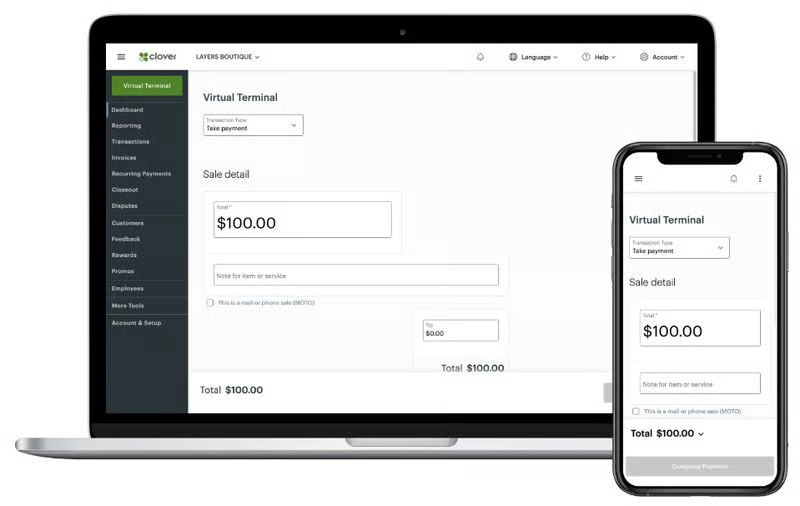
I recommend Clover mainly to restaurants and other businesses already using Clover. The Virtual Terminal sits inside the Clover Web Dashboard and lets you process payments and refunds without a Clover device. For a restaurant, that is useful for taking catering deposits, private event payments, phone orders, or another remote transaction without adding a separate processor.
I would not open a Clover account solely to gain access to a virtual terminal unless its broader POS system also fits your business. Clover itself notes that monthly software fees and processing terms vary by business type and service provider, including thousands of financial institution partners.
Also read: Best Clover Alternatives & Competitors
Clover pricing
Clover does not publish one universal Virtual Terminal price because processing rates and other costs depend on the merchant's Clover plan and processing agreement.
- Monthly software fee: Varies by Clover plan and business type
- Virtual terminal monthly fee: $0 additional fee for eligible Clover merchants
- Keyed-in (virtual terminal) transaction fees: Based on merchant processing agreement
- In-person (swipe, dip, tap) transaction fees: Based on merchant processing agreement
- Rapid Deposit fee: 1.75% on plans where offered
- Contract term: Varies by provider or reseller
Note: Clover Virtual Terminal is included in the Clover Web Dashboard for eligible merchants. Manually entered payments are charged according to the merchant's processing agreement.
Clover standout features
- POS-connected Virtual Terminal: Remote transactions sit alongside your existing Clover POS activity.
- Device-independent access: Clover says merchants can log in and process payments from a computer, smartphone, or tablet.
- Payment security: Clover uses encryption and tokenization and states that the Virtual Terminal supports PCI-compliant payment handling.
Why I chose PaymentCloud
PaymentCloud is my pick for businesses that cannot reliably use mainstream processors because of their industry, chargeback profile, business model, or processing history. It works with high-risk merchants and supports Virtual Terminals, payment gateways, shopping carts, CRMs, accounting platforms, and other payment integrations.
The downside to using PaymentCloud is pricing certainty. High-risk rates depend heavily on underwriting, transaction volume, chargebacks, average ticket size, and business history. PaymentCloud's own 2026 guidance puts typical high-risk processing around 3.49% to 3.95%, with base monthly account fees often between $10 and $50 before gateway, PCI, and other costs. Those are industry ranges rather than guaranteed PaymentCloud quotes.
Also read: Best High-Risk Merchant Account Providers
PaymentCloud pricing
PaymentCloud does not publish standardized pricing because rates and fees are customized based on your business type, processing history, risk level, transaction volume, and chosen payment setup. The figures below are estimates provided by PaymentCloud and may vary significantly after underwriting.
- Monthly account fee: $10 to $45
- Virtual terminal monthly fee: $15 to $45
- Keyed-in (virtual terminal) transaction fees: 2% to 4.3%
- In-person (swipe, dip, tap) transaction fees: 2% to 4.3%
- Hardware cost: Varies by hardware provider
- Chargeback fee: $25
- Application/setup fee: $0
- Cancellation fee: Typically waived
- Contract term: Mostly short-term
PaymentCloud standout features
- High-risk merchant placement: PaymentCloud works with acquiring partners willing to consider industries and risk profiles that conventional processors may decline.
- Multiple payment integrations: High-risk accounts can be paired with supported gateways, Virtual Terminals, ecommerce systems, accounting tools, and CRMs.
- Risk controls: PaymentCloud emphasizes machine learning, two-factor authentication, chargeback management, and payment security for higher-risk merchants.
Why I chose Finix
Finix is my pick for growing businesses that want more payment control than a basic aggregator account provides. Each merchant gets a dedicated merchant account, and Finix uses interchange-plus pricing rather than a single flat rate. It also supports Level 2 and Level 3 processing, ACH and EFT, and gives merchants a browser-based Virtual Terminal at no additional fee beyond standard processing costs.
I especially like Finix for businesses moving beyond occasional keyed-in payments and managing both remote and in-person sales. Virtual Terminal transactions appear alongside other online and in-person payments in the Finix dashboard, with reporting, refunds, disputes, and stored payment information managed in one place. The tradeoff is cost and setup: with its paid subscription and individual underwriting, Finix is harder to justify for a very small or low-volume merchant. Square is the easier choice in that case, while Helcim may be better if B2B payment optimization is the main priority.
Finix pricing
- Monthly subscription fee: Starting at $250 per month; custom pricing for businesses processing more than $1 million annually. Finix notes that subscription pricing is based on processing volume and may increase if volume thresholds are exceeded.
- Virtual terminal monthly fee: Included with the Finix subscription
- Keyed-in (virtual terminal) transaction fees: Interchange + 15 cents per card-not-present transaction.
- In-person (swipe, dip, tap) transaction fees: Interchange + 8 cents per card-present transaction.
- American Express cards: Additional 0.30% per transaction.
- Subscription billing fee: 0.4% per transaction.
- ACH/bank transfer fees: 1% per same-day entry, with a $1 minimum and $10 maximum.
- ACH validation: 55 cents per validation.
- ACH returns: $5 each.
- ACH instant payout: 1.5%.
- Card and ACH disputes: $30 per dispute.
- Account updater: 55 cents per update.
- Card network tokenization: 15 cents per update.
Finix standout features
- Dedicated merchant account and interchange optimization: Finix individually underwrites direct merchants rather than placing them under a shared aggregator account. It also supports interchange-plus pricing and Level 2 and Level 3 data for qualifying B2B transactions.
- Card, ACH, and EFT Virtual Terminal payments: The browser-based Virtual Terminal supports manually entered card payments plus ACH and EFT, with no extra Virtual Terminal fee or special hardware required. Merchants can also store payment information for faster repeat transactions.
- Unified payment management and fraud controls: Finix brings Virtual Terminal, online, and in-person payments into the same dashboard for reporting, refunds, and dispute management. Machine-learning fraud screening, encryption, tokenization, and a secure vault help protect card-not-present transactions.
.png)
Why I chose Stax
Stax is my pick for higher-volume businesses that want a virtual terminal to do more than just key in card payments. Its platform supports phone payments, recurring billing, electronic invoicing, customer and catalog management, tokenized card storage, text-to-pay, and even a hosted online shopping cart. This is particularly useful for professional services, healthcare, food delivery, memberships, and other businesses that regularly collect payments remotely.
Stax’s advantage over lower-cost options is its membership-based pricing. Stax gives merchants access to interchange rates without adding a percentage markup to card-not-present transactions, which can become more cost-effective as processing volume grows. The downside is that the monthly membership makes less sense for businesses with occasional phone or invoice payments. For lower or inconsistent volume, I would choose Square or Helcim instead.
Stax pricing
- Monthly subscription fee:
- $99 per month for up to $150,000 in annual processing
- $139 per month for $150,000 to $250,000
- $199+ per month for $250,000+
- Custom quote for higher volumes
- Virtual terminal monthly fee: Included with Stax Pay subscription
- Keyed-in (virtual terminal) transaction fees: Interchange + 15 cents per transaction
- In-person (swipe, dip, tap) transaction fees: Interchange + 8 cents per transaction
- Invoice transaction fees: Interchange + 15 cents per card-not-present transaction; customized invoicing is included with the subscription
- Ecommerce transaction fees: Interchange + 15 cents per card-not-present transaction
- ACH/bank transfer fees: 1% per transaction, capped at $10
- Chargeback protection: $25 per chargeback
- Cancellation fee: $0
- Terminal protection plan: $19 per month, optional
Stax standout features
- Remote billing and recurring payments: Stax supports one-time and recurring electronic invoices that can be sent by email or text, making it useful for memberships, professional services, and businesses that bill customers repeatedly.
- Customer and catalog management: Merchants can keep customer information and tokenized cards on file, manage products or services, and track inventory and sales from the same payment environment.
- Text-to-pay and hosted checkout: Stax lets businesses send payment requests by text and create a branded online shopping cart without building a separate checkout integration. This gives businesses additional ways to collect remote payments beyond manually keying a card into the virtual terminal.
.png)
What is a virtual terminal?
A virtual terminal is a secure browser-based tool that lets you manually enter customer payment information without a physical card reader. Businesses commonly use one for phone orders, deposits, invoices, recurring payments, and other card-not-present sales.
Because keyed-in transactions carry more fraud risk than tapped, dipped, or swiped payments, they usually cost more to process. Pricing also varies by provider:
- Flat rate: You pay a fixed processing rate per transaction, which is simple to predict and often works well for lower or variable sales volume. Square uses this model.
- Interchange-plus: You pay the card network’s interchange cost plus the processor’s markup. Helcim and Payment Depot use this approach, which can become more cost-effective at higher volumes.
- Subscription: You pay a fixed monthly fee plus interchange and a small per-transaction charge. Stax uses this model and is generally better suited to higher-volume businesses.
When comparing providers, factor in more than the transaction rate. Monthly software or virtual terminal fees, gateway charges, ACH fees, chargebacks, funding fees, and contract terms can all affect your total cost.
How to choose the best virtual terminal for your business
1. Identify how you will take remote payments
Start with the transactions you actually expect to process. A contractor collecting deposits has different needs from a wholesaler processing commercial cards, a restaurant taking catering orders, or a subscription company storing customer payment information.
If you mainly take occasional phone payments, a $0 terminal such as Square may be all you need. If you regularly invoice other businesses, prioritize ACH, card storage, and Level 2/3 support. High-risk businesses should evaluate merchant approval first because the lowest advertised rate will not matter if the processor does not support your industry.
2. Estimate your monthly card-not-present volume
Your volume changes the economics considerably. Flat-rate pricing removes the monthly commitment but takes a percentage of every transaction. Interchange-plus pricing may become cheaper as volume rises, while Stax's subscription model depends on processing enough each month to justify its fixed fee.
Compare estimated costs using your actual card-not-present volume and average ticket size, rather than your total company sales.
3. Match the provider to your must-have payment features
Look beyond manual credit card entry. Useful virtual terminal features can include ACH or e-checks, recurring billing, stored cards, invoices, itemized transactions, payment links, refunds and voids, Level 2/3 data, user permissions, fraud screening, and customer profiles.
B2B merchants should pay particular attention to Level 2/3 support. High-risk businesses should prioritize fraud controls and underwriting. Businesses using the terminal alongside a POS should look for shared customer, inventory, and transaction data.
4. Compare total cost and funding speed
Add the monthly account or software cost to estimated card processing, gateway, ACH, and other payment fees. A terminal advertised at $0 per month can still cost more than a paid product if your keyed-in volume is high enough.
Funding is another practical consideration. Chase's eligible QuickAccept setup provides same-day deposits to Chase Business Complete Banking at no additional cost, while Stax advertises next-business-day funding with its plans.
Methodology: How I evaluated the best virtual terminals
I evaluated payment processors that provide browser-based or manually keyed payment tools suitable for small businesses. I compared each provider using the same scoring framework and reviewed current provider documentation for pricing, payment features, account requirements, and limitations. Where I had direct product access, demos, or prior hands-on experience, I used that experience to assess the actual payment workflow.
My rubric is weighted as follows:
- Pricing and Contract (30%): I awarded the most points to providers with low or no virtual terminal fees, competitive keyed-in processing costs, and favorable merchant account terms. I also considered chargeback fees and any added costs required to access the virtual terminal. Helcim and Square performed especially well in this category.
- Features (25%): This category covers core virtual terminal functionality, including credit card processing, ACH or e-check payments, recurring billing and invoicing, customer and inventory management, and Level 2 and Level 3 B2B payment support. Helcim earned the strongest feature score, while several providers followed closely behind.
- Ease of Use (25%): I looked at funding speed, dispute management, merchant setup, customer support availability, and whether the provider can work with high-risk businesses. Chase scored well here because of its funding options and account support, though it lost points for limited high-risk compatibility.
- Expert Score (20%): This score reflects overall value and practical fit, including affordability, ease of use, integrations, provider reputation, and feedback from real users. I also considered whether each service makes sense for the type of small business it targets rather than judging features in isolation.
Frequently asked questions (FAQs)
What is the cheapest virtual terminal for a small business?
Square and Helcim both offer virtual terminals without a separate monthly fee. The cheapest provider for your business still depends on processing volume because transaction rates can outweigh the monthly software price.
Are virtual terminal transactions more expensive than in-person payments?
Usually, yes. Virtual terminal transactions are typically card-not-present transactions because the card is manually entered rather than tapped, dipped, or swiped. Square charges 3.5% + 15 cents for manually entered Virtual Terminal transactions versus 2.6% + 15 cents for eligible card-present Virtual Terminal transactions.
Can I use a virtual terminal without a card reader?
Yes. A virtual terminal is specifically meant to let you accept payments without requiring physical card-reading hardware. Square, PayPal, Finix, Clover, and Chase all offer browser-based manual payment workflows.
Which virtual terminal is best for ACH payments?
Helcim is my top choice if ACH is a regular part of your virtual terminal workflow. It supports ACH directly through its Virtual Terminal and charges 0.5% + 25 cents per transaction, with a $6 cap on qualifying transactions. Finix also supports ACH and EFT through its Virtual Terminal, while Stax offers ACH for 1%, capped at $10.
Is flat-rate, interchange-plus, or subscription pricing better?
Flat-rate pricing is usually easiest for lower or unpredictable processing volumes because there is little or no fixed monthly cost. Interchange-plus pricing can become more economical for established and higher-volume businesses, especially those processing commercial cards. Subscription pricing, such as Stax, can make sense at higher volumes when removing the processor's percentage markup saves more than the monthly subscription costs.
Bottom line
The best virtual terminal for your business depends on how often you key in payments, whether you accept ACH or recurring payments, your card-not-present volume, and how much payment management you need beyond simple card entry. Pricing models matter just as much as advertised rates, particularly as processing volume grows.
Square is my top choice for most small businesses because its Virtual Terminal has no monthly fee, is quick to access from a browser, and connects with Square's wider payment and business tools. Helcim is the stronger option for B2B businesses needing ACH and Level 2/3 processing, while Payment Depot and Stax are worth comparing at higher transaction volumes.
You might also like
