






The best customer database software should turn scattered information into a single, usable customer record — not simply replace a contact spreadsheet. It should give your team a 360-degree view of customer interactions, automate routine data updates, and provide reporting that improves follow-up and decision-making.
Customer databases may be standalone tools or built into customer relationship management (CRM) platforms. To help you choose, I evaluated dozens of options based on pricing, data management, automation, reporting, ease of use, and support, then narrowed the field to the seven best solutions for small businesses.
Provider | Best for | Starting price |
| HubSpot CRM | Unifying sales, marketing, and service customer data | Free or $7/user/month |
| monday CRM | Ease of use | $12/user/month (3-user minimum) |
| ClickUp | Data view customization | Free or $7/user/month |
| Pipedrive | B2B communications tracking | $14/user/month |
| Zoho CRM | Automating data management tasks | Free or $14/user/month |
| Insightly CRM | Project-based businesses | $29/user/month |
| Bitrix24 | Ecommerce businesses | Free or $49/month |
*Billed annually.
- Overview of the best customer database for small business
- HubSpot CRM: Best for unifying sales, marketing, and service customer data
- monday CRM: Best for ease of use
- ClickUp: Best for data view customization
- Pipedrive: Best for B2B communications tracking
- Zoho CRM: Best for automating data management tasks
- Insightly CRM: Best client database for project-based businesses
- Bitrix24: Best for ecommerce businesses
- Bottom line
- Recommended for you…
Overview of the best customer database for small business
Provider | Automated data enrichment | Automated duplicate detection | Multichannel activity tracking | Expert score out of 5 |
| HubSpot CRM | ✓ | ✓ | ✓ | 4.65 |
| monday CRM | ✓ | ✕ | ✓ | 4.57 |
| ClickUp | ✕ | ✕ | ✕ | 4.56 |
| Pipedrive | ✓ | ✓ | ✓ | 4.52 |
| Zoho CRM | ✓ | ✓ | ✓ | 4.50 |
| Insightly CRM | ✕ | ✕ | ✓ | 4.30 |
| Bitrix24 | ✕ | ✓ | ✓ | 4.27 |
Why you can trust Fit Small Business
To ensure we provide readers with the best answers, the Fit Small Business editorial process adheres to strict standards, including rigorous research, assessment, and provider scoring.
In this review, I evaluated customer database software for small businesses based on contact and data management, automation, reporting, integrations, ease of use, pricing, and customer support. My methodology also incorporated firsthand experience assessing platform usability and feedback from real product users.
Furthermore, I leverage the following work experiences when carrying out software reviews:
- Over 14 years of editorial research and writing
- Over eight years of writing expert reviews about sales and business technologies
- Over two years in insurance sales and team management
- Almost two years in sales territory management


Methodology: How I evaluated the best customer database software
I evaluated the specific features relevant to collecting, storing, organizing, and securing customer information to choose the best CRM systems or customer database programs. For instance, being able to store and auto-enrich contact data ensures reps are using up-to-date information during outreach campaigns.
I also looked at other critical attributes of software, like customer support availability, subscription prices, and what users say about each product. Below are my evaluation insights on the best client data management software and the top CRM features and functionalities:
- General features (30%): I evaluated contact and lead management, customizable pipelines, dashboards and reporting, workflow automation, email management, data import and export, integrations, and mobile access.
- Pricing (25%): I compared free plans and trials, entry-level and higher-tier subscription costs, monthly billing options, annual discounts, and overall value.
- Ease of use (15%): I assessed templates and prebuilt automations, setup requirements, onboarding, learning curve, interface usability, and scalability.
- Customer support (15%): I reviewed support hours, contact channels, onboarding materials, demos and webinars, knowledge bases, and community forums.
- Expert score (15%): I considered each platform’s customer database capabilities, value for money, suitability for small businesses, product transparency, and ratings on reputable third-party review sites.
Why I chose HubSpot CRM
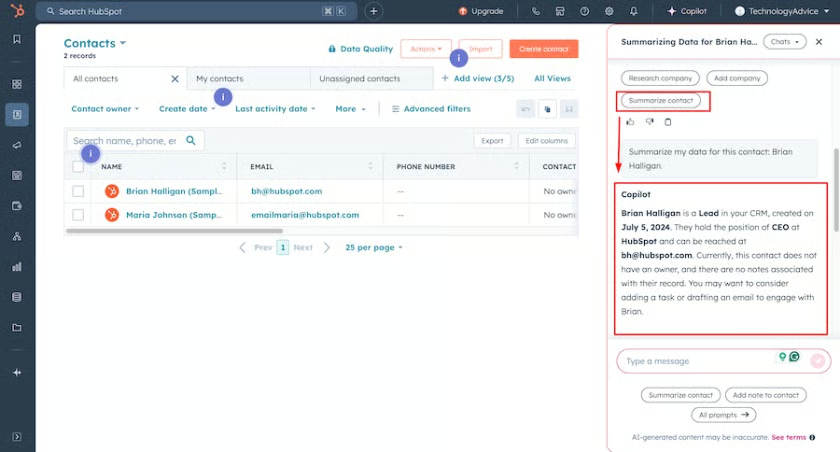
I chose HubSpot CRM as the best overall customer database software because it gives a RevOps team one platform for connecting customer data across marketing, sales, service, content, commerce, and operations. Its intuitive interface makes it easy to manage contacts, companies, deals, and engagement histories, while built-in AI enriches records, identifies data issues, and surfaces relevant customer context. This gives small teams a more complete view of each relationship without relying on several disconnected systems.
HubSpot’s modular structure provides room to grow, although costs can increase as businesses add users, products, and advanced capabilities. Sophisticated account insights, automation, and data customization may also require higher-tier subscriptions. Even so, its accessible core CRM, ease of use, and extensive integration ecosystem allow small businesses to start with essential database tools and expand without migrating to another platform.
Key features
- Unified customer records: Consolidates contact details, company information, deals, communications, and engagement history into centralized customer profiles.
- Automated data enrichment: Adds relevant business information to contact and company records, reducing manual research and incomplete fields.
- Duplicate management: Identifies and merges duplicate records to improve data accuracy and prevent customer activity from being divided across profiles.
- Custom data structure: Provides custom properties, record associations, and custom objects for organizing information around specific business processes.
- Cross-team activity tracking: Connects marketing, sales, service, and commerce interactions so teams can follow the broader customer relationship.
HubSpot CRM pricing
HubSpot Customer Platform plans | Free | Starter | Professional | Enterprise |
| Monthly price, billed annually | $0 for 2 users | $7/seat | $1,300 for 6 seats $45 per additional seat | $4,700 for 8 seats $75 per additional seat |
| Monthly price, billed monthly | $0 for 2 users | $10/seat | $1,450 for 6 seats $45 per additional seat | N/A |
Why I chose monday CRM
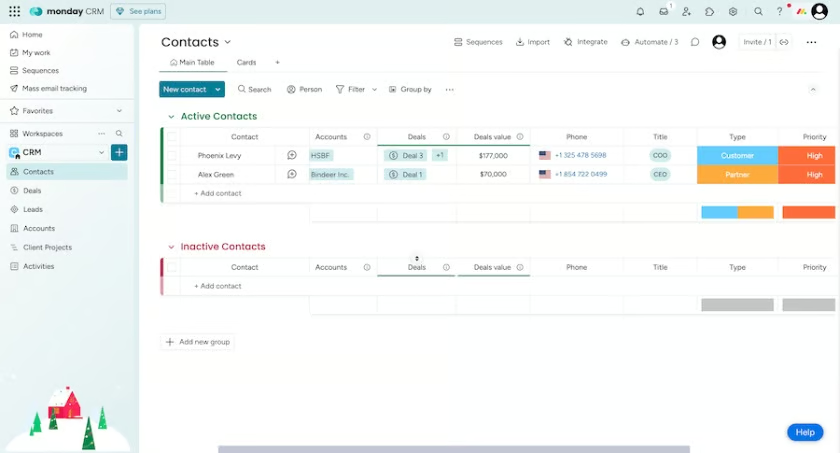
monday CRM stood out to me as a strong option for small businesses that want a visual, intuitive customer database they can customize without technical expertise. Its board-based interface organizes contacts, accounts, deals, and activities across Kanban, calendar, timeline, map, and chart views. This flexibility also makes it one of my picks for the best simple CRM, particularly for teams that want to adapt how they view and manage customer data without navigating a rigid system.
That level of customization can require some initial configuration, while advanced capabilities such as AI lead sourcing, enrichment, and scoring may involve higher-tier access or usage limits. However, customizable templates, no-code automations, centralized interaction histories, and extensive learning resources help teams build a practical database without the administrative burden of a more complex CRM.
Key features
- Multiple data views: Displays customer and sales information through Kanban, calendar, timeline, map, chart, and workload views for easier analysis and collaboration.
- Customizable CRM boards: Lets teams modify fields, stages, layouts, and templates to match their customer management and sales processes.
- Centralized interaction history: Records emails, calls, meetings, and messages against the relevant contact or account, giving teams shared customer context.
- AI-powered data enrichment: Adds relevant business and contact information to lead records, reducing manual research and incomplete profiles.
- No-code workflow automation: Automates record updates, assignments, notifications, and follow-ups without requiring programming.
monday CRM pricing*
| monday CRM plans | Basic | Standard | Pro | Enterprise |
| Monthly price, billed annually | $12/user | $17/user | $28/user | Custom |
| Monthly price, billed monthly | $15/user | $20/user | $33/user | Custom |
*All monday CRM plans have a three-user minimum.
Free trial: 14 days
Why I chose ClickUp
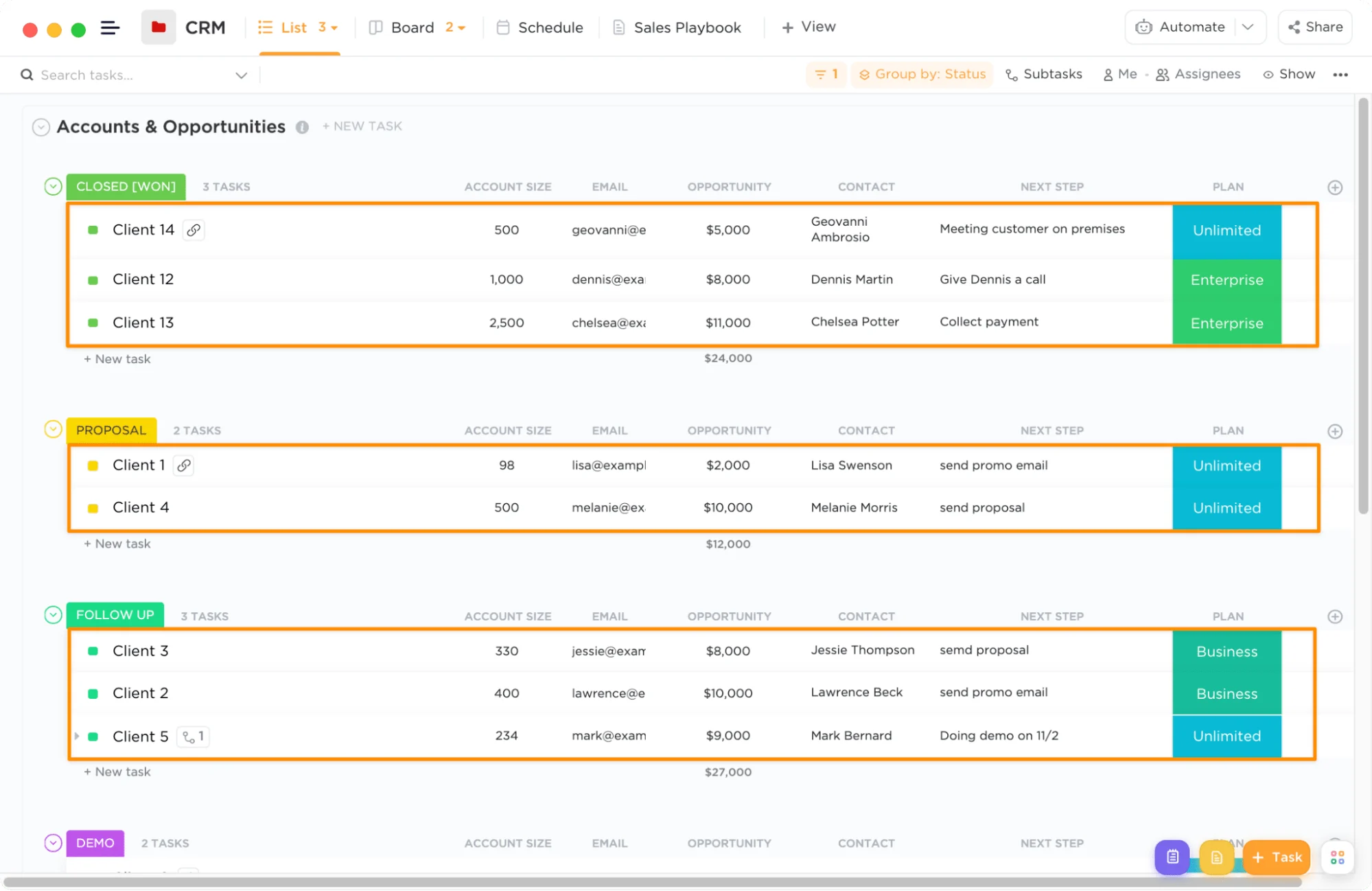
I recommend ClickUp for service-based businesses that want to manage customer data alongside projects, deliverables, and internal workflows. As an active ClickUp user, I find its flexibility especially useful for building tailored account records, sales pipelines, and post-sale processes with custom fields, templates, and multiple views. These capabilities make it one of the stronger CRM alternatives for teams that want customer management and project delivery in the same workspace.
ClickUp’s work management foundation means it requires more setup than a purpose-built CRM, particularly for teams that want predefined sales processes or native calling. However, its CRM templates, no-code automations, collaboration tools, and extensive customization make it a practical option for businesses that prioritize operational flexibility over a conventional CRM structure.
Key features
- Customizable CRM workspace: Lets teams structure contact, account, and deal records with custom fields, statuses, relationships, and workflows.
- Multiple data views: Provides more than 15 views, including List, Board, Table, Calendar, and Gantt, for organizing customer and pipeline data around different workflows.
- Prebuilt CRM templates: Offers templates for sales pipelines, account management, customer service, and revenue forecasting to simplify setup.
- Forms and workflow automation: Captures inquiries through forms and automates assignments, stage changes, record updates, and follow-up tasks.
- Customer-to-project handoffs: Connects customer records with tasks, documents, chat, time tracking, and deliverables so teams can manage work after the sale without changing platforms.
ClickUp pricing
| ClickUp plans | Free Forever | Plus | Business | Enterprise |
| Monthly price, billed annually | $0 for unlimited users | $7/user | $12/user | Custom |
| Monthly price, billed monthly | $0 for unlimited users | $10/user | $19/user | Custom |
Why I chose Pipedrive
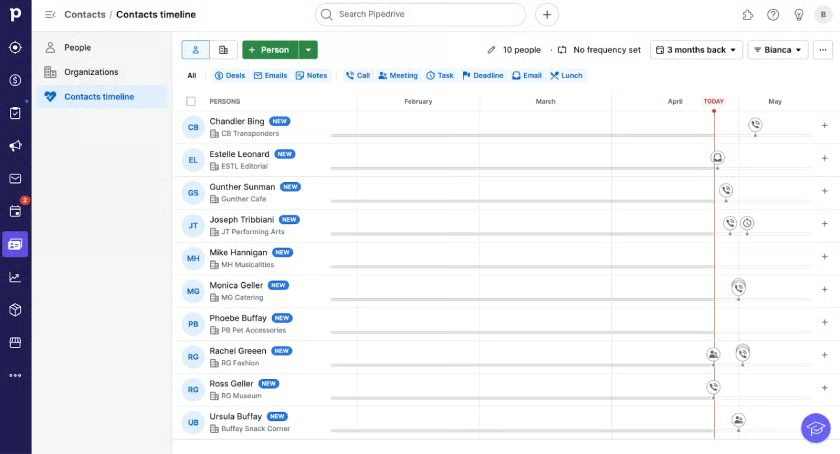
Pipedrive is a highly intuitive tool for organizing B2B customer communication around active sales opportunities. I found its contact and organization records especially useful for connecting emails, calls, meetings, notes, and deals into a clear interaction history. Sales reps can quickly determine who contacted a customer, what was discussed, and which follow-up should happen next without searching across disconnected tools.
Its sales-focused approach makes Pipedrive less suitable for businesses seeking a free database or an all-in-one marketing and customer service platform. Advanced email capabilities and data enrichment may also require higher-tier access or usage credits. Still, its intuitive pipeline, customizable records, activity automation, and data-quality tools give B2B teams a focused way to maintain customer context and keep deals moving.
Key features
- Unified contact history: Connects emails, calls, meetings, notes, activities, and deals to each person or organization record.
- Automated data enrichment: Adds available company and contact information to records, reducing manual research and incomplete profiles.
- Duplicate management: Identifies potential duplicate contacts and organizations and lets authorized users consolidate their information.
- Customizable customer records: Supports custom fields, filters, labels, and linked participants for tracking details relevant to each sales process.
- Sales activity automation: Creates follow-ups, assigns activities, updates deal stages, and logs outreach to help keep records current.
Pipedrive pricing
Pipedrive plans | Lite | Growth | Premium | Ultimate |
| Monthly price, billed annually | $14/user | $39/user | $59/user | $79/user |
| Monthly price, billed monthly | $24/user | $49/user | $79/user | $99/user |
Free trial: 14 days
Why I chose Zoho CRM
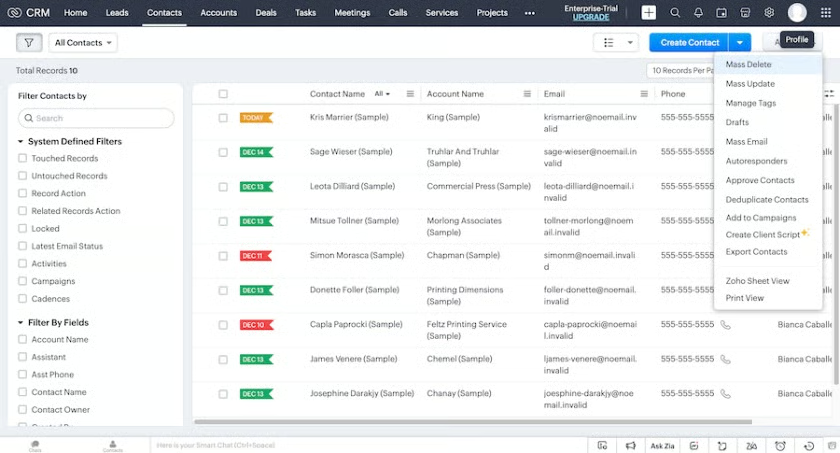
The greatest strength I found in Zoho CRM is its ability to automate how customer data is created, updated, assigned, and maintained. Its workflow tools reduce repetitive administration by creating records, updating fields, assigning owners, and triggering follow-ups when defined conditions are met. Customizable fields, layouts, views, and modules also make it one of my picks for the best customizable CRM. These features allow businesses to structure the database around their sales processes instead of adapting to a fixed system.
This depth can make the initial setup and interface feel dense, especially for first-time CRM users. Advanced customization and some Zia AI capabilities may also require higher-tier subscriptions. However, its extensive automation, scalable data structure, free entry point, and broad product ecosystem make Zoho CRM a strong value for teams willing to spend more time configuring the platform.
Key features
- Workflow automation: Creates or updates records, assigns owners, sends notifications, and triggers follow-up actions based on predefined conditions.
- Custom modules and layouts: Lets businesses customize fields, record pages, views, and entire modules around their customer data requirements.
- Zia data enrichment: Adds available company addresses, phone numbers, employee counts, and social profiles to supported records.
- Duplicate prevention: Checks leads and contacts against designated unique fields to reduce duplicate entries and fragmented customer histories.
- Blueprint process controls: Guides users through required stages, actions, and data-entry steps to standardize how records move through a business process.
Zoho CRM pricing
Zoho CRM plans | Free | Standard | Professional | Enterprise | Ultimate |
| Monthly price, billed annually | $0 for 3 users | $14/user | $23/user | $40/user | $52/user |
| Monthly price, billed monthly | $0 for 3 users | $20/user | $35/user | $50/user | $65/user |
Free trial: 15 days
Why I chose Insightly CRM
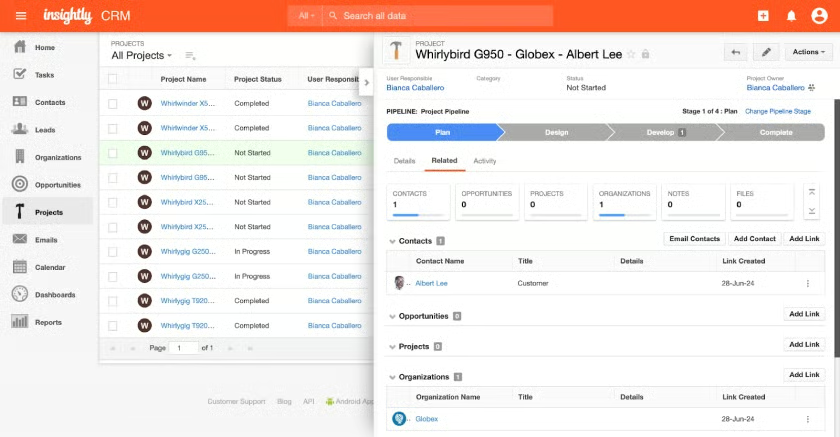
I recommend Insightly CRM for project-based businesses because it connects customer data directly with post-sale delivery. Teams can convert a won opportunity into a project while carrying over the associated contacts, records, and tasks. This preserves customer context as work moves from sales to fulfillment, making Insightly especially useful for agencies, consultancies, and professional services firms.
Its relationship-linking capabilities also help teams map connections among contacts, organizations, opportunities, and projects — a useful advantage for referral-driven businesses and complex B2B accounts. Insightly is less suitable for teams that need native social media management or extensive marketing and customer service automation. However, it offers a practical way to manage customer relationships and client projects within one system.
Key features
- Opportunity-to-project conversion: Teams can turn won opportunities into projects while retaining the related customer records, tasks, and activity history.
- Relationship linking: Record links show how contacts, organizations, opportunities, and projects connect, helping teams trace referrals and understand account relationships.
- Built-in project management: Project pipelines, milestones, and task tracking keep client deliverables connected to the appropriate customer records.
- Customizable customer records: Custom fields, objects, layouts, and validation rules let businesses structure customer data around their processes.
- Workflow automation: Rule-based automations can update records, assign tasks, and notify users when customer or project data meets predefined conditions.
Insightly CRM pricing
Insightly CRM plans | Plus | Professional | Enterprise |
| Monthly price, billed annually | $29/user | $49/user | $99/user |
| Monthly price, billed monthly | $35/user | $59/user | $129/user |
Free trial: 14 days
Why I chose Bitrix24
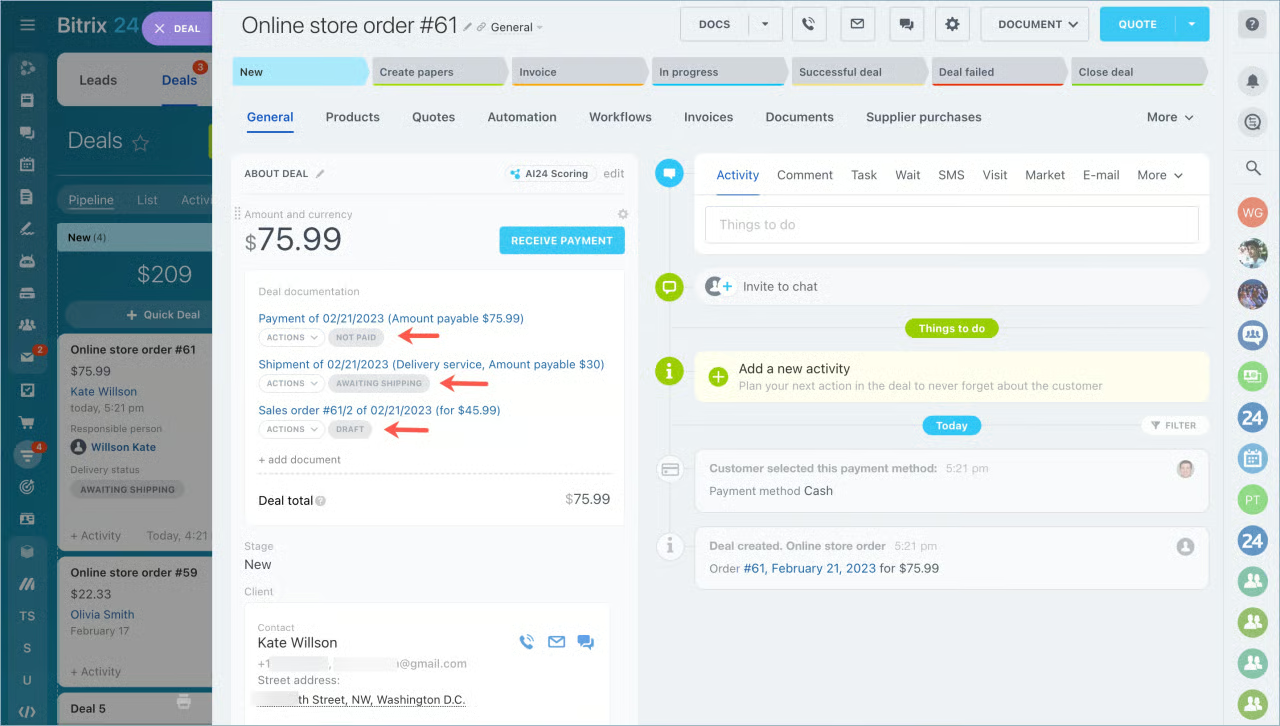
Bitrix24 is the best customer database software for ecommerce businesses because it connects customer records directly with online store activity. Teams can manage contacts, products, orders, payments, and deal histories without maintaining a separate database for online sales. This gives sales reps a more complete view of each buyer, from the initial inquiry through purchase.
Bitrix24 also supports automated lead capture and granular access permissions, helping businesses collect customer information while controlling which teams or departments can view it. Its extensive toolset can make the interface feel crowded, and capabilities such as custom CRM fields and advanced analytics may require a higher-tier plan. Still, it offers substantial value for businesses willing to accept a steeper learning curve in exchange for integrated CRM, ecommerce, and collaboration tools.
Key features
- Built-in ecommerce tools: Businesses can connect customer profiles with products, orders, payments, and deal records from an integrated online store.
- Centralized customer profiles: Each record brings together contact details, communication history, sales activity, and order information for a more complete customer view.
- Automated lead capture: CRM forms and website widgets collect visitor information and create lead or contact records for follow-up.
- Data access controls: Role- and department-based permissions help businesses limit access to sensitive customer information.
- Sales workflow automation: Rules and triggers can assign leads, update records, create tasks, and move deals through predefined stages.
Bitrix24 pricing
Bitrix24 Essential plans | Free | Basic | Standard | Professional | Enterprise |
| Monthly price, billed annually | $0 for 2 users | $49 for 5 users | $99 for 50 users | $199 for 100 users | Starts at $399 for 250 users |
| Monthly price, billed monthly | $0 for 2 users | $61 for 5 users | $124 for 50 users | $249 for 100 users | Starts at 4399 for 250 users |
Free trial: 15 days
Frequently asked questions (FAQs)
What features should customer database software have?
Customer database software should include centralized contact and account records, custom fields, search and filtering, interaction tracking, reporting, integrations, data import and export, and user permissions. Automated enrichment and duplicate management are also valuable for keeping records complete and accurate with less manual work.
Is a CRM the same as a customer database?
A CRM system includes a customer database, but the terms are not interchangeable. Customer database software primarily stores and organizes customer information, while a CRM adds tools for managing sales pipelines, communications, tasks, automation, and ongoing customer relationships.
Why is a customer database important for a small business?
A customer database gives teams a centralized source for contact details, purchase history, preferences, and previous interactions. Businesses can use this information to personalize communication, coordinate follow-ups, identify sales opportunities, and make informed decisions.
What information should a customer database contain?
A customer database should contain relevant contact and account details, lead sources, communication history, purchases, pipeline stages, assigned owners, customer preferences, and consent records. Businesses should collect only the information they need and protect it with appropriate permissions and security controls.
Bottom line
The best customer database software gives small businesses a centralized view of their contacts, interactions, and sales activity. I recommend HubSpot Smart CRM as the best overall for its combination of data management, automation, reporting, and communication tools. Before committing, compare each option’s cost, usability, integrations, and features with your business needs.